Fifty thousand years ago, the world was a colder, wilder, and far less predictable place. Ice sheets gripped vast portions of the Northern Hemisphere. Herds of mammoths, woolly rhinoceroses, and giant deer roamed across open steppe. In caves lit by flickering firelight, small bands of humans stitched clothing, sharpened stone edges, told stories, and planned their next journey. They had no metal, no writing, no agriculture. Yet they were not primitive in mind or spirit. They were inventive, observant, and astonishingly skilled.
Archaeological discoveries from Africa, Europe, Asia, and Australia reveal that by 50,000 years ago, Homo sapiens had already developed a remarkable toolkit. These tools were not merely practical objects. They were expressions of intelligence, planning, social cooperation, and imagination. Some were so sophisticated that, at first glance, they seem almost modern.
The tools described below are not myths or exaggerations. They are grounded in archaeological evidence—stone points found embedded in animal bones, bone needles recovered from cave floors, carefully shaped adhesives analyzed in laboratories. Together, they tell a powerful story: long before cities and civilizations, our ancestors were innovators.
1. Stone-Tipped Spear Points
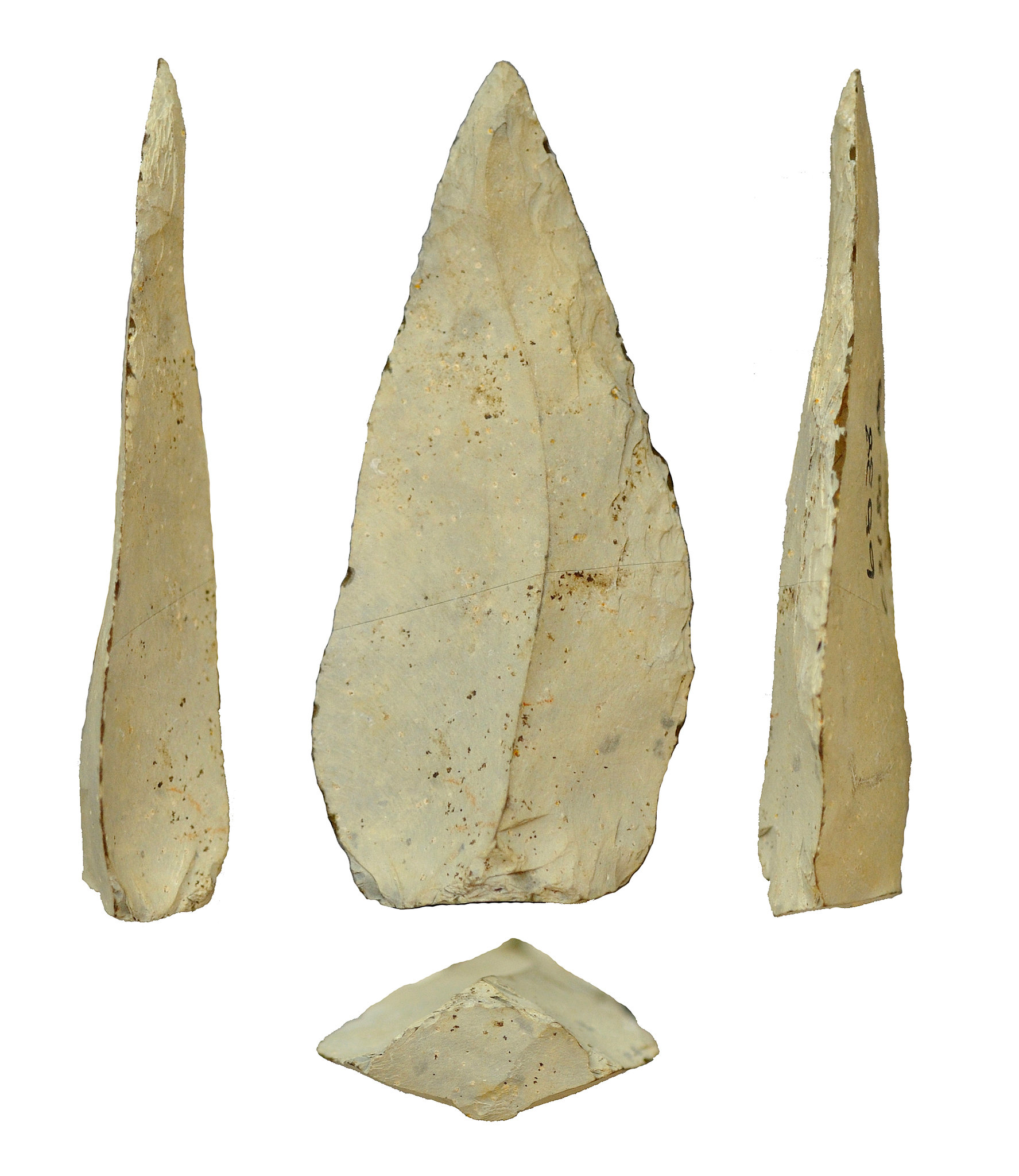
One of the most transformative tools of the Late Pleistocene was the stone-tipped spear. Long before metal blades, humans shaped sharp flakes and points from stone—often flint, chert, or obsidian—through a technique known as knapping. By striking a prepared stone core with controlled force, they produced thin, razor-sharp edges.
What makes these spear points surprising is not simply their sharpness, but their design. Many were carefully shaped into symmetrical forms, with bases crafted to attach securely to wooden shafts. Archaeological evidence shows that these points were often hafted using plant fibers, sinew, and adhesive substances such as tree resins mixed with powdered minerals. This was not a random attachment. It required understanding materials, heating resins to the right consistency, and ensuring a tight fit.
Some spear points from this era were likely thrusting weapons, used at close range against large animals. Others may have been thrown. Experimental archaeology has demonstrated that properly hafted stone points can penetrate deeply into animal flesh, making hunting far more efficient and less dangerous.
The creation of stone-tipped spears represents a leap in cognitive complexity. It required planning ahead, collecting materials from different sources, and assembling them into a composite tool. This was engineering tens of thousands of years before the word existed.
2. Bone Needles with Eyes
Among the most intimate and revealing tools of our ancestors are bone needles. Archaeological sites in Siberia and other regions have yielded finely crafted needles dating back tens of thousands of years. Some even have carefully drilled eyes for threading.
The existence of eyed needles 50,000 years ago tells us something profound: humans were making tailored clothing. In Ice Age climates, survival required more than draping animal skins over the body. Fitted garments—stitched together from multiple pieces—provided better insulation and protection from wind and moisture.
Crafting a bone needle required skill and patience. A long bone from an animal had to be shaped into a slender shaft, polished smooth, and carefully perforated at one end without breaking. The hole for the eye had to be precise enough to hold sinew or plant fiber thread.
This tool suggests not only technical ability but aesthetic awareness. Clothing may have carried social or symbolic meaning. The act of sewing also implies a division of labor and knowledge transmission across generations.
A small needle, delicate and easily overlooked, becomes a powerful symbol of adaptation and cultural sophistication.
3. Atlatls and Spear-Throwers
The spear-thrower, often known as an atlatl, was a remarkable innovation that extended the power of the human arm. While the earliest secure evidence for spear-throwers varies by region, forms of projectile technology were emerging by around 50,000 years ago.
The concept is simple yet brilliant. A short wooden shaft with a hook at one end holds the butt of a dart or spear. When the hunter swings the device, it acts as a lever, increasing the velocity and distance of the projectile.
Experimental tests show that spear-throwers dramatically enhance hunting efficiency. They allow hunters to strike prey from safer distances and with greater force. This innovation would have been particularly valuable when targeting large Ice Age animals.
The atlatl represents applied physics in its most intuitive form. Our ancestors did not write equations about leverage and momentum, but they understood through experience how to amplify their strength. The tool embodies problem-solving and mechanical insight.
4. Composite Tools with Stone and Adhesives
Perhaps one of the most surprising technological achievements of early humans was the production of adhesives. Archaeological analyses have identified traces of birch bark tar and plant resins used to glue stone points onto wooden shafts.
Producing birch tar is not straightforward. It requires heating birch bark in a low-oxygen environment to extract the sticky substance. This suggests controlled use of fire and an understanding of chemical transformation.
Composite tools—objects made from multiple materials combined into a single implement—are a hallmark of advanced cognition. A stone blade alone is useful. A wooden shaft alone is useful. But binding them together with adhesive and fiber creates a far more effective weapon or cutting instrument.
This layered approach to toolmaking demonstrates foresight and experimentation. It required knowledge of which materials would adhere best, how to process them, and how to maintain the bond under stress.
Such innovation challenges outdated stereotypes of early humans as crude or simplistic. They were, in many ways, chemists and engineers.
5. Fishing Tools and Barbed Points
While large land animals often capture our imagination, archaeological sites reveal that humans 50,000 years ago also exploited aquatic resources. In parts of Africa and Asia, barbed bone points have been discovered that were likely used for fishing.
These points feature small projections along their edges designed to prevent slippery fish from escaping once struck. Crafting barbs into bone required precision and planning. The tool had to balance sharpness with durability.
Fishing expands the image of Ice Age life. It suggests dietary flexibility and intimate knowledge of seasonal patterns. Rivers and coastlines became sources of reliable food.
Some evidence indicates that early humans even reached Australia more than 50,000 years ago, which would have required crossing open water. While the specific boats or rafts have not survived, the presence of seafaring implies advanced planning and tool use.
Barbed points hint at an adaptable species willing to explore every available ecological niche.
6. Grinding Stones and Pigment Tools
Another surprising category of tools from this era involves grinding stones used to process plant materials and pigments. Archaeological sites in Africa have yielded stones bearing traces of ochre—a reddish mineral rich in iron oxide.
Ochre could be ground into powder and mixed with binders to create paint or body pigment. The use of pigment suggests symbolic behavior. People were marking objects, perhaps decorating bodies, or creating art.
Grinding stones also likely processed plant foods. Seeds and tubers could be crushed to make them easier to eat or digest. This indicates dietary diversity and a deep understanding of local environments.
The act of grinding pigment is more than functional. It hints at identity, ritual, and communication. By 50,000 years ago, humans were not only surviving—they were expressing themselves.
7. Bone and Antler Harpoons
In certain regions, particularly where rivers and coastal areas were rich in resources, early humans crafted harpoon-like tools from bone and antler. These implements featured detachable heads that could remain embedded in prey, connected by a line.
The engineering behind a detachable harpoon head is sophisticated. It allows the prey to be secured even if it struggles. Evidence for such tools appears in Upper Paleolithic contexts and suggests strategic thinking in hunting aquatic or semi-aquatic animals.
Working with antler required careful shaping, scraping, and polishing. Unlike stone, bone and antler are organic and respond differently to pressure and carving techniques.
Harpoons represent specialization. They show that our ancestors were not limited to one hunting method but developed tools tailored to specific environments and prey.
8. Early Musical Instruments
Perhaps the most astonishing tools from around 50,000 years ago are musical instruments. In Europe, flutes carved from bird bones and mammoth ivory have been discovered in caves associated with early modern humans.
These instruments have carefully placed finger holes, indicating deliberate design to produce different notes. Creating such an instrument requires planning, precision drilling, and an understanding of how air vibration creates sound.
Music does not directly kill prey or build shelter. Its existence in the archaeological record reveals something deeply human: the desire for expression, rhythm, and shared emotional experience.
The presence of musical instruments suggests social gatherings, storytelling, and cultural transmission. Sound would have echoed through cave chambers, blending with firelight and painted walls.
Music, in this context, becomes a tool of connection—a way to strengthen bonds within a group.
Intelligence, Adaptation, and Imagination
These eight tools—stone-tipped spears, bone needles, spear-throwers, adhesive composite tools, barbed fishing points, grinding stones, harpoons, and musical instruments—paint a vivid picture of humanity 50,000 years ago. They reveal technical skill, environmental awareness, and creative imagination.
Our ancestors were not merely reacting to their environment. They were reshaping it. They experimented with materials, refined designs, and passed knowledge across generations.
Each tool tells a story of adaptation. In freezing climates, needles stitched protective clothing. In open plains, spear-throwers extended hunting range. Along rivers, barbed points secured fish. In caves, flutes filled the air with melody.
The Cognitive Revolution
Anthropologists sometimes speak of a cognitive revolution occurring in this period. Whether sudden or gradual, something changed in human behavior. Symbolic expression, long-distance trade of materials, and increasingly complex tools became more common.
The archaeological record does not preserve thoughts, but it preserves actions. The sophistication of these tools suggests abstract thinking, planning depth, and social learning.
Fire had been controlled for much longer, but now it was used to transform materials into adhesives. Stone was not simply broken—it was shaped with intention. Bone was not discarded—it was carved into instruments.
These developments hint at language capable of transmitting detailed instructions. Knowledge had to be shared, corrected, improved.
A Shared Humanity
When we look at a bone needle or a stone spear point, we are not seeing relics of a separate, lesser species. We are seeing reflections of ourselves. The hands that shaped those tools were anatomically modern. The brains behind them were capable of reasoning, emotion, and imagination much like our own.
Fifty thousand years may seem distant, but in evolutionary terms it is recent. The people who made these tools would recognize hunger, fear, love, and curiosity just as we do.
Their tools were extensions of their minds. They reveal foresight and creativity. They remind us that innovation did not begin in factories or laboratories. It began around campfires, in caves, along riverbanks.
The Continuing Discovery
Archaeology continues to uncover new evidence, refining our understanding of early technology. Scientific techniques such as microscopic wear analysis and chemical residue testing allow researchers to determine how tools were used and what substances they once held.
Each discovery adds detail to the story. It corrects assumptions and deepens appreciation for early human ingenuity.
The surprising tools of 50,000 years ago challenge us to rethink progress. Civilization did not emerge from intellectual emptiness. It grew from a foundation laid by skilled hands and curious minds long ago.
The Legacy of Innovation
What is most moving about these ancient tools is not only their age but their familiarity. A needle is still a needle. A spear is still a spear. A musical instrument still carries melody across space.
Technology evolves, but the impulse to innovate remains constant. The same drive that led someone to mix resin and ash to secure a stone blade fuels modern scientific research.
When we hold a smartphone or board an airplane, we are participating in a continuum of toolmaking stretching back tens of thousands of years.
The story of our ancestors’ tools is not a story of primitiveness. It is a story of brilliance under harsh conditions. It is a testament to resilience and creativity.
And perhaps most surprisingly of all, it is a reminder that even in an Ice Age world filled with danger and uncertainty, humans found time not only to survive—but to create beauty, to experiment boldly, and to shape the world with thoughtful hands.