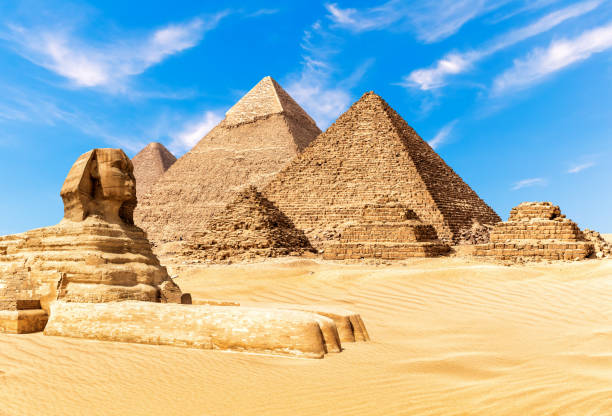
For more than four and a half thousand years, the Great Pyramids have stood on the Giza Plateau, silent and immovable, rising from the desert like geometric mountains. They are at once familiar and mysterious. We see their images in textbooks, documentaries, and travel brochures. We know they were built in ancient Egypt during the Fourth Dynasty. We know they were royal tombs. And yet, for all that we know, the Great Pyramids still guard secrets that continue to challenge archaeologists, engineers, physicists, and historians alike.
The most famous of them, the Great Pyramid of Khufu, often called the Pyramid of Cheops, was once the tallest human-made structure on Earth. Built around 2600 BCE during the reign of Pharaoh Khufu, it originally stood about 146 meters tall. Nearby rise the pyramids of Khafre and Menkaure, along with temples, causeways, and the Great Sphinx. Together, they form one of the most extraordinary architectural complexes ever created.
Over centuries, explorers have pried into their chambers, deciphered hieroglyphs, measured angles, and scanned their interiors with advanced technology. Yet the deeper we look, the more questions arise. Here are seven of the most enduring and scientifically grounded mysteries surrounding the Great Pyramids.
1. How Were the Massive Stones Transported and Lifted?
The Great Pyramid of Khufu contains an estimated 2.3 million stone blocks. Most weigh between 2 and 15 tons, while some of the granite beams in the King’s Chamber weigh as much as 60 to 80 tons. These stones were quarried from different locations. Limestone blocks came from nearby quarries, but the granite was transported from Aswan, hundreds of kilometers south along the Nile.
The mystery is not whether the ancient Egyptians built the pyramids. Archaeological evidence clearly shows they did. Workers’ villages, tools, inscriptions, and administrative records confirm organized labor under state authority. The real mystery lies in the exact methods they used to move and position such enormous stones with remarkable precision.
One widely accepted theory suggests that the blocks were transported on sledges pulled by teams of workers over lubricated sand. A wall painting from the tomb of Djehutihotep shows a colossal statue being dragged on a sledge while a worker pours liquid in front of it, possibly water to reduce friction. Experimental archaeology has demonstrated that wetting sand can significantly decrease resistance.
Yet the challenge does not end with transportation. The stones had to be raised to heights exceeding 100 meters. Several ramp theories have been proposed. A straight ramp extending from the ground to the top would have required an enormous volume of material, possibly more than the pyramid itself. Spiral ramps, zigzagging ramps, and even internal ramps built within the structure have been suggested.
Recent architectural studies and 3D modeling have explored the possibility of internal spiral ramps that would explain how upper levels were reached without leaving massive external ramp remains. However, no definitive evidence has confirmed a single method. The question remains open: what exact combination of ramps, levers, manpower, and ingenuity allowed ancient builders to assemble these colossal monuments?
The mystery is not about alien intervention or lost civilizations, but about the astonishing organizational and engineering capabilities of an ancient society using tools made of copper, stone, and wood.
2. What Lies Within the Unexplored Voids?
For centuries, explorers believed the internal structure of the Great Pyramid was fully known. It contains the descending passage, the ascending passage, the Grand Gallery, the Queen’s Chamber, and the King’s Chamber, along with narrow shafts and hidden spaces. Yet modern technology has revealed that the pyramid still hides unknown voids within its core.
In 2017, the ScanPyramids project announced the discovery of a large void above the Grand Gallery using muon radiography. Muons are subatomic particles that constantly rain down from cosmic rays. By detecting how muons pass through dense stone, scientists can identify empty spaces within massive structures without physically opening them.
The detected void appears to be at least 30 meters long. Its purpose remains unclear. Is it a structural feature designed to reduce weight and pressure? Is it an undiscovered chamber? Or does it represent part of a construction strategy not yet fully understood?
Because the void has not been entered, speculation is limited by evidence. Researchers are cautious, emphasizing that it may not contain artifacts or secret burial chambers. Still, the discovery reminds us that even after centuries of exploration, the Great Pyramid has not yielded all its secrets.
Each new scan, each refined measurement, challenges the assumption that the interior is fully mapped. The pyramid continues to guard hidden spaces, like a stone labyrinth resisting complete understanding.
3. Why Were the Pyramids Aligned with Such Precision?
One of the most astonishing features of the Great Pyramid of Khufu is its near-perfect alignment with the cardinal directions. Its sides face almost exactly north, south, east, and west, with only a tiny fraction of a degree of error. Achieving such precision without modern instruments raises profound questions.
How did ancient Egyptian surveyors determine true north so accurately? Several scientific theories exist. One suggests that they used observations of circumpolar stars, which appear to rotate around the north celestial pole. By tracking the positions of specific stars over time, they could establish a true north-south line.
Another theory proposes the use of a gnomon, a vertical rod that casts a shadow. By marking the shortest shadow at noon and tracking the sun’s path, surveyors could determine cardinal directions. However, solar methods alone may not account for the extraordinary precision observed.
Astronomical alignment appears central to pyramid design. The shafts from the King’s Chamber and Queen’s Chamber seem to point toward specific stars or star regions significant in ancient Egyptian cosmology, including Orion and the circumpolar stars. While interpretations vary, the builders clearly integrated astronomical knowledge into architectural planning.
The precision of alignment suggests not only technical skill but also symbolic intent. For ancient Egyptians, cosmic order was deeply connected to divine authority and kingship. The alignment of the pyramid with the heavens may have reflected a desire to anchor earthly power within celestial order.
Yet the exact surveying methods remain partially unresolved. We know they succeeded. We are still piecing together exactly how.
4. How Was the Workforce Organized?
The Great Pyramids were not built by enslaved masses driven by whips, as once popularized in older narratives. Archaeological discoveries near Giza have revealed workers’ villages with bakeries, breweries, and medical facilities. Inscriptions refer to organized labor teams with names such as “Friends of Khufu.”
The mystery lies not in whether there was organization, but in the scale and logistics of that organization. Estimates suggest that tens of thousands of workers may have been involved over two decades. Feeding, housing, and coordinating such a workforce required a highly developed administrative system.
Evidence suggests a rotating labor force, possibly drawn from across Egypt during the Nile’s annual flood season when agricultural work was limited. Skilled craftsmen, engineers, and permanent laborers likely worked year-round, while seasonal workers contributed during peak construction.
The ability to mobilize and sustain such a massive project speaks to the political and economic strength of the Old Kingdom. The pyramids were not merely tombs; they were national enterprises reflecting centralized authority and societal cohesion.
Yet many details remain uncertain. How were teams coordinated at each construction stage? How were tools distributed and maintained? What systems ensured accuracy across millions of stone placements? Administrative papyri discovered at Wadi al-Jarf have provided glimpses into supply logistics, including records of transporting limestone, but the full picture remains incomplete.
The Great Pyramids stand as monuments not only to stone but to human organization on an extraordinary scale.
5. What Was the True Purpose Beyond Burial?
The Great Pyramid of Khufu is widely accepted as a royal tomb. Its internal chambers, sarcophagus, and funerary complex support this interpretation. However, no intact burial of Khufu has been found inside. Grave goods typical of later Egyptian tombs are absent, likely due to ancient looting.
Some researchers argue that the pyramid’s purpose extended beyond a simple burial site. Its scale, precision, and integration with temples and causeways suggest a complex religious function. The pyramid may have symbolized the primordial mound from which creation emerged in Egyptian cosmology. Its shape may have represented rays of the sun, linking the pharaoh with the sun god Ra.
The pyramid complex functioned as a ritual center, where priests conducted ceremonies long after the pharaoh’s death. The structure may have served as a spiritual machine of sorts, facilitating the king’s transformation into a divine being in the afterlife.
The mystery lies in the full depth of its symbolic meaning. While inscriptions from later periods illuminate Egyptian beliefs about the afterlife, the Great Pyramid itself contains almost no decorative inscriptions. Its interior walls are largely bare. This absence leaves room for interpretation.
Was its simplicity intentional? Did its geometry embody theological principles now only partially understood? The pyramid may have functioned as a cosmic symbol, aligning architecture, religion, and kingship in a unified statement of power and eternity.
6. How Did the Builders Achieve Such Structural Stability?
The Great Pyramid has endured earthquakes, erosion, and millennia of environmental stress. Its internal chambers are protected by carefully designed relieving chambers that distribute weight away from the King’s Chamber. Massive granite beams and angled limestone blocks redirect pressure.
The precision with which stones were cut and fitted contributes to stability. In some areas, the joints between blocks are so tight that even a thin blade cannot pass between them. This level of craftsmanship raises questions about measurement tools and techniques.
Copper chisels, stone hammers, and wooden mallets were among the primary tools available. Yet shaping hard granite with copper tools presents challenges. Experimental archaeology has shown that pounding stones and abrasive sand could assist in shaping harder materials.
The mystery is not that ancient Egyptians lacked capability, but how they optimized limited technology to achieve maximum structural integrity. The pyramids are not merely large; they are resilient.
Modern engineers study pyramid construction to understand how ancient builders distributed stress and ensured longevity. The pyramids are lessons in load management and architectural foresight, yet some construction details remain under debate.
7. What Do the Pyramids Reveal About Lost Knowledge?
The final mystery is not about a hidden chamber or secret treasure. It concerns knowledge itself. The Great Pyramids reflect an advanced understanding of geometry, astronomy, and large-scale project management. Their proportions have inspired mathematical discussions for centuries.
Some have suggested that the pyramid encodes advanced mathematical constants or secret wisdom. Most such claims are exaggerated or based on selective interpretation. However, it is undeniable that the builders possessed sophisticated practical geometry.
They understood how to create a stable four-sided pyramid with smooth faces meeting at a precise apex. They mastered leveling techniques that ensured a nearly flat foundation across uneven terrain. The base of the Great Pyramid deviates from perfect level by only a few centimeters.
What remains mysterious is how knowledge was transmitted, refined, and preserved in an era without printed texts or digital records. Apprenticeship, oral instruction, and practical training must have played central roles. Yet much of that tradition has vanished.
The pyramids stand as physical textbooks written in stone, but many chapters are missing. We see the results of knowledge, yet not always the methods by which that knowledge evolved.
The Silence That Endures
The Great Pyramids are not puzzles waiting for a single final answer. They are layered achievements reflecting the ambition, faith, and ingenuity of an ancient civilization. Each mystery is not a sign of ignorance but an invitation to deeper exploration.
Archaeology continues. Technology advances. Scans become more precise. Theories evolve. And still the pyramids remain, watching the desert wind sweep across their weathered stones.
They remind us that human beings, even in distant antiquity, were capable of extraordinary feats. They challenge modern assumptions about progress and sophistication. They stand not only as tombs of kings but as monuments to curiosity.
In their shadow, we confront a humbling truth: even in an age of satellites and particle accelerators, some of humanity’s greatest creations still whisper unanswered questions.
And perhaps that is their greatest mystery of all.