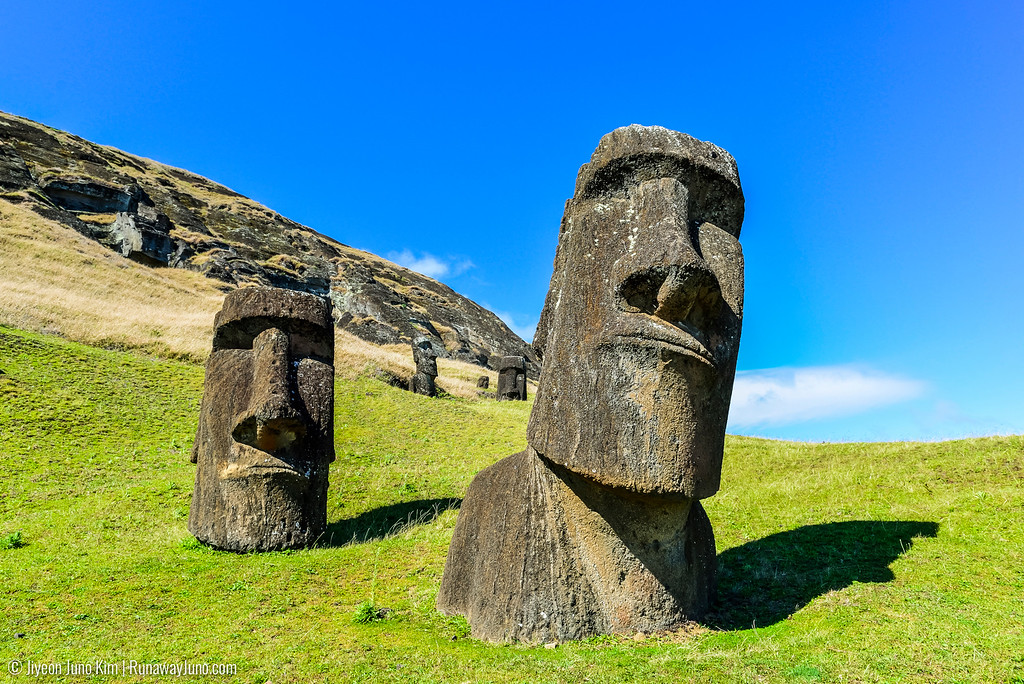
Far out in the vastness of the southeastern Pacific lies one of the most isolated inhabited places on Earth. Here, enormous stone faces gaze across windswept landscapes, their expressions calm, watchful, and enduring. These monumental figures—known worldwide for their scale and mystery—stand as reminders of a civilization that flourished in extraordinary isolation and left behind one of humanity’s most puzzling cultural legacies.
The island known today as Rapa Nui lies thousands of kilometers from the nearest continental landmass. It is part of Chile, yet culturally and geographically belongs to the great expanse of the Pacific Ocean. Its remoteness shaped everything about its history—its ecology, its society, and its monuments.
For centuries, the massive carved figures and the people who created them have inspired fascination, debate, and scientific investigation. Archaeologists, anthropologists, geologists, and historians have studied the island intensively, attempting to understand how a small population in extreme isolation constructed hundreds of enormous stone statues and organized a society capable of such ambitious expression.
The story of this island is not merely about stone carvings. It is about navigation across vast oceans, environmental transformation, social adaptation, technological ingenuity, and cultural meaning embedded in landscape and memory.
To explore the mystery of the Moai is to explore the relationship between humans and their environment under some of the most challenging conditions imaginable. The following eight facts reveal the scientific, historical, and cultural realities behind one of the world’s most remarkable archaeological landscapes.
1. Human Arrival Required One of the Greatest Voyages in History
Long before European ships reached the island, Polynesian navigators had already accomplished something extraordinary. They crossed immense distances of open ocean without modern instruments, guided by stars, currents, winds, and deep knowledge of environmental patterns.
Archaeological and linguistic evidence indicates that the island was settled by Polynesian voyagers around the late first millennium CE. These seafarers traveled in large ocean-going canoes capable of carrying people, animals, plants, and tools. Their navigation methods were based on systematic observation of the natural world—wave patterns reflecting off distant islands, flight paths of birds, seasonal winds, and the predictable motion of celestial bodies.
Settlement of such a remote island required deliberate planning, not accidental drifting. It represented the expansion of one of humanity’s most sophisticated maritime cultures. The island became the easternmost reach of Polynesian expansion, a frontier where navigation, survival, and adaptation converged.
Once established, the population developed a unique society shaped by limited resources and geographic isolation. Cultural traditions evolved independently, though they retained deep connections to wider Polynesian heritage.
The presence of monumental sculpture on such an isolated island demonstrates not only artistic achievement but also the organizational capacity of a community capable of coordinating labor, knowledge, and long-term planning across generations.
2. The Moai Were Carved From a Single Volcanic Quarry
Nearly all the giant stone statues were carved from compressed volcanic ash known as tuff. The primary source of this material was a crater quarry called Rano Raraku.
This quarry functioned as both workshop and sacred landscape. Hundreds of statues in various stages of completion remain embedded in its slopes, providing a rare archaeological record of the carving process itself. Some figures were fully formed but never transported. Others remain partially attached to the bedrock, revealing the techniques used to extract them.
Archaeological study shows that carvers used stone tools to shape the statues directly from the volcanic material. The softness of tuff allowed detailed sculpting, but its fragility required careful handling. Once detached, the statues were moved across the island—sometimes several kilometers—to ceremonial platforms.
The quarry landscape reveals something profound: statue production occurred continuously over long periods. It was not a single building campaign but an enduring cultural practice. The environment became inseparable from the act of creation.
Scientific mapping of the quarry has revealed hundreds of statues still present, many buried partially by centuries of sediment accumulation. Excavations show that some figures extend deep below ground level, demonstrating that the visible heads often represent only a fraction of the full sculpture.
The quarry stands as a frozen record of artistic labor spanning generations.
3. The Statues Were Designed to Represent Ancestors
The massive stone figures were not merely decorative. Archaeological and ethnographic evidence indicates they represented deified ancestors—powerful figures believed to protect communities and maintain spiritual connection between the living and the dead.
Most statues were positioned on ceremonial platforms called ahu, facing inland toward villages rather than outward toward the sea. This orientation suggests their role was to watch over the people, symbolically maintaining social order and continuity.
One of the most striking ceremonial complexes is Ahu Tongariki, where multiple restored statues stand in a dramatic line overlooking the landscape. Geological analysis of this site reveals repeated construction phases, indicating that ceremonial architecture evolved over time.
Anthropological interpretation suggests that building and erecting statues reinforced social identity and hierarchy. Communities likely competed or collaborated in constructing increasingly large figures, expressing prestige, lineage, and spiritual authority.
The statues embody a worldview in which ancestors remained active participants in social life. Their stone presence materialized memory, authority, and continuity.
4. Moving the Giants Was an Engineering Achievement
One of the most debated questions concerns transportation. How were statues weighing many tons moved across uneven terrain without wheels or large domesticated animals?
Experimental archaeology has provided plausible answers. Evidence suggests that statues were transported in upright positions, possibly “walked” forward using ropes and coordinated human effort. This method would have required precise teamwork, balance control, and knowledge of weight distribution.
Computer simulations and physical experiments show that relatively small groups could move large statues using rocking motions and tension control. Wear patterns on statue bases support the possibility of upright movement.
Transport routes identified through archaeological survey reveal carefully planned pathways connecting quarry and ceremonial sites. These routes demonstrate landscape engineering, including leveling and clearing.
The movement of statues was not merely mechanical. It was likely ceremonial, symbolic, and socially significant. Transport may have been part of ritual practice reinforcing communal cooperation and spiritual purpose.
Engineering analysis reveals that technological sophistication does not always depend on metal tools or machines. Knowledge, organization, and collective action can achieve extraordinary results.
5. The Island Underwent Major Environmental Change
Scientific research into pollen records, charcoal deposits, and soil composition reveals that the island’s environment changed dramatically over time. Early settlers encountered a landscape that included forests, including large palm species now extinct on the island.
Over centuries, deforestation occurred due to wood use for fuel, construction, and possibly agricultural expansion. Reduced tree cover affected soil stability, water retention, and biodiversity.
Environmental transformation has been a major focus of scientific debate. Earlier interpretations suggested ecological collapse caused societal breakdown. More recent research presents a more complex picture, emphasizing adaptation, resilience, and multiple interacting factors, including climate variation and external contact.
Geoarchaeological studies indicate that inhabitants developed strategies to manage soil fertility, including stone mulching and agricultural modification of terrain. These practices demonstrate ecological knowledge and resource management under challenging conditions.
The island became a powerful case study in human-environment interaction—how societies respond to limited resources and changing ecosystems.
6. European Contact Changed the Island’s Trajectory
The island entered global awareness in 1722 when Dutch navigator Jacob Roggeveen arrived during an expedition across the Pacific. His arrival marked the beginning of sustained outside contact.
Subsequent encounters with Europeans introduced new dynamics—disease, cultural disruption, and eventually colonial influence. Historical records describe population decline and social upheaval in the centuries following contact.
Anthropological study of these interactions reveals the profound impact of global expansion on isolated societies. External forces reshaped demographic patterns, cultural practices, and political organization.
European accounts also provided early descriptions of the statues, though interpretations often reflected limited understanding of local cultural meaning.
The encounter between isolation and globalization became a defining chapter in the island’s history.
7. Modern Archaeology Transformed Understanding of the Island
Early interpretations of the island’s past often relied on speculation or dramatic narratives. Scientific archaeology has replaced many of these assumptions with evidence-based understanding.
In the twentieth century, Norwegian explorer Thor Heyerdahl conducted extensive investigations that drew global attention to the island’s monuments. Although some of his theories about cultural origins were later revised, his expeditions stimulated systematic research.
Modern archaeology employs radiocarbon dating, stratigraphic excavation, isotopic analysis, and digital mapping to reconstruct settlement patterns, diet, and social organization.
Excavation of habitation sites reveals complex community structures, craft production, and long-distance cultural connections within Polynesia. The island is now understood not as an anomaly but as part of a broader network of oceanic societies.
Scientific study continues to uncover new insights into chronology, labor organization, and symbolic meaning.
8. The Island Is Now a Global Heritage Landscape
Today, much of the island’s archaeological landscape is protected as UNESCO World Heritage, recognizing its cultural and historical significance.
Preservation efforts involve monitoring erosion, tourism impact, and environmental change. Conservation science integrates geology, climate research, and material analysis to protect stone surfaces from weathering.
The modern settlement of Hanga Roa serves as the island’s population center and gateway for visitors, researchers, and conservation teams.
Heritage management reflects collaboration between local communities, scientists, and international organizations. The goal is not merely preservation of monuments but protection of cultural identity and historical memory.
The island stands as a living archaeological landscape where past and present coexist.
The Deeper Meaning of the Moai
The monumental statues are often described as mysterious, but their meaning becomes clearer through scientific and cultural understanding. They are not puzzles without context. They are expressions of ancestry, identity, environmental adaptation, and social organization.
They represent a society capable of remarkable coordination, symbolic expression, and technological ingenuity despite profound isolation. Their scale reflects not excess but commitment—commitment to memory, continuity, and spiritual connection.
The statues are not silent in the archaeological sense. They speak through geological composition, carving marks, transport pathways, and spatial orientation. Each physical detail contains information about cultural practice and historical process.
A Landscape of Enduring Questions
Despite decades of research, questions remain. Scholars continue to investigate population size fluctuations, changes in ritual practice, and the chronology of statue production.
New technologies, including high-resolution mapping and chemical analysis of stone weathering, continue to reveal details invisible to earlier generations of researchers.
The island remains one of the most intensively studied archaeological environments in the world—and one of the most compelling.
Humanity Reflected in Stone
The story of this remote island is ultimately a story about humanity itself. It reveals the power of belief, the capacity for cooperation, the fragility of ecosystems, and the resilience of culture.
The giant stone figures do not simply represent a vanished past. They embody enduring questions about how societies organize meaning, respond to isolation, and shape landscapes according to vision and necessity.
Across centuries, wind and sea have worn their surfaces. Yet they remain upright, watching, enduring—testimony to human imagination carved into the very geology of the Earth.
The mystery of the Moai is not merely how they were built. It is why humans, everywhere and always, feel compelled to leave something that outlasts them.