There are places on Earth where silence is not merely the absence of sound but the presence of immense distance. Distance from cities, from infrastructure, from easy explanation. In these places, landscapes dominate human memory. Mountains isolate valleys. Oceans encircle land. Deserts stretch beyond visibility. Jungles erase pathways almost as quickly as they are made. Yet in these remote regions, humanity once built monuments, carved symbols, raised cities, and organized complex societies.
Isolation in archaeology is not simply geographic remoteness. It is a condition shaped by environment, accessibility, and time. Some sites are isolated because of terrain so harsh that sustained settlement seems improbable. Others lie far from major cultural centers, forcing archaeologists to ask how ancient people reached them in the first place. Still others are isolated in a temporal sense—forgotten for centuries, separated from historical memory even when physically near modern populations.
Studying such places is scientifically important because isolation often preserves evidence. Limited development means fewer disturbances. Dry deserts protect organic remains. Volcanic ash seals entire cities. Dense forests conceal architectural landscapes. Extreme environments act as natural archives.
Yet isolation also complicates discovery and research. Reaching these sites may require long sea voyages, mountain expeditions, aerial surveys, or weeks of travel through uninhabited terrain. Excavation demands logistical planning comparable to polar exploration. Every artifact recovered from these regions represents not only ancient human activity but also modern scientific endurance.
The following ten archaeological sites stand among the most geographically and environmentally isolated ever studied. Each reveals how humans once lived in places where survival demanded extraordinary adaptation. Each demonstrates how remoteness can preserve history while simultaneously hiding it from the world.
1. Easter Island
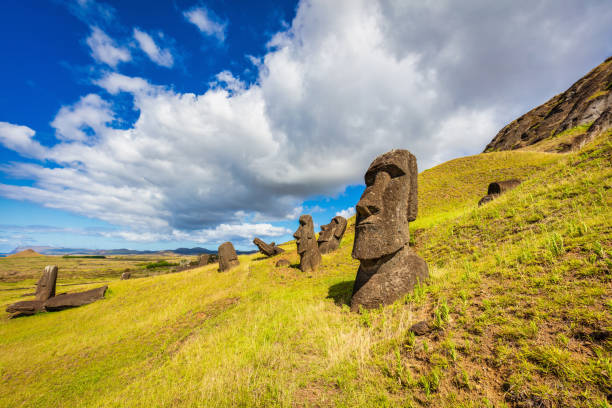
Rising alone in the vast southeastern Pacific Ocean, this volcanic island lies thousands of kilometers from the nearest continental landmass. Its remoteness is so extreme that it is often considered one of the most isolated inhabited places on Earth. Yet long before modern navigation, Polynesian voyagers reached this distant land and built one of the most visually striking archaeological landscapes ever discovered.
The island, part of Chile, is globally known for its monumental stone statues, the moai. Carved from volcanic rock, these figures stand as silent witnesses to a complex society that developed in profound geographic isolation.
Archaeological evidence indicates that Polynesian settlers arrived around the late first millennium CE. They transformed the island through agriculture, quarrying, and ceremonial construction. Massive statues were transported across rugged terrain without wheeled vehicles or metal tools. Experimental archaeology suggests the use of coordinated human labor, ropes, and controlled rocking motion to move these enormous sculptures.
Isolation shaped both development and decline. Limited natural resources forced careful environmental management. Pollen analysis and soil studies show that large-scale deforestation occurred over centuries, affecting agriculture and ecological stability. The island became a laboratory for understanding human–environment interaction under extreme constraints.
Its archaeological significance lies not only in the statues but in the entire cultural landscape—ceremonial platforms, quarry sites, habitation zones, and agricultural modifications. The site reveals how a society constructed monumental symbolism while living at the edge of ecological sustainability, far removed from any neighboring civilization.
2. Göbekli Tepe
In southeastern Anatolia stands a site so ancient that it fundamentally altered the understanding of early human society. Located in what is now Turkey, this hilltop complex dates to around 9600 BCE—long before the emergence of agriculture as previously understood.
Today the region appears open and rural, but in prehistory it was an ecological transition zone between fertile plains and upland environments. Its relative isolation from later urban centers helped preserve its structures for millennia beneath accumulated sediment.
Excavation revealed massive T-shaped stone pillars arranged in circular enclosures. Many pillars are carved with animal reliefs—foxes, birds, serpents, and abstract symbols. The scale of construction indicates organized labor and symbolic activity among communities that were still largely hunter-gatherers.
This discovery challenged traditional models of civilization. Previously, archaeologists believed that large-scale architecture followed agricultural settlement. Evidence here suggests that monumental ritual spaces may have preceded farming, possibly even encouraging it by drawing dispersed groups together.
The site remained buried for thousands of years, protected by deliberate backfilling performed by its own builders. Geological and stratigraphic analysis shows that layers of sediment sealed the structures, preserving them from erosion.
Isolation here is intellectual as well as geographic. The site exists outside conventional narratives of social development, forcing scholars to reconsider how and why complex symbolic architecture emerged in human history.
3. Nan Madol
Off the eastern shore of Pohnpei Island, in the Federated States of Micronesia, lies a city built directly over a shallow lagoon. Constructed from massive basalt columns stacked into artificial islets, this site forms a network of canals and stone platforms that appear almost impossible given its remote oceanic setting.
Nan Madol served as the ceremonial and political center of the Saudeleur dynasty between roughly the twelfth and seventeenth centuries. Its construction required transporting heavy volcanic stone across water without advanced lifting machinery. Geological sourcing shows that much of the basalt came from distant quarry sites on the island, implying coordinated labor and maritime engineering.
Isolation is absolute in environmental terms. The site sits far from major landmasses, surrounded by dense tropical vegetation and coral reefs. For centuries, knowledge of its full extent remained limited because jungle growth concealed structural boundaries.
Archaeological investigation reveals elite residential compounds, ceremonial spaces, and mortuary structures. Soil chemistry and artifact distribution indicate restricted access zones, suggesting a highly stratified social system.
The city’s abandonment remains partly mysterious. Environmental change, political shifts, and resource stress likely played roles. Today, tidal movement and plant growth continue to challenge preservation, demonstrating how fragile monumental architecture becomes when nature reclaims territory.
4. Machu Picchu
High within the Andes Mountains, concealed among steep ridges and persistent mist, stands one of the most dramatic examples of architectural adaptation to extreme topography. Located in Peru, this Inca settlement occupies a narrow mountain crest nearly impossible to detect from surrounding valleys.
Its isolation is geographic, climatic, and strategic. The terrain consists of precipitous slopes prone to landslides and seismic activity. Yet the builders engineered terraces, drainage systems, and precisely fitted stone structures capable of enduring centuries of environmental stress.
Agricultural terraces stabilized soil and regulated water flow. Hydraulic channels directed rainfall through carefully designed pathways. Geological mapping shows that structures were aligned with natural fracture lines in the bedrock, reducing earthquake damage.
The site remained largely unknown to the outside world for centuries after the fall of the Inca Empire. Its remote elevation and surrounding forest concealed it from colonial forces that destroyed many other settlements.
Archaeological research suggests a royal estate or ceremonial retreat linked to imperial authority. Botanical studies indicate controlled cultivation of diverse plant species transported from multiple ecological zones.
The mountain citadel demonstrates how advanced engineering can transform inhospitable landscapes into sustainable urban environments.
5. Ciudad Perdida
Hidden deep within the Sierra Nevada mountains of northern Colombia, this ancient settlement lies beneath dense rainforest canopy accessible only after multi-day treks through steep terrain.
Built by the Tairona civilization around the eighth century CE, the city consists of hundreds of stone terraces carved into mountainsides. These terraces supported dwellings, ceremonial spaces, and agricultural zones linked by stone stairways ascending through forest-covered slopes.
Environmental isolation preserved the site for centuries after abandonment. Rapid vegetation growth concealed architecture so thoroughly that its existence vanished from historical record.
Archaeological analysis reveals sophisticated landscape modification. Soil stabilization techniques prevented erosion on steep gradients. Hydrological management directed rainfall away from residential areas. The settlement formed part of a network of connected mountain communities.
Paleoenvironmental research suggests that climatic fluctuation and social transformation may have contributed to decline before European arrival. Today, preservation efforts must contend with heavy rainfall, biological growth, and fragile soils.
This mountain city illustrates how human engineering can reshape vertical environments while remaining vulnerable to ecological change.
6. Tikal
Deep within the tropical forests of Guatemala rise towering limestone pyramids emerging above dense canopy. At its peak, this city was one of the most powerful centers of the Maya civilization, yet for centuries it lay swallowed by jungle.
Its isolation is ecological rather than oceanic or mountainous. Tropical rainforest rapidly envelops abandoned structures. Roots penetrate masonry. Humidity accelerates decay. Within decades, architecture can disappear beneath vegetation layers.
When explorers first documented the ruins in the nineteenth century, towering temples emerged like geological formations rather than human constructions.
Archaeological mapping revealed a vast urban complex including plazas, residential zones, reservoirs, and causeways extending through forested terrain. Population estimates suggest tens of thousands of inhabitants.
Environmental studies indicate intensive landscape management, including water storage systems designed to capture seasonal rainfall in a region lacking permanent rivers. Pollen and charcoal analysis reveal cycles of deforestation and regrowth linked to agricultural expansion.
The site’s abandonment around the ninth century CE coincided with broader regional transformation in Maya political networks. Today, continued forest growth and climatic effects require constant conservation monitoring.
Tikal demonstrates how tropical ecosystems can both sustain and conceal large-scale civilization.
7. Skara Brae
On the windswept coast of Scotland lies a remarkably preserved Neolithic settlement buried beneath sand dunes for thousands of years. Its isolation stems from harsh maritime climate, limited agricultural potential, and exposure to North Atlantic storms.
The village remained hidden until severe weather in the nineteenth century eroded protective sand layers, revealing stone structures beneath.
Excavation uncovered interconnected houses built partly underground for insulation against wind and cold. Stone furniture—beds, shelves, and storage compartments—remains intact, offering detailed insight into domestic life around 3000 BCE.
Environmental reconstruction shows that inhabitants relied on marine resources, livestock, and limited crop cultivation. Midden deposits reveal diet composition and seasonal activity patterns.
Coastal erosion continues to threaten preservation, illustrating how the same environmental forces that concealed the site now expose it.
This settlement provides one of the clearest windows into prehistoric daily life in northern Europe, preserved by isolation within a dynamic coastal landscape.
8. Mesa Verde National Park
High sandstone cliffs in the arid landscape of United States shelter complex residential structures built directly into rock faces. These cliff dwellings, constructed by the Ancestral Pueblo people, represent remarkable adaptation to environmental and defensive challenges.
The region’s isolation arises from rugged canyon systems, limited water sources, and extreme seasonal temperature variation. Access to many dwellings requires navigating steep cliff walls or narrow ledges.
Archaeological study shows multi-room structures with advanced masonry, ventilation systems, and communal spaces. Tree-ring dating provides precise chronological information about construction phases.
Environmental evidence indicates that prolonged drought in the late thirteenth century contributed to regional abandonment. Soil analysis and paleoclimate data suggest declining agricultural productivity.
The cliff dwellings reveal how architectural innovation can respond directly to environmental constraint, creating protected living spaces within geological formations.
9. Tassili n’Ajjer
In the vast expanse of the Algeria rises a sandstone plateau containing one of the world’s most extensive collections of prehistoric rock art. Today the region lies within the central Sahara Desert, one of the most inhospitable environments on Earth.
Yet thousands of years ago, the landscape was dramatically different. Climatic evidence shows that the Sahara once supported lakes, grasslands, and diverse animal populations. Rock paintings depict cattle herding, wildlife, and human ceremonial activity.
The site’s isolation is extreme. Access requires travel across remote desert terrain with minimal water and infrastructure. This remoteness has preserved fragile artworks from extensive disturbance.
Archaeological and climatic analysis together reveal long-term environmental transformation from humid savanna to hyper-arid desert. The art serves as both cultural record and paleoclimatic evidence.
Tassili n’Ajjer demonstrates how changing climate can isolate cultural landscapes that were once central to human life.
10. L’Anse aux Meadows
On the northern tip of the island of Newfoundland in Canada lies the only confirmed Norse settlement in North America. The site occupies a windswept coastal plain far from major population centers, facing the cold North Atlantic.
Archaeological excavation revealed turf-walled structures, iron-working evidence, and artifacts consistent with Norse culture around the eleventh century CE. Radiocarbon dating and artifact typology confirm its connection to transatlantic voyages from Greenland.
Environmental conditions are harsh—short growing seasons, strong winds, and limited natural resources. The settlement appears to have been short-lived, possibly serving as an exploratory base rather than permanent colony.
Its rediscovery required careful comparison between archaeological evidence and medieval Norse sagas describing voyages to a land west of Greenland.
Isolation here reflects the limits of medieval navigation and the challenges of sustaining distant colonies across open ocean.
The Science of Remote Discovery
The study of isolated archaeological sites depends on technological innovation. Satellite imaging reveals patterns invisible at ground level. LiDAR penetrates forest canopy. Radiocarbon dating establishes chronology. Isotopic analysis reconstructs diet and migration. Geological surveying identifies resource origins.
Isolation transforms archaeological work into interdisciplinary research requiring environmental science, climatology, engineering, and anthropology.
Why Isolation Preserves History
Remote environments often protect cultural remains from urban development, agriculture, and looting. Natural burial—sand, ash, vegetation, sediment—creates preservation conditions that allow detailed reconstruction of past life.
Yet isolation also means fragility. Climate change, erosion, and tourism can rapidly damage sites that survived untouched for centuries.
The Human Story in Remote Landscapes
These ten locations demonstrate that human societies have flourished in environments that appear, at first glance, uninhabitable. Mountains, deserts, forests, oceans, and cliffs have all hosted complex cultures capable of engineering, symbolism, and social organization.
Isolation did not prevent civilization. In many cases, it shaped it.
The Continuing Frontier of Archaeology
Many remote regions remain only partially explored. Technological advances continue to reveal hidden structures beneath vegetation, ice, and sand. Each discovery expands understanding of human adaptability and cultural diversity.
Isolation, once a barrier to knowledge, is becoming a pathway to deeper historical insight.
The Enduring Dialogue Between Humanity and Landscape
Archaeological sites in remote regions embody a dialogue between human intention and environmental reality. People shape landscapes, and landscapes reshape memory. Over centuries, nature conceals what humans build. Science uncovers what nature preserves.
In the quietest corners of Earth, far from modern cities, the past waits—not lost, but hidden—until curiosity, evidence, and persistence bring it back into view.