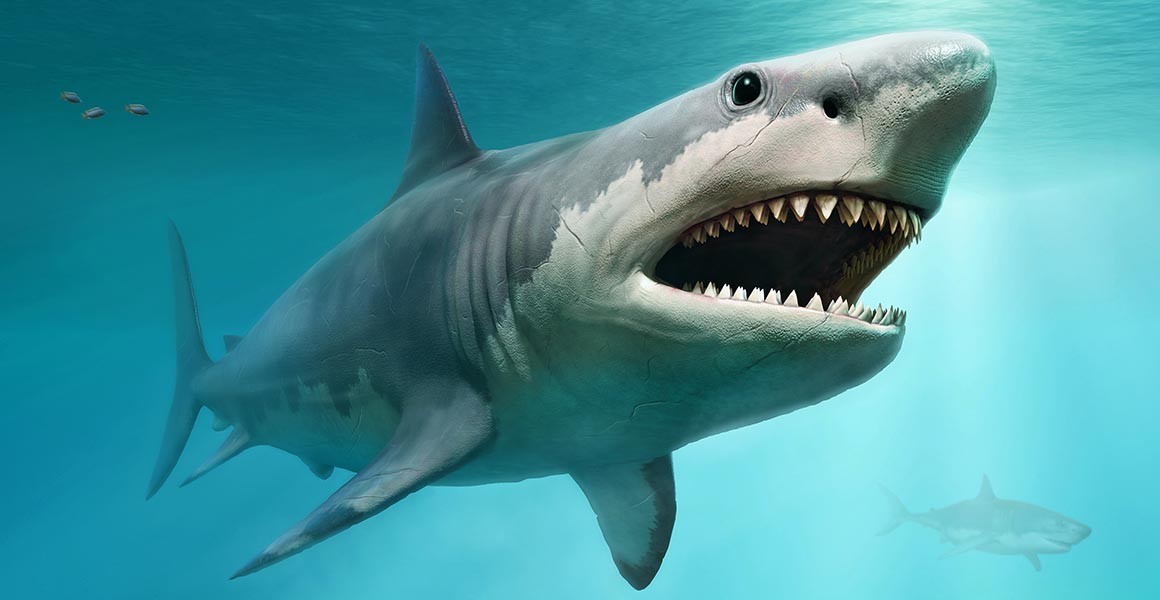
There are creatures that haunt our imagination long after they have vanished from the Earth. Among them, few inspire as much awe and unease as the Megalodon. Officially known as Otodus megalodon, this ancient shark once ruled the oceans with a presence so immense that even modern great whites seem modest by comparison. It lived millions of years ago, yet its shadow stretches into our present, fueled by fossil teeth the size of a human hand and bite marks carved into the bones of whales.
The Megalodon was not a myth, not a sea monster invented by sailors, but a real apex predator that swam Earth’s oceans for millions of years. Scientifically accurate reconstructions paint a picture of a shark built for domination—powerful, efficient, and terrifyingly effective.
What follows are ten carefully grounded facts about the Megalodon. Each one is rooted in paleontological evidence and modern scientific research. And together, they create a portrait of a predator so formidable that it might just make you think twice before venturing too far from shore.
1. It Was Larger Than Almost Any Predator in Earth’s History
Size alone makes the Megalodon unforgettable.
Modern scientific estimates suggest that Megalodon reached lengths of around 15 to 20 meters, with some estimates clustering near 18 meters. That’s roughly three times the length of the largest confirmed individuals of the great white shark. At that size, it would have weighed somewhere between 40 and 70 metric tons.
To grasp this scale emotionally, imagine a school bus gliding silently beneath your boat. Now imagine it moving with the stealth and acceleration of a shark.
Length estimates are based primarily on fossil teeth and vertebrae, because sharks have skeletons made of cartilage rather than bone, which rarely fossilizes. Scientists compare the proportions of Megalodon teeth to those of living sharks to reconstruct body size. While there is still debate about the exact shape of its body, the general consensus is clear: Megalodon was one of the largest predatory fish ever to exist.
When a predator reaches that size, it does not merely participate in its ecosystem. It defines it.
2. Its Bite Was Among the Strongest Ever Measured
The Megalodon didn’t just rely on size. It had a bite force that likely surpassed almost every other known animal in history.
Biomechanical modeling suggests that Megalodon’s bite force could have reached between 100,000 and 180,000 newtons. For comparison, the bite force of a modern great white shark is estimated at around 18,000 newtons. Even the mighty Tyrannosaurus rex, often portrayed as the ultimate land predator, had a bite force estimated in a similar or slightly lower range than Megalodon.
That means Megalodon’s jaws could crush bone with astonishing efficiency.
Fossil whale bones have been discovered bearing deep gouges and puncture marks that match Megalodon teeth. These are not superficial scratches. They are crushing injuries. The spacing and depth of the marks suggest deliberate targeting of large prey, including whales.
A bite like that would not merely wound. It would shatter ribs, rupture organs, and end struggles quickly.
3. It Hunted Whales as Prey, Not as Rivals
One of the most chilling facts about Megalodon is not that it could eat whales, but that it did.
During the Miocene and Pliocene epochs, when Megalodon lived, whales were diversifying and increasing in size. Fossil evidence shows that Megalodon preyed on early baleen whales and toothed whales.
Paleontologists have found whale vertebrae and ribs with bite marks consistent with Megalodon’s dentition. In some cases, the pattern of injuries suggests a hunting strategy. Rather than attacking randomly, Megalodon may have targeted flippers or tails to immobilize its prey before delivering a fatal bite.
This behavior mirrors hunting strategies observed in some modern sharks, but scaled up to a magnitude that feels almost cinematic.
Imagine the open ocean millions of years ago. A pod of early whales swims through warm water. Below them, unseen, a predator longer than their own bodies rises with calculated force.
For millions of years, Megalodon was the apex predator of the seas.
4. Its Teeth Were the Size of a Human Hand
If you want a tangible measure of Megalodon’s power, hold one of its teeth.
Megalodon teeth are among the most common shark fossils found today. Individual teeth can measure over 18 centimeters in length. They are triangular, serrated, and thick, designed not just for slicing but for gripping and crushing.
Each Megalodon may have had around 250 teeth arranged in multiple rows. Like modern sharks, it would have continually replaced lost teeth throughout its lifetime. This constant shedding is one reason we have so many Megalodon teeth today.
Those teeth are not delicate relics. They are heavy, robust, and designed for destruction.
When you look at a Megalodon tooth, you are not seeing an abstract fossil. You are seeing a weapon.
5. It Lived Almost Everywhere in Warm Oceans
Megalodon was not confined to a single sea.
Fossils have been discovered on every continent except Antarctica. This wide distribution suggests that Megalodon inhabited warm and temperate oceans across the globe. During its time, Earth’s climate was generally warmer than today’s, and sea levels were higher.
Coastal regions appear to have been important habitats, especially for juveniles. Some fossil sites are interpreted as nursery areas, where young Megalodons grew in relatively protected shallow waters before venturing into deeper seas.
This global presence means that wherever there were large marine mammals in warm waters, Megalodon may have been there too.
It was not a local terror. It was a planetary one.
6. It Likely Had a Body Built for Speed and Power
Although we do not have a complete Megalodon skeleton, scientists reconstruct its body using fossil vertebrae and comparisons with modern lamniform sharks.
Earlier reconstructions often portrayed Megalodon as an oversized great white shark. More recent studies suggest that it may have had a slightly different body shape—possibly more robust and streamlined, optimized for sustained cruising and bursts of speed.
A predator of such massive size would have needed efficiency. Swimming continuously in open oceans requires energy conservation. At the same time, hunting large whales demands explosive acceleration.
Its tail fin was likely crescent-shaped, similar to that of fast-swimming sharks today. That shape minimizes drag and maximizes propulsion.
In the vast blue darkness, Megalodon would not have lumbered. It would have glided, powerful and precise.
7. It Ruled the Oceans for Millions of Years
Megalodon did not appear briefly and vanish. It endured.
The species first emerged approximately 23 million years ago during the early Miocene. It persisted until about 3.6 million years ago in the late Pliocene. That is nearly 20 million years of evolutionary success.
For perspective, Homo sapiens has existed for roughly 300,000 years. Megalodon’s reign was staggeringly long in comparison.
Over those millions of years, ocean ecosystems changed, climates shifted, and prey species evolved. Yet Megalodon remained at the top of the marine food chain.
It was not an experimental fluke of evolution. It was a dominant, stable apex predator for an immense span of geological time.
8. Its Extinction Was Real and Permanent
Despite popular myths and sensational television specials, Megalodon is extinct.
Scientific evidence indicates that the species disappeared around 3.6 million years ago. The fossil record shows no confirmed Megalodon teeth younger than that period. If Megalodon still existed today, we would expect to find fresh teeth, carcasses, or unmistakable evidence of its presence.
The reasons for its extinction are still studied, but several factors likely contributed. Global cooling during the Pliocene altered ocean temperatures. Sea levels fell, reducing shallow coastal nursery habitats. Prey species changed, and new competitors emerged, including early great white sharks and other large marine predators.
Extinction does not mean failure. It means change. The world that sustained Megalodon shifted, and the giant predator could not adapt quickly enough.
The oceans today are vast and mysterious, but they are not hiding a living Megalodon.
9. It Shaped Marine Ecosystems in Profound Ways
A predator of Megalodon’s size does not simply consume prey. It influences entire ecosystems.
By hunting large marine mammals, Megalodon likely affected whale population structures and behaviors. Predation pressure can influence migration routes, breeding grounds, and evolutionary adaptations.
In modern ecosystems, apex predators help maintain balance by regulating prey populations. It is reasonable to infer that Megalodon played a similar ecological role in its time.
Its disappearance may have opened ecological space for other predators to rise. The evolution and spread of large modern sharks, including the lineage leading to today’s great white, may have been influenced by Megalodon’s decline.
When a giant falls, the ocean rearranges itself.
10. Even in Death, It Dominates Our Imagination
Perhaps the most enduring fact about Megalodon is psychological.
It is gone, and yet it feels close.
Part of that unease comes from the ocean itself. The sea remains one of Earth’s least explored environments. We cannot see far beneath its surface. Sound travels differently. Depth swallows light. When we swim in the open ocean, we are acutely aware of how small we are.
Now layer onto that awareness the knowledge that, for millions of years, a shark longer than a bus patrolled these waters.
Unlike dinosaurs, which roamed landscapes that feel distant and alien, Megalodon lived in oceans that still exist. When you stand on a beach and look out at the horizon, you are gazing at waters that once held this predator.
The mind connects past and present.
Scientifically, we know Megalodon is extinct. Emotionally, the image of it lingers. A dark silhouette below. A sudden surge upward. A flash of serrated teeth.
And that is the final truth about Megalodon. It reminds us that Earth has hosted creatures far larger, stronger, and more dominant than we are. It humbles us. It unsettles us. It invites awe.
The Deep Memory of the Ocean
Physics explains gravity and motion. Biology explains evolution and adaptation. Paleontology reconstructs ancient life from fragments of stone. Together, these sciences allow us to know Megalodon not as a legend but as a real organism that once lived, hunted, reproduced, and died.
There is no need to exaggerate its size or invent survival stories. The reality is astonishing enough.
The Megalodon was one of the most powerful predators ever to inhabit our planet. It hunted whales, spanned oceans, and endured for millions of years before vanishing as climates and ecosystems shifted.
So the next time you step into the ocean, feel the cool water around your legs, and stare into the blue beyond the waves, remember this: you are entering an environment with a deep history. The sea has known giants. It has echoed with the movements of creatures so immense that they reshape imagination itself.
And while Megalodon will never again rise from the depths, its story remains a testament to the raw, untamed power that once ruled the ancient oceans.