Human history is usually told in terms of towering pyramids, sky-piercing cathedrals, and glittering cities that rise above the earth. Yet some of the most astonishing chapters of our past were written not in the sunlight, but in darkness. Across continents and centuries, people carved entire cities underground—vast labyrinths of rooms, tunnels, chapels, storage chambers, and hidden passageways. These subterranean worlds were born from necessity, faith, survival, and sometimes fear.
Underground cities are not myths or fantasies. They are real, archaeologically documented spaces shaped by geology and human ingenuity. Some were carved into soft volcanic rock; others were dug into chalk or limestone. Many served as refuges during war or invasion. Others were sacred burial grounds or spiritual sanctuaries. What unites them is their defiance of expectation. Civilization, we assume, rises upward. But here, it descended.
In the quiet darkness below the soil, communities once lived, prayed, stored food, hid from danger, and created intricate systems of ventilation and water supply. Their work challenges our assumptions about ancient engineering and social organization. It reveals that humanity’s drive to adapt and endure is as deep as the tunnels it carved.
Here are six of the most mysterious and scientifically significant underground cities ever discovered.
1. Derinkuyu – The Deepest Known Underground City of Cappadocia
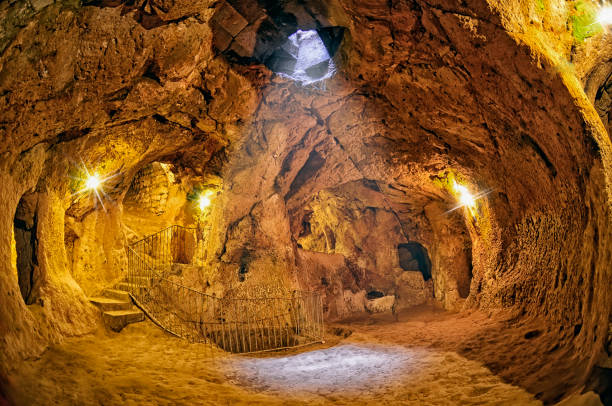
In the heart of Derinkuyu lies one of the most extraordinary underground complexes on Earth. Carved into the soft volcanic tuff of the Cappadocia region in central Turkey, Derinkuyu descends approximately 60 meters below the surface and extends across multiple levels—at least eight of which are accessible today.
This underground city was not discovered through grand excavation but by accident. In the 1960s, a local resident renovating his home reportedly broke through a wall and found himself facing a hidden passage. What followed was the revelation of a vast subterranean network capable of sheltering thousands of people.
Derinkuyu includes living quarters, storage rooms, wine and oil presses, stables, kitchens, chapels, and even a schoolroom. Heavy circular stone doors could be rolled into place from the inside to seal off corridors, creating defensible sections. These stone slabs were designed to block invaders and could only be moved from within.
One of the most remarkable features of Derinkuyu is its sophisticated ventilation system. Vertical shafts descend through the levels, allowing air circulation even in the deepest chambers. Some shafts also functioned as wells, providing access to water without requiring residents to surface.
Archaeological evidence suggests that early phases of the city may date back to the first millennium BCE, possibly initiated by the Phrygians. Later expansions occurred during the Byzantine period, particularly between the 5th and 10th centuries CE, when Christian populations used the underground city as refuge from invading forces.
The geology of Cappadocia made such construction possible. Volcanic eruptions millions of years ago deposited thick layers of tuff—soft enough to carve yet strong enough to remain structurally stable. This unique rock allowed inhabitants to create expansive chambers without modern tools.
Derinkuyu is not merely a shelter. It is a testament to long-term planning, engineering foresight, and communal organization. It shows that underground living was not chaotic improvisation but structured adaptation.
2. Kaymaklı – A Labyrinth of Interconnected Subterranean Life
Not far from Derinkuyu lies another immense underground settlement: Kaymaklı. While Derinkuyu may be deeper, Kaymaklı is often considered more expansive horizontally, spreading across a broader area beneath the surface.
Kaymaklı consists of multiple levels arranged around central ventilation shafts. Its rooms are interconnected through low, narrow passageways that forced inhabitants—and potential attackers—to move slowly. Like Derinkuyu, it features stone doors that could be sealed from within.
Archaeological studies suggest that Kaymaklı was used continuously for centuries. Storage rooms contained large jars for grain and wine, indicating preparation for extended stays underground. Stables were located on lower levels, suggesting that livestock were sheltered alongside people during periods of danger.
What distinguishes Kaymaklı is its sense of planned spatial organization. Residential areas cluster around communal spaces. Religious rooms contain carved crosses and symbols, reflecting its use during early Christian periods.
The presence of soot on ceilings reveals prolonged habitation with oil lamps. The ventilation shafts ensured oxygen flow and prevented suffocation. These were not temporary hideouts but fully functional urban environments beneath the soil.
The Cappadocian underground cities may have been connected by tunnels stretching kilometers. While not all connections are accessible today, evidence suggests a regional network of subterranean refuge sites.
Kaymaklı and Derinkuyu together demonstrate how geology, political instability, and religious history combined to produce one of the most remarkable examples of underground urbanization in human history.
3. Naours – The Hidden City Beneath Northern France
Far from the volcanic landscapes of Turkey, in the chalky soils of northern France, lies Naours—a vast underground complex known as the Naours caves.
Unlike Cappadocia’s rock-cut cities formed in volcanic tuff, Naours was carved into chalk, a softer sedimentary rock common in the region. The underground network includes approximately 300 chambers connected by corridors stretching over two kilometers.
The origins of Naours date back to at least the Middle Ages, though the site may have earlier roots. It became particularly important during periods of conflict, including the Thirty Years’ War in the 17th century, when villagers sought refuge from invading armies.
Naours functioned as a communal shelter rather than a permanently inhabited city. Inside, archaeologists have identified wells, chapels, stables, bakeries, and communal spaces. Ventilation shafts ensured airflow, and staircases connected the surface to the underground refuge.
One of the most intriguing discoveries at Naours is the presence of thousands of carved inscriptions left by soldiers during World War I. Troops stationed nearby visited the caves and etched their names into the chalk walls, leaving a layered record of history.
Naours illustrates how underground architecture adapted to local geological conditions. Chalk, though easier to excavate, is more prone to collapse than volcanic tuff. Builders reinforced ceilings and structured chambers to maintain stability.
This underground city reminds us that subterranean refuge was not unique to one region. Across Europe, communities used geology to protect themselves from war and upheaval.
4. Wieliczka – The Underground City of Salt
Beneath the town of Wieliczka lies one of the world’s most extraordinary underground complexes: the Wieliczka Salt Mine. Though technically a mine rather than a city in the traditional sense, its vast chambers, chapels, lakes, and corridors form a subterranean world that functioned almost like a hidden urban environment.
The Wieliczka Salt Mine has been in operation since the 13th century. Over centuries, miners carved tunnels extending more than 300 kilometers, descending to depths of over 300 meters.
Salt was once a precious commodity, essential for food preservation. The economic importance of the mine sustained generations of workers. Over time, miners transformed certain chambers into chapels and ceremonial spaces, carving sculptures and altars entirely from salt.
The most famous chamber, the Chapel of St. Kinga, is an underground cathedral adorned with chandeliers made from salt crystals. Reliefs depicting biblical scenes line the walls. This space demonstrates how even industrial labor environments can become sites of artistic expression.
Scientifically, salt mines present unique geological challenges. Rock salt is relatively stable but susceptible to water infiltration. Engineers carefully managed drainage and structural reinforcement to prevent collapse.
Wieliczka represents the intersection of geology, economy, faith, and engineering. It shows that underground spaces were not solely for refuge but also for sustained economic production.
5. Petra’s Subterranean Secrets
The ancient city of Petra is famous for its monumental facades carved into rose-red sandstone cliffs. Yet beneath and around its iconic structures lies a network of subterranean chambers, tombs, and water systems that add another layer of mystery to this Nabataean capital.
Founded around the 4th century BCE and flourishing until Roman annexation in 106 CE, Petra was a major trade hub. Its underground features include elaborate tomb complexes carved deep into rock faces and hidden water channels that captured and stored rainfall in a desert environment.
The Nabataeans engineered sophisticated hydraulic systems, including cisterns, channels, and dams. These underground components were crucial for survival in an arid climate. Without them, Petra could not have sustained a large population.
Unlike Cappadocia’s defensive underground cities, Petra’s subterranean structures were integrated into urban planning. Tombs symbolized wealth and status. Water channels demonstrated advanced engineering knowledge.
Archaeological research shows that sandstone’s relative softness allowed intricate carving, but it also required constant maintenance. Weathering and erosion continue to threaten Petra’s structures.
Petra’s underground elements highlight how subterranean design can be aesthetic, symbolic, and practical simultaneously.
6. Montreal’s Underground City – A Modern Subterranean Metropolis
Not all underground cities belong to ancient history. Beneath the streets of Montreal lies a vast modern network known as the RÉSO.
Spanning over 30 kilometers of tunnels, RÉSO connects shopping centers, metro stations, office buildings, universities, and residential complexes. Unlike ancient refuge cities, this network was designed to protect residents from harsh winter conditions.
Montreal’s climate includes long, freezing winters. The underground system allows pedestrians to move through large portions of downtown without exposure to extreme cold.
Engineered with modern materials, climate control systems, and structural reinforcements, RÉSO represents the evolution of subterranean architecture. It demonstrates that building downward remains a practical urban strategy.
Though very different from Derinkuyu or Naours, Montreal’s underground city shares a common theme: adaptation. Humans continue to use the space beneath their feet to solve environmental and social challenges.
Why Do Underground Cities Exist?
Across continents and eras, underground cities arise from three main motivations: protection, climate control, and resource access.
Protection from invasion drove the creation of Cappadocia’s deep refuges. Climate adaptation shaped Montreal’s network and Petra’s water systems. Resource extraction defined Wieliczka.
Geology plays a decisive role. Soft volcanic tuff, chalk, sandstone, and salt are all carveable materials. Regions lacking such geology rarely produce large underground cities.
Scientific study of these sites involves archaeology, geology, structural engineering, and environmental science. Researchers analyze tool marks, ventilation systems, and material stability to understand how ancient builders achieved structural integrity.
The Psychological and Cultural Dimension
Living underground is not merely an engineering problem. It affects light exposure, airflow, temperature, and psychological well-being. Ancient builders compensated with ventilation shafts, communal spaces, and religious rooms.
Archaeological evidence shows that many underground cities were temporary refuges rather than permanent homes. Extended absence of sunlight can disrupt circadian rhythms, and limited airflow can create health risks.
Yet these communities endured. Their underground worlds became symbols of resilience and collective survival.
The Continuing Mystery
Even today, not all tunnels have been mapped. Some passages remain sealed. New sections are occasionally discovered, especially in Cappadocia.
Modern technology such as ground-penetrating radar and 3D scanning allows archaeologists to explore subterranean spaces with minimal disturbance. These tools reveal hidden chambers and structural details invisible from the surface.
Underground cities challenge our imagination. They invert our expectations of civilization. They show that human ingenuity is not confined to the visible skyline.
Conclusion: Cities of Shadow and Survival
What do these six underground cities tell us about humanity? They reveal a species capable of adapting to danger, climate, scarcity, and uncertainty. They show engineering skill without modern machinery. They testify to communal cooperation in times of threat.
Beneath fields, deserts, mountains, and modern streets lie silent corridors where history once breathed. These subterranean cities are not fantasies but tangible realities shaped by geological conditions and human determination.
In darkness, people found safety. In confinement, they created order. In hidden spaces, they built worlds.
The Earth beneath our feet is not empty. It carries echoes of civilizations that chose, for a time, to live in shadow—proving that even underground, humanity shines.