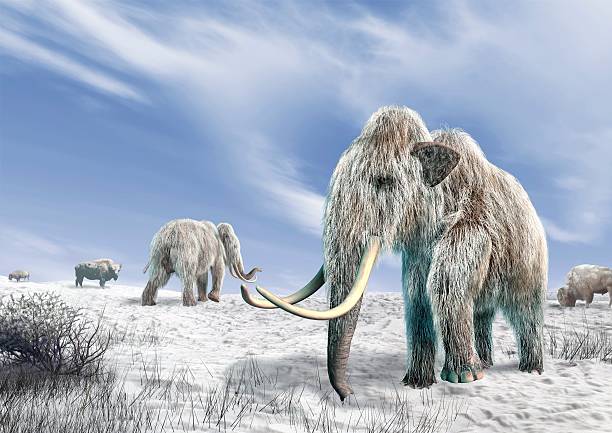
There is something haunting about the woolly mammoth. When we imagine it, we see a towering, shaggy giant moving slowly across a frozen plain, its long curved tusks catching the pale light of the Ice Age sun. It feels both distant and strangely familiar. Unlike dinosaurs, which vanished tens of millions of years ago, the woolly mammoth walked the Earth alongside early humans. Our ancestors saw them, hunted them, painted them, and perhaps even feared them. The mammoth is not just a fossil; it is a memory buried in ice.
The most famous species, the Woolly Mammoth, lived during the last Ice Age and became extinct only about 4,000 years ago. That means mammoths were still alive when the pyramids of Egypt were being built. They were not prehistoric monsters from an unimaginably distant past. They were part of a world already shaped by human hands.
In this article, we will explore twelve surprising facts about the woolly mammoth. Each fact reveals not only the biology of this remarkable creature but also the story of climate change, evolution, survival, and extinction. The mammoth is more than a symbol of the Ice Age. It is a window into how life adapts—and how it disappears.
1. Woolly Mammoths Were Not Dinosaurs
One of the most common misconceptions is that woolly mammoths lived alongside dinosaurs. In reality, dinosaurs went extinct around 66 million years ago, long before mammals like mammoths evolved into large, dominant animals.
The woolly mammoth was a mammal, not a reptile. It belonged to the same order as modern elephants. In fact, it was closely related to today’s Asian elephant. Genomic studies show that mammoths and Asian elephants share a recent common ancestor compared to other elephant species.
This means mammoths were warm-blooded, gave birth to live young, and likely had complex social structures similar to modern elephant herds. They were not scaly, cold-blooded giants of deep time. They were intelligent, social mammals adapted to cold environments.
The image of mammoths and dinosaurs walking together may be dramatic, but the truth is even more fascinating. Mammoths represent the success of mammals after the age of dinosaurs ended. They are part of the story of how mammals rose to dominate the Earth.
2. They Were Perfectly Adapted to Extreme Cold
The woolly mammoth was a masterpiece of Ice Age engineering. Everything about its body was designed for survival in freezing environments.
Its most obvious feature was its thick coat of fur. Mammoths had long outer guard hairs that could reach up to a meter in length, along with a dense underlayer of insulating wool. Beneath the fur, they had a thick layer of fat that helped retain heat. This fat layer could be several centimeters thick, functioning much like blubber in marine mammals.
Even their ears were small compared to modern elephants. Smaller ears reduce heat loss, an important adaptation in cold climates. Their tails were also shorter, minimizing the risk of frostbite.
Their blood may have contained special adaptations as well. Research suggests that mammoth hemoglobin was uniquely suited to release oxygen efficiently in cold temperatures, allowing their tissues to function even in extreme cold.
The woolly mammoth was not just surviving the Ice Age—it was built for it.
3. They Roamed Vast Areas of the Northern Hemisphere
Woolly mammoths were not confined to a small region. They inhabited a massive area known as the mammoth steppe, which stretched across northern Europe, Asia, and North America.
This landscape was not an endless sheet of ice. Instead, it was a cold, dry grassland ecosystem. The mammoth steppe supported a variety of large herbivores, including woolly rhinoceroses, bison, and reindeer. It was one of the most extensive ecosystems in Earth’s history.
Mammoths migrated across these vast plains in search of food. Their diet consisted mainly of grasses, sedges, and shrubs. Their large, flat molars were specially adapted for grinding tough vegetation.
The idea of mammoths wandering across continents gives us a sense of their scale—not just in size, but in ecological importance. They were keystone herbivores shaping entire ecosystems.
4. Their Tusks Could Grow to Enormous Sizes
One of the most striking features of the woolly mammoth was its long, spiraled tusks. These tusks were elongated incisor teeth that grew continuously throughout the animal’s life.
Some tusks reached lengths of over four meters. They curved dramatically, sometimes crossing in front of the animal’s trunk. The exact function of these enormous tusks is still studied, but they likely served multiple purposes.
Tusks may have been used to clear snow from the ground to access buried vegetation. They were also probably used in social interactions, including dominance displays and fights between males during mating season.
Like tree rings, tusks contain growth layers that can reveal information about an individual’s age, diet, and even seasonal changes. By analyzing these layers, scientists can reconstruct aspects of a mammoth’s life history.
The tusks were not just weapons or tools; they were biological archives of a frozen world.
5. Humans and Mammoths Coexisted
Perhaps one of the most astonishing facts about woolly mammoths is that humans lived alongside them. Early Homo sapiens encountered mammoths in Eurasia, and humans in North America also interacted with them.
Archaeological evidence shows that humans hunted mammoths. Mammoth bones have been found at ancient campsites, sometimes arranged in circular structures that may have served as dwellings. In some regions, entire houses were built using mammoth bones, covered with animal hides.
Cave paintings depict mammoths with remarkable detail, suggesting they were important in the cultural and symbolic lives of Ice Age people.
This coexistence raises profound questions. Did human hunting contribute significantly to mammoth extinction? Or was climate change the primary driver? The answer likely involves a combination of both factors.
The story of mammoths is intertwined with our own evolutionary history.
6. Some Mammoths Survived on Isolated Islands
While most woolly mammoths disappeared around 10,000 years ago at the end of the last Ice Age, some populations survived much longer.
On remote islands such as Wrangel Island in the Arctic Ocean, small populations of mammoths persisted until about 4,000 years ago. These island mammoths were smaller than their mainland ancestors, a phenomenon known as island dwarfism.
Isolation protected them temporarily from human hunting and environmental pressures. However, small populations are vulnerable to genetic problems and environmental changes. Eventually, these last mammoths also vanished.
The idea that mammoths were alive when ancient civilizations were flourishing elsewhere in the world feels almost surreal. It reminds us how recent their extinction truly was.
7. Frozen Bodies Have Been Remarkably Preserved
One of the reasons we know so much about woolly mammoths is the extraordinary preservation of some individuals in permafrost.
In Siberia and other Arctic regions, frozen carcasses have been discovered with fur, skin, and even internal organs intact. These specimens provide invaluable information about mammoth anatomy, diet, and genetics.
Stomach contents from frozen mammoths have revealed the types of plants they ate. DNA extracted from preserved tissues has allowed scientists to sequence large portions of the mammoth genome.
These frozen giants seem almost asleep, as if they could awaken at any moment. They bridge the gap between paleontology and modern biology.
8. Mammoths Were Highly Social Animals
Modern elephants are known for their complex social structures, emotional bonds, and long memories. Evidence suggests that woolly mammoths had similar social behavior.
Fossil sites indicate that mammoths often lived in herds. Like elephants, females and their young likely formed matriarchal groups led by an older female. Adult males may have lived more solitary lives or formed temporary bachelor groups.
The social intelligence of elephants includes cooperation, communication, and mourning behavior. While we cannot observe mammoths directly, their close relationship to elephants strongly suggests they shared many of these traits.
Imagining mammoths not just as giant animals but as social beings with relationships and family bonds adds emotional depth to their story.
9. Climate Change Played a Major Role in Their Extinction
The end of the last Ice Age brought dramatic environmental changes. Temperatures rose, glaciers retreated, and ecosystems shifted.
The mammoth steppe, once vast and continuous, began to fragment. Forests replaced grasslands in many regions, reducing suitable habitat for grazing mammoths.
These rapid climate shifts likely stressed mammoth populations. Combined with human hunting pressure, the changing environment may have pushed them beyond recovery.
The extinction of the woolly mammoth serves as a powerful reminder of how sensitive large animals can be to environmental change. It also resonates in today’s world, where climate change once again threatens ecosystems.
10. Their DNA Has Been Sequenced
Advances in molecular biology have allowed scientists to extract and sequence DNA from mammoth remains.
Genomic analysis has revealed details about mammoth evolution, adaptation to cold, and relationships with modern elephants. Specific genes associated with hair growth, fat storage, and temperature sensitivity have been identified.
This genetic knowledge has fueled discussions about the possibility of “de-extinction,” using biotechnology to reintroduce mammoth-like traits into modern elephants. While such projects remain controversial and complex, they demonstrate how deeply science has advanced.
The mammoth, though extinct, still speaks to us through its DNA.
11. Mammoths Shaped Their Ecosystem
Woolly mammoths were not passive inhabitants of their environment. As large herbivores, they played an active role in shaping landscapes.
By grazing and trampling vegetation, they influenced plant communities. Their feeding habits may have helped maintain open grasslands by preventing the spread of trees and shrubs.
Their dung fertilized soil, supporting plant growth. In this way, mammoths were ecosystem engineers.
The disappearance of such large herbivores likely altered Arctic and sub-Arctic ecosystems in lasting ways. Their extinction was not just the loss of a species but the transformation of entire habitats.
12. They Continue to Inspire Science and Imagination
The woolly mammoth captures our imagination like few other extinct animals. It appears in museums, documentaries, and popular culture. It symbolizes the Ice Age and the mystery of lost worlds.
Yet beyond imagination, mammoths continue to inspire scientific research. They provide insights into evolution, adaptation, climate change, extinction dynamics, and even modern conservation biology.
Studying mammoths helps scientists understand how species respond to environmental stress and human impact. It offers lessons that are urgently relevant today.
The mammoth is gone, but its legacy endures—in ice cores, in genetic sequences, in cave paintings, and in the questions we continue to ask.
Conclusion: A Giant That Still Walks in Our Minds
The woolly mammoth was not merely a large, furry elephant. It was a creature exquisitely adapted to a harsh world, a participant in complex ecosystems, and a companion species to early humans.
Its story is one of resilience and vulnerability. It survived brutal Ice Age winters but could not withstand rapid environmental change and human expansion. Its extinction reminds us that even the mightiest species can vanish.
When we look at images of mammoths preserved in ice or reconstructed in museums, we are not just seeing a relic of the past. We are seeing a reflection of our own world—a world shaped by climate, evolution, and human influence.
The woolly mammoth may no longer roam the frozen steppes, but it still walks through our imagination. It challenges us to understand the past, to respect the fragility of life, and to consider carefully the future we are shaping.
In learning about the woolly mammoth, we are ultimately learning about ourselves.