The story of dinosaurs often brings to mind enormous predators with bone-crushing jaws and thunderous footsteps. Yet among these giants of prehistory, some species followed paths far stranger than the familiar images of toothy tyrants and long-necked herbivores. One of the most intriguing of these ancient creatures is Baryonyx, a dinosaur whose unusual anatomy, curious diet, and dramatic discovery have fascinated scientists for decades.
Baryonyx stands apart in the dinosaur world. Its name means “heavy claw,” a reference to the massive, curved talon that once dominated its forelimb. But the mystery of Baryonyx extends far beyond a single claw. It was a predator that seemed perfectly adapted for fishing. It possessed crocodile-like jaws, conical teeth suited for gripping slippery prey, and a lifestyle that blended land hunting with aquatic foraging.
Unlike many dinosaurs that were known only from fragmentary fossils, the discovery of Baryonyx revealed an astonishingly complete skeleton. Even more remarkable was what scientists found inside its ribcage: fossilized remains of fish scales and bones, preserved evidence of its last meals. This extraordinary find offered rare insight into the daily life of a dinosaur that once prowled riverbanks more than 120 million years ago.
The mystery of Baryonyx lies not only in what we know about it but also in what it reveals about evolution, adaptation, and the diversity of dinosaurs during the Early Cretaceous period.
A Chance Discovery That Changed Dinosaur Science
The discovery of Baryonyx was not made by a professional paleontologist but by an amateur fossil hunter. In 1983, a man named William Walker was searching for fossils in a clay pit in Surrey, England. The site, part of the geological formation known as the Weald Clay, had long been known to produce fossils from the Early Cretaceous period.
While exploring the pit, Walker uncovered something unusual protruding from the clay: a massive claw nearly 30 centimeters long. Its size and shape immediately suggested that it belonged to a large predator, yet it was unlike the claws of any dinosaur known from Britain at the time.
The fossil was soon brought to the attention of paleontologists at the Natural History Museum. There, experts realized that the claw represented something extraordinary. Excavations began in earnest, and over the following months scientists uncovered one of the most complete theropod dinosaur skeletons ever found in the United Kingdom.
In 1986, paleontologists Alan J. Charig and Angela C. Milner formally described the new species, naming it Baryonyx walkeri in honor of Walker and the enormous claw that first revealed its existence.
The discovery caused excitement throughout the scientific community. It was not just the completeness of the skeleton that was remarkable, but the unusual features that suggested a very different kind of dinosaur predator.
Life During the Early Cretaceous
To understand Baryonyx, it is necessary to imagine the world it inhabited. Around 125 million years ago, during the Early Cretaceous period, much of what is now southern England was a landscape of floodplains, rivers, lagoons, and dense vegetation.
The climate was warm and humid. Forests of conifers, ferns, and early flowering plants covered the land. Rivers wound slowly through muddy plains, carrying sediments that would eventually preserve fossils in remarkable detail.
Dinosaurs thrived in this environment. Large herbivores roamed the forests, including armored dinosaurs like Iguanodon. Small mammals scurried in the undergrowth, while pterosaurs glided overhead.
In this ecosystem, Baryonyx occupied a unique niche. Instead of competing directly with other large carnivores for terrestrial prey, it appears to have specialized in hunting fish and other aquatic animals.
Its body was shaped by the demands of this unusual lifestyle.
The Anatomy of a Fish-Eating Predator
Baryonyx was a large theropod dinosaur, measuring roughly nine to ten meters in length and weighing perhaps two tons. At first glance, its body resembled that of other carnivorous dinosaurs: it walked on powerful hind legs, balanced by a long tail, with a large head and relatively short forelimbs.
Yet a closer look reveals a series of remarkable adaptations.
The skull of Baryonyx was long, narrow, and somewhat crocodile-like in shape. Unlike the deep, crushing jaws of predators such as Tyrannosaurus rex, the snout of Baryonyx was elongated and slender.
Its teeth were conical and slightly curved, lacking the serrated edges common in many meat-eating dinosaurs. These teeth were perfectly suited for gripping slippery fish rather than slicing through flesh.
Along the snout were small pits believed to house pressure-sensitive receptors, similar to those found in modern crocodiles. These receptors may have helped Baryonyx detect movement in water, allowing it to sense fish swimming nearby.
But perhaps the most striking feature of Baryonyx was its enormous claw.
The Heavy Claw That Inspired Its Name
The name Baryonyx comes from Greek words meaning “heavy claw,” and the description is accurate. The first finger of each hand bore a gigantic curved claw that could reach nearly 30 centimeters in length.
This claw was not merely large; it was strongly built, thick at the base and sharply pointed at the tip. Paleontologists have long debated its exact function.
One possibility is that the claw helped Baryonyx hook fish from the water, much like a bear scoops salmon from a river. Another theory suggests it may have been used to hold struggling prey or to tear open carcasses.
The claw could also have served as a defensive weapon against rival predators or as a display structure used in social interactions.
Whatever its exact purpose, the heavy claw was clearly an important part of Baryonyx’s hunting toolkit.
Evidence of a Fish Diet
The most dramatic evidence of Baryonyx’s feeding habits came from the original fossil specimen itself.
Inside the ribcage of the dinosaur, paleontologists discovered fossilized fish scales and bones. These remains belonged to a large prehistoric fish called Lepidotes, a common inhabitant of Cretaceous rivers and lakes.
The presence of fish remains inside the stomach region provided direct proof that Baryonyx consumed aquatic prey.
Even more surprising was the discovery of bones from a juvenile Iguanodon in the same area. This suggests that Baryonyx was not strictly a fish specialist but an opportunistic predator capable of hunting or scavenging land animals as well.
This combination of aquatic and terrestrial feeding behavior made Baryonyx one of the most versatile predators of its time.
The Spinosaur Family
Baryonyx belongs to a group of dinosaurs known as spinosaurids. These dinosaurs are famous for their crocodile-like snouts, conical teeth, and strong forelimbs.
The most famous member of this family is Spinosaurus, a massive predator that lived in North Africa during the Late Cretaceous period. Spinosaurus possessed an enormous sail-like structure on its back and may have spent much of its life in the water.
Other relatives include Suchomimus and Irritator.
Baryonyx appears to represent an early branch of this group. Its anatomy suggests a transitional stage in the evolution of spinosaurids, combining features of typical theropods with specialized adaptations for fishing.
The discovery of Baryonyx helped scientists understand that not all dinosaur predators hunted the same way. Some evolved to exploit aquatic environments, much like modern crocodiles or fishing birds.
Hunting Along Ancient Rivers
Imagining Baryonyx in its natural habitat reveals a predator very different from the classic image of a dinosaur hunter charging across open plains.
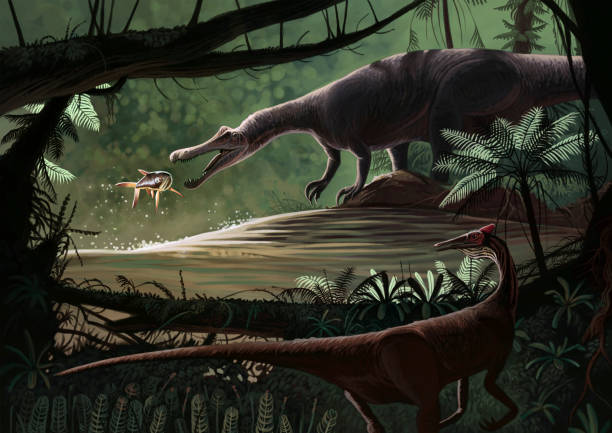
Instead, Baryonyx may have spent much of its time along riverbanks, wading through shallow water or waiting patiently near the edge.
With its long snout pointed downward, it could watch the surface of the water for movement. When a fish swam within reach, the dinosaur might snap its jaws shut with remarkable speed.
Its powerful forelimbs and massive claws could help secure struggling prey or pull fish from the water.
This style of hunting required patience, precision, and specialized anatomy. It suggests that Baryonyx occupied a unique ecological niche, reducing competition with other large carnivores.
The Brain and Senses of Baryonyx
Although soft tissues rarely fossilize, scientists can learn about dinosaur brains and senses by studying the internal structure of fossil skulls.
The shape of the brain cavity in Baryonyx indicates that it possessed well-developed sensory abilities. Its sense of smell was likely strong, helping it detect prey or carrion from a distance.
Vision also appears to have been important. The position of its eyes suggests that it may have had good forward vision, useful for targeting prey with precision.
The specialized pits along its snout may have allowed it to detect vibrations in water, similar to modern crocodilians. If so, Baryonyx could have sensed fish movement even when visibility was poor.
Together, these sensory adaptations would have made it an effective predator in watery environments.
Growth and Life History
Understanding how Baryonyx grew and lived remains an ongoing challenge for paleontologists.
The known fossil specimens suggest that Baryonyx may have reached adulthood at lengths of around nine meters, though individuals may have varied in size.
Like other dinosaurs, it likely hatched from eggs laid in nests on land. Juveniles probably looked similar to adults but smaller and more lightly built.
Young Baryonyx may have hunted small fish, amphibians, and insects before graduating to larger prey as they grew.
Seasonal changes in river levels and climate may have influenced their behavior. During dry periods, shrinking water sources could concentrate fish populations, creating ideal feeding opportunities.
The Global Story of Spinosaurids
The discovery of Baryonyx helped spark a broader reevaluation of spinosaurid dinosaurs around the world.
Fossils of similar animals have been found across Europe, Africa, South America, and Asia, suggesting that these fish-eating predators were widespread during the Cretaceous period.
The presence of spinosaurids on multiple continents reflects the geography of Earth at the time. During the Early Cretaceous, many landmasses were still connected or closer together than they are today.
These connections allowed dinosaurs to migrate and diversify across vast regions.
Baryonyx represents one piece of this larger evolutionary puzzle.
Scientific Debates and New Discoveries
Like many dinosaur species, Baryonyx remains the subject of ongoing research and debate.
Some paleontologists have proposed that certain fossils discovered in Europe may belong to closely related species or even to Baryonyx itself. Determining whether these fossils represent new species or variations of known ones requires careful analysis.
Advances in technology have also transformed how scientists study dinosaurs. CT scanning allows researchers to examine internal structures of fossils without damaging them. Computer modeling helps reconstruct movement and biomechanics.
These tools continue to reveal new insights into how Baryonyx lived, hunted, and evolved.
The Legacy of an Unusual Dinosaur
The discovery of Baryonyx reshaped scientific understanding of dinosaur ecology. Before its discovery, large theropods were often assumed to be primarily land-based predators that hunted other dinosaurs.
Baryonyx showed that some carnivorous dinosaurs adapted to very different lifestyles.
It demonstrated that dinosaur ecosystems were more complex and diverse than once imagined. Predators could specialize in fish, hunt along rivers, and exploit aquatic environments in ways previously associated only with reptiles like crocodiles.
This realization has inspired new research into other dinosaurs that may have lived semi-aquatic lives.
Why Baryonyx Still Captivates Us
There is something deeply captivating about Baryonyx. Perhaps it is the image of a giant dinosaur standing quietly beside a prehistoric river, waiting for the flicker of a fish beneath the surface.
Perhaps it is the story of its discovery—a single claw emerging from clay, leading to one of the most remarkable fossil finds in Britain.
Or perhaps it is the reminder that the prehistoric world was far stranger and more diverse than we once believed.
Dinosaurs were not simply giant reptiles dominating the land. They were complex animals occupying countless ecological roles.
Baryonyx, with its long snout, fish-eating habits, and enormous claws, stands as one of the most fascinating examples of this diversity.
Its fossils continue to teach us about evolution, adaptation, and the ancient ecosystems that once flourished on Earth.
And as paleontologists continue to uncover new discoveries, the mystery of Baryonyx remains an open chapter in the ever-expanding story of life’s history on our planet.