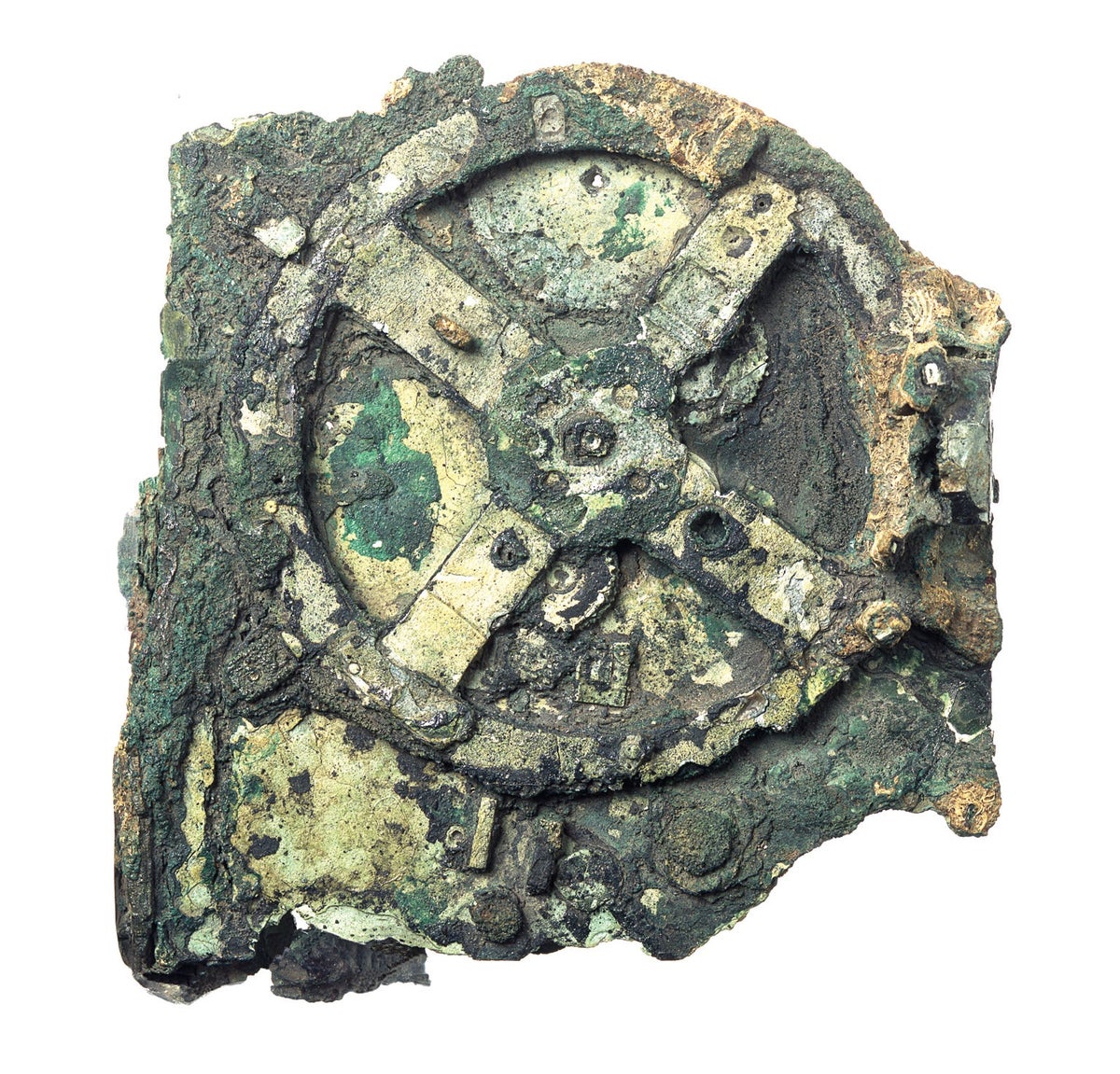
At the bottom of the Mediterranean Sea, hidden for nearly two thousand years beneath shifting sand and quiet currents, lay a device that modern historians would one day struggle to comprehend. It was not a statue, not a jewel, not a weapon, nor a fragment of pottery. Instead, it was something stranger—an intricate mechanism made of bronze gears, plates, and inscriptions. When it was finally brought back to the surface, scholars would stare at it with disbelief.
The object looked impossibly advanced.
It resembled the internal mechanism of a clock, yet it came from a world that supposedly did not possess such technology. The gears were cut with remarkable precision, arranged in a complex system capable of tracking celestial cycles. Its purpose was not mechanical power but calculation—astronomical calculation.
This artifact would later be known as the Antikythera Mechanism. Today, many historians and scientists consider it the world’s first known analog computer. Built more than two thousand years ago, it was designed to predict the movements of the Sun, the Moon, and possibly the planets. It could forecast eclipses and track important astronomical cycles.
The existence of such a machine seems almost unbelievable. Nothing like it would appear again in history for more than a millennium.
To understand the Antikythera Mechanism is to confront a mystery: how could ancient engineers create something so advanced, and why did such technology vanish for so long?
Discovery Beneath the Mediterranean
The story begins in the spring of 1900 near a small Greek island called Antikythera, located between Crete and mainland Greece. At that time, a group of sponge divers from the island of Symi were exploring the seabed when they stumbled upon something extraordinary.
While diving at a depth of about forty-five meters, one diver surfaced in shock. He claimed that the ocean floor was littered with statues. At first, his companions thought the diver had suffered from nitrogen narcosis, a condition that can cause hallucinations during deep dives. But when others descended, they saw the same sight.
The seabed held the remains of an ancient shipwreck.
The wreck was filled with bronze statues, marble sculptures, pottery, jewelry, coins, and other artifacts. It appeared to be a Roman-era cargo ship transporting treasures, likely from Greece to Rome during the first century BCE.
The Greek government soon organized an official salvage operation. Over many months, divers recovered dozens of statues and artifacts. Among the finds were magnificent sculptures of athletes, philosophers, and mythological figures.
Yet one object, at first glance unremarkable, would prove to be the most astonishing discovery of all.
It was a corroded lump of bronze and wood.
A Strange Fragment Emerges
When the artifacts from the shipwreck arrived at the National Archaeological Museum in Athens, curators began the slow process of cleaning and cataloging them. The bronze lump from Antikythera seemed like little more than debris.
Then, in 1902, a museum worker noticed something peculiar.
Inside the corroded mass were tiny bronze gears.
This was shocking. Ancient Greek artifacts rarely contained complex mechanical parts. The gears were clearly deliberate and finely crafted, with triangular teeth carefully cut along their edges.
Further examination revealed more fragments of the device. Eventually, researchers identified dozens of gear wheels embedded in the corrosion. Some fragments showed inscriptions in ancient Greek.
The object was not simply a decorative mechanism. It was a machine.
Historians were puzzled. Ancient Greek engineers had built mechanical devices before—water clocks, automata, and simple machines—but nothing approaching this level of complexity had ever been found.
The Antikythera Mechanism appeared to be centuries ahead of its time.
The First Attempts to Understand It
For decades, scholars struggled to understand what the mechanism was.
Early researchers suggested it might have been an astronomical calculator, but the extent of its complexity remained unclear. The device had been badly damaged during its long stay underwater. Wood from its casing had decayed, and corrosion had fused many components together.
Only fragments remained.
Even so, scientists could see that the mechanism contained an intricate system of gears. Some estimates suggested there were more than thirty gear wheels.
The idea that ancient Greeks had built such a device seemed almost impossible. Mechanical clocks with comparable complexity did not appear in Europe until the medieval period, more than a thousand years later.
In the early twentieth century, researchers had limited tools for studying such a delicate artifact. They could examine it visually and photograph it, but they could not see inside the solid lumps of corrosion.
The Antikythera Mechanism remained a mystery for decades.
The Power of X-Ray Vision
A major breakthrough came in the 1950s and 1970s when scientists began using X-ray imaging to examine the fragments.
X-rays allowed researchers to see hidden gears inside the corroded bronze blocks without damaging them. For the first time, the internal structure of the mechanism began to emerge.
The results were astonishing.
The device contained a sophisticated arrangement of interlocking gears designed to reproduce astronomical cycles. Some gears had very specific numbers of teeth, carefully chosen to match known celestial periods.
One gear, for example, had 223 teeth, corresponding to the Saros cycle, an eclipse cycle known in ancient astronomy. After 223 lunar months, the Sun, Earth, and Moon return to nearly the same relative alignment, allowing eclipses to repeat.
Other gears represented the Metonic cycle, a nineteen-year period after which lunar phases repeat on the same calendar dates.
The mechanism was not just tracking time. It was predicting celestial events.
This meant the device was essentially a mechanical model of the cosmos.
The Structure of the Ancient Computer
The Antikythera Mechanism originally sat inside a wooden box roughly the size of a shoebox. Bronze plates formed the front and back faces of the machine.
On the front, a large circular dial displayed the positions of the Sun and the Moon in the zodiac. The zodiac was divided into twelve constellations, reflecting the path of the Sun across the sky throughout the year.
A hand-cranked knob allowed the user to rotate the mechanism. As the gears turned, the pointers on the dial moved, showing the predicted positions of celestial bodies.
The Moon pointer even displayed the changing phases of the Moon. This was achieved through an ingenious system of gears that modeled the Moon’s irregular motion.
On the back of the device were spiral dials representing long astronomical cycles. One spiral tracked the Metonic cycle of nineteen years. Another recorded the Saros cycle of eclipses.
By turning the crank, the user could move forward or backward in time and observe how celestial events would unfold.
The device was not merely decorative. It was an instrument of prediction.
In essence, it was an analog computer.
Ancient Greek Astronomy
To understand how the Antikythera Mechanism was possible, we must look at the intellectual world of ancient Greece.
By the third and second centuries BCE, Greek astronomers had developed sophisticated mathematical models of the heavens. Scholars such as Hipparchus studied the motions of the Sun and Moon with remarkable precision.
Hipparchus discovered the precession of the equinoxes, a slow shift in the orientation of Earth’s axis. He also developed methods for predicting eclipses and mapping the positions of stars.
Greek astronomers believed the heavens followed orderly patterns governed by mathematical laws. Although their cosmology placed Earth at the center of the universe, their geometric models could predict planetary motions with considerable accuracy.
The Antikythera Mechanism appears to have been built using this astronomical knowledge.
Its gear ratios correspond closely to cycles known from Greek astronomy. Some researchers believe the design may even reflect the work of Hipparchus himself.
The device represents the practical application of theoretical science.
A Lost Tradition of Engineering
One of the greatest mysteries surrounding the Antikythera Mechanism is whether it was unique or part of a broader technological tradition.
Ancient Greek texts mention mechanical devices used for astronomical demonstrations. The philosopher Cicero wrote about a device built by the mathematician Archimedes that could reproduce the motions of the heavens.
According to Cicero, this device showed the movements of the Sun, Moon, and planets.
Some historians believe the Antikythera Mechanism may have been inspired by such earlier inventions.
If that is true, then the device discovered in the shipwreck might represent the surviving example of a once-thriving tradition of mechanical astronomy.
Yet no other devices of comparable complexity have survived.
It is possible that many such instruments existed but were lost due to the fragility of materials or the collapse of ancient civilizations.
History is full of technological achievements that disappeared and had to be rediscovered centuries later.
The Antikythera Mechanism may be one of the most dramatic examples.
The Role of the Roman Shipwreck
The ship that carried the mechanism likely sank sometime around 60 to 70 BCE.
It was a large cargo vessel traveling through the Mediterranean, probably transporting Greek artworks and luxury items to wealthy Roman buyers. During this period, Rome was expanding its influence across the Greek world, and Roman elites had developed a fascination with Greek culture.
Statues, philosophical texts, and scientific instruments were highly valued.
The Antikythera Mechanism may have been part of this cargo.
Perhaps it belonged to a scholar, a noble collector, or a teacher of astronomy. Perhaps it was meant as a demonstration instrument for education or public display.
We may never know exactly who owned it.
When the ship sank near Antikythera Island, its cargo fell into the depths, where it remained hidden for two millennia.
Ironically, the wreck preserved the device from melting, recycling, or destruction.
Decoding the Inscriptions
One of the most important clues to the mechanism’s purpose lies in its inscriptions.
Tiny Greek letters are engraved on many parts of the device. These inscriptions function like instructions and labels, explaining how the dials and indicators work.
Modern imaging techniques have allowed researchers to read thousands of characters from the fragments.
The inscriptions describe astronomical cycles and refer to celestial phenomena such as eclipses.
They also include a calendar system linked to Greek festivals and possibly the Olympic Games.
This suggests the mechanism was not only a scientific tool but also connected to cultural and civic life.
It may have helped users track important dates and events tied to celestial cycles.
In ancient societies, astronomy and timekeeping were deeply connected to religion, agriculture, and public celebrations.
The Antikythera Mechanism may have served as a bridge between science and daily life.
The Eclipse Prediction System
One of the most remarkable features of the device is its eclipse prediction system.
Ancient astronomers knew that eclipses occur in repeating patterns. By tracking the Saros cycle of approximately eighteen years and eleven days, they could forecast when eclipses might occur.
The Antikythera Mechanism incorporated this cycle into its gears.
As the user turned the crank, a pointer moved along a spiral dial marking the Saros cycle. Symbols indicated the likelihood and type of upcoming eclipses.
This capability would have been extremely valuable in ancient times.
Eclipses were dramatic celestial events that often carried religious or political significance. Predicting them could enhance the authority of astronomers and scholars.
The mechanism effectively transformed complex astronomical calculations into a mechanical process.
Instead of solving equations, the user simply turned a handle.
The Moon’s Complex Motion
Another astonishing feature of the Antikythera Mechanism is its ability to model the Moon’s irregular motion.
The Moon does not move across the sky at a constant speed. Its orbit is elliptical, meaning its apparent motion varies slightly over time.
Ancient Greek astronomers had developed mathematical models to account for this variation.
The mechanism incorporates a clever gear system known as a differential gear to reproduce the Moon’s changing speed.
Differential gears are commonly used in modern machines such as automobiles, but they are rarely found in ancient technology.
The presence of such a system in the Antikythera Mechanism demonstrates an extraordinary level of engineering sophistication.
Reconstructing the Ancient Device
Modern researchers have spent decades trying to reconstruct the original appearance of the mechanism.
Using X-ray tomography, 3D imaging, and computer modeling, scientists have gradually revealed its internal structure.
Several working reconstructions have been built, demonstrating how the gears interact to produce astronomical predictions.
These reconstructions show that the mechanism likely contained more than thirty gears arranged in multiple layers.
The device could track solar and lunar cycles, predict eclipses, display the phases of the Moon, and possibly model the motions of the known planets.
Each gear had a precise number of teeth chosen to represent specific astronomical ratios.
The result was a mechanical representation of the cosmos.
Why the Mechanism Disappeared
Perhaps the most puzzling aspect of the Antikythera Mechanism is what happened afterward.
Why did such technology vanish for centuries?
One possibility is that these devices were rare and expensive. They may have been handcrafted by highly skilled artisans working with astronomers and mathematicians.
If only a few were ever built, the loss of workshops or skilled craftsmen could have ended the tradition.
Another factor may have been the political and economic upheavals of the ancient world. The Roman Empire eventually declined, and scientific institutions in the Mediterranean fragmented.
Knowledge can be fragile. Without continuous transmission, even sophisticated technologies can disappear.
Mechanical astronomy would not reappear in Europe until medieval clockmakers began constructing astronomical clocks more than a thousand years later.
The Antikythera Mechanism Today
Today, the fragments of the Antikythera Mechanism are preserved in the National Archaeological Museum in Athens.
Researchers from around the world continue to study it using cutting-edge technologies.
New imaging techniques have revealed previously hidden inscriptions and gear structures. Each discovery adds another piece to the puzzle.
Despite more than a century of research, the mechanism still holds secrets.
Scientists continue to debate its exact functions, its origins, and the full extent of its capabilities.
Yet one thing is clear.
The Antikythera Mechanism stands as one of the most extraordinary artifacts of the ancient world.
A Message from Ancient Minds
The Antikythera Mechanism reminds us that human curiosity is timeless.
Two thousand years ago, ancient engineers and astronomers sought to understand the rhythms of the cosmos. They transformed mathematical knowledge into a physical machine capable of predicting celestial events.
In doing so, they built something that feels strikingly modern.
The device reveals a world where science, craftsmanship, and imagination worked together to unlock the secrets of the sky.
It shows that technological brilliance is not confined to any single era.
Across the centuries, humanity has repeatedly reached toward the stars—sometimes with ideas so advanced that history itself struggles to keep pace.
The Antikythera Mechanism is not just an ancient artifact.
It is a message from the past, reminding us that the pursuit of knowledge is one of humanity’s oldest and most powerful impulses.