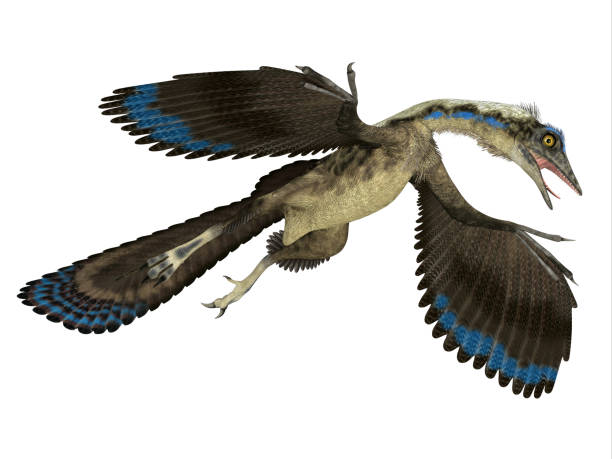
In the long story of life on Earth, there are certain discoveries that transform the way we understand evolution. One fossil, discovered in a quiet limestone quarry in Germany during the nineteenth century, became one of the most important pieces of evidence ever found in the history of biology. That fossil belonged to a creature known as Archaeopteryx.
Archaeopteryx is often called the first bird, but the truth is even more fascinating than that simple description suggests. It was not fully a bird, and it was not entirely a dinosaur. Instead, it was a breathtaking bridge between two worlds. It possessed feathers and wings, yet it also had teeth, a long bony tail, and clawed fingers like a small dinosaur.
This strange combination made Archaeopteryx one of the most powerful demonstrations of evolution ever discovered. It revealed that birds did not suddenly appear in the fossil record. They evolved gradually from feathered dinosaurs that lived during the age of reptiles.
Living about 150 million years ago during the Late Jurassic period, Archaeopteryx inhabited a tropical archipelago that once existed in what is now southern Germany. The region was dotted with lagoons and shallow seas surrounded by small islands. Fine limestone sediments preserved delicate organisms in extraordinary detail, including the fragile feathers of this remarkable animal.
Today, Archaeopteryx remains one of the most iconic fossils in the world. It tells a story of transformation, adaptation, and the evolutionary origins of flight. Understanding this ancient creature means exploring not only its anatomy but also its place in the grand narrative of life.
Below are five essential facts about Archaeopteryx that reveal why this extraordinary fossil changed science forever.
1. Archaeopteryx Was a Perfect Evolutionary Transition Between Dinosaurs and Birds
One of the most astonishing things about Archaeopteryx is the way its body blends features of both dinosaurs and modern birds. It is neither fully one nor the other. Instead, it represents a transitional form—an organism that preserves traits from both ancestral and descendant groups.
When scientists first examined Archaeopteryx fossils, they noticed its unmistakable bird-like feathers. The wings were covered with asymmetrical flight feathers similar to those seen in modern birds. These feathers were complex structures with barbs and vanes, designed to interact with air and generate lift.
Yet the skeleton told a very different story.
Instead of a short bird tail, Archaeopteryx had a long bony tail composed of many vertebrae, much like small theropod dinosaurs. Its jaws were filled with sharp teeth rather than a toothless beak. Each wing contained three clawed fingers capable of grasping objects. These claws resemble those of predatory dinosaurs rather than modern birds.
Its breastbone was also relatively small compared to modern birds, which possess large keeled sternums that anchor powerful flight muscles. Archaeopteryx likely lacked the strong muscular system necessary for sustained powered flight.
These mixed features created an evolutionary mosaic.
In the nineteenth century, the concept of evolution by natural selection was still controversial. Charles Darwin had published his groundbreaking book On the Origin of Species in 1859, proposing that species evolve gradually over time. Critics argued that transitional fossils linking major groups of animals had not been found.
Just two years later, the first Archaeopteryx fossil was discovered.
It provided stunning evidence that birds evolved from reptilian ancestors. Over time, additional discoveries strengthened this idea. Today, paleontologists recognize that birds are living descendants of a group of small carnivorous dinosaurs known as theropods.
Archaeopteryx sits near the base of this evolutionary transition. It shows us what early bird-like dinosaurs looked like during the dawn of avian evolution.
The creature reminds us that evolution rarely produces sharp boundaries. Instead, it creates gradual shifts, where old features persist while new ones emerge.
2. The Discovery of Archaeopteryx Was One of the Most Important Fossil Finds in Scientific History
The discovery of Archaeopteryx did not happen all at once. Instead, it unfolded in stages, each adding a new piece to the puzzle.
The first evidence appeared in 1860, when a single fossil feather was found in the Solnhofen limestone deposits of Bavaria, Germany. This delicate feather looked almost identical to those of modern birds. It was carefully preserved in the fine sediment, capturing every detail of its structure.
At the time, scientists did not know exactly which animal the feather belonged to. But the mystery was solved the following year.
In 1861, quarry workers uncovered a nearly complete skeleton of a small dinosaur-like animal with wings and feathers. This specimen became known as the London specimen because it was later acquired by the Natural History Museum in London.
The fossil stunned the scientific community.
Here was an animal that possessed unmistakable feathers yet clearly retained reptilian features. It was unlike anything previously known.
More Archaeopteryx specimens were discovered in the years that followed, including the famous Berlin specimen in 1874. The Berlin fossil preserved the skull in remarkable detail, revealing rows of teeth in its jaws.
These discoveries cemented Archaeopteryx as one of the most significant fossils ever found. It became a cornerstone of evolutionary biology, providing tangible evidence that major groups of animals can evolve from common ancestors.
The Solnhofen limestone played a crucial role in preserving these fossils. This rock formed in calm lagoon environments where oxygen levels were low, slowing decomposition and allowing delicate structures like feathers to fossilize.
Without such extraordinary conditions, Archaeopteryx might never have been preserved.
And without its fossils, our understanding of bird evolution might have remained incomplete for much longer.
3. Archaeopteryx Lived in a Tropical Island Environment
To understand Archaeopteryx fully, we must imagine the world in which it lived.
During the Late Jurassic period, about 150 million years ago, Europe looked very different from today. Instead of large landmasses, the region consisted of small islands scattered across shallow tropical seas.
The Solnhofen area was part of a warm archipelago surrounded by calm lagoons. These lagoons had extremely salty water, making them hostile to most scavengers and bottom-dwelling organisms. When animals died and sank into the lagoon sediments, their bodies were often preserved intact.
The surrounding islands likely hosted forests of conifers, cycads, and other ancient plants. Insects buzzed through the humid air, and small reptiles scurried through the undergrowth.
Archaeopteryx probably lived among these trees, moving between branches and hunting for small prey.
Its diet may have included insects, small reptiles, and other invertebrates. The sharp teeth in its jaws suggest it was a carnivore or insectivore rather than a seed eater like many modern birds.
The long tail likely helped with balance while climbing or gliding. The claws on its wings may have allowed it to grasp branches or scramble across tree trunks.
Predators may have included larger dinosaurs or early crocodile-like reptiles that inhabited the islands.
Life in this environment required agility and adaptability. Archaeopteryx appears to have been well suited for this lifestyle.
The island ecosystem may also have played a role in the evolution of flight. Moving between trees or escaping predators could have favored animals capable of gliding or flapping short distances.
Thus, the environment of Jurassic Germany may have been one of the cradles of avian evolution.
4. Archaeopteryx May Have Flown — But Probably Not Like Modern Birds
The question of whether Archaeopteryx could truly fly has fascinated scientists for over a century.
Its feathers clearly resemble those of flying birds. They are asymmetrical, meaning one side of the feather vane is narrower than the other. This structure helps generate aerodynamic lift during flight.
However, other aspects of its anatomy suggest that its flying ability may have been limited.
Modern birds possess a large keeled sternum where powerful flight muscles attach. Archaeopteryx lacked such a pronounced keel. This implies that its chest muscles were relatively small compared to those of strong fliers like pigeons or hawks.
Additionally, its shoulder joint structure may have restricted the range of wing movement necessary for vigorous flapping flight.
Some scientists believe Archaeopteryx was primarily a glider. It may have launched from trees and glided between branches or down toward the ground.
Others propose that it was capable of short bursts of powered flight, perhaps flapping its wings while running or leaping.
Studies of its wing shape suggest it may have been adapted for maneuverability rather than speed or endurance. This would make sense in a forested island environment where quick turns and short flights were more useful than long-distance travel.
Whatever its exact flight capabilities, Archaeopteryx represents an early stage in the evolution of avian flight.
It shows that feathers evolved before the fully efficient flight systems seen in modern birds.
Flight, like many evolutionary innovations, did not appear suddenly. It developed gradually through intermediate stages, each offering its own advantages.
5. Archaeopteryx Helped Reveal That Birds Are Living Dinosaurs
One of the most profound insights in modern paleontology is that birds are not merely descendants of dinosaurs—they are dinosaurs.
Archaeopteryx played a crucial role in revealing this connection.
Over the past few decades, paleontologists have discovered numerous feathered dinosaur fossils in China and other parts of the world. These fossils show a wide range of feather types, from simple filaments to complex flight feathers.
Many of these dinosaurs share skeletal features with Archaeopteryx and modern birds. These include hollow bones, wishbones, and similar hip structures.
This evidence confirms that birds evolved from small theropod dinosaurs, closely related to predators like Velociraptor.
In this evolutionary framework, Archaeopteryx occupies an important early position. It represents one of the first known dinosaurs with fully developed flight feathers.
Modern birds have since undergone millions of years of further evolution, refining flight abilities and adapting to diverse environments.
Yet when we watch a bird take flight today, we are witnessing the legacy of ancient dinosaur ancestors.
In a very real sense, the dinosaurs never truly disappeared. They live on in every sparrow, eagle, and hummingbird.
Archaeopteryx reminds us of that deep evolutionary connection.
A Fossil That Changed How We See Life
Archaeopteryx is more than just an ancient creature preserved in stone. It is a symbol of discovery. It represents the moment when a fossil bridged two worlds—dinosaurs and birds—and showed that evolution is not merely a theory but a process recorded in the rocks of Earth.
This small, feathered animal lived millions of years before humans appeared. It hunted insects among Jurassic trees and glided through warm island air. It left behind only a handful of fossils, yet those fossils reshaped our understanding of life’s history.
Today, researchers continue to study Archaeopteryx with new technologies, including high-resolution imaging and detailed biomechanical analysis. Each new study reveals more about how early birds evolved and how flight first emerged.
In the end, Archaeopteryx tells a story far larger than itself. It is a reminder that life changes over time, adapting and transforming across countless generations.
And from those ancient transformations came the living world we see today—one that still carries echoes of Jurassic wings beating softly through prehistoric forests.