Long before humans dreamed of flight, long before airplanes sliced through the clouds and satellites circled the planet, the skies of Earth were ruled by creatures so enormous they seemed impossible. These giants were not birds. They were not bats. They were something stranger, something ancient—members of a remarkable group of flying reptiles known as pterosaurs. Among them, one stood above the rest in both size and legend: Quetzalcoatlus.
With wings stretching as wide as a small airplane and a body built for soaring across prehistoric landscapes, Quetzalcoatlus was one of the largest flying animals that ever lived. Its discovery stunned scientists and ignited imaginations around the world. How could something so massive rise into the air? What did it eat? How did it live? And what kind of world allowed such an enormous creature to exist?
The story of Quetzalcoatlus is not only the story of a giant reptile. It is the story of evolution pushing the limits of flight, of ancient ecosystems filled with strange life, and of the relentless curiosity of scientists trying to reconstruct a world that vanished tens of millions of years ago.
A World Before Birds Ruled the Sky
To understand Quetzalcoatlus, we must first step back into deep time. Roughly 70 million years ago, during the final chapter of the Age of Dinosaurs, Earth looked very different from today.
This period, known as the Late Cretaceous, was a time of remarkable diversity. Dinosaurs dominated the land, enormous marine reptiles filled the oceans, and strange flying reptiles ruled the skies.
These flying reptiles were pterosaurs, a group that first appeared more than 220 million years ago. They were the first vertebrates ever to achieve powered flight. Unlike birds, which evolved later from small feathered dinosaurs, pterosaurs developed a unique wing structure supported by a single enormously elongated finger.
For millions of years, pterosaurs evolved into an astonishing range of shapes and sizes. Some were small enough to perch in trees. Others became aerial giants. Among the most extraordinary members of this group was Quetzalcoatlus, a creature that seemed to defy the very laws of aerodynamics.
The Discovery That Shocked Paleontology
The story of Quetzalcoatlus began in the early 1970s in the deserts of Texas. Fossils were discovered within rock layers of the Javelina Formation, part of the larger Big Bend National Park region.
A graduate student named Douglas A. Lawson uncovered enormous fossilized bones belonging to a creature unlike anything scientists had seen before. These bones were clearly from a pterosaur, but their size was staggering.
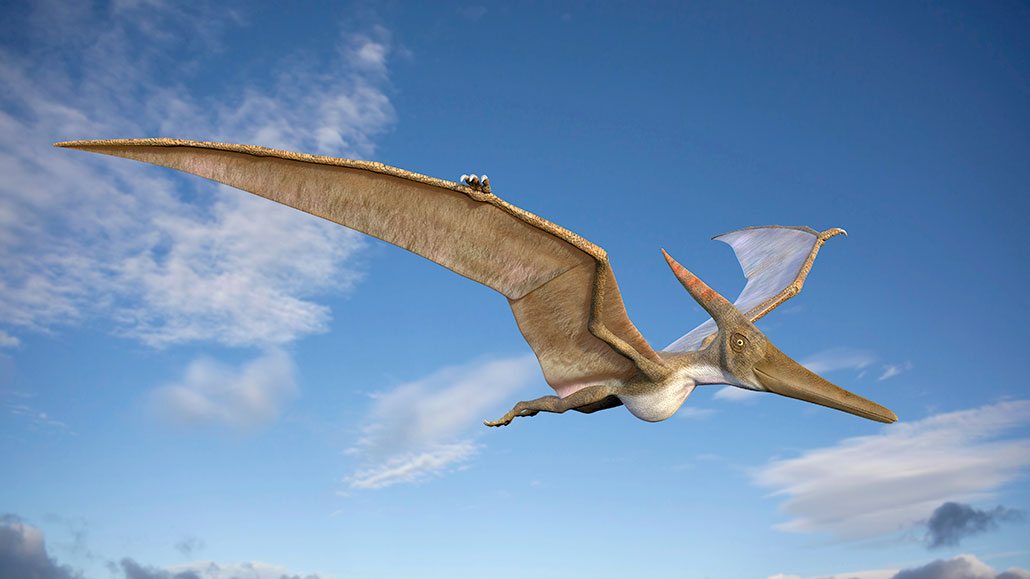
The wingspan of the animal, when reconstructed, was estimated to reach about 10 to 11 meters—roughly the same width as a small aircraft. Nothing this large had ever been known to fly.
The species was later named Quetzalcoatlus in honor of Quetzalcoatl, the feathered serpent god of Aztec mythology. The name was fitting. Like the legendary deity, the animal was associated with the sky and seemed almost supernatural in scale.
From the moment of its announcement, Quetzalcoatlus became one of the most famous prehistoric animals ever discovered.
Anatomy of a Sky Giant
At first glance, Quetzalcoatlus might seem like a reptilian dragon. But a closer look reveals an animal shaped by millions of years of evolutionary refinement.
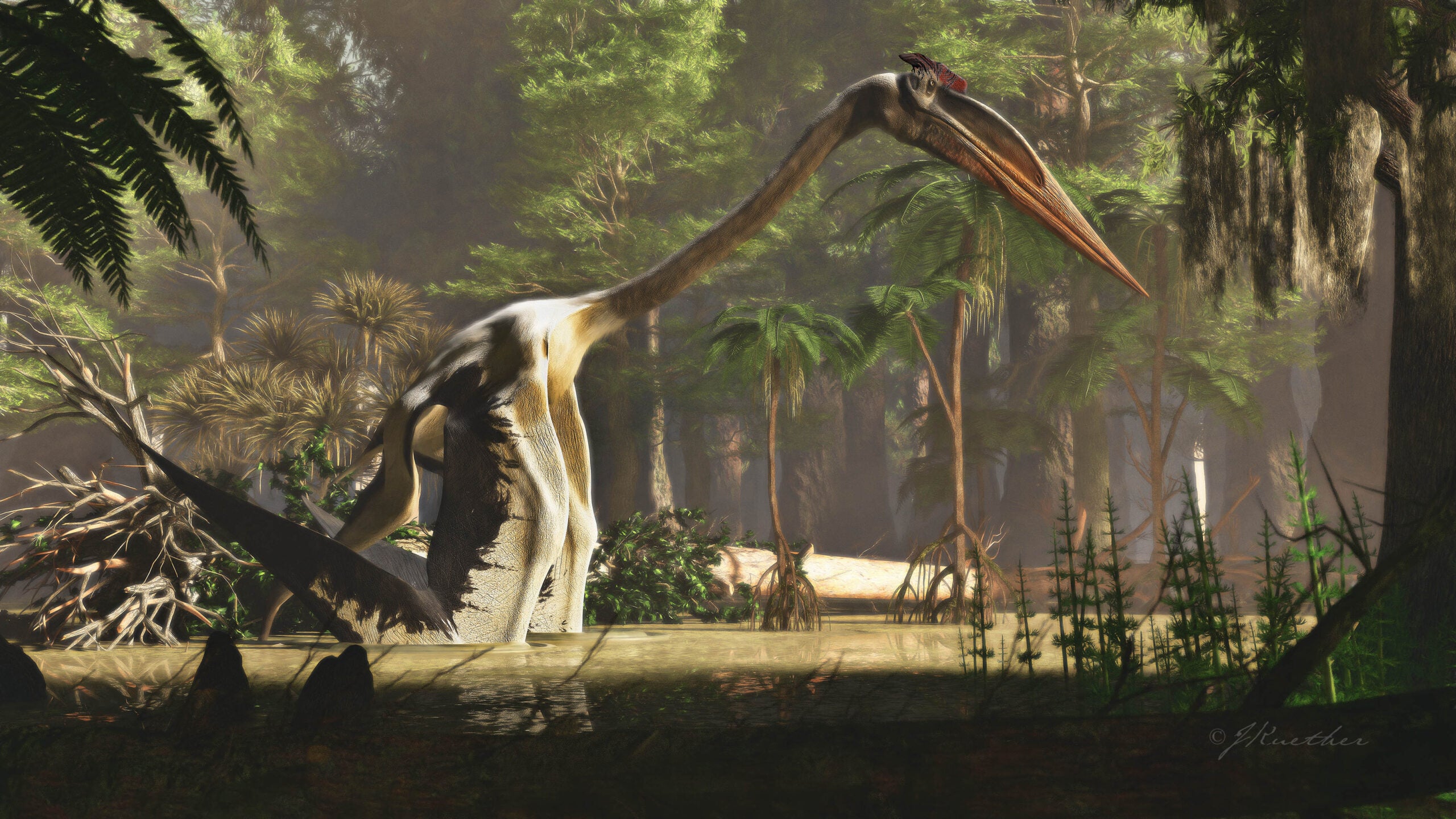
Its most striking feature was its immense wingspan. The wings were formed by a membrane of skin and muscle stretched between the body, the legs, and a single elongated finger that acted as the wing’s main support.
Despite their size, the wings were surprisingly lightweight. Like birds, pterosaurs had hollow bones filled with air spaces. These structures reduced weight while maintaining strength, allowing large bodies to remain airborne.
The skull of Quetzalcoatlus was long and slender, measuring several meters in length. It lacked teeth and ended in a sharp, pointed beak. This beak may have been used for grabbing prey, probing the ground, or snatching small animals.
Rising from the head was a long neck that was both flexible and strong. The neck vertebrae were elongated but reinforced with internal structures that made them remarkably sturdy.
The body itself was relatively small compared with the wings and head. Powerful shoulder muscles anchored the wings, enabling strong flapping during takeoff.
Its limbs were also unusual. Unlike birds, pterosaurs walked on all fours when on the ground. Their wings folded neatly alongside their bodies, and the animals moved using both their hind legs and their winged forelimbs.
How Could Something So Large Fly?
The question that fascinated scientists the most was simple yet profound: how did Quetzalcoatlus actually get into the air?
At first, some researchers believed that animals this large might have struggled to fly at all. But further study suggested something extraordinary. Quetzalcoatlus was not only capable of flight—it was likely an exceptionally efficient flier.
Paleontologists believe that Quetzalcoatlus launched itself using a powerful four-limbed jump. By pushing off the ground with both its hind legs and its strong winged forelimbs, it could propel itself upward with tremendous force.
Once airborne, it likely relied heavily on soaring flight. Much like modern vultures or albatrosses, it could ride rising air currents, gliding for long distances while expending minimal energy.
The huge wings provided enormous lift, allowing the animal to remain airborne for extended periods. Some scientists estimate that it could travel hundreds of kilometers in a single journey.
In this way, Quetzalcoatlus may have dominated vast prehistoric landscapes from the air.
Life on the Ground
Despite its mastery of the skies, Quetzalcoatlus likely spent a considerable amount of time on land.
Fossil evidence suggests that members of its group, known as azhdarchids, were surprisingly well adapted to walking. Their limbs were long and strong, and their posture was upright and balanced.
When walking, Quetzalcoatlus probably moved across the ground with a graceful, stalking gait. Its long neck allowed it to reach down and pick up prey without bending its entire body.
Some paleontologists believe it hunted much like modern storks or herons. It may have wandered across floodplains and open landscapes, scanning for small animals such as lizards, mammals, or baby dinosaurs.
Others suggest it may have been an opportunistic feeder, scavenging carcasses or catching fish in shallow waters.
The truth is that its exact diet remains uncertain. But its anatomy suggests a versatile predator capable of exploiting many food sources.
The World It Inhabited
During the Late Cretaceous, the region that is now Texas was a warm coastal environment. Rivers flowed through broad floodplains, and forests grew along their banks.
Dinosaurs roamed these landscapes in great variety. Massive herbivores grazed on vegetation, while formidable predators hunted them.
Flying above this world, Quetzalcoatlus may have shared the sky with smaller pterosaurs and early birds. But none approached its enormous size.
From its lofty vantage point, it could have spotted prey across vast distances. The landscape beneath would have been alive with movement: herds of dinosaurs, winding rivers, and forests stretching to the horizon.
In this world, Quetzalcoatlus was one of the most extraordinary aerial predators ever to exist.
Growth and Development
One of the fascinating aspects of pterosaur biology is how quickly they appear to have grown.
Fossil evidence suggests that young pterosaurs may have been capable of flight not long after hatching. Their wings were already well developed, allowing them to take to the air early in life.
This would have given them an advantage in avoiding predators and finding food.
Quetzalcoatlus likely followed a similar pattern, though its growth would have continued for many years before reaching its enormous adult size.
As it matured, its wings expanded dramatically, transforming it from a relatively small flier into one of the largest flying animals ever to live.
The End of the Sky Giants
The reign of Quetzalcoatlus and other giant pterosaurs came to a sudden end about 66 million years ago.
At that time, Earth experienced one of the most catastrophic events in its history: the Cretaceous–Paleogene extinction event.
Triggered by the impact of a massive asteroid and accompanied by volcanic activity and climate disruption, this event wiped out about 75 percent of all species on Earth.
Non-avian dinosaurs disappeared. Many marine reptiles vanished. And the great pterosaurs, including Quetzalcoatlus, went extinct.
After their disappearance, birds gradually expanded to occupy the ecological niches once dominated by flying reptiles.
The skies would never again host creatures quite like the pterosaurs.
Legacy of a Giant
Today, Quetzalcoatlus remains one of the most iconic prehistoric animals ever discovered.
Its fossils continue to be studied, revealing new insights about pterosaur anatomy, flight mechanics, and ecology. Advances in computer modeling have allowed scientists to simulate its flight and better understand how such a massive creature could soar through the air.
Museums around the world display reconstructions of Quetzalcoatlus, often suspended from ceilings with wings fully spread. Visitors standing beneath these models often experience a moment of awe.
The sheer scale of the animal challenges our assumptions about what is possible in nature.
It reminds us that Earth’s history is filled with wonders far stranger than anything in myth or fiction.
The Wonder of Prehistoric Flight
Quetzalcoatlus represents the extreme limits of vertebrate flight. No living animal today approaches its wingspan or body size while remaining capable of powered flight.
Its existence demonstrates how evolution can push biological systems to extraordinary heights. Bone structure, muscle arrangement, wing membranes, and aerodynamic efficiency all combined to make its flight possible.
Understanding these mechanisms not only illuminates ancient life but also inspires modern engineering. The principles of aerodynamics studied in ancient flyers continue to influence aircraft design today.
In this sense, the legacy of Quetzalcoatlus stretches far beyond paleontology.
A Window Into Deep Time
Studying Quetzalcoatlus is like opening a window into a lost world. Each fossil fragment carries a message from millions of years ago, waiting to be interpreted.
Scientists reconstruct its life by combining geology, anatomy, biomechanics, and ecology. Piece by piece, the story emerges.
Yet many mysteries remain. Exactly how it hunted, how far it migrated, and how it interacted with other species are still subjects of ongoing research.
This uncertainty is part of the beauty of paleontology. Every discovery has the potential to reshape what we think we know.
The Giant That Still Captures Our Imagination
There is something deeply captivating about creatures that once ruled our planet but vanished long before humans arrived.
Quetzalcoatlus stands among the most awe-inspiring of them all. Its immense wings, towering height, and alien appearance make it feel almost mythical.
And yet it was real.
It soared above ancient landscapes, rode thermal winds across prehistoric plains, and watched a world of dinosaurs unfold beneath it.
For millions of years, it ruled the skies with unmatched grace and scale.
Today, all that remains are fossils embedded in stone and the scientific efforts to understand them. But through those fossils, we glimpse a breathtaking chapter of Earth’s history—a time when giants truly flew.
The story of Quetzalcoatlus reminds us that our planet’s past is filled with wonders beyond imagination, waiting patiently in the rocks for us to discover them.