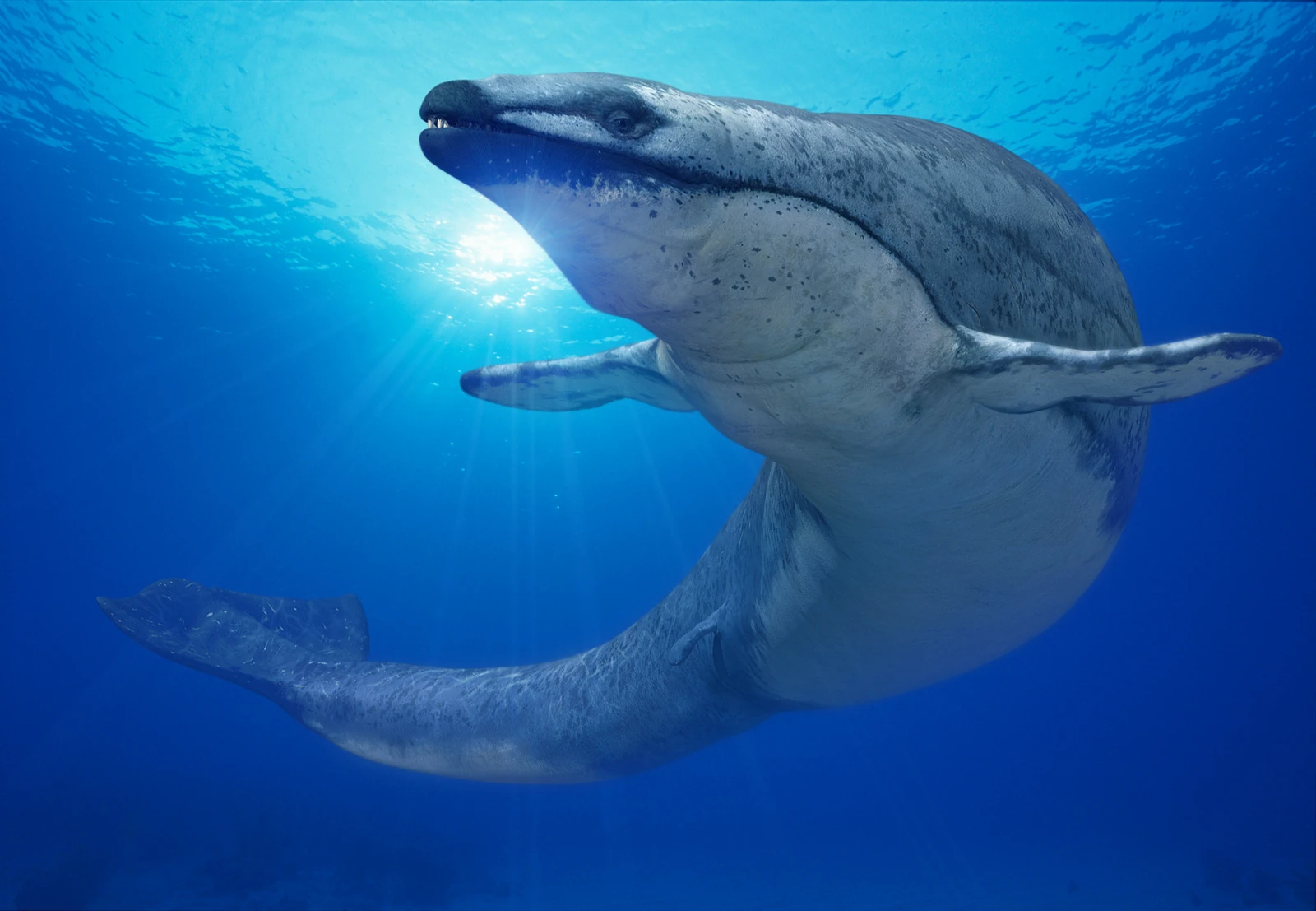
More than forty million years ago, long before modern whales ruled the oceans, a very different kind of marine giant dominated the warm prehistoric seas. Its body was long and serpentine, stretching through the water like an enormous eel. Its jaws were filled with sharp, slicing teeth capable of tearing through flesh. And hidden near the back of its body were small, mysterious limbs—tiny legs that hinted at an extraordinary evolutionary past.
This creature was Basilosaurus, one of the most fascinating predators in the history of life. Today, whales are graceful giants that filter plankton or hunt fish in vast oceans. But their ancestors were once land animals that slowly returned to the sea. Basilosaurus stands at the dramatic midpoint of that story—a creature fully adapted to marine life but still carrying faint echoes of its terrestrial heritage.
The fossil record reveals Basilosaurus as both a powerful predator and a key evolutionary milestone. Its skeleton tells a tale of transformation: from hoofed mammals walking on land to the ocean-dwelling whales we know today. To understand Basilosaurus is to witness evolution in motion, frozen in bone and stone across millions of years.
Discovery and the Great Fossil Confusion
The story of Basilosaurus begins in the early nineteenth century, when fossil hunters in North America uncovered enormous bones embedded in ancient sediments. These fossils were discovered in regions that had once been covered by shallow tropical seas during the Eocene Epoch, roughly 40 million years ago.
At first, scientists were deeply puzzled by the remains. The bones seemed reptilian—long vertebrae, elongated body shape, and enormous size. Because of this, early naturalists believed they had discovered the remains of a gigantic prehistoric sea reptile.
The American naturalist Richard Harlan examined some of these fossils and gave the creature its name: Basilosaurus, meaning “king lizard.” The name reflected the assumption that it was a reptile similar to marine reptiles like mosasaurs or plesiosaurs.
But science rarely stands still. Soon another scientist took a closer look.
The renowned British anatomist Richard Owen analyzed the fossils in greater detail and noticed something remarkable. The teeth, skull structure, and bone anatomy were not reptilian at all. They were mammalian.
The supposed “king lizard” was actually a whale.
Although the name Basilosaurus remained due to scientific naming conventions, its identity changed forever. What had been mistaken for a reptile turned out to be one of the earliest fully aquatic whales ever discovered.
The World of the Eocene Seas
To understand Basilosaurus, one must imagine Earth during the Eocene Epoch. The planet was warmer than today, with tropical climates extending far toward the poles. Dense forests covered continents, and shallow seas flooded large portions of land.
The oceans were vibrant ecosystems teeming with life. Coral reefs flourished, fish swam in abundance, and ancient sharks patrolled the waters. Early marine mammals were beginning to diversify, experimenting with new ways of living in the sea.
It was within this warm, nutrient-rich ocean environment that Basilosaurus thrived. Fossils of this animal have been found in regions that were once ancient seas, including parts of North America, North Africa, and the Middle East.
These discoveries show that Basilosaurus was not a rare curiosity but a widespread predator dominating multiple marine ecosystems.
A Serpent of the Sea
One of the most striking features of Basilosaurus was its body shape. Unlike modern whales, which have compact and streamlined bodies, Basilosaurus was astonishingly long and slender.
Some species of Basilosaurus reached lengths of around 15 to 20 meters, rivaling the size of modern sperm whales. Yet its body proportions were very different. The spine consisted of elongated vertebrae that gave the animal a snake-like appearance.
Because of this unusual anatomy, Basilosaurus likely moved through the water in a distinctive way. Rather than relying primarily on a powerful tail fluke like modern whales, it probably swam with undulating movements, bending its long body in waves as it propelled itself forward.
This swimming style would have made Basilosaurus a flexible and agile predator capable of twisting and turning rapidly while hunting.
Its body design represents an evolutionary experiment—an early stage in the transformation of whales from land animals to fully aquatic giants.
The Mystery of the Tiny Legs
Perhaps the most fascinating feature of Basilosaurus was something almost invisible: its legs.
Near the rear of the animal’s body were two tiny hind limbs. These limbs were incredibly small compared to the massive size of the whale, measuring only a few tens of centimeters long.
They were far too small to support the animal’s weight or assist with walking. Basilosaurus was completely incapable of moving on land.
Yet the legs were real, complete with bones corresponding to the femur, tibia, and even small toes. Their presence revealed something extraordinary: whales had once walked on land.
These tiny limbs are considered vestigial structures—remnants of a distant evolutionary past. Millions of years earlier, the ancestors of whales were four-legged mammals that lived near rivers and coastlines.
Over time, as these animals adapted to life in the water, their hind limbs gradually shrank and lost their original function.
Scientists believe that in Basilosaurus these small legs may have played a role in reproduction, possibly helping individuals position themselves during mating.
Regardless of their exact function, these vestigial limbs serve as powerful evidence of evolution. They are anatomical whispers from a time when whales still walked on land.
Fearsome Teeth and a Powerful Bite
If Basilosaurus possessed one trait that truly made it terrifying, it was its teeth.
Unlike many modern whales that feed by filtering tiny organisms from seawater, Basilosaurus was a predator equipped with large, sharp teeth designed for slicing flesh.
Its jaws contained multiple types of teeth, including pointed incisors and blade-like molars with serrated edges. These teeth were ideal for gripping prey and tearing it into manageable pieces.
Fossil evidence shows that Basilosaurus hunted a wide range of marine animals. It likely preyed on fish, sharks, and other marine mammals. Some fossilized stomach contents even suggest that it consumed smaller whales.
This made Basilosaurus one of the top predators in its ecosystem—a marine hunter capable of dominating the food chain.
The powerful bite and formidable teeth of Basilosaurus stand in contrast to many modern whales, reminding us that early whales were not gentle giants but formidable carnivores.
Evolutionary Links to Land Mammals
Basilosaurus occupies a crucial position in the evolutionary history of whales. It represents a transitional stage between early semi-aquatic ancestors and the fully marine whales of today.
Millions of years before Basilosaurus swam through the oceans, primitive whale ancestors lived near rivers and coastlines.
One such early form was Pakicetus, a wolf-sized mammal that lived on land but hunted in water.
Another important ancestor was Ambulocetus, whose name means “walking whale.” This animal had strong legs and could move both on land and in the water, much like a modern crocodile.
Over millions of years, these early whales became increasingly aquatic. Their limbs transformed into flippers, their bodies became streamlined, and their nostrils migrated toward the top of the head, eventually forming the blowholes seen in modern whales.
Basilosaurus represents a stage where the transition was nearly complete. Its front limbs had evolved into flippers, its body was fully marine, and it spent its entire life in the ocean. Yet the small hind limbs remained as evolutionary relics.
Hunting in Ancient Oceans
The oceans of the Eocene were competitive environments filled with predators. Basilosaurus had to be an effective hunter to survive.
Its long body allowed it to move smoothly through the water, while its flexible spine enabled quick turns. The strong jaws and sharp teeth gave it the ability to seize struggling prey.
Scientists believe Basilosaurus may have used ambush tactics. It could have lurked beneath the surface before launching sudden attacks on passing animals.
The warm Eocene seas supported large populations of fish, turtles, and early marine mammals. Basilosaurus likely played a major role in regulating these populations as an apex predator.
Its dominance in the food chain mirrors the ecological roles later taken by modern killer whales.
Life Cycle and Reproduction
Although much about Basilosaurus remains unknown, fossil evidence provides clues about its life cycle.
Like modern whales, Basilosaurus was a mammal and gave birth to live young rather than laying eggs. The young would have developed inside the mother’s body and been born in the water.
Fossilized skeletons of pregnant ancient whales show that early whales gave birth tail-first, a method still used by modern whales to prevent newborns from drowning during delivery.
After birth, young Basilosaurus would have relied on their mothers for milk and protection until they grew strong enough to hunt independently.
This reproductive strategy was essential for survival in the vast and sometimes dangerous ocean environment.
The Decline of Basilosaurus
Despite its power and dominance, Basilosaurus did not last forever.
By the end of the Eocene Epoch, roughly 34 million years ago, major environmental changes began reshaping marine ecosystems. Global climates cooled, ocean currents shifted, and new groups of whales began to appear.
These newer whales had more efficient body shapes and swimming styles better suited for long-distance movement.
Gradually, Basilosaurus disappeared from the fossil record, leaving behind only bones buried in ancient seabeds.
Its extinction marked the end of one evolutionary experiment and the beginning of another.
Fossils and Scientific Discovery
Today, Basilosaurus fossils provide invaluable insight into whale evolution. Many of the most important specimens have been discovered in the United States and Egypt.
One famous fossil site lies within the desert region known as Wadi Al-Hitan, often called the “Valley of the Whales.” This UNESCO World Heritage Site preserves dozens of fossilized skeletons of ancient whales, including Basilosaurus.
These fossils reveal not only the anatomy of early whales but also their behaviors and environments.
By studying these remains, paleontologists can reconstruct ancient ecosystems and understand how marine mammals evolved over millions of years.
Basilosaurus and the Story of Evolution
Perhaps the greatest significance of Basilosaurus lies in what it teaches us about evolution.
For centuries, people wondered how whales—fully aquatic animals—could have descended from land mammals. The idea seemed impossible.
Yet fossils like Basilosaurus provide undeniable evidence of the transition.
They show intermediate stages where ancient mammals gradually adapted to life in the water. Limbs transformed into flippers. Bodies became streamlined. Tails evolved into powerful propulsive flukes.
Basilosaurus stands as a dramatic chapter in this evolutionary narrative—a reminder that the forms of life we see today are the result of long and complex histories.
The Legacy of a Sea Monster
To ancient fossil hunters who first discovered its bones, Basilosaurus must have seemed like a sea monster from myth. Its immense vertebrae and serpentine body suggested a creature of legends.
In reality, it was something even more remarkable.
Basilosaurus was a living experiment in evolution, a predator that ruled ancient seas while carrying traces of its terrestrial ancestry. Its tiny hind legs whisper of forests and rivers long vanished. Its terrifying teeth speak of hunts in warm prehistoric oceans.
Though it vanished millions of years ago, Basilosaurus continues to shape our understanding of life’s history.
Every fossil discovered adds another piece to the puzzle of how whales became the majestic creatures we know today.
In its bones, preserved across deep time, lies the story of transformation—one of nature’s most extraordinary journeys, from land to sea.