In the early years of the twentieth century, sponge divers searching the seabed near the Greek island of Antikythera made a discovery that would quietly unsettle the history of science. Beneath the waves lay the remains of an ancient cargo vessel, scattered across the ocean floor like fragments of a forgotten world. Statues, ceramics, jewelry, and bronze objects emerged from the wreckage—typical relics of classical antiquity.
But among these artifacts was something no one expected.
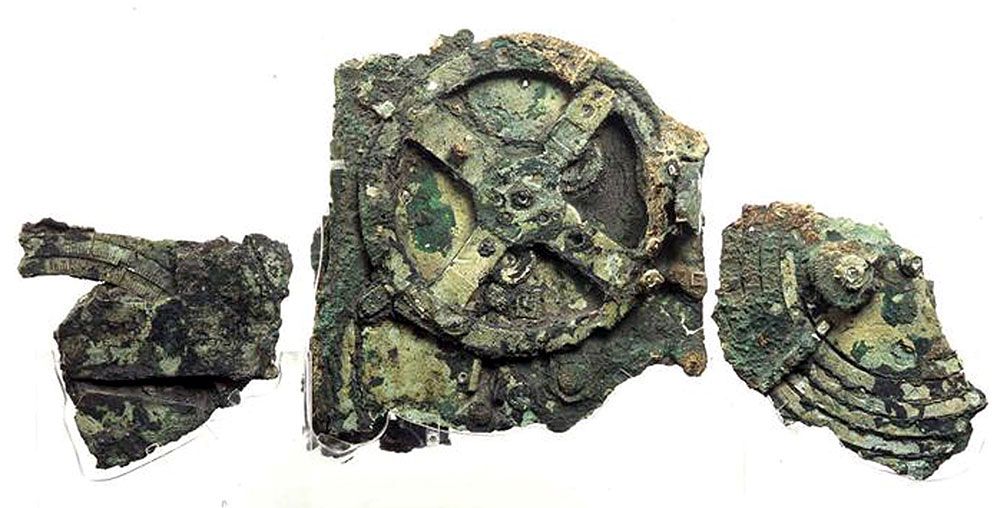
At first glance, it looked like nothing more than a corroded lump of bronze and wood. Its surface was encrusted with marine deposits accumulated over two thousand years. It appeared shapeless, fragile, and unremarkable. Yet when scientists began examining it more closely, they noticed something astonishing—tiny interlocking gear teeth embedded within the corrosion.
Ancient gears.
Intricate ones.
Precision-engineered ones.
The object would later be recognized as the most sophisticated mechanical device known from the ancient world. It was not merely a tool or instrument. It was a calculating machine capable of predicting astronomical events with remarkable accuracy.
Today, it is widely described as the world’s first analog computer.
Its existence challenges long-held assumptions about technological development. For centuries, historians believed the level of mechanical sophistication seen in this device did not emerge until medieval clockmaking—over a thousand years later. Yet here was clear physical evidence that ancient engineers had achieved something far more advanced than anyone imagined.
The discovery forced a rethinking of ancient science, mathematics, and engineering. It revealed that the intellectual achievements of antiquity were not limited to philosophy, geometry, or architecture. They extended into precision mechanical computation.
This extraordinary artifact, recovered from the seabed, is known today as the Antikythera Mechanism.
To understand its significance is to step into a world where astronomy, mathematics, craftsmanship, and imagination merged into a single machine—one that captured the rhythms of the cosmos itself.
The following five facts reveal why this device is not simply an archaeological curiosity, but one of the most important scientific discoveries ever made.
1. It Was Discovered in a Shipwreck That Preserved a Moment in Time
The story of the mechanism begins with a maritime disaster.
The ancient vessel now known as the Antikythera shipwreck sank sometime around the first century BCE while transporting luxury goods across the Mediterranean. Archaeological analysis suggests the ship carried statues, metalwork, and finely crafted objects—likely destined for elite Roman patrons.
When the ship went down, its cargo descended into cold, dark waters where oxygen was limited and disturbance minimal. This environment slowed decomposition and preserved delicate materials that might otherwise have vanished.
Marine encrustation gradually sealed objects in mineral layers, effectively creating protective shells. Ironically, the same corrosion that obscured the mechanism also preserved it.
When divers recovered the fragments in 1901, the true nature of the device was not immediately recognized. Only later did researchers realize that the corroded mass concealed complex mechanical structures.
This context is scientifically significant because shipwrecks function as time capsules. They preserve objects in association with one another, allowing archaeologists to reconstruct chronology, trade networks, and technological capabilities.
The mechanism’s presence among luxury artifacts indicates it was not an experimental prototype casually discarded. It was a valued object—transported, traded, and worthy of protection.
That single moment of maritime catastrophe froze a technological achievement in time, preserving evidence of knowledge that would otherwise have been lost forever.
Without the shipwreck, the existence of such a device might never have been known.
2. It Contains an Astonishingly Complex System of Precision Gears
When conservators carefully separated the mechanism’s fragments and began imaging them using X-ray tomography, the scale of its engineering became clear.
Inside the corroded mass lay dozens of interlocking bronze gears arranged in layered assemblies. Their teeth were cut with remarkable precision. Gear ratios were carefully calculated to represent astronomical cycles.
This was not decorative metalwork. It was computational machinery.
Each gear transmitted motion to another, translating rotational movement into mathematical relationships. Turning a crank caused multiple dials to move simultaneously, each representing a different celestial cycle.
Some gears incorporated pin-and-slot mechanisms that allowed for nonuniform motion—essential for modeling irregular orbital behavior. This indicates an advanced understanding of celestial mechanics and mechanical design.
For centuries, historians believed such gear complexity did not appear until medieval mechanical clocks. Yet here it existed in a device built over two thousand years ago.
Scientific reconstruction has revealed that the mechanism contained at least thirty gears, though the original number may have been higher. Their arrangement forms one of the earliest known examples of compound gearing in human history.
The precision required to manufacture these components is extraordinary. Gear teeth must be evenly spaced, carefully shaped, and aligned to function correctly. Even small errors would disrupt calculations.
This level of craftsmanship suggests specialized workshops, skilled metalworkers, and a strong theoretical foundation guiding design.
The mechanism demonstrates that ancient engineers were not merely artisans—they were applied mathematicians working in metal.
3. It Predicted Astronomical Cycles With Mathematical Accuracy
The true purpose of the device becomes clear when examining its functions.
The mechanism modeled the motions of celestial bodies—primarily the Sun, Moon, and possibly known planets. Its dials tracked lunar phases, eclipse cycles, and calendrical relationships.
One of its most remarkable features is a dial representing the Saros cycle, an approximately eighteen-year period after which eclipses repeat in similar patterns. By turning the device’s crank, users could determine when solar and lunar eclipses would occur.
This required not only observational astronomy but also mathematical modeling of periodic motion.
The device also tracked the Metonic cycle, which reconciles lunar months with solar years over a nineteen-year period. Such cycles were essential for maintaining accurate calendars in societies dependent on agricultural timing and ritual observances.
What makes this extraordinary is not merely that ancient astronomers knew these cycles—but that someone built a machine to calculate them automatically.
This transforms theoretical astronomy into mechanical computation.
Scholars believe the astronomical knowledge embedded in the device may reflect traditions associated with figures such as Hipparchus, whose mathematical models of celestial motion influenced later scientific thought.
The mechanism demonstrates that Greek astronomy was not purely descriptive. It was predictive, quantitative, and technologically implemented.
It mechanized the sky.
4. It Represents a Level of Engineering Thought Far Ahead of Its Time
Understanding the mechanism requires more than recognizing its gears or functions. Its deeper significance lies in the conceptual leap it represents.
To build such a device, engineers had to translate abstract astronomical theory into physical motion. They had to determine how gear ratios correspond to celestial cycles. They had to design systems capable of representing periodicity, irregularity, and synchronization.
This is systems engineering.
It reflects the idea that physical machines can embody mathematical relationships. That idea is foundational to all modern computing.
Scholars have long debated who might have influenced or inspired such a device. Some point to intellectual traditions associated with figures like Archimedes, whose work demonstrated deep understanding of mechanics and geometry.
Whether directly connected or not, the mechanism reflects a culture in which theoretical science and practical engineering were deeply intertwined.
The device also reveals something else—technological discontinuity.
After its creation, knowledge of such complex gearing appears to have faded. No similar devices are known for many centuries. The intellectual lineage seems to have been interrupted, possibly by social upheaval, economic change, or loss of technical tradition.
The mechanism is not simply ahead of its time—it belongs to a technological branch that did not continue.
It is evidence of a forgotten engineering revolution.
5. Modern Science Was Needed to Truly Understand It
For decades after its recovery, the mechanism remained puzzling. Its fragments were fragile, incomplete, and heavily corroded. Traditional examination could reveal only limited information.
Understanding the device required modern technology.
Advanced imaging techniques, including high-resolution X-ray tomography, allowed scientists to visualize internal structures without dismantling them. Digital reconstruction enabled researchers to model missing components and simulate operation.
One of the earliest scholars to recognize the device’s significance was Derek de Solla Price, who conducted pioneering studies revealing its astronomical functions. Later, detailed mechanical reconstructions by Michael Wright demonstrated how gear systems produced complex celestial predictions.
Exploration of the shipwreck itself continued, including expeditions led by Jacques Cousteau, whose underwater research expanded understanding of the site and its artifacts.
Today, the fragments are preserved and studied at the National Archaeological Museum of Athens, where they remain among the most intensively analyzed objects in the history of archaeology.
The mechanism’s interpretation is a triumph of interdisciplinary science—combining physics, engineering, archaeology, mathematics, and digital modeling.
Only modern science could fully reveal ancient science.
The Intellectual World That Created the Mechanism
To understand the device fully, one must imagine the intellectual environment that produced it.
The Hellenistic world was a period of intense scientific activity. Scholars studied geometry, mechanics, astronomy, and mathematics with remarkable sophistication. Observatories tracked celestial motion. Mathematical models described periodic phenomena.
Knowledge was not purely theoretical. Engineers built water clocks, automata, and mechanical instruments. Workshops translated abstract ideas into physical devices.
The mechanism emerges from this world—a place where the cosmos was seen not merely as divine mystery but as a system governed by discoverable patterns.
It reflects a profound confidence: that the universe is intelligible, measurable, and representable through machinery.
The Fragility of Knowledge
Perhaps the most haunting aspect of the mechanism is not its sophistication but its isolation.
Why do we not possess more devices like it?
Why did such technology disappear?
History is not a steady upward progression. Knowledge can be lost. Skills can vanish. Traditions can break.
The mechanism stands as a reminder that intellectual achievement depends on cultural continuity. When networks of learning collapse, technologies may vanish even if the underlying principles remain true.
It is possible that many similar devices once existed—now destroyed, melted down, or decomposed beyond recognition.
What survives is a single voice from a lost technological tradition.
The Emotional Power of Discovery
Scientific discovery often unfolds quietly—in laboratories, calculations, and publications. But occasionally, it arrives dramatically, reshaping entire fields of knowledge.
The recognition of this mechanism’s significance produced such a moment.
Historians of science were forced to reconsider timelines. Engineers reevaluated assumptions about ancient craftsmanship. Archaeologists reexamined the technological capacity of classical civilizations.
A corroded artifact from the seabed had rewritten history.
There is something deeply moving about this realization. Human ingenuity stretches further back than we imagined. The desire to model the universe—to understand it, predict it, and represent it physically—is ancient.
Across millennia, minds separated by time share the same curiosity.
The First Computer—And More Than a Computer
Calling the device the world’s first computer is both accurate and incomplete.
It is a computer because it performs calculations through mechanical processes. It models systems, predicts outcomes, and encodes mathematical relationships.
But it is also a philosophical object.
It embodies a worldview in which the universe operates according to structured, predictable laws. It demonstrates belief in order, regularity, and intelligibility.
It is not merely a machine.
It is a physical expression of cosmic understanding.
The Continuing Mystery
Despite extensive research, many questions remain unanswered. Some inscriptions are incomplete. Some gear functions remain debated. The full extent of planetary modeling is uncertain.
New imaging techniques continue to reveal previously unseen details. Scholars refine reconstructions. Interpretations evolve.
The mechanism is not a solved puzzle—it is an ongoing scientific investigation.
The Legacy of a Bronze Machine
More than two thousand years ago, someone built a device capable of tracking celestial cycles with mathematical precision. They crafted gears, calculated ratios, and encoded astronomical knowledge into rotating bronze.
That device sank beneath the sea, disappeared from memory, and slept in darkness for centuries.
When it emerged again, it changed how humanity understands its own past.
The Antikythera Mechanism is not simply an artifact of ancient engineering. It is a testament to human curiosity, creativity, and intellectual courage. It reveals that long before modern science, people sought to grasp the structure of the universe—not just in thought, but in mechanism.
It reminds us that knowledge is both fragile and enduring.
And it proves that even after millennia of silence, the past can still speak—through gears, through mathematics, and through the persistent human desire to understand the cosmos.