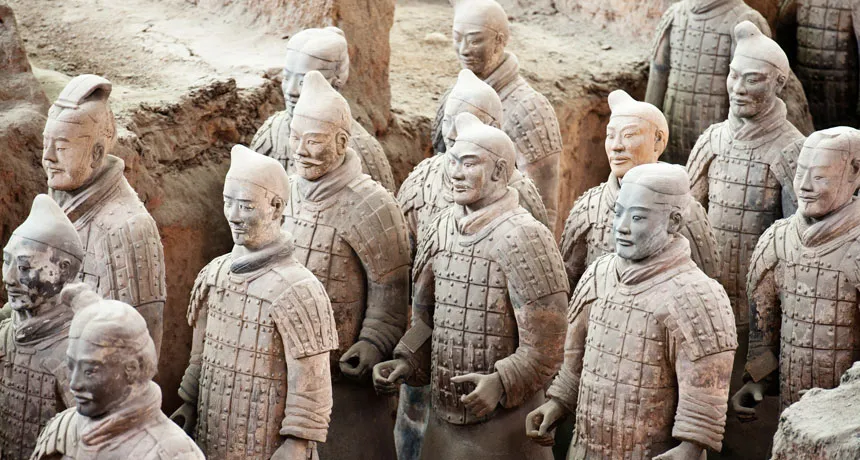
In the spring of 1974, farmers digging a well in rural north-central China struck something far more extraordinary than water. Beneath the soil lay fragments of sculpted clay—human forms, life-sized and hauntingly detailed. What began as a practical search for groundwater soon became one of the most astonishing archaeological revelations in human history.
The discovery occurred near the modern city of Xi’an, close to the vast burial complex built for China’s first emperor, Qin Shi Huang. Over time, excavation revealed thousands of life-size clay soldiers arranged in military formation, guarding the immense burial site known as the Mausoleum of Qin Shi Huang in Shaanxi. Archaeologists from the Chinese Academy of Social Sciences soon recognized that this was no ordinary funerary display. It was an entire army, crafted more than two thousand years ago and hidden beneath layers of earth.
The scale alone is staggering. Thousands of soldiers, horses, chariots, officers, and military formations stretch across multiple excavation pits. Yet what continues to astonish researchers is not merely the number of figures, but their complexity, their realism, and the technological sophistication required to produce them.
The army was built to accompany the emperor into the afterlife, but its rediscovery opened an entirely new window into ancient state power, industrial organization, artistic expression, and technological innovation.
Many people know the basic story of this monumental burial army. Far fewer understand the scientific and historical details that make it one of the most remarkable archaeological discoveries ever made. Beneath its imposing visual presence lies a web of surprising facts—each revealing something profound about ancient engineering, craftsmanship, and human belief.
The following eight lesser-known facts reveal the deeper reality of this underground world and the extraordinary civilization that created it.
1. Every Soldier Was Originally Painted in Brilliant Color
At first glance, the figures appear to be made from plain gray clay. This subdued appearance has shaped modern perception, giving the army a solemn and austere character. Yet when the statues were first created, they were anything but colorless.
Scientific analysis of pigment residues has revealed that each figure was once covered in vivid paint. Archaeologists have identified mineral-based pigments including cinnabar red, malachite green, azurite blue, and carbon black. These colors were applied over a layer of lacquer derived from tree sap, which served as a binding and protective coating.
When newly completed, the soldiers would have displayed richly patterned armor, brightly colored garments, detailed facial features, and individualized decorative elements. The entire formation would have resembled a living army frozen in motion rather than a monochrome field of clay.
So why do we not see these colors today?
The answer lies in chemistry. When the statues were excavated, the lacquer layer that held the pigments rapidly dried and contracted upon exposure to air. This caused the paint to flake off within minutes or hours. In many early excavations, brilliant color literally vanished before researchers’ eyes.
Modern conservation science has since developed stabilization techniques that allow some pigment to be preserved. By controlling humidity and applying protective compounds, archaeologists can now slow or prevent the rapid deterioration that occurs when buried lacquer is exposed.
The army we see today is therefore not its original form but a faded remnant of something far more visually dynamic. The ancient burial chamber was not a muted clay installation—it was an explosion of color designed to convey vitality, realism, and symbolic power.
2. The Army Was Produced Using an Early Form of Mass Manufacturing
At first glance, the individuality of each soldier suggests that every figure must have been sculpted entirely by hand. Indeed, faces differ dramatically—some stern, some youthful, some contemplative. Hairstyles vary. Armor styles shift. Expressions appear distinct.
Yet detailed structural analysis reveals something unexpected. The army was produced using an organized, large-scale manufacturing system that resembles early industrial production.
Researchers have found that different body parts were created separately using molds. Heads, torsos, arms, and legs were fabricated in standardized forms and then assembled. After assembly, artisans added individualized details by hand—sculpting facial features, adjusting posture, carving hair patterns, and refining armor textures.
This hybrid process allowed for both efficiency and uniqueness. Standardized components enabled large-scale production, while manual finishing created the appearance of individuality.
Kiln studies show that different workshops produced components that were later assembled at the burial site. Marks stamped or carved onto figures identify specific artisan groups or production teams, indicating a coordinated labor system under centralized supervision.
This level of organization reflects an extraordinary administrative capacity. The creation of thousands of life-size figures required raw material extraction, transportation networks, skilled labor specialization, quality control, and logistical planning on a massive scale.
The army is therefore not only an artistic achievement but also evidence of one of the earliest known examples of state-directed large-scale manufacturing.
3. The Soldiers Represent a Real Military Formation
The arrangement of figures is not random or decorative. Archaeological mapping of the excavation pits shows that the army is organized according to actual military structure.
Infantry units form the main body, arranged in precise rows. Archers occupy strategic positions, including kneeling archers in front lines and standing archers behind. Charioteers and cavalry appear in designated formations. Officers stand apart, identifiable by distinctive armor and posture.
Weapons found at the site—including bronze swords, spears, crossbow mechanisms, and arrowheads—are functional military equipment, not symbolic replicas. Many were sharp enough to be used in battle.
Spatial analysis reveals defensive strategies embedded in the layout. Vanguard troops face outward. Flanking units guard the sides. Command structures are reflected in hierarchical placement.
The army is not merely a representation of soldiers. It is a representation of military organization itself—a structured force prepared for deployment.
This suggests that the emperor’s vision of the afterlife required not just symbolic protection but the continuation of state power and military order beyond death. The burial complex reflects a worldview in which political authority extended into eternity.
4. The Weapons Were Exceptionally Advanced—and Remarkably Well Preserved
Among the most intriguing discoveries at the site are the bronze weapons. Thousands have been recovered, many in excellent condition despite being buried for more than two millennia.
Metallurgical analysis shows that these weapons were made using advanced casting techniques. Bronze composition varies depending on weapon type, indicating deliberate control of alloy properties for strength and durability.
For many years, scholars believed that the weapons were coated with a chromium-based protective layer that prevented corrosion—a technology not widely used in modern industry until much later. Later research clarified that preservation resulted primarily from environmental factors, including alkaline soil composition and the protective properties of surrounding materials.
Nevertheless, the craftsmanship remains remarkable. Blade edges are finely finished. Crossbow triggers exhibit mechanical precision. Standardized arrowheads indicate efficient mass production combined with performance optimization.
The army’s weaponry demonstrates that technological sophistication extended far beyond architecture and sculpture. It encompassed metallurgy, engineering, and materials science.
5. The Burial Complex Is Vastly Larger Than the Excavated Area
Public attention often focuses on the main excavation pits containing thousands of soldiers. Yet these represent only a portion of the total burial complex.
Geophysical surveys using ground-penetrating radar and remote sensing indicate that the emperor’s tomb itself remains sealed. Historical records describe an elaborate underground palace containing rivers of mercury, mechanical traps, and celestial representations of the heavens.
Soil sampling around the central mound has revealed unusually high concentrations of mercury, supporting ancient textual descriptions of flowing mercury landscapes inside the burial chamber.
Archaeologists have chosen not to excavate the central tomb for several reasons. Preservation technology is not yet sufficient to guarantee protection of delicate internal structures. Opening the chamber could expose artifacts to rapid deterioration, similar to what happened with painted statues in early excavations.
Thus, much of the burial complex remains untouched—a vast hidden world still waiting beneath the earth.
The army we see today may represent only the outer defensive perimeter of an even more elaborate underground realm.
6. Many Figures Show Evidence of Repair Before Burial
Close inspection of certain statues reveals cracks, patching, and structural reinforcement. Some figures were repaired after firing but before burial.
This suggests that quality control existed during production. Imperfect statues were not discarded automatically; they were fixed and made suitable for inclusion in the formation.
Archaeologists have identified clay plugs, smoothing marks, and structural adjustments. Some figures even show evidence of replacement components.
This attention to repair demonstrates the immense value placed on completing the army. The project was not merely decorative—it was essential to the emperor’s funerary vision.
The presence of repaired figures also provides insight into the practical challenges of producing large ceramic structures. Firing life-size clay bodies can produce stress fractures, warping, or structural weakness. Ancient artisans developed techniques to address these challenges long before modern ceramic engineering emerged.
7. The Army Was Built by an Enormous Labor Force Working Under Strict Organization
Constructing thousands of life-size statues required far more than artistic talent. It demanded a vast labor system operating with precision and discipline.
Archaeological evidence suggests that skilled craftsmen, laborers, kiln operators, material transporters, and supervisors worked in coordinated teams. Workshops produced standardized parts. Logistics ensured steady supplies of clay, fuel, and tools.
Historical sources indicate that large numbers of workers were conscripted for imperial construction projects. Some may have been prisoners, others skilled artisans. The scale of the enterprise reflects the centralized authority of the imperial state.
Production likely continued for decades. Each statue required shaping, drying, firing, assembling, painting, and placement. Multiply this process thousands of times, and the magnitude of the undertaking becomes clear.
The army represents not just artistic achievement but also administrative control over labor, resources, and time.
It is a monument to political power expressed through organized human effort.
8. The Army Continues to Reveal New Information Today
Despite decades of research, the site remains an active field of discovery. New excavation areas reveal additional figures, new weapon types, and previously unknown structural features.
Advances in scientific technology continue to transform understanding. Isotopic analysis helps identify clay sources. Microscopic examination reveals manufacturing techniques. Digital modeling reconstructs original color patterns. Remote sensing detects buried structures without excavation.
Each new method allows researchers to ask deeper questions about production, organization, and cultural meaning.
The army is not a finished story. It is an ongoing scientific investigation.
Every layer of soil removed, every pigment fragment analyzed, every artifact cataloged adds new dimensions to our understanding of ancient society.
The buried army continues to speak—not in words, but through material evidence waiting to be interpreted.
The Meaning of an Eternal Army
The creation of a life-size military force to guard a ruler after death reveals a worldview shaped by continuity between earthly authority and cosmic order. Death did not end power. It required protection, structure, and organization.
Yet the army also reveals something more universal. It reflects humanity’s desire to overcome mortality through creation. Clay figures became substitutes for living soldiers. Art became a form of permanence.
Ironically, the army meant to serve one man in eternity has instead become a gift to humanity across millennia. It preserves knowledge of ancient craftsmanship, technology, and governance. It allows modern observers to encounter the ambitions of a distant age with astonishing immediacy.
The Silent Witnesses of History
Standing before the rows of sculpted soldiers, one senses both presence and absence. They stand in formation, ready for command, yet their emperor remains sealed within an unopened tomb. They embody order, yet they also embody mystery.
Each face represents careful observation of human form. Each weapon reflects technological mastery. Each arrangement expresses political structure.
Together, they form one of the most profound archaeological testimonies ever uncovered—a silent army preserving the memory of a civilization’s power, artistry, and vision of eternity.
And beneath the earth, where excavation has not yet reached, countless secrets remain—waiting for future generations to uncover what history has hidden, and what time has preserved.