Few subjects ignite the human imagination quite like dinosaurs. They thunder through our movies, fill the pages of children’s books, tower over us in museum halls, and dominate documentaries with roaring intensity. For many of us, dinosaurs were our first introduction to deep time—the dizzying realization that Earth has a history stretching back hundreds of millions of years, filled with creatures stranger and grander than anything alive today.
But fascination often travels hand in hand with misunderstanding. Dinosaurs have been misrepresented in early scientific reconstructions, exaggerated in fiction, and simplified for storytelling. As paleontology has advanced—through fossil discoveries, improved dating techniques, and sophisticated imaging technologies—many long-held assumptions have been overturned.
What follows is a careful exploration of ten of the most common myths about dinosaurs. Each one has persisted in popular culture, but modern science tells a more nuanced and often more astonishing story.
1. Dinosaurs Were Cold-Blooded, Sluggish Reptiles
For decades, dinosaurs were imagined as slow, lumbering reptiles, dragging their tails through swamps under a blazing sun. Early 20th-century museum mounts often reinforced this image, showing them as heavy, awkward creatures with sprawling postures.
Modern evidence paints a dramatically different picture.
Bone structure reveals that many dinosaurs had upright, efficient stances more like mammals and birds than modern reptiles. Their limbs were positioned beneath their bodies, allowing for faster and more sustained movement. Fossilized trackways show evidence of running behavior. Predator-prey relationships inferred from fossil assemblages suggest active lifestyles.
Microscopic analysis of dinosaur bones reveals growth rings that indicate rapid growth rates. Some species grew from hatchlings to multi-ton adults in relatively short periods. Such rapid development is more consistent with high metabolic rates than with the slow metabolism of typical cold-blooded reptiles.
While not all dinosaurs may have been fully warm-blooded in the same way as modern mammals or birds, many scientists conclude that numerous species had elevated metabolisms. The old image of sluggish, swamp-bound giants has given way to one of dynamic, active animals that dominated terrestrial ecosystems for over 160 million years.
2. All Dinosaurs Were Massive Giants
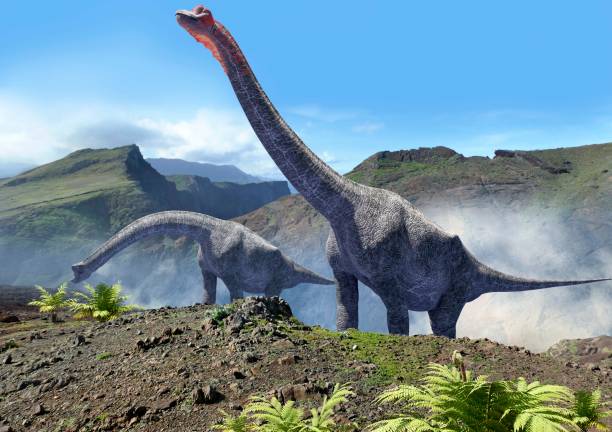
When people hear the word “dinosaur,” they often picture towering giants like Tyrannosaurus or long-necked sauropods stretching across prehistoric landscapes. It is true that some dinosaurs were enormous. Certain sauropods reached lengths over 30 meters and weighed as much as several elephants combined.
But not all dinosaurs were gigantic.
Many species were small—some no larger than a chicken or a dog. Fossils reveal a remarkable diversity of body sizes. Small theropods darted through ancient forests. Agile, lightly built species likely hunted insects or small vertebrates. Some dinosaurs weighed only a few kilograms.
The fossil record shows that dinosaurs occupied a wide range of ecological niches. Just as modern ecosystems include animals of many sizes—from mice to elephants—prehistoric ecosystems were equally varied.
The dominance of large species in popular culture obscures the extraordinary diversity of dinosaur forms. Giants existed, yes, but they were only part of a much broader evolutionary tapestry.
3. Dinosaurs Lived at the Same Time as Humans
This myth is perhaps one of the most persistent and dramatic. Movies, cartoons, and fantasy stories often depict humans fleeing from or riding dinosaurs. The image is compelling, but it is entirely fictional.
Dinosaurs first appeared during the Triassic Period, over 230 million years ago. They flourished through the Jurassic and Cretaceous periods. The non-avian dinosaurs became extinct approximately 66 million years ago at the end of the Cretaceous Period.
Modern humans, Homo sapiens, emerged roughly 300,000 years ago. Even the earliest primate ancestors appeared tens of millions of years after the extinction of non-avian dinosaurs.
There is a vast gulf of time between dinosaurs and humans—so large that it is almost impossible to fully comprehend. If Earth’s history were compressed into a single year, dinosaurs would vanish in late December, and humans would appear in the final minutes of December 31.
Dinosaurs and humans never coexisted. Their worlds were separated by immense stretches of evolutionary change.
4. Dinosaurs Are Completely Extinct
This statement is only partially true.
While non-avian dinosaurs disappeared 66 million years ago, one lineage survived. Birds are the direct descendants of certain theropod dinosaurs. This conclusion is supported by extensive fossil evidence showing transitional forms with both reptilian and avian features.
Fossils reveal dinosaurs with feathers, wishbones, and other characteristics previously thought unique to birds. Skeletal similarities between birds and small theropod dinosaurs are striking, including features of the hips, wrists, and skulls.
From a scientific perspective, birds are living dinosaurs. Every sparrow, eagle, or penguin is part of a lineage that stretches back to the age of Tyrannosaurus.
When we say dinosaurs are extinct, we mean that non-avian dinosaurs are extinct. But the evolutionary story continues in the skies above us and in the trees outside our windows.
5. Dinosaurs Dragged Their Tails on the Ground
Early dinosaur reconstructions often showed heavy tails dragging behind massive bodies, leaving grooves in the soil. This image persisted for decades.
However, fossilized trackways tell a different story. In many cases, footprints are preserved without any corresponding tail drag marks. This suggests that dinosaurs held their tails aloft rather than letting them scrape the ground.
Anatomical studies support this interpretation. Many dinosaur tails were stiffened by interlocking vertebrae and tendons. This structure would have provided balance and stability, especially in bipedal species.
For two-legged dinosaurs, the tail likely acted as a counterbalance to the head and torso. Holding it horizontally would have enabled efficient movement and rapid turning.
The dragging tail image belongs to an earlier era of paleontology. Modern reconstructions show dynamic postures, with tails lifted and bodies balanced.
6. Dinosaurs Were Failures Because They Went Extinct
It is tempting to equate extinction with failure. If dinosaurs were so successful, why did they disappear?
This line of thinking misunderstands both evolution and extinction.
Dinosaurs dominated terrestrial ecosystems for more than 160 million years. In comparison, humans have existed for a tiny fraction of that time. From an evolutionary perspective, dinosaurs were extraordinarily successful.
Their extinction was triggered by a catastrophic event—widely accepted to be a massive asteroid impact that caused global environmental disruption. Rapid climate changes, wildfires, darkness from atmospheric debris, and collapsing food chains created conditions that many species could not survive.
Extinction events are part of Earth’s natural history. Many lineages have risen and fallen over geological time. Survival does not imply superiority, nor does extinction imply failure.
In fact, the extinction of non-avian dinosaurs opened ecological niches that allowed mammals to diversify dramatically. Without that event, human evolution might never have occurred.
7. All Dinosaurs Were Scaly and Lizard-Like
For much of the 20th century, dinosaurs were depicted as oversized lizards covered in scales. This image has been transformed by fossil discoveries.
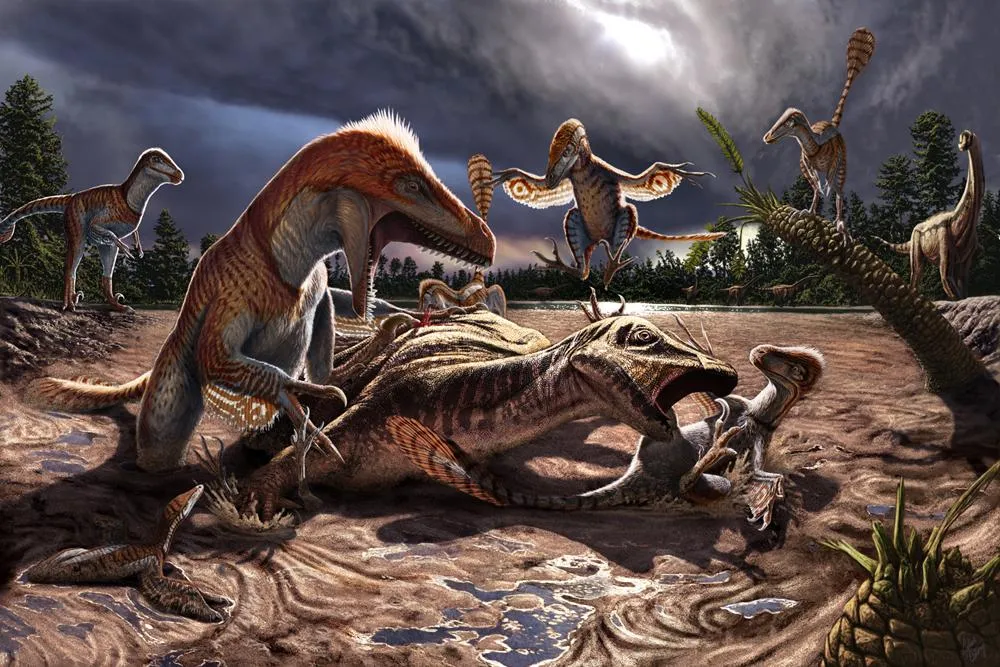
In several well-preserved fossils, scientists have found clear evidence of feathers or feather-like structures in certain dinosaur species. These structures range from simple filaments to complex feathers resembling those of modern birds.
Not all dinosaurs had feathers, and skin impressions from some large species indicate scaly coverings. However, it is now clear that feathers were widespread among many theropod dinosaurs and possibly other groups.
Feathers may have initially evolved for insulation, display, or other functions before being adapted for flight in the lineage leading to birds.
The popular image of dinosaurs as uniformly scaly reptiles is outdated. The prehistoric world likely included a surprising variety of textures and appearances.
8. The Tyrannosaurus Rex Could Not See Well
A long-standing myth suggests that Tyrannosaurus rex had vision based solely on movement, similar to certain fictional portrayals. According to this idea, remaining still would render a person invisible to it.
There is no scientific evidence to support this claim.
Examinations of the skull and eye sockets of Tyrannosaurus rex indicate that it had forward-facing eyes, suggesting binocular vision. This arrangement provides depth perception, an advantage for predators.
Studies of the optic nerve size and brain structure suggest that Tyrannosaurus likely had keen eyesight. Combined with evidence indicating a strong sense of smell and sensitive hearing, it appears to have been a highly capable predator.
The notion that one could survive by standing still belongs to cinematic storytelling, not paleontological research.
9. Dinosaurs All Lived in Hot, Tropical Environments
The classic image of dinosaurs places them in steamy jungles or arid deserts under intense sunlight. While some species certainly lived in warm climates, this does not represent the full picture.
Fossils have been discovered in regions that were once located near the poles. Evidence suggests that some dinosaurs lived in environments with seasonal darkness and cooler temperatures.
The climate during much of the Mesozoic Era was generally warmer than today, and polar regions were not covered in permanent ice as they are now. However, these areas still experienced seasonal variation.
Some species may have adapted to cooler conditions, and the presence of feathers in certain dinosaurs suggests possible insulation.
Dinosaurs were geographically widespread, occupying diverse habitats across ancient continents.
10. We Know Everything About Dinosaurs
Perhaps the most subtle myth of all is the assumption that dinosaurs are fully understood—that science has answered all major questions.
In reality, paleontology is an evolving field filled with ongoing discoveries and debates. New fossils are uncovered every year. Advanced imaging technologies allow researchers to examine internal structures without damaging specimens. Chemical analyses can reveal clues about diet, growth, and even coloration in some cases.
Questions remain about dinosaur behavior, social structures, migration patterns, and physiology. Scientists continue to refine models of their growth rates and metabolic systems. The transition from non-avian dinosaurs to birds is an area of rich ongoing research.
The story of dinosaurs is not finished. It is continually being rewritten as new evidence emerges.
The Deeper Lesson Behind the Myths
Why do these myths persist? Partly because dinosaurs occupy a space between science and imagination. They are real, yet distant in time. They must be reconstructed from fragments—bones, footprints, and impressions preserved in stone. Interpretation is inevitable.
Early reconstructions reflected the scientific understanding of their time. As new evidence appeared, old images were revised. This process is not a weakness of science but a strength. It shows a willingness to change in the face of new data.
Dinosaurs remind us that knowledge grows through correction. What once seemed certain may be reconsidered. What once seemed impossible may become accepted.
Dinosaurs as Windows into Deep Time
Beyond myths and corrections lies something even more profound. Dinosaurs open a window into Earth’s deep history. They connect us to a time when continents were arranged differently, when flowering plants were just emerging, when giant reptiles ruled the land.
They reveal patterns of evolution, adaptation, and extinction. They demonstrate how life responds to environmental change. They show that dominance is temporary and that resilience often lies in unexpected lineages—like the small feathered theropods whose descendants now fill the skies.
Understanding dinosaurs is not simply about cataloging ancient species. It is about understanding the dynamic nature of life on Earth.
Conclusion: Wonder Rooted in Evidence
The myths surrounding dinosaurs are powerful because they are dramatic and simple. The reality uncovered by science is often more complex—and far more fascinating.
Dinosaurs were not sluggish failures but dynamic, diverse creatures that shaped ecosystems for millions of years. They were not confined to swamps or tropical jungles. They were not all giants. They did not vanish without legacy.
Instead, they represent one of the most extraordinary chapters in the history of life. Their bones, preserved in rock, speak across unimaginable spans of time. Their descendants sing in trees and soar above oceans.
To debunk myths is not to diminish wonder. It is to deepen it. The more accurately we understand dinosaurs, the more astonishing they become. Science does not take away magic; it replaces illusion with insight. And in the case of dinosaurs, the truth is more awe-inspiring than fiction ever was.