Long before the sleek silhouette of a great white shark sliced through blue water, before the word “shark” carried its modern aura of fear and fascination, Earth’s oceans belonged to other hunters. They were armored, many-limbed, serpent-necked, fish-jawed, and sometimes utterly alien to modern eyes. They lived in seas that covered continents, in warm shallow lagoons and vast open waters teeming with strange life. Some were invertebrates with crushing claws. Others were reptiles that breathed air but hunted like torpedoes. A few were fishes so heavily armored they seemed like living tanks.
Sharks themselves have an ancient lineage, appearing more than 400 million years ago. But for long stretches of deep time, they were not the uncontested rulers of the sea. Other predators dominated the top of marine food webs, shaping ecosystems through sheer size, speed, or biting power. To travel back into those ancient oceans is to enter a world where evolution experimented boldly, where predation drove innovation, and where extinction repeatedly reshaped the balance of power.
Here are seven of the deadliest ocean predators that ruled before sharks became the iconic masters of the sea.
1. Anomalocaris: The Alien Apex of the Cambrian
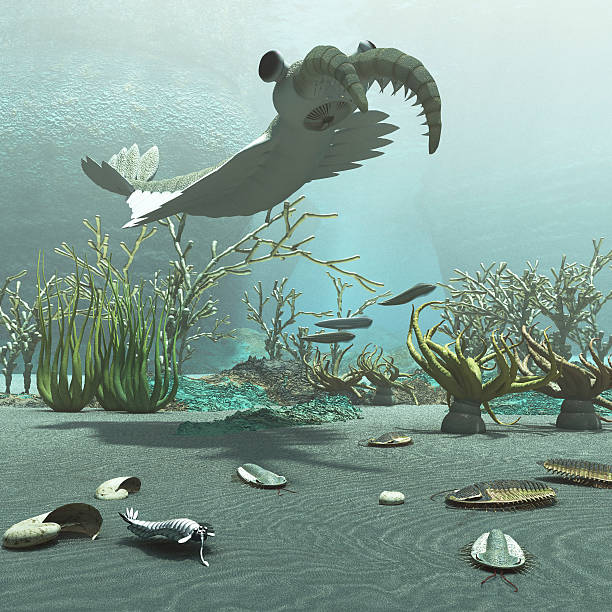
More than 500 million years ago, during the Cambrian Period, life in the oceans underwent an explosion of diversity. Strange body plans appeared and vanished in evolutionary experiments that still astonish paleontologists. Among the most formidable predators of this era was Anomalocaris.
Anomalocaris was not a fish, nor a reptile, nor anything that swims in today’s seas. It belonged to an extinct group of early arthropods. With a streamlined body, flaps along its sides for propulsion, large compound eyes, and two spiny frontal appendages for grasping prey, it looked like a creature imagined for science fiction. At up to about a meter in length, it was enormous by Cambrian standards.
Its mouth was a circular structure made of overlapping plates arranged like a pineapple slice, designed to grip and crush. For decades, scientists debated what it ate. Early fossils suggested it preyed on trilobites, hard-shelled arthropods common in Cambrian seas. Some trilobite fossils bear injuries that match the kind of crushing damage Anomalocaris could have inflicted. However, newer research indicates its bite may not have been strong enough to pulverize the hardest shells, suggesting it may have preferred softer prey or attacked trilobites from vulnerable angles.
Regardless of its precise diet, Anomalocaris was clearly an apex predator of its time. Its sophisticated eyes, among the most complex known from the Cambrian, suggest active hunting in well-lit waters. In an ocean where many animals were small, slow, or poorly defended, Anomalocaris was a swift and intelligent killer.
It ruled during a time when sharks did not yet exist. The very idea of a jawed fish was still in the future. In the Cambrian seas, the shape of predation was utterly different—and Anomalocaris stood at the top.
2. Eurypterus and the Rise of the Sea Scorpions
As the Paleozoic Era continued, another group of arthropods emerged as powerful marine hunters: the eurypterids, often called sea scorpions. Among them, Eurypterus is one of the most famous genera, though some of its relatives grew even larger.
Eurypterus lived during the Silurian and Devonian periods, roughly 430 to 390 million years ago. It resembled a massive aquatic scorpion, with a segmented body, multiple pairs of limbs, and a pair of swimming paddles. While many species were under a meter long, some eurypterids reached sizes exceeding two meters, making them among the largest arthropods ever to live.
These predators likely hunted fish and other marine invertebrates. Their grasping appendages could seize prey, and some species had large, powerful claws. Fossil evidence suggests that eurypterids were active swimmers rather than bottom-dwelling ambush predators. They inhabited both marine and brackish environments, and some even ventured into freshwater.
In their time, early jawless and primitive jawed fishes were beginning to diversify. Sharks were present in primitive forms, but they were not yet dominant. Eurypterids occupied high trophic levels, exerting significant predatory pressure.
The image of a giant scorpion gliding through ancient seas may seem nightmarish, yet it represents a critical stage in marine evolution. The dominance of arthropod predators in the Paleozoic oceans set the stage for future evolutionary arms races. Harder shells, better mobility, and improved sensory systems evolved partly in response to such formidable hunters.
Eventually, eurypterids declined and disappeared by the end of the Permian Period, long before sharks reached their later prominence. But for tens of millions of years, sea scorpions were among the most feared creatures in Earth’s waters.
3. Dunkleosteus: The Armored Terror of the Devonian
If there is one prehistoric predator that rivals modern sharks in raw intimidation, it is Dunkleosteus. Living about 380 to 360 million years ago during the Late Devonian Period, Dunkleosteus was a placoderm—an early group of armored fishes.
Unlike sharks, which have skeletons made of cartilage, placoderms had bony plates covering the front parts of their bodies. Dunkleosteus was among the largest of them, with estimates suggesting lengths up to 8 to 10 meters. Its head and thorax were encased in thick armor, while the rear of its body was more flexible.
Instead of true teeth, Dunkleosteus possessed sharp bony plates that functioned like self-sharpening blades. Studies of its jaw mechanics indicate that it had one of the most powerful bites of any fish, ancient or modern. Its jaws could open rapidly and snap shut with tremendous force, capable of crushing bone and armor.
Fossil evidence suggests that Dunkleosteus was an apex predator, feeding on other placoderms, fish, and possibly even its own kind. Some fossils show bite marks and signs of predation consistent with its jaw structure.
During the Devonian, sharks existed but were relatively small and ecologically secondary compared to massive placoderms like Dunkleosteus. In many marine ecosystems, placoderms dominated.
The end of the Devonian brought a series of extinction events that devastated marine life. Placoderms, including Dunkleosteus, vanished. In the ecological vacuum that followed, sharks began to diversify and expand into new niches. The fall of Dunkleosteus marked a turning point in oceanic power structures.
4. Cameroceras: The Giant Straight-Shelled Cephalopod
Long before giant squids haunted sailors’ imaginations, ancient oceans were patrolled by enormous cephalopods with straight shells. Cameroceras, living during the Ordovician Period over 450 million years ago, is often cited as one of the largest of these early predators.
Cameroceras belonged to a group of cephalopods called orthocones. Unlike modern squids and octopuses, these animals had long, conical shells that could reach lengths of several meters. The soft body occupied the largest chamber at one end, with tentacles extending outward to grasp prey.
Though exact size estimates are debated, some fossils suggest individuals may have exceeded six meters in length. For its time, this was gigantic. In seas dominated by trilobites and early fishes, a multi-meter-long predator with grasping tentacles would have been terrifying.
Cameroceras likely propelled itself by jet propulsion, similar to modern nautiluses and squids. It may have hunted smaller marine animals, using its tentacles to capture prey and a beak-like mouth to tear flesh.
In the Ordovician oceans, vertebrates were still in their infancy. Sharks were hundreds of millions of years away from dominance. Cephalopods like Cameroceras filled the role of top predator.
As evolutionary time progressed, other marine predators arose, and straight-shelled orthocones declined. Yet in their prime, they were the undisputed giants of their world.
5. Liopleurodon: The Jurassic Super-Pliosaur
Fast forward to the Mesozoic Era, often called the Age of Reptiles. The oceans were no longer dominated by armored fishes or giant arthropods. Instead, marine reptiles had taken control. Among the most formidable was Liopleurodon, a pliosaur that lived during the Middle to Late Jurassic Period, around 160 million years ago.
Liopleurodon was a short-necked plesiosaur relative, built for power rather than grace. With a massive head, enormous jaws, and four strong flippers, it was adapted for speed and force. Estimates of its size vary, but large individuals may have reached lengths of 6 to over 10 meters.
Its skull was massive relative to its body, filled with long, conical teeth ideal for gripping slippery prey. It likely fed on fish, squid, and other marine reptiles. Bite force estimates suggest it was capable of delivering devastating attacks.
Unlike sharks, Liopleurodon was an air-breathing reptile. It had to surface for oxygen, yet it spent most of its life hunting in marine environments. Its flippers allowed it to “fly” underwater with remarkable agility.
During the Jurassic, sharks were present and diversifying, but they were not the supreme predators of all marine ecosystems. Large marine reptiles like Liopleurodon occupied the highest trophic levels in many regions.
The reign of pliosaurs would eventually end as ecosystems shifted and new predators emerged. But for millions of years, Liopleurodon embodied oceanic dominance in the age of dinosaurs.
6. Mosasaurus: The Sea Dragon of the Late Cretaceous
If Liopleurodon was a powerhouse of the Jurassic, Mosasaurus was the sea dragon of the Late Cretaceous, about 70 to 66 million years ago. Mosasaurus belonged to a group of marine reptiles closely related to modern lizards and snakes.
Growing up to around 12 to 15 meters in length, Mosasaurus was among the largest marine predators of its time. Its long, streamlined body, powerful tail, and paddle-like limbs made it an efficient swimmer. Its jaws were lined with sharp, backward-curving teeth designed to seize and hold struggling prey.
Fossils reveal stomach contents that include fish, sea turtles, ammonites, and even other mosasaurs. This suggests a broad and opportunistic diet. Mosasaurus was an apex predator, capable of tackling large and armored prey.
Its skull shows adaptations for swallowing prey whole, similar in some respects to snakes. A double-hinged jaw structure allowed it to open its mouth widely.
Sharks were abundant in the Cretaceous oceans, and some species were formidable. Yet mosasaurs often occupied the very top of the food chain. They were the tyrants of the sea at the same time that Tyrannosaurus rex ruled the land.
The end-Cretaceous mass extinction, triggered by an asteroid impact and associated environmental upheaval, wiped out mosasaurs along with non-avian dinosaurs. With their disappearance, marine ecosystems were once again reshaped, and sharks diversified further in the Paleogene.
7. Basilosaurus: The Serpent Whale of the Eocene
After the extinction of marine reptiles, mammals began to explore the oceans in new ways. One of the earliest and most dramatic examples of a marine mammal apex predator was Basilosaurus, which lived during the Late Eocene Epoch about 40 to 34 million years ago.
Despite its name, Basilosaurus was not a reptile but an early whale. It had an elongated, serpentine body that could reach lengths of 15 to 18 meters. Unlike modern whales, Basilosaurus retained small hind limbs, a vestige of its terrestrial ancestry.
Its jaws were filled with differentiated teeth—incisors, canines, and molars—indicating a varied diet. Fossil evidence shows that it preyed on fish and smaller whales. Some fossils of other early whales bear bite marks attributed to Basilosaurus, suggesting active predation.
Basilosaurus swam using powerful undulations of its long body and tail. It was fully aquatic, giving birth at sea and spending its entire life in marine environments.
By the Eocene, sharks were well established and diverse, including large predatory forms. However, Basilosaurus was among the dominant marine predators of its ecosystems, demonstrating that mammals could also rise to the top of the oceanic food chain.
Its existence marks a pivotal chapter in marine evolution: the transition of mammals from land back to sea, and the emergence of whales as major oceanic players.
The Shifting Crown of the Sea
The history of ocean predators is not a simple linear story of sharks replacing all who came before. Sharks themselves are ancient and coexisted with many of these creatures. But dominance in marine ecosystems has shifted repeatedly over hundreds of millions of years.
From the alien visage of Anomalocaris in Cambrian seas, to the armored ferocity of Dunkleosteus, to the reptilian might of Mosasaurus, the oceans have seen many rulers rise and fall. Mass extinctions, climate shifts, continental drift, and evolutionary innovation have constantly reshaped the balance of power.
Sharks eventually became iconic apex predators in many marine systems, especially after the extinction of large marine reptiles. Their cartilaginous skeletons, efficient swimming styles, and continual tooth replacement give them evolutionary advantages. Yet they are only the latest chapter in a much older saga.
The deep past reveals that the ocean has never been static. It has always been a battleground of adaptation and survival. Each predator listed here once reigned supreme in its own era, shaping life through fear and force.
When we look at modern seas and see sharks cruising through coral reefs or open water, we are witnessing the current holders of a crown that has passed through many forms. Beneath the waves lies not only mystery, but memory—the memory of alien arthropods, armored fishes, giant cephalopods, marine reptiles, and serpent whales that once ruled the blue world.
The ocean remembers its ancient kings, even if we must piece them together from stone.