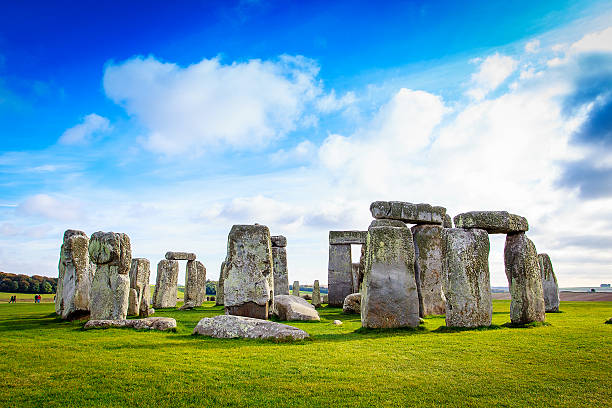
Across a quiet plain in southern England stands one of the most mysterious monuments ever built by human hands. The massive stones of Stonehenge rise from the grassy landscape like fragments of a forgotten world. Some stand upright in solemn circles. Others lie fallen, worn smooth by wind and rain. Together they form a structure that has fascinated historians, archaeologists, astronomers, and dreamers for centuries.
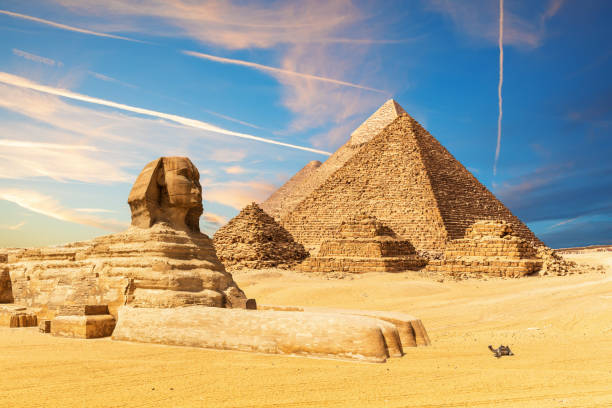
Stonehenge is ancient—far older than the Roman Empire, older even than many early civilizations. The earliest parts of the monument were constructed around 3000 BCE, and its most iconic stone structures appeared roughly between 2500 and 2000 BCE. This means that when the pyramids of Egypt were rising beside the Nile, people in Britain were already shaping and raising these colossal stones.
And yet, despite decades of scientific investigation and modern archaeological methods, many aspects of Stonehenge remain deeply mysterious.
How were its enormous stones transported across vast distances without modern technology? Why was the monument built in the first place? What cultural or spiritual significance did it hold for the people who constructed it?
Even today, many of the most intriguing features of Stonehenge defy simple explanations. The monument seems to contain layers of purpose—astronomical, ceremonial, social, and possibly even symbolic meanings that modern researchers are still trying to untangle.
Here are ten astonishing facts about Stonehenge that continue to puzzle experts.
1. The Monument Was Built Over Many Centuries
One of the most surprising discoveries about Stonehenge is that it was not built all at once.
Instead, the site evolved over more than a thousand years. Archaeological evidence shows that construction occurred in several major phases. The earliest stage, around 3000 BCE, consisted primarily of a circular ditch and bank surrounding a ring of pits known as the Aubrey Holes. These holes may have held wooden posts or stones, though their original purpose remains uncertain.
Several centuries later, enormous stones were added to the site, transforming the landscape dramatically. This gradual development suggests that Stonehenge was part of a long cultural tradition rather than the vision of a single generation.
What remains unclear is why the monument continued to evolve for so long. Most ancient structures reflect the needs or beliefs of a particular period, yet Stonehenge appears to have been continually modified by different communities across many centuries.
Each generation reshaped the monument, but the deeper meaning behind those changes has largely been lost to time.
2. Some Stones Were Transported Over 200 Kilometers
Stonehenge’s stones are not all local.
The largest stones, known as sarsens, weigh up to 25 tons and likely originated from Marlborough Downs, roughly 25 kilometers away. Moving such massive blocks would have been an immense challenge for Neolithic people using only simple tools and human labor.
But the real mystery lies in the smaller stones known as bluestones.
These stones have been traced to the Preseli Hills in Wales, more than 200 kilometers from Stonehenge. Transporting them would have required crossing rugged terrain, rivers, forests, and possibly even open water.
Archaeologists have proposed various methods. Some suggest sledges and wooden rollers pulled by large teams of people. Others propose that stones were transported by raft along rivers and coastal waters.
Yet even these explanations struggle to account for the sheer logistical complexity. Moving dozens of multi-ton stones across such distances without wheels, metal tools, or domesticated draft animals remains astonishing.
Why the builders chose stones from such a distant location is equally puzzling. The effort involved suggests the bluestones held special significance—perhaps spiritual or symbolic.
But the exact reason remains one of Stonehenge’s enduring mysteries.
3. The Stones Were Shaped With Remarkable Precision
At first glance, the stones of Stonehenge appear rough and natural. But closer inspection reveals something remarkable: many of them were carefully shaped.
The massive sarsen stones were not simply placed upright. Their tops were flattened to support horizontal lintel stones, forming the famous stone trilithons that define the monument’s silhouette.
Even more impressive is the way these stones were joined. The builders used woodworking techniques translated into stone. Mortise-and-tenon joints—commonly used in carpentry—connect vertical stones with horizontal lintels. Tongue-and-groove joints were used between adjacent lintel stones.
These techniques ensured stability and alignment, preventing stones from slipping out of place over time.
Such precision is extraordinary given the tools available to Neolithic builders. Stone tools made of harder rock were likely used for shaping, but the process would have required immense patience and skill.
The engineering sophistication of these joints suggests a deep understanding of structural design—centuries before metal tools became common.
Yet we still do not know exactly how this knowledge developed.
4. Stonehenge Aligns With the Movements of the Sun
One of the most famous features of Stonehenge is its alignment with the Sun.
During the summer solstice, the longest day of the year, the Sun rises in perfect alignment with the monument’s main axis. From within the circle, the Sun appears to rise above the Heel Stone, a large solitary stone located outside the main structure.
At the winter solstice, the alignment works in reverse. The setting Sun aligns with the central axis of the monument.
These alignments suggest that the builders possessed sophisticated astronomical knowledge. Observing the Sun’s annual movement across the horizon would have allowed them to track seasonal cycles—critical information for agricultural societies.
However, the deeper purpose of this alignment remains uncertain.
Was Stonehenge a kind of solar calendar? A ceremonial site marking important seasonal transitions? Or a sacred space where cosmic events were celebrated?
The alignment itself is undeniable. But the meaning behind it remains open to interpretation.
5. The Monument Was Part of a Much Larger Ritual Landscape
Stonehenge does not stand alone.
Archaeological research has revealed that the monument sits within a vast prehistoric landscape filled with other ceremonial sites. Nearby structures include burial mounds, processional avenues, timber circles, and settlements.
One particularly important site is Durrington Walls, a large prehistoric settlement located only a few kilometers away. Excavations there suggest that people lived, feasted, and gathered in large numbers.
Evidence indicates that Durrington Walls may have been connected to Stonehenge by a ceremonial route leading to the River Avon.
Some archaeologists believe the two locations formed part of a ritual landscape representing different aspects of life and death. Timber structures may have symbolized the world of the living, while the enduring stones of Stonehenge symbolized ancestors or the realm of the dead.
Yet this interpretation remains debated.
What is clear is that Stonehenge was not an isolated monument. It was part of a much larger network of sacred spaces.
6. Many People Were Buried at Stonehenge
Excavations at Stonehenge have uncovered numerous human remains.
In fact, Stonehenge is one of the largest known Neolithic cremation cemeteries in Britain. Archaeologists have identified dozens of cremated individuals buried within the monument’s early features, particularly in the Aubrey Holes.
This discovery suggests that Stonehenge may have served as an important burial site for elite members of society.
But questions remain.
Were these individuals leaders, priests, or important ancestors? Why were they chosen for burial at this specific location? And how did funerary rituals evolve as the monument changed over time?
The presence of cremated remains adds a deeply human dimension to Stonehenge. It was not only an architectural marvel—it was a place of mourning, remembrance, and possibly spiritual connection.
7. The Monument’s Stones May Have Had Acoustic Properties
Some researchers believe Stonehenge may have been designed with sound in mind.
Experiments conducted with reconstructed stone circles suggest that large standing stones can reflect and amplify sound waves in unusual ways. Within such a space, chanting or music could produce echoes and resonances unlike those in open landscapes.
If Stonehenge functioned as a ceremonial gathering place, sound may have played a powerful role in rituals.
Imagine drums echoing against towering stones, voices rising in unison beneath the open sky, and the acoustic environment enhancing the emotional intensity of ceremonies.
While this idea remains speculative, it highlights how the monument’s physical structure could influence sensory experience.
The builders may have understood something about sound and space that we are only beginning to appreciate.
8. The Purpose of the Bluestones Remains Unclear
The smaller bluestones at Stonehenge are among its most intriguing elements.
Unlike the larger sarsen stones, which form the outer circle and central trilithons, the bluestones were arranged in multiple configurations over time. Archaeological evidence suggests they were rearranged repeatedly during different construction phases.
Why did the builders move them so often?
Some scholars have proposed that the stones possessed symbolic or healing properties. Folklore in Wales associates certain stones with medicinal powers, leading to speculation that the bluestones may have been considered sacred.
Others suggest they represented alliances between distant communities, symbolizing connections across regions.
But there is no definitive answer.
The bluestones’ long journey and repeated rearrangement hint at cultural meanings that modern archaeology has yet to fully decipher.
9. The Builders Left No Written Records
Perhaps the greatest challenge in understanding Stonehenge is the absence of written evidence.
The monument was constructed thousands of years before writing systems appeared in Britain. The people who built it left no inscriptions, no documents, and no direct explanation of their intentions.
Everything we know about Stonehenge comes from archaeology—tools, bones, pottery, and the stones themselves.
Without written records, researchers must reconstruct the past through fragments. Radiocarbon dating, isotopic analysis, and geophysical surveys help fill gaps, but they cannot reveal beliefs or myths that once surrounded the monument.
This silence makes Stonehenge both fascinating and frustrating. The builders created something extraordinary, yet they left no words to explain it.
The stones speak only through their presence.
10. Stonehenge Continues to Reveal New Secrets
Despite centuries of study, Stonehenge still surprises researchers.
Modern technologies such as ground-penetrating radar, aerial lidar mapping, and advanced geophysical surveys have revealed hidden features beneath the surrounding landscape. Entire networks of prehistoric pits, pathways, and structures continue to emerge.
These discoveries show that Stonehenge was embedded in a far more complex environment than previously imagined.
Each new find raises new questions. Why were certain structures aligned in particular ways? What rituals occurred there? How did communities interact with the monument across generations?
Stonehenge is not a finished mystery. It is an evolving puzzle.
The Enduring Mystery of Stonehenge
More than 4,000 years after its stones were raised, Stonehenge still commands awe.
Its builders had no metal tools, no written language, and no advanced machinery. Yet they created a monument that required immense coordination, planning, and engineering skill.
It is easy to view Stonehenge simply as a prehistoric curiosity. But in reality, it represents something profound about human nature. It shows that even early societies possessed complex beliefs, social organization, and the desire to connect with something larger than themselves.
Whether it served as an astronomical observatory, a sacred temple, a burial ground, or all of these at once, Stonehenge clearly held immense meaning for the people who built it.
And perhaps that is why its mysteries endure.
The stones remain silent. The wind moves through the ancient circle as it has for millennia. Visitors stand among the towering blocks and feel something difficult to explain—a sense of deep time, of forgotten rituals, of human creativity reaching across thousands of years.
Experts continue to study Stonehenge with ever more sophisticated tools. Yet the monument refuses to yield all its secrets.
In that silence lies its greatest power.
Stonehenge reminds us that even in an age of satellites and supercomputers, the past still holds mysteries capable of humbling modern knowledge.