The Mediterranean has always been more than a sea. It is a vast blue crossroads where continents lean toward one another, where winds carry stories from Africa to Europe and from the Levant to Iberia. Along its shores, some of humanity’s earliest cities rose in limestone and mudbrick, in marble and basalt. Ships stitched its coasts together with trade routes long before highways and railways existed. Empires were born on its waters. Religions spread across it. Ideas flowed like currents.
And yet the Mediterranean is not only a cradle of civilization. It is also a keeper of secrets.
Over thousands of years, earthquakes have torn at its coasts. Volcanic eruptions have reshaped islands. Rivers have shifted their mouths. Sea levels have risen since the end of the last Ice Age, swallowing ancient shorelines. Ports that once bustled with merchants and sailors now lie beneath shimmering waves. Entire neighborhoods have slipped below the surface, preserved in eerie stillness.
Marine archaeologists, geologists, and historians have spent decades mapping these drowned landscapes. Using sonar, diving expeditions, underwater robotics, and sediment analysis, they have revealed cities that were once alive with voices, footsteps, and prayers. The stones remain. The streets endure. The sea has become both destroyer and guardian.
Here are ten of the most compelling sunken cities of the Mediterranean, each a testament to the restless forces of nature and the fragile brilliance of human civilization.
1. Pavlopetri, Greece
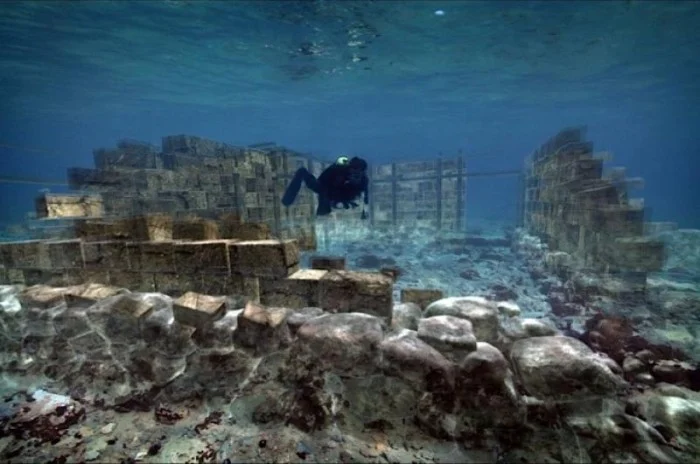
Off the southern coast of Laconia in the Peloponnese, near the small island of Elafonisos, lies Pavlopetri, one of the oldest known submerged cities in the world. Resting just a few meters beneath clear, shallow water, it appears almost as if it could be reoccupied tomorrow. Streets, courtyards, building foundations, and even tombs form a remarkably coherent urban plan.
Archaeological research suggests that Pavlopetri was inhabited as early as the Bronze Age, more than 3,000 years ago. Its layout includes what seem to be multi-roomed houses, a central plaza, and a complex street grid. Pottery recovered from the site connects it to the broader Mycenaean world, indicating active trade and cultural exchange across the Aegean.
The city’s submergence is linked to a combination of tectonic activity and gradual sea-level rise. The Mediterranean sits atop dynamic geological boundaries, and the region around southern Greece is particularly prone to earthquakes. Over centuries, seismic shifts likely lowered the land relative to the sea. Combined with post-glacial sea-level rise that followed the last Ice Age, Pavlopetri slowly slipped beneath the waves.
Today, advanced underwater mapping techniques have created detailed digital reconstructions of the site. Pavlopetri is not a myth, not a legend whispered by fishermen. It is a real Bronze Age town, frozen in time beneath the sea, offering a rare and intimate glimpse into everyday life more than three millennia ago.
2. Thonis-Heracleion, Egypt
Near the Nile Delta, beneath the waters of Abu Qir Bay, lies Thonis-Heracleion, once a major port city of ancient Egypt. Known as Thonis in Egyptian sources and Heracleion in Greek accounts, it flourished during the first millennium BCE as a gateway between Egypt and the Mediterranean world.
Ancient texts described the city as a place of temples, trade, and ritual. For centuries, its exact location was uncertain. Then, in the late 20th and early 21st centuries, underwater archaeological expeditions identified massive stone blocks, colossal statues, and inscribed stelae resting on the seabed.
These discoveries confirmed that Thonis-Heracleion had indeed existed where the texts suggested. Temples dedicated to Egyptian gods once stood there, and inscriptions document decrees regulating trade and taxation. The city was an economic and religious hub.
Its destruction was not sudden in the sense of a volcanic explosion, but dramatic nonetheless. Geological studies indicate that the Nile Delta region is prone to subsidence, where water-saturated sediments can lose stability during earthquakes. This process, known as soil liquefaction, can cause land to collapse. Combined with rising sea levels and shifting river channels, Thonis-Heracleion gradually sank.
The city’s rediscovery has reshaped understanding of Egypt’s interaction with the Greek world. Beneath the silt and saltwater, statues and temple fragments remain, testifying to a once-thriving metropolis that now rests in silence.
3. Baiae, Italy
On the western coast of Italy, near Naples, lies Baiae, once a luxurious resort town of the Roman elite. Emperors and senators built villas there overlooking the Bay of Naples. Thermal baths, grand residences, and elaborate gardens made Baiae synonymous with indulgence and opulence.
Today, part of ancient Baiae lies underwater.
The region sits within the Campi Flegrei volcanic area, a geologically active zone characterized by bradyseism, a slow, vertical movement of the Earth’s surface caused by magma and hydrothermal activity beneath the crust. Over centuries, the land around Baiae gradually subsided, allowing the sea to encroach.
Underwater ruins reveal mosaics, columns, statues, and bath complexes now colonized by marine life. The outlines of villas remain visible beneath the surface, their once-luxurious halls now home to fish and sea grass.
Baiae’s submergence was not the result of a single catastrophic event but a slow geological process. The city did not fall in a day. It sank over generations, a reminder that even the grandest architecture can be humbled by the patient power of the Earth.
4. Port Royal of Alexandria (Eastern Harbor), Egypt
In the eastern harbor of Alexandria lie the remains of royal quarters associated with the Ptolemaic dynasty, the Greek rulers of Egypt after the conquests of Alexander the Great. This area once included palaces, administrative buildings, and monumental architecture.
Ancient Alexandria was founded in the 4th century BCE and became one of the most important cities of the ancient Mediterranean. It was a center of scholarship, trade, and culture. The harbor area played a crucial role in its power and prestige.
Over time, earthquakes and tsunamis affected the region. Geological studies show that the Nile Delta coast has experienced seismic activity capable of triggering subsidence. As parts of the coastline lowered, buildings along the waterfront slipped into the sea.
Underwater excavations have uncovered sphinxes, columns, and massive stone blocks. These remnants reveal a complex urban landscape that once stood above the waterline. The sea, while destructive, has also shielded these structures from later construction and looting, preserving them in unexpected ways.
5. Kekova (Simena), Turkey
Along the southwestern coast of Turkey, near the island of Kekova, the remains of a Lycian settlement lie partially submerged. Stone staircases descend into the sea. Foundations of houses can be seen beneath the surface, their outlines clear in calm weather.
The Lycian civilization thrived in this region during the first millennium BCE. Coastal settlements were integral to trade networks that connected Anatolia with the wider Mediterranean.
An earthquake in antiquity is believed to have contributed to the partial submergence of this settlement. The Mediterranean basin is a tectonically active area, and seismic events can cause sudden changes in coastal elevation. In Kekova’s case, parts of the city slipped below sea level, leaving a haunting shoreline where architecture meets water.
Unlike some submerged cities buried deep offshore, Kekova’s ruins are visible from boats passing overhead. The transparency of the water allows modern visitors to glimpse walls and foundations just beneath the surface, blurring the boundary between land and sea.
6. Atlit-Yam, Israel
Off the coast of Israel, south of Haifa, lies Atlit-Yam, a prehistoric village dating back roughly 9,000 years. Though not a “city” in the classical sense, it represents one of the earliest known submerged settlements in the Mediterranean region.
Atlit-Yam belonged to the Neolithic period, when communities were transitioning from hunter-gatherer lifestyles to agriculture. The site includes stone-built houses, wells, and evidence of early farming. Human burials have also been discovered there.
Its submergence is linked to post-glacial sea-level rise. At the end of the last Ice Age, massive ice sheets melted, causing global sea levels to rise significantly. Coastal settlements that once stood safely inland were gradually inundated.
Atlit-Yam provides rare insight into early agricultural societies and how they adapted—or failed to adapt—to environmental change. It stands as a reminder that rising seas are not only a modern concern. They have reshaped human history for thousands of years.
7. Neapolis, Tunisia
Near the modern city of Nabeul in Tunisia lie the submerged remains of Neapolis, a Roman city that once thrived along the North African coast. Archaeological investigations have identified streets, monuments, and industrial installations beneath the sea.
Historical accounts describe a powerful tsunami in 365 CE triggered by a major earthquake near Crete. Geological and archaeological evidence suggests that parts of Neapolis were affected by this event. Coastal sections may have been devastated and submerged.
The discovery of large underwater areas of Neapolis has expanded understanding of Roman urban life in North Africa. Factories used for producing garum, a fermented fish sauce popular across the Roman world, have been identified among the ruins.
Neapolis illustrates how sudden natural disasters could transform prosperous coastal cities into submerged relics in a matter of hours.
8. Olous, Crete
On the northeastern coast of Crete, near the modern town of Elounda, lie the remains of Olous, an ancient Greek city. Today, parts of its harbor and buildings rest just beneath the shallow waters.
Olous was an important city-state in antiquity, engaged in trade and regional politics. Like many Cretan settlements, it occupied a coastal location advantageous for commerce.
Seismic activity and gradual changes in sea level contributed to its partial submergence. Earthquakes in the eastern Mediterranean have repeatedly reshaped shorelines. In Olous, these forces appear to have lowered sections of the city relative to the sea.
Walking along the shore today, one can sometimes see submerged walls and blocks extending into the water. The boundary between ancient city and present sea feels fragile, as if history itself were dissolving at the edge.
9. Leptis Magna (Submerged Harbor Areas), Libya
Leptis Magna, on the coast of modern Libya, was one of the most magnificent cities of the Roman Empire in North Africa. While much of the city remains on land, parts of its harbor structures are now underwater.
The harbor was central to Leptis Magna’s prosperity. It facilitated trade across the Mediterranean, connecting North Africa with Italy and beyond. Over time, sedimentation from nearby rivers altered the coastline, and sections of the harbor infrastructure became submerged.
Changes in sea level, combined with coastal processes and perhaps seismic events, reshaped the waterfront. The underwater remains provide valuable evidence about Roman engineering and maritime trade networks.
Leptis Magna’s partially submerged harbor is a reminder that even cities that still stand above ground can have hidden chapters beneath the waves.
10. Phanagoria (Submerged Districts), Black Sea Connection to Mediterranean World
Although located on the Taman Peninsula along the Black Sea, Phanagoria was deeply connected to the Mediterranean through Greek colonization and trade. Portions of this ancient city now lie underwater due to shifting coastlines and rising water levels.
Founded by Greek settlers in the 6th century BCE, Phanagoria became an important urban center. Archaeological research has revealed that sections of the city, particularly near the ancient harbor, are submerged.
The Black Sea is linked to the Mediterranean via the Bosporus and Dardanelles, forming part of the broader maritime world of antiquity. Coastal subsidence and sea-level changes contributed to the drowning of parts of Phanagoria.
Underwater excavations have uncovered streets, building foundations, and artifacts that illuminate the life of this once-thriving city.
The Sea as Archivist
The Mediterranean’s sunken cities tell a complex story. Some were overtaken gradually by rising seas after the last Ice Age. Others were struck by earthquakes, tsunamis, or volcanic processes that lowered land or raised water. In many cases, multiple forces worked together over centuries.
Underwater archaeology is a meticulous science. Researchers map sites with sonar, document structures through diving surveys, and analyze sediments to reconstruct environmental changes. They must balance preservation with exploration, as exposure to oxygen and human interference can damage fragile remains.
Paradoxically, the sea often protects what it destroys. Beneath layers of sand and silt, wooden objects, organic materials, and delicate artifacts can survive far longer than they would on land. The Mediterranean has become an immense underwater archive.
These sunken cities challenge us to rethink permanence. Stone walls and grand temples once seemed eternal. Yet coastlines shift, and tectonic plates move. The Earth itself is restless.
At the same time, these submerged landscapes affirm human resilience and creativity. Even after catastrophe, new cities rose nearby. Trade resumed. Culture persisted. Civilization did not end when a harbor sank.
Standing at the shore of the Mediterranean today, one might see only waves and horizon. But beneath that surface lie streets once walked, prayers once spoken, markets once alive with bargaining voices. The sea holds them now, not as ruins of failure, but as chapters in an ongoing story of humanity’s dance with nature.
The drowned cities of the Mediterranean are not merely archaeological curiosities. They are reminders that the boundary between land and water is never fixed, that human history is written not only in books but in stone and sediment, and that the Earth, patient and powerful, always has the final word.