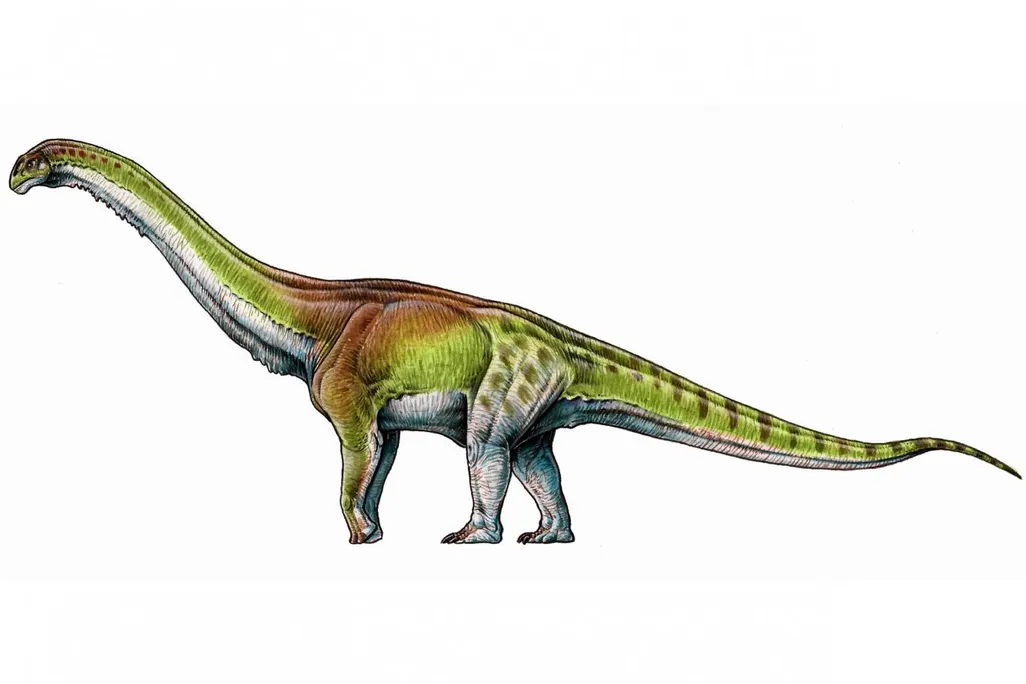
Deep in the windswept plains of southern South America, where vast grasslands stretch toward distant mountains and the earth holds secrets millions of years old, scientists uncovered a creature that would challenge everything we thought we knew about the limits of life on land. Its bones lay buried for nearly one hundred million years beneath the soils of Patagonia. When they finally emerged into the sunlight of the modern world, they revealed the remains of one of the largest animals ever to walk the Earth: Patagotitan mayorum.
This dinosaur was not simply large. It was colossal on a scale that pushes the imagination to its limits. Measuring roughly the length of several buses placed end to end and weighing more than a herd of elephants combined, Patagotitan represents one of the most massive land animals ever discovered. Its existence raises extraordinary questions. How could such a creature grow so enormous? What kind of world allowed animals to reach these sizes? How did scientists measure something so immense from fossilized bones?
The story of Patagotitan is more than a tale of prehistoric gigantism. It is a journey into deep time, into the science of paleontology, and into the methods researchers use to reconstruct animals that vanished tens of millions of years ago. Through careful excavation, detailed analysis, and a remarkable combination of geology, biology, and physics, scientists pieced together the life of a dinosaur that once dominated its ancient landscape.
Discovery in the Patagonian Wilderness
The beginning of Patagotitan’s story lies in the remote region of Patagonia, a vast and rugged area that stretches across southern Argentina and Chile. Patagonia is famous among paleontologists for its rich fossil deposits, particularly from the Cretaceous Period, a time when dinosaurs ruled the continents.
In 2012, a farm worker named Aurelio Hernández made a remarkable observation while walking across land on a ranch in the province of Chubut Province. Protruding from the ground was a massive fossilized bone. At first glance, it was clear that this was not the remnant of any ordinary animal. The bone was enormous, far larger than those typically found in fossil digs.
The discovery was reported to scientists from the Museo Paleontológico Egidio Feruglio, an institution known for its research on South American dinosaurs. Soon a team of paleontologists arrived at the site. What they uncovered exceeded even their most hopeful expectations.
Over several excavation seasons, researchers discovered the fossilized remains of multiple giant dinosaurs. The bones included enormous vertebrae, limb bones, ribs, and parts of the tail and neck. Many of the bones were astonishingly well preserved. The sheer scale of the fossils suggested that these animals belonged to a species far larger than most previously known dinosaurs.
As more bones emerged from the rock, scientists realized they were dealing with a new species of titanosaur, a group of long-necked herbivorous dinosaurs known for their immense size. In 2017, the dinosaur was formally named Patagotitan mayorum.
The name itself tells a story. “Patago” refers to Patagonia, the region where the fossils were found. “Titan” evokes the giants of ancient mythology, a fitting description for an animal of such magnitude. The species name “mayorum” honors the Mayo family, the owners of the ranch where the fossils were discovered.
The Age of the Giant
Patagotitan lived during the Late Cretaceous Period, approximately 100 million years ago. At that time, the world looked very different from today.
The continents were still drifting toward their modern positions after the breakup of the supercontinent Gondwana. South America had begun separating from Africa, creating new coastlines and changing climate patterns. Warm temperatures and high sea levels characterized much of the planet.
Patagonia itself was a lush environment filled with forests, rivers, and floodplains. Giant conifer trees towered overhead, while ferns and flowering plants spread across the landscape. These environments provided abundant food for massive herbivores like Patagotitan.
Dinosaurs dominated terrestrial ecosystems. Predators stalked the plains, including large carnivorous theropods. In this world, survival required both strength and scale. For plant-eating dinosaurs, enormous size offered protection from predators and allowed them to reach vast amounts of vegetation.
Patagotitan thrived in this environment. Its massive body, long neck, and powerful limbs made it one of the true giants of its time.
The Anatomy of a Colossus
Understanding an animal as enormous as Patagotitan requires careful study of its bones. Paleontologists analyze fossilized skeletons to reconstruct body size, posture, and movement.
Patagotitan belonged to a group of dinosaurs called titanosaurs, members of the larger sauropod lineage. Sauropods were characterized by their long necks, long tails, small heads, and massive bodies supported by column-like legs.
The bones of Patagotitan reveal a creature built on an extraordinary scale. Its femur, or thigh bone, measured more than two meters in length. Vertebrae from its backbone were enormous yet surprisingly lightweight due to air-filled cavities that reduced mass while maintaining strength.
The dinosaur’s neck likely stretched more than twelve meters in length. This immense neck allowed Patagotitan to reach vegetation across a wide area without needing to move its heavy body constantly.
Its tail, long and muscular, helped balance the body and likely played a role in communication or defense. Meanwhile, its limbs functioned like pillars supporting a living mountain of flesh and muscle.
Despite its massive size, Patagotitan was not clumsy. Evidence from sauropod trackways suggests these dinosaurs were capable walkers, able to move across landscapes in search of food and water.
Measuring a Dinosaur That No One Ever Saw Alive
One of the greatest challenges in paleontology is estimating the size and weight of extinct animals. Unlike living creatures, dinosaurs cannot be placed on a scale or measured directly.
Scientists rely on several techniques to estimate body mass and length. For Patagotitan, researchers used comparisons with other well-known sauropods, digital modeling, and biomechanical analysis.
By measuring the circumference of weight-bearing bones such as the femur and humerus, scientists can estimate how much weight those bones supported. These measurements are combined with scaling relationships observed in living animals to calculate body mass.
Digital models also play an important role. Researchers scan fossil bones and use computer software to reconstruct the entire skeleton. They then add layers representing muscles, organs, and skin to estimate the total body volume.
From these methods, scientists concluded that Patagotitan measured roughly 37 meters in length and weighed around 70 metric tons. That is comparable to the weight of a fully loaded passenger jet.
These estimates place Patagotitan among the largest known land animals in Earth’s history.
The Life of a Titanosaur
To imagine Patagotitan’s life, we must picture an ecosystem filled with giants.
These dinosaurs were herbivores, feeding primarily on vegetation. Their long necks allowed them to reach high branches as well as sweep across low-growing plants. Instead of chewing their food like mammals, sauropods swallowed vegetation whole. Their digestive systems likely relied on fermentation to break down tough plant material.
A single adult Patagotitan may have consumed hundreds of kilograms of plants every day. The forests and floodplains of Cretaceous Patagonia would have needed to produce enormous quantities of vegetation to sustain herds of such animals.
Growth in sauropods was rapid. Fossil evidence suggests that young titanosaurs grew quickly during their early years, eventually reaching gigantic adult sizes. This rapid growth helped reduce vulnerability to predators.
Patagotitan likely lived in groups or loose herds. Such social behavior could offer protection and improve access to food sources across large territories.
The Role of Predators
Even giants faced threats in the Cretaceous world. Large carnivorous dinosaurs roamed the same landscapes as Patagotitan.
One of the most formidable predators in the region was Tyrannotitan chubutensis, a massive meat-eating dinosaur capable of hunting large prey.
Adult Patagotitans were probably too large for most predators to attack successfully. However, juveniles would have been far more vulnerable. Like many large herbivores today, young animals may have depended on the protection of the herd.
The presence of such predators likely influenced the behavior and evolution of titanosaurs, shaping their growth rates and defensive strategies.
Why Could Dinosaurs Grow So Large?
One of the most fascinating questions raised by Patagotitan concerns the limits of size in land animals. Why could dinosaurs grow so much larger than modern mammals?
Scientists propose several factors. One key element is the sauropod respiratory system. Like modern birds, sauropods may have possessed air sacs connected to their lungs. This system allowed efficient oxygen exchange and helped lighten their skeletons.
Their long necks also allowed them to gather food across wide areas without moving their bodies constantly, conserving energy.
Reproduction may have played a role as well. Dinosaurs laid eggs, allowing populations to produce many offspring without the energetic cost of pregnancy typical of large mammals.
Environmental conditions during the Cretaceous Period may also have supported giant body sizes. Warm climates and abundant vegetation created ecosystems capable of sustaining enormous herbivores.
Together, these factors allowed sauropods like Patagotitan to push the boundaries of size.
Excavating the Giants
Excavating a dinosaur as large as Patagotitan is a monumental task. Each bone must be carefully uncovered from rock that has hardened over millions of years.
Paleontologists begin by mapping the fossil site, documenting the precise position of each bone. The fossils are then encased in protective plaster jackets before being transported to laboratories for further preparation.
At the laboratory, technicians slowly remove surrounding rock using delicate tools. This process can take months or even years.
Once prepared, the bones are studied in detail. Measurements are taken, surfaces examined for muscle attachments, and comparisons made with other dinosaurs.
Through this meticulous work, scientists transform fragments of ancient skeletons into a picture of a living creature.
Reconstructing the Skeleton
When enough bones are recovered, paleontologists can reconstruct the entire skeleton of a dinosaur.
Patagotitan’s fossils were so extensive that researchers were able to create a nearly complete skeletal reconstruction. This reconstruction now stands in museums, allowing visitors to stand beneath the towering frame of one of Earth’s greatest giants.
Such displays are not merely for public fascination. They also serve scientific purposes, helping researchers study posture, balance, and biomechanics.
Seeing the skeleton assembled reveals the extraordinary proportions of Patagotitan. Its body stretches across vast distances, yet every bone fits into a coherent structure shaped by millions of years of evolution.
A Window into Deep Time
The discovery of Patagotitan provides a glimpse into a world long vanished. The rocks that preserved its bones formed during ancient floods that buried the remains of animals and plants.
Over millions of years, sediment hardened into stone, locking fossils within layers that scientists can read like pages of a history book.
By studying these layers, paleontologists reconstruct ancient ecosystems. They learn what plants grew there, what animals lived together, and how environments changed over time.
Patagotitan is not just a dinosaur. It is a clue to the structure of entire prehistoric worlds.
The Legacy of the Largest Dinosaurs
The study of giant dinosaurs continues to evolve as new discoveries are made. Each fossil adds another piece to the puzzle of how life evolved on Earth.
Patagotitan stands as one of the most impressive examples of sauropod gigantism. Its discovery reminds us that nature once produced creatures far beyond the scale of anything alive today.
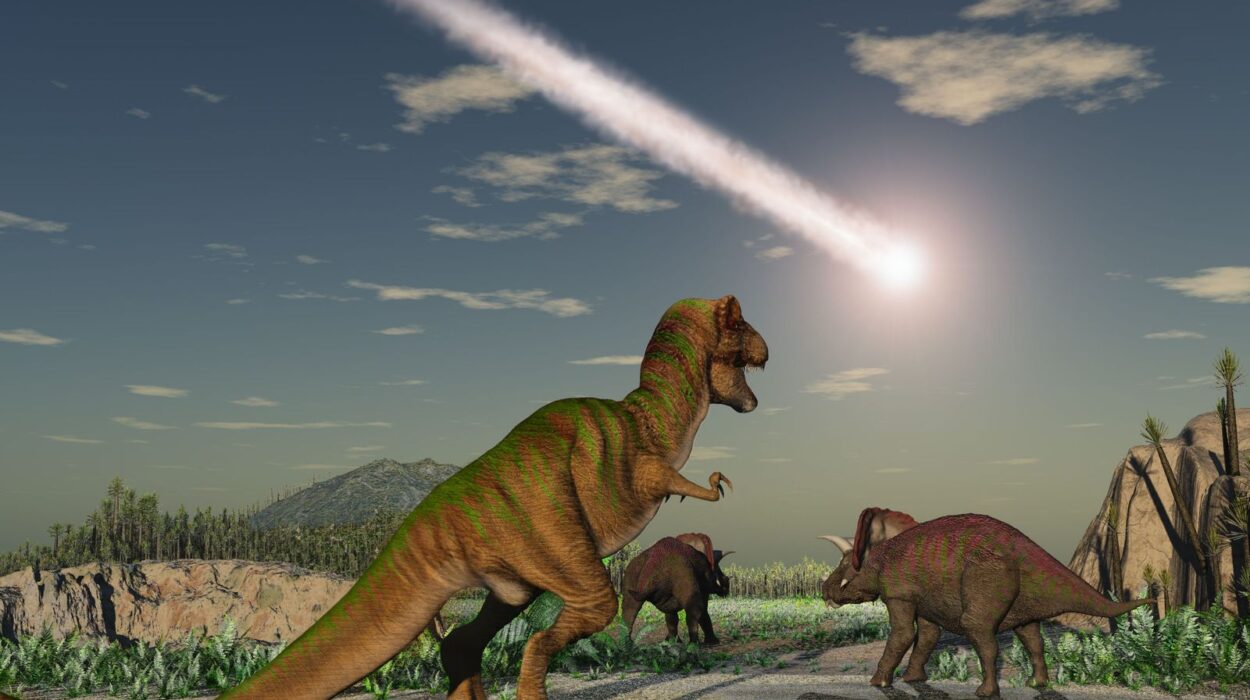
Yet its bones also tell a story of fragility. Even the largest animals cannot escape extinction. Around 66 million years ago, the age of dinosaurs ended in the catastrophe known as the Cretaceous–Paleogene extinction event, when an asteroid impact and global environmental changes wiped out most dinosaur species.
Patagotitan had vanished long before that event, but its relatives remained until the final days of the dinosaurs.
The Continuing Quest
Every fossil discovery reminds us how much remains unknown. New dinosaur species are found every year, and improved technologies allow scientists to examine fossils in ways that were impossible just decades ago.
CT scanning, digital modeling, and advanced biomechanical simulations are transforming our understanding of prehistoric life.
Patagotitan represents both a culmination of knowledge and a starting point for new questions. How many giant titanosaurs once roamed Patagonia? How did their ecosystems function? What limits ultimately constrained their size?
Paleontology continues to explore these mysteries, driven by curiosity and the enduring human desire to understand the past.
Standing Beneath a Giant
Imagine standing beside the skeleton of Patagotitan in a museum hall. Its neck rises high overhead, vertebrae stacked like massive stones in a living tower. Its ribs curve outward like the beams of a vast cathedral. Its tail stretches far behind, disappearing into the distance of the exhibit.
In that moment, the past feels suddenly alive.
This dinosaur once walked across a landscape filled with ancient forests and roaring rivers. It breathed, fed, moved in herds, and shaped its ecosystem through sheer scale.
Today, only its bones remain, yet they speak with remarkable clarity.
Patagotitan reminds us that Earth’s history is filled with wonders beyond imagination. Long before humans appeared, giants ruled the land. Their story is written in stone, waiting patiently for those willing to search, measure, and listen.
And through the science of paleontology, those ancient giants walk again in our understanding of the natural world.