Among the countless creatures that once walked the Earth during the age of dinosaurs, few have captured the human imagination as intensely as Velociraptor. The name itself evokes speed, danger, and cunning. In popular culture it has often been portrayed as a terrifying predator capable of coordinated attacks and frightening intelligence. Yet the real Velociraptor is both more subtle and more fascinating than the fictional versions that dominate movies and books. Far from being a giant monster, Velociraptor was actually a relatively small dinosaur, roughly the size of a large turkey or small wolf. What it lacked in size, however, it made up for with agility, sharp senses, and specialized hunting adaptations that made it one of the most efficient predators of its time.
The story of Velociraptor is not just the story of a single dinosaur species. It is a window into the evolution of predatory behavior, the origins of birds, and the complex ecosystems of the Late Cretaceous world. It is also a reminder that scientific understanding evolves. Over the past century, paleontologists have transformed Velociraptor from a scaly reptilian predator into a feathered, bird-like hunter that reveals deep evolutionary connections between dinosaurs and modern birds. Each new fossil discovery adds another piece to this puzzle, bringing us closer to understanding how these animals lived, hunted, and interacted with their environment.
To explore Velociraptor is to step into a lost world, a world of shifting deserts, ancient rivers, strange vegetation, and creatures that would seem both alien and familiar. In that world, Velociraptor moved quietly through the landscape, alert, intelligent, and deadly.
Discovery of Velociraptor
The first scientific discovery of Velociraptor occurred in the early twentieth century during an expedition to the Gobi Desert in Mongolia. This region, harsh and windswept today, holds some of the most important dinosaur fossil sites on Earth. In 1923, paleontologists uncovered the remains of a small predatory dinosaur unlike anything previously described. The fossils included a skull, claws, and parts of the skeleton that revealed a swift, agile animal built for hunting.
The dinosaur was given the name Velociraptor mongoliensis. The name combines Latin words meaning “swift thief,” an appropriate description for an animal that likely relied on speed and stealth to capture prey. At the time of its discovery, Velociraptor immediately intrigued scientists because of its unusual anatomy, particularly the large curved claw on its second toe. This claw suggested a specialized hunting strategy unlike that of many other carnivorous dinosaurs.
Early interpretations of Velociraptor imagined it as a small but vicious reptile, similar in appearance to other theropod dinosaurs. Paleontologists knew it was related to larger predators such as Tyrannosaurus and Allosaurus, but its size and proportions indicated a very different lifestyle. Over time, more fossils were discovered in Mongolia and northern China, revealing additional details about its anatomy and behavior.
Perhaps the most famous fossil associated with Velociraptor was discovered in 1971. Known as the “Fighting Dinosaurs” fossil, it preserved an extraordinary moment frozen in time. The fossil shows a Velociraptor locked in combat with a herbivorous dinosaur called Protoceratops. The Velociraptor’s sickle-shaped claw is embedded in the throat region of its opponent, while the Protoceratops has clamped its powerful jaws onto the predator’s arm. Both animals appear to have died suddenly, likely buried by a collapsing sand dune during their struggle. This remarkable fossil provided direct evidence of predatory behavior and remains one of the most dramatic discoveries in paleontology.
Anatomy of a Hunter
Velociraptor was not a giant dinosaur, but its body was perfectly designed for speed, balance, and lethal precision. Adults measured roughly two meters in length from nose to tail and stood about half a meter tall at the hip. Their bodies were lightweight and streamlined, allowing them to move quickly across the ground. Despite their modest size, they were powerful predators with sharp teeth, grasping hands, and specialized claws.
The skull of Velociraptor was long and low, filled with dozens of serrated teeth. These teeth were curved and razor-sharp, ideal for slicing through flesh. Unlike the crushing teeth of some predators, Velociraptor’s teeth were built for cutting and tearing. This suggests that once it captured prey, it likely delivered multiple quick bites rather than relying on a single powerful bite.
The arms of Velociraptor were long and flexible, ending in three clawed fingers capable of grasping objects. These hands were not simply for balance or movement. They were tools for seizing prey, holding struggling animals in place, and possibly even manipulating objects in the environment.
One of the most distinctive features of Velociraptor was the large sickle-shaped claw on the second toe of each foot. This claw could reach several centimeters in length and was sharply curved like a knife. Unlike the other toes, which touched the ground during walking, this claw was held off the ground to keep it sharp. When attacking prey, Velociraptor could raise the claw and drive it downward with force.
For many years, scientists believed this claw was used to slash open prey in dramatic fashion. More recent research suggests a slightly different interpretation. The claw may have been used more like a grappling hook, helping Velociraptor latch onto prey and maintain balance while delivering bites. In this scenario, the predator might leap onto a struggling animal, dig its claws into the body, and use its jaws to finish the attack.
The tail of Velociraptor was long and stiffened by bony rods. This structure acted as a counterbalance, allowing the dinosaur to make sharp turns while running. Much like the tail of a modern cheetah helps maintain balance during high-speed chases, the tail of Velociraptor would have allowed quick changes in direction during pursuit.
Together, these anatomical features formed a predator perfectly adapted for speed, agility, and precise attacks.
Evidence of Feathers
One of the most exciting developments in dinosaur research over the past few decades has been the discovery that many theropod dinosaurs had feathers. Velociraptor is among the species that show clear evidence of this feature.
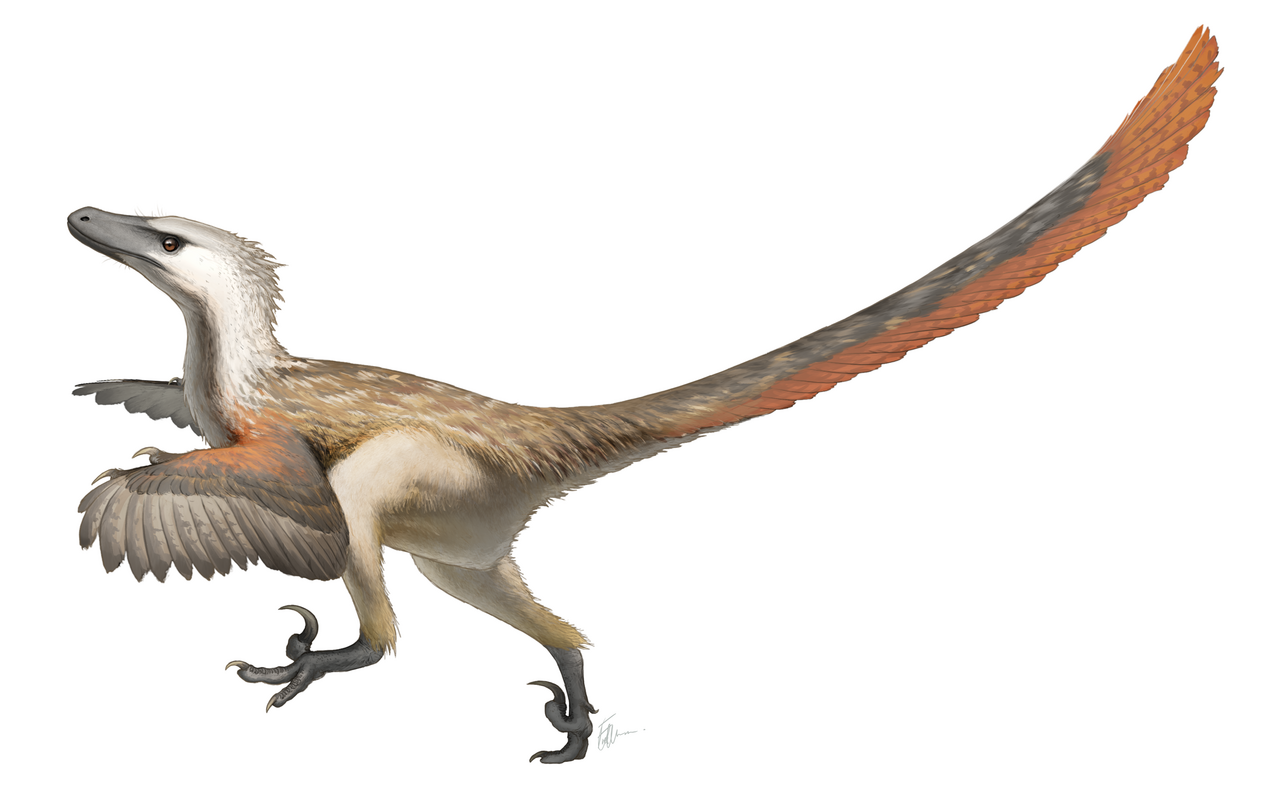
In 2007, scientists discovered small bumps on the forearm bones of a Velociraptor fossil. These bumps are known as quill knobs and serve as attachment points for feathers in modern birds. Their presence indicates that Velociraptor had well-developed feathers attached to its arms.
These feathers were likely similar to the flight feathers of birds, although Velociraptor itself was far too large and heavy to fly. Instead, the feathers may have served other purposes. They could have helped regulate body temperature, providing insulation in cooler environments. They may also have played a role in display, allowing individuals to communicate through visual signals during courtship or territorial interactions.
Feathers might also have assisted with balance during rapid movement. Some scientists propose that spreading the feathered arms while running or jumping could have provided stability, similar to how birds use their wings for balance.
The presence of feathers on Velociraptor strengthens the evolutionary link between dinosaurs and birds. In fact, birds are now widely recognized as living dinosaurs, descended from small feathered theropods that survived the mass extinction at the end of the Cretaceous period.
When imagining Velociraptor today, scientists no longer picture a scaly reptile. Instead, they envision a sleek predator covered in feathers, perhaps with patterned plumage and a bird-like appearance that would seem both strange and familiar to modern eyes.
The World of the Late Cretaceous
Velociraptor lived approximately seventy-five million years ago during the Late Cretaceous period. At that time, the continents were arranged differently than they are today, and the climate of Earth was generally warmer.
The region that is now Mongolia was part of a vast landscape that included deserts, sand dunes, river systems, and seasonal lakes. Fossil evidence from the Gobi Desert suggests that the environment could be harsh and dry, with shifting sands capable of burying animals suddenly.
Despite these challenging conditions, the ecosystem supported a wide variety of life. Small mammals scurried through the underbrush, early birds flew overhead, and numerous dinosaur species roamed the land. Herbivorous dinosaurs such as Protoceratops and various small ornithopods provided potential prey for Velociraptor.
Vegetation included hardy plants adapted to semi-arid conditions, such as ferns, shrubs, and early flowering plants. These plants formed the foundation of the food chain, supporting herbivores that in turn supported predators like Velociraptor.
The presence of rivers and lakes meant that water sources attracted animals from across the landscape. These gathering points likely created opportunities for predators. A Velociraptor waiting silently near a watering hole might have had a chance to ambush unsuspecting prey.
This environment was dynamic and sometimes dangerous. Sandstorms, sudden dune collapses, and seasonal changes could transform the landscape rapidly. The fossil record suggests that some animals died quickly when buried by shifting sands, preserving remarkable snapshots of ancient life.
Hunting Behavior and Intelligence
Understanding how Velociraptor hunted has been a major focus of paleontological research. While fossils cannot reveal every detail of behavior, they provide clues that allow scientists to make informed interpretations.
The anatomy of Velociraptor suggests a predator that relied on speed, agility, and precise attacks rather than brute strength. Its relatively small size means it likely targeted prey that was smaller or similar in size. Juvenile dinosaurs, small mammals, and reptiles may have been common targets.
The famous “Fighting Dinosaurs” fossil demonstrates that Velociraptor could engage with prey that fought back fiercely. Protoceratops was a strong, horned herbivore with powerful jaws, yet Velociraptor still attempted to attack it.
Some popular portrayals depict Velociraptor as a highly intelligent animal capable of coordinated pack hunting. While this idea is intriguing, direct evidence for complex pack behavior is limited. However, the brain of Velociraptor was relatively large for a dinosaur of its size, suggesting good sensory abilities and possibly advanced behavior compared with many other reptiles.
Its large eye sockets indicate strong vision, which would have been useful for detecting movement and tracking prey. Combined with agility and sharp claws, this made Velociraptor an efficient hunter.
Rather than charging blindly, Velociraptor may have used stealth. A feathered body could help break up its outline in vegetation or rocky terrain, allowing it to approach prey quietly before launching a sudden attack.
Growth, Life Cycle, and Reproduction
Although complete life histories of dinosaurs are difficult to reconstruct, fossil evidence provides hints about how Velociraptor grew and reproduced.
Like many dinosaurs, Velociraptor likely hatched from eggs laid in nests. Fossils of closely related species show that some theropods brooded their eggs, sitting on nests in a bird-like posture to keep them warm. It is possible that Velociraptor behaved in a similar way.
Young Velociraptors would have been small and vulnerable, requiring protection or concealment during their early stages of life. As they grew, their bodies would gradually develop the strong legs, claws, and hunting skills needed for survival.
Growth rates in many dinosaurs were surprisingly fast compared with modern reptiles. Studies of bone structure suggest that some theropods reached maturity within several years rather than decades. Velociraptor may have grown quickly, allowing it to become an effective predator while still relatively young.
Social interactions among Velociraptors remain uncertain, but display behaviors involving feathers may have played a role in attracting mates or establishing dominance.
Velociraptor and the Evolution of Birds
Perhaps the most profound scientific importance of Velociraptor lies in its connection to the origin of birds. Over the past several decades, fossil discoveries have revealed that birds evolved from small theropod dinosaurs closely related to species like Velociraptor.
Shared features include hollow bones, three-fingered hands, flexible wrists, feathers, and similar skeletal structures. These similarities show that the boundary between dinosaurs and birds is not sharp but gradual.
In evolutionary terms, Velociraptor represents a branch of the dinosaur family tree that is closely related to the ancestors of modern birds. Although Velociraptor itself could not fly, it possessed many traits that later became essential for flight in birds.
This realization has transformed the way scientists view dinosaurs. Rather than being completely extinct, dinosaurs still live today in the form of birds. Every sparrow, eagle, or pigeon carries within its body the legacy of ancient theropods.
Velociraptor in Popular Culture
Few dinosaurs have achieved the cultural fame of Velociraptor. In films, novels, and documentaries, it is often portrayed as a clever and terrifying predator. These portrayals have helped spark public interest in dinosaurs and paleontology.
However, popular depictions often exaggerate the size and abilities of Velociraptor. In reality, the dinosaurs shown in many movies more closely resemble a larger relative called Deinonychus.
Despite these inaccuracies, the popularity of Velociraptor has encouraged scientific curiosity. Many people first learn about dinosaurs through entertainment and later discover the fascinating truths revealed by research.
Modern reconstructions increasingly depict Velociraptor with feathers, bringing it closer to its true appearance. As scientific knowledge grows, the public image of this dinosaur continues to evolve.
The End of the Age of Dinosaurs
Velociraptor lived during the final chapter of the dinosaur era. About sixty-six million years ago, a catastrophic event changed life on Earth forever. A massive asteroid impact triggered environmental changes that led to the extinction of most dinosaur species.
Predatory dinosaurs like Velociraptor disappeared along with many other animals. Only certain lineages survived, including the ancestors of modern birds.
Although Velociraptor itself did not survive this extinction, its evolutionary relatives did. Their descendants spread across the world and adapted to countless environments, eventually becoming the birds that fill our skies today.
A Predator Remembered
Velociraptor remains one of the most fascinating dinosaurs ever discovered. It was not the largest predator of its time, nor the strongest, but it was among the most specialized. Its anatomy reveals an animal built for precision hunting, equipped with sharp claws, keen senses, and remarkable agility.
More importantly, Velociraptor represents a crucial link in the story of evolution. Its feathers, bird-like skeleton, and advanced features show how closely dinosaurs and birds are connected.
Each fossil discovery adds depth to this story, transforming Velociraptor from a mysterious skeleton in the desert into a living creature in the imagination of science. It becomes easier to picture it moving across the dunes of ancient Mongolia, feathers rustling in the wind, eyes alert for movement in the distance.
In that moment, Velociraptor is no longer just a fossil or a movie monster. It is a real animal that once lived, hunted, struggled, and survived in a world long vanished. Through science, its story continues to unfold, reminding us that the past is never truly lost. It waits patiently in stone, ready to speak to those who know how to listen.