More than sixty-six million years ago, near the end of the age of dinosaurs, vast landscapes stretched across what is now North America. Rivers wound through forests of conifers and flowering plants, wetlands teemed with life, and herds of enormous herbivorous dinosaurs moved slowly across the plains. Among these giants lived one of the most recognizable creatures ever to walk the Earth: Triceratops. With its massive body, powerful legs, distinctive frill, and three formidable horns, Triceratops was not only a dominant herbivore of its time but also one of the most iconic dinosaurs in human imagination.
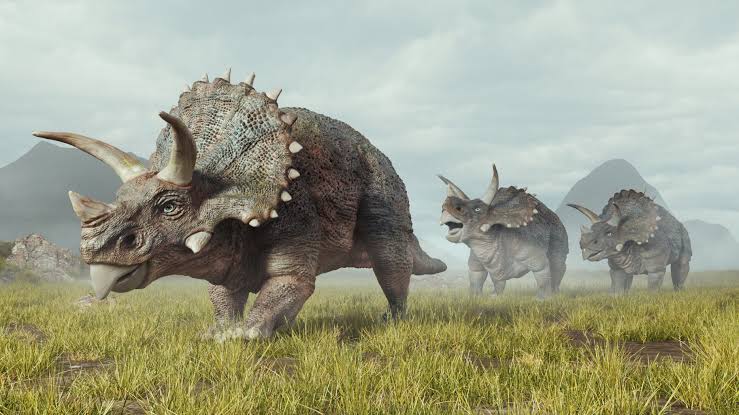
Triceratops is often called the “three-horned face,” a name derived from Greek roots that describe its most striking features. Two long horns rose above its eyes, curving slightly forward, while a shorter horn projected from its nose. Behind its skull spread a broad bony frill, creating a shield-like structure that made its head appear enormous. When paleontologists first discovered its fossils in the late nineteenth century, the creature immediately captured attention. Here was a dinosaur that looked almost mythical, like a dragon forged from bone and muscle.
Yet Triceratops was not a fantasy beast. It was a real animal, shaped by millions of years of evolution, perfectly adapted to the environment of the Late Cretaceous period. Its story reveals not only the life of a powerful herbivore but also the dynamic ecosystems in which dinosaurs lived. To understand Triceratops is to glimpse a world long vanished, a world where survival depended on strength, strategy, and constant adaptation.
The Discovery of a Dinosaur Icon
The story of Triceratops began in the late nineteenth century during an era known as the “Bone Wars,” a fierce scientific rivalry between American paleontologists searching for dinosaur fossils in the western United States. During this period, fossil hunters uncovered enormous bones scattered across the badlands and rocky outcrops of the Great Plains.
In 1887, a large horned skull fragment was discovered in Colorado. At first, scientists believed it belonged to a giant prehistoric bison. The horn looked remarkably similar to the horns of modern mammals, and the idea that such a creature could belong to a dinosaur seemed almost impossible at the time. However, further discoveries quickly changed this interpretation.
More complete skulls began to emerge from the rock layers of Montana, Wyoming, and South Dakota. These fossils revealed a creature unlike anything previously known. The skull alone could measure over two meters long, making it one of the largest skulls of any land animal that has ever lived. The combination of horns and frill clearly placed the animal within a group of dinosaurs known as ceratopsians, meaning “horned faces.”
When the dinosaur was formally described and named Triceratops, it became an instant symbol of the prehistoric world. Its dramatic appearance captured the imagination of both scientists and the public. Museums proudly displayed reconstructed skeletons, and illustrations of Triceratops charging across ancient landscapes became common in books and magazines.
Over the decades, hundreds of Triceratops fossils have been discovered, making it one of the best-known dinosaurs in the fossil record. These discoveries have allowed scientists to study its anatomy, growth, and behavior in remarkable detail.
The Physical Power of Triceratops
Triceratops was a massive animal. Adults could grow approximately nine meters in length and weigh between six and twelve tons. Its body was broad and muscular, supported by four strong legs that carried its tremendous weight across the land. Unlike some dinosaurs that walked on two legs, Triceratops was a quadruped, meaning it moved on all fours like modern rhinoceroses or elephants.
Its head was its most extraordinary feature. The skull alone could weigh hundreds of kilograms, making it one of the largest and most elaborate skulls ever evolved. The two brow horns were particularly impressive, often reaching lengths of nearly one meter. These horns were solid bone, capable of withstanding powerful impacts.
The nasal horn was shorter but still prominent. Together with the brow horns, it created a triangular arrangement that gave the dinosaur its name. Behind the horns extended the frill, a broad bony shield that formed part of the skull.
The frill was not merely decorative. It served several potential functions, including protection, display, and possibly thermoregulation. The edges of the frill were lined with small bony projections that varied slightly between individuals, suggesting that visual appearance may have played a role in social behavior.
The body of Triceratops was low and sturdy, with a deep chest and powerful shoulders. Its front limbs were particularly strong, allowing it to support the enormous weight of its head. Fossil evidence suggests that its limbs were positioned somewhat beneath the body rather than sprawled outward, giving it a stable and efficient stance.
Its tail was relatively short compared to many other dinosaurs. Unlike the long whip-like tails of some species, the tail of Triceratops likely served mainly for balance rather than defense.
The Role of the Three Horns
The three horns of Triceratops are perhaps the most famous feature of any dinosaur. For generations, scientists have debated their exact purpose. While it is clear that the horns could be used as weapons, their role may have been more complex than simple defense.
One possibility is that the horns were used to defend against predators. During the Late Cretaceous, the enormous carnivorous dinosaur Tyrannosaurus rex roamed the same ecosystems as Triceratops. Fossil evidence suggests that these two giants sometimes encountered each other in life-and-death struggles.
Some Triceratops fossils show healed injuries on their frills and horns, suggesting that they survived violent encounters. Meanwhile, certain Tyrannosaurus bones bear marks that resemble horn wounds. These clues hint at dramatic confrontations in which Triceratops may have used its horns to fend off attacks.
Another possibility is that the horns were used in contests between individuals of the same species. Many modern animals with horns or antlers use them to compete for dominance or mating rights. The shape and strength of Triceratops horns suggest they may have been used in similar head-to-head clashes.
In addition, the horns likely served as visual signals. Their size, shape, and orientation may have helped individuals recognize members of their own species or display strength and health to potential mates. In this way, the horns of Triceratops were not merely weapons but also tools of communication.
The Protective Frill
The frill of Triceratops is another remarkable feature. This wide bony plate extended backward from the skull, creating a dramatic silhouette that made the dinosaur instantly recognizable.
One of the earliest interpretations suggested that the frill acted as a shield, protecting the neck from predators. Because the neck is a vulnerable area in many animals, this idea seemed plausible. The thick bone of the frill could have absorbed bites or blows during attacks.
However, later research revealed that the frill was not as solid as once believed. In some individuals, parts of the frill were relatively thin, suggesting that its primary role might not have been purely defensive.
Another possibility is that the frill served as a display structure. Its large surface area could have supported bright colors or patterns in life, helping individuals communicate visually with one another. Just as peacocks display their feathers or deer display their antlers, Triceratops may have used its frill to attract mates or intimidate rivals.
Some scientists have also suggested that the frill could help regulate body temperature by allowing heat to dissipate through blood vessels within the bone. Although this idea remains debated, it highlights the many potential functions such structures may have served.
Feeding in a Prehistoric World
Despite its intimidating appearance, Triceratops was a plant-eater. Its diet consisted entirely of vegetation, and it spent much of its life searching for and consuming plants.
The Late Cretaceous environment offered a rich variety of plant life. Forests included conifers, cycads, ferns, and early flowering plants. Triceratops likely fed on low-growing vegetation, using its powerful beak to clip leaves, stems, and branches.
Its jaws were equipped with specialized teeth arranged in groups called dental batteries. Unlike simple reptilian teeth, these teeth were constantly replaced and worn down through chewing. This allowed Triceratops to process tough plant material efficiently.
The beak at the front of its mouth was sharp and strong, resembling the beak of a giant parrot or turtle. This beak allowed the dinosaur to slice through vegetation before grinding it with its teeth.
Because plants are less energy-rich than meat, herbivorous dinosaurs needed to consume large quantities of food to sustain their enormous bodies. A single adult Triceratops likely spent many hours each day feeding, moving slowly across the landscape in search of fresh vegetation.
Growth and Development
Like many dinosaurs, Triceratops underwent significant changes as it grew from hatchling to adult. Fossil evidence suggests that young individuals looked quite different from mature ones.
Juvenile Triceratops had shorter horns and smaller frills. As they matured, their horns grew longer and curved forward, while the frill expanded dramatically. These changes may have signaled age and maturity within the population.
The growth of horns and frills also indicates that social interactions may have become more important as individuals reached adulthood. Mature Triceratops likely used these structures to establish dominance or attract mates.
Bone studies show that Triceratops grew rapidly during its early years, reaching large sizes relatively quickly. This rapid growth may have helped young dinosaurs avoid predators, as larger animals are more difficult to attack.
Life in the Late Cretaceous
The world in which Triceratops lived was vibrant and dynamic. The Late Cretaceous period, about 68 to 66 million years ago, was a time of rich biodiversity. Dinosaurs dominated the land, while flying reptiles soared through the skies and marine reptiles ruled the oceans.
North America at this time was divided by a vast inland sea that split the continent into two large landmasses. Triceratops lived on the western portion, a region known as Laramidia. This land was filled with rivers, floodplains, and forests, creating ideal habitats for herbivorous dinosaurs.
Triceratops shared its environment with a variety of other species, including duck-billed hadrosaurs, armored ankylosaurs, and small agile predators. The ecosystem was complex, with each species occupying a unique ecological role.
At the top of the food chain stood Tyrannosaurus rex, one of the most formidable predators in Earth’s history. The presence of such a predator likely influenced the behavior and evolution of Triceratops, encouraging the development of strong defenses.
Encounters with Tyrannosaurus
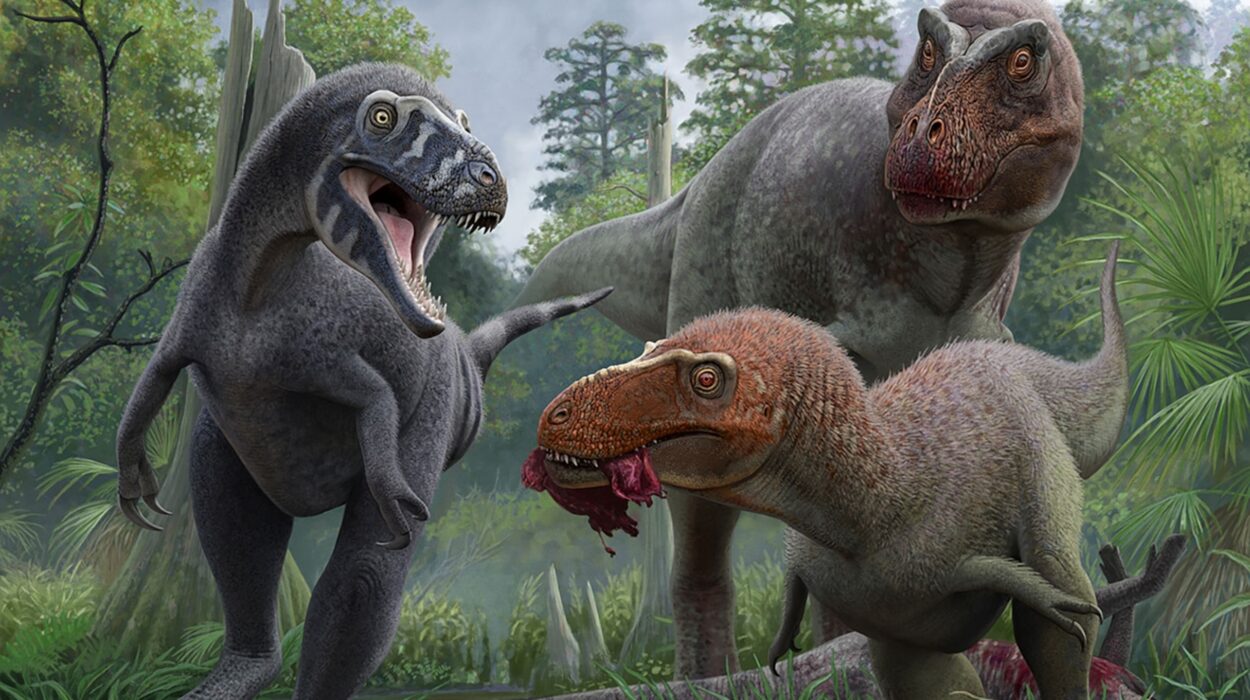
One of the most dramatic aspects of Triceratops’ life was its potential encounters with Tyrannosaurus rex. Fossil evidence strongly suggests that these two dinosaurs interacted frequently.
Some Triceratops fossils show bite marks that match the teeth of Tyrannosaurus. In certain cases, the wounds show signs of healing, indicating that the dinosaur survived the attack. These injuries provide a rare glimpse into real-life struggles that occurred millions of years ago.
On the other hand, some Tyrannosaurus skeletons show damage that may have been caused by Triceratops horns. This suggests that the herbivore was not a helpless victim but a powerful opponent capable of fighting back.
Imagining such encounters reveals the intensity of prehistoric life. A charging Triceratops, lowering its massive horns in defense, would have been a formidable sight even for a giant predator.
The Final Days of the Dinosaurs
Triceratops lived during the final chapter of the dinosaur era. Approximately sixty-six million years ago, a catastrophic event transformed life on Earth.
A massive asteroid struck what is now the Yucatán Peninsula in Mexico, triggering global devastation. The impact released enormous energy, sending dust and debris into the atmosphere and disrupting climates around the world.
Sunlight was blocked, temperatures dropped, and ecosystems collapsed. Plants died in large numbers, and herbivores like Triceratops lost their primary food sources. Predators soon followed.
This event marked the end of the non-avian dinosaurs and many other forms of life. The age of dinosaurs, which had lasted more than 160 million years, came to a sudden and dramatic close.
Triceratops was among the last dinosaurs to roam the Earth before this extinction. Its fossils appear right up to the boundary that marks the end of the Cretaceous period, making it one of the final representatives of its kind.
Triceratops in Modern Culture
Although Triceratops disappeared millions of years ago, it remains vividly alive in human culture. Its distinctive appearance has made it one of the most recognizable dinosaurs in books, films, and museums.
Children often learn the name Triceratops early in their fascination with dinosaurs. Its combination of strength and herbivorous nature makes it both impressive and approachable, a gentle giant with powerful defenses.
In museums around the world, reconstructed skeletons allow visitors to stand face-to-face with this ancient animal. The massive skull and sweeping horns inspire awe, reminding us of the incredible diversity of life that once existed.
Artists and scientists continue to collaborate to reconstruct its appearance, behavior, and environment with increasing accuracy. Each new fossil discovery adds another piece to the puzzle of its life.
The Legacy of the Three-Horned King
Triceratops represents more than just a dinosaur species. It symbolizes the richness of Earth’s evolutionary history and the power of scientific discovery. From scattered bones in remote badlands, paleontologists have reconstructed the story of a magnificent creature that lived millions of years before humans existed.
Its horns and frill tell a tale of adaptation and survival. Its massive body reflects the abundance of ancient ecosystems. Its fossils remind us that the Earth has changed dramatically over time and that life has continually evolved in response to those changes.
The study of Triceratops continues today. New technologies allow scientists to examine fossils in greater detail than ever before, revealing clues about growth, movement, and behavior. Each discovery deepens our understanding not only of this dinosaur but also of the entire prehistoric world.
In the imagination of humanity, Triceratops stands as a symbol of strength, resilience, and wonder. It was a peaceful giant that carried its defenses proudly, a creature perfectly suited to its time and place.
Though the forests and plains of the Late Cretaceous are long gone, the legacy of the three-horned king endures in stone, in science, and in the endless curiosity of those who seek to understand the ancient past.