Among the many strange creatures that once walked the Earth during the age of dinosaurs, few are as instantly recognizable—or as mysterious—as Pachycephalosaurus. This dinosaur, whose name means “thick-headed lizard,” lived roughly 66 million years ago during the Late Cretaceous Period. It roamed ancient landscapes in what is now North America, sharing its world with some of the most famous dinosaurs in history.
At first glance, Pachycephalosaurus might seem easy to understand. Its most obvious feature is its incredibly thick, domed skull—one of the most distinctive anatomical structures in the entire fossil record. For decades, popular culture portrayed this dinosaur as the prehistoric equivalent of a battering ram, smashing its head into rivals during dramatic combat.
But the more scientists studied Pachycephalosaurus, the more complicated the story became. New fossils, advanced imaging techniques, and careful biomechanical studies have revealed that this animal was far more complex than its nickname “bone-headed dinosaur” suggests.
Behind that famous dome lies a story of evolutionary innovation, scientific debate, and surprising discoveries about how dinosaurs lived, grew, and interacted. Far from being just a simple head-butting reptile, Pachycephalosaurus may represent one of the most unusual experiments in dinosaur evolution.
The following five facts reveal just how extraordinary—and surprising—this dinosaur truly was.
1. Pachycephalosaurus Had One of the Thickest Skulls Ever Evolved by a Land Animal
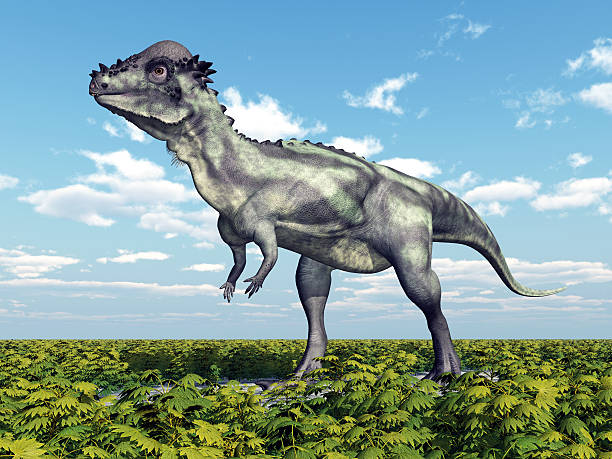
The most iconic feature of Pachycephalosaurus is its skull. Rising above the animal’s head was a massive bony dome that could reach up to 25 centimeters thick in some areas. This dome formed from fused skull bones, creating a solid structure unlike anything seen in most other dinosaurs.
To understand how unusual this is, it helps to imagine the anatomy of a typical vertebrate skull. Most animals have skulls made of several bones joined together, with relatively thin walls surrounding the brain. These bones protect the brain while keeping the head light enough for efficient movement.
Pachycephalosaurus was completely different. Its skull roof grew into a thick dome of solid bone, reinforced by layers of dense tissue. This dome formed above a relatively small brain cavity, creating what essentially looked like a natural helmet.
But the dome was not the only striking feature of the skull. Around the back and sides of the head, Pachycephalosaurus possessed rows of small bony knobs and spikes called osteoderms. These protrusions likely served as both protection and visual display structures.
The skull was so distinctive that for many years, paleontologists often found isolated domes without the rest of the skeleton. These fossils puzzled early researchers, who struggled to determine what kind of animal they belonged to.
When more complete fossils were eventually discovered, scientists realized they were dealing with an entirely unique group of dinosaurs called pachycephalosaurs—small to medium-sized herbivorous dinosaurs characterized by thick skull roofs.
Among them, Pachycephalosaurus was the largest and most extreme example.
But the real question was not just how the dome formed. It was why.
2. Scientists Still Debate Whether Pachycephalosaurus Actually Head-Butted
For decades, the most popular explanation for the dome-shaped skull was that Pachycephalosaurus used it in head-butting contests, much like modern bighorn sheep or musk oxen. According to this theory, males would collide head-to-head to compete for dominance or mating rights.
The idea captured the imagination of both scientists and the public. Museums depicted Pachycephalosaurus ramming rivals. Documentaries showed dramatic slow-motion impacts between domed skulls.
At first glance, the theory seemed logical. The dome was thick and strong, suggesting it could absorb impacts. Head-butting is also a behavior seen in many modern animals.
However, as scientists began analyzing Pachycephalosaurus skulls more carefully, questions emerged.
One issue involves the internal structure of the bone. Modern head-butting animals have specialized adaptations that help absorb shock, including sinus cavities, reinforced neck muscles, and specific bone arrangements. Pachycephalosaurus lacked some of these features.
Computer simulations have produced mixed results. Some studies suggest the dome could withstand impacts. Others indicate that direct head-to-head collisions might have been risky, potentially causing brain injuries.
Another possibility is that Pachycephalosaurus engaged in flank-butting rather than head-on collisions. In this behavior, individuals would swing their heads sideways to strike the flanks of rivals. This method would reduce the risk of brain trauma while still allowing the dome to function as a weapon.
There is also the possibility that the dome served primarily as a display structure. Bright coloration or distinctive shapes might have helped individuals recognize each other or attract mates.
The truth may be a combination of these behaviors. Pachycephalosaurus might have used its skull for display, pushing contests, and occasional combat.
More fossils and biomechanical research are still needed to fully understand how this extraordinary structure was used.
3. Pachycephalosaurus May Have Looked Very Different When It Was Young
One of the most surprising discoveries about Pachycephalosaurus involves how dramatically it may have changed as it grew.
For many years, paleontologists believed that several different species of pachycephalosaurs lived during the Late Cretaceous. These included dinosaurs with flat skulls, partially domed skulls, and fully developed domes.
Examples included animals like Dracorex and Stygimoloch, which had elaborate spikes and relatively flat skull roofs.
However, a controversial but intriguing hypothesis suggests that these may not represent separate species at all. Instead, they might represent different growth stages of Pachycephalosaurus.
According to this theory, young individuals began life with flatter skulls and large spikes. As they matured, their skull bones thickened and expanded upward, gradually forming the rounded dome seen in adults.
During this transformation, some of the spikes and protrusions may have been reabsorbed or reduced.
If this idea is correct, it would mean that what scientists once thought were multiple species are actually different life stages of a single dinosaur.
This would also make Pachycephalosaurus one of the most dramatic examples of growth-related skull transformation among dinosaurs.
Not all paleontologists agree with this interpretation, and debate continues. But the possibility highlights how difficult it can be to classify extinct animals based solely on fossilized bones.
Dinosaurs did not simply grow larger as they aged. Their bodies sometimes changed in remarkable ways.
4. Pachycephalosaurus Was Likely a Fast, Agile Dinosaur
Despite its thick skull and somewhat bulky appearance in popular illustrations, Pachycephalosaurus was probably a relatively agile animal.
It was a bipedal dinosaur, meaning it walked on two legs. Its hind limbs were long and well developed, suggesting it could move quickly across the landscape.
Estimates suggest that Pachycephalosaurus may have reached lengths of about 4.5 meters and weighed around 450 kilograms. This made it moderately sized compared to giant predators like Tyrannosaurus rex.
Its body shape resembled that of other small ornithischian dinosaurs, with a relatively light torso balanced by a stiff tail. This tail likely helped maintain balance while running or turning.
Speed would have been important for survival. The Late Cretaceous ecosystems of North America included formidable predators such as Tyrannosaurus rex and Dakotaraptor. A smaller herbivore like Pachycephalosaurus would need to stay alert and mobile to avoid becoming prey.
Its large eyes, positioned on the sides of its head, likely provided a wide field of vision. This would help detect approaching predators from multiple directions.
While the skull dome often steals the spotlight, the rest of the animal’s anatomy suggests a nimble dinosaur capable of navigating forests, floodplains, and open landscapes.
5. Pachycephalosaurus Lived During the Final Chapter of the Dinosaur Era
One of the most poignant aspects of Pachycephalosaurus is the time in which it lived.
This dinosaur existed during the very end of the Cretaceous Period, roughly 66 million years ago. This was the final chapter of the age of non-avian dinosaurs.
The ecosystems of Late Cretaceous North America were rich and diverse. Pachycephalosaurus shared its environment with famous species such as Triceratops, Edmontosaurus, Ankylosaurus, and Tyrannosaurus rex.
These dinosaurs lived in landscapes filled with rivers, forests, and coastal plains. Flowering plants were spreading rapidly, creating new ecological opportunities.
But this vibrant world was living on borrowed time.
Around 66 million years ago, a massive asteroid struck the region that is now the Yucatán Peninsula in Mexico. The impact triggered a global catastrophe known as the Cretaceous–Paleogene extinction event.
The collision released enormous energy, igniting wildfires, generating massive tsunamis, and throwing vast quantities of dust and debris into the atmosphere. Sunlight was blocked, temperatures dropped, and ecosystems collapsed.
Nearly all non-avian dinosaurs disappeared.
Pachycephalosaurus, like so many other remarkable species, vanished in this global extinction. Only the lineage that evolved into modern birds survived.
Today, the fossils of Pachycephalosaurus offer a glimpse into that lost world—a world filled with extraordinary creatures and evolutionary experiments that ended in a moment of cosmic violence.
The Legacy of the Bone-Headed Dinosaur
Pachycephalosaurus remains one of the most intriguing dinosaurs ever discovered. Its thick skull dome continues to spark debate among scientists, its growth patterns challenge our understanding of dinosaur development, and its behavior remains an active area of research.
Each new fossil adds another piece to the puzzle. Advanced technologies such as CT scanning allow researchers to examine internal bone structures without damaging precious specimens. Computer simulations help test hypotheses about biomechanics and behavior.
As paleontology advances, our picture of Pachycephalosaurus becomes richer and more complex.
This dinosaur reminds us that fossils are not merely ancient bones. They are clues to entire ecosystems, behaviors, and evolutionary stories.
The “bone-headed dinosaur” was not just a curiosity of anatomy. It was a living, moving creature navigating the challenges of its environment, interacting with rivals, avoiding predators, and participating in the vibrant ecosystems of the Late Cretaceous.
And although its species vanished millions of years ago, its story continues to evolve with every new discovery—inviting us to imagine the extraordinary world that existed long before humans ever walked the Earth.