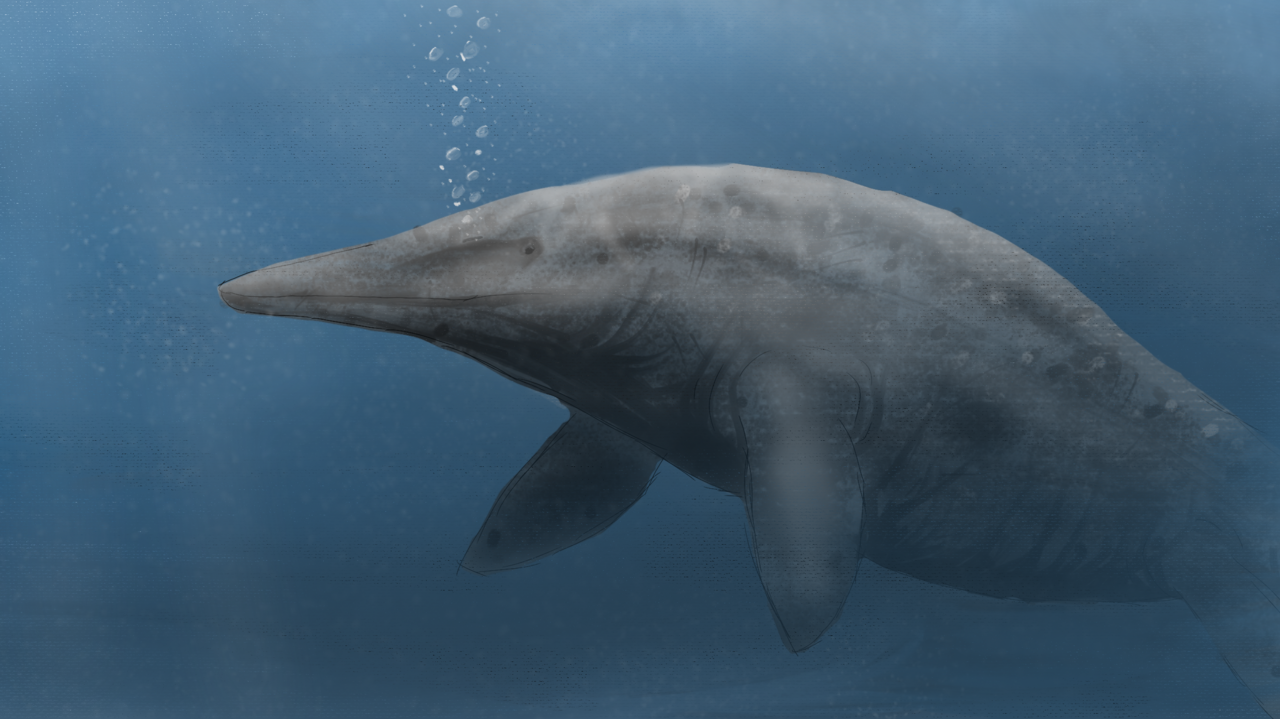
Far beneath the waves of the ancient oceans, long before whales ruled the seas and millions of years before humans walked the Earth, an enormous creature glided silently through the water. Its body was streamlined like a living torpedo, its massive skull cut through the currents, and its powerful tail drove it forward across vast marine landscapes. This animal was not a dinosaur, nor was it a whale or fish. It belonged to a strange and fascinating group of reptiles that had adapted completely to life in the sea. Among them, one giant stood above the rest.
Its name was Shastasaurus.
For paleontologists and lovers of prehistoric life alike, Shastasaurus represents one of the most extraordinary creatures ever to inhabit Earth’s oceans. It was not only a marine reptile but possibly the largest marine reptile ever discovered, rivaling the size of some modern whales. Living during the Triassic Period, long before the age of giant marine reptiles like mosasaurs and plesiosaurs, Shastasaurus ruled the oceans with remarkable elegance.
Yet despite its immense size, this giant was not a ferocious predator with terrifying teeth. Instead, it appears to have lived a life that was far more subtle and mysterious. Its anatomy suggests a creature uniquely adapted for gliding through the ocean in search of small prey, possibly feeding in ways surprisingly similar to some modern whales.
To understand Shastasaurus is to journey back more than 200 million years into a world very different from our own—a world of recovering ecosystems, evolving marine life, and oceans teeming with strange reptiles that were experimenting with new ways of living in the sea.
The Ancient Oceans of the Triassic Period
Shastasaurus lived during the Late Triassic Period, roughly 230 to 210 million years ago. This was a time when life on Earth was recovering from one of the most devastating events in the planet’s history: the Permian–Triassic mass extinction. That extinction, which occurred about 252 million years ago, wiped out the vast majority of species on Earth, including most marine life.
In the millions of years that followed, ecosystems slowly rebuilt themselves. New species evolved, filling ecological roles left vacant by extinction. The oceans, in particular, became laboratories of evolutionary experimentation.
During this time, the continents were joined together in a giant supercontinent known as Pangaea. Surrounding it was a vast global ocean called Panthalassa. The seas that covered much of what is now North America, Europe, and Asia were warm, shallow, and rich with marine life.
Coral reefs thrived. Ammonites—spiral-shelled relatives of modern squid and octopus—floated through the water. Early fish flourished in large numbers. Marine reptiles, which had evolved from land-dwelling ancestors, began diversifying rapidly.
Among these marine reptiles were ichthyosaurs, a group whose name means “fish lizards.” These animals evolved body shapes remarkably similar to modern dolphins and tuna, demonstrating one of nature’s most striking examples of convergent evolution. They had streamlined bodies, large eyes, dorsal fins, and powerful tails adapted for swimming.
Shastasaurus was one of the most remarkable ichthyosaurs ever discovered.
Discovery in the Mountains of California
The story of Shastasaurus began in the mountains of northern California in the late nineteenth century. In 1895, paleontologist John Campbell Merriam and his colleagues discovered enormous fossil bones in the rocks of the region surrounding Mount Shasta.
These rocks belonged to ancient marine sediments deposited during the Triassic Period. Over millions of years, tectonic forces lifted these ocean sediments high into the mountains, preserving fossils of marine reptiles that once swam through the prehistoric sea.
The fossils represented a gigantic ichthyosaur unlike anything scientists had seen before. Merriam named the new genus Shastasaurus, honoring Mount Shasta, near where the remains were found.
Early reconstructions suggested that Shastasaurus was extremely large, but for many decades the exact size and anatomy of the animal remained uncertain. Fossils were incomplete, and paleontologists struggled to interpret the fragments.
Over time, new discoveries and improved analysis began to clarify the picture. Shastasaurus emerged as one of the most massive marine reptiles known from the Triassic oceans.
The Giant Body of Shastasaurus
Estimates of Shastasaurus size vary depending on species and fossil interpretation, but some specimens suggest lengths approaching 20 meters, or about 65 feet. This would place it in the same size range as modern sperm whales and make it one of the largest marine reptiles ever to exist.
Its body was elongated and streamlined, designed for efficient movement through water. Like other ichthyosaurs, Shastasaurus had a torpedo-shaped torso that minimized drag and allowed it to swim long distances with relatively little energy.
Its tail likely ended in a powerful crescent-shaped fin that propelled it through the ocean. Fossil evidence from related ichthyosaurs shows that this tail was vertical, moving side to side in a motion similar to that of fish.
Its front and rear limbs had evolved into paddle-like flippers, used primarily for steering rather than propulsion. These flippers allowed Shastasaurus to maneuver gracefully despite its immense size.
One of the most unusual features of Shastasaurus was its skull.
Unlike many ichthyosaurs, which had long jaws filled with sharp teeth for catching fish, Shastasaurus had a surprisingly short snout and very few teeth—or none at all in some species. This unusual anatomy suggests that it fed in a way very different from typical marine reptiles.
A Mysterious Feeding Strategy
The reduced or absent teeth of Shastasaurus have puzzled scientists for decades. Many early reconstructions imagined it as a large predator, but the anatomy of its jaws suggests otherwise.
Instead, researchers believe that Shastasaurus may have been a suction feeder.
Suction feeding occurs when an animal rapidly expands its throat and mouth, creating a powerful vacuum that pulls water and prey inside. This feeding strategy is used by many modern marine animals, including some whales and certain fish.
If Shastasaurus used suction feeding, it may have specialized in capturing soft-bodied prey such as squid or small fish. Its large mouth could have drawn in prey along with seawater, which would then be expelled while the food was swallowed.
This feeding strategy would explain the lack of large teeth and the shape of the skull.
Some paleontologists have even suggested that Shastasaurus might have been similar to modern baleen whales in ecological role, though it lacked the baleen filtering structures whales possess. Instead of filtering plankton, it likely targeted larger but soft-bodied prey.
Such a feeding strategy would have been highly efficient for an animal of its size.
The Evolution of Ichthyosaurs
To fully appreciate Shastasaurus, it is helpful to understand the evolutionary journey of ichthyosaurs.
Ichthyosaurs first appeared early in the Triassic Period, evolving from reptiles that originally lived on land. Over time, these animals adapted more and more completely to life in the ocean.
Early ichthyosaurs still retained some primitive features, such as relatively long bodies and less efficient swimming styles. But as millions of years passed, natural selection shaped them into streamlined swimmers.
Their bodies evolved dorsal fins, powerful tails, and large eyes suited for underwater vision. Some species developed extremely large eyes capable of seeing in dim ocean depths.
By the Late Triassic, ichthyosaurs had become some of the most successful marine predators in the world.
Shastasaurus represented one extreme of this evolutionary radiation: a gigantic, specialized ichthyosaur adapted for life in the open ocean.
The Enormous Skull and Jaw
The skull of Shastasaurus could measure several meters long, making it one of the most striking features of the animal. Its jaw structure suggests it had a wide gape capable of engulfing large volumes of water.
Unlike predators with sharp teeth for gripping prey, Shastasaurus likely relied on speed and suction to capture food. This required a skull capable of expanding rapidly.
The bones of the skull were shaped to allow powerful muscles to control the opening and closing of the mouth. These muscles would have generated the force needed for suction feeding.
The nostrils of ichthyosaurs were located high on the skull, allowing the animal to breathe quickly when surfacing. Though not true blowholes like those of whales, these nostrils were well positioned for efficient breathing.
Combined with its streamlined body, this skull structure made Shastasaurus an incredibly specialized marine reptile.
Swimming Through the Ancient Seas
Shastasaurus likely spent most of its life far from shore in the open ocean. Its enormous size and streamlined form suggest that it was a strong, efficient swimmer capable of traveling great distances.
The ocean during the Late Triassic was vast and filled with life. Schools of fish and squid would have provided abundant food sources. Large marine reptiles shared these waters, including other ichthyosaurs, early plesiosaurs, and predatory species.
Despite its massive size, Shastasaurus may not have been an aggressive hunter. Its feeding strategy likely involved gliding through the water in search of prey concentrations, capturing them through suction rather than pursuit.
This style of life may have allowed it to conserve energy while still obtaining sufficient food.
Its large body would also have helped regulate temperature, a phenomenon known as gigantothermy. Large marine animals often retain heat more effectively than smaller ones, allowing them to remain active in cooler waters.
Fossils and Scientific Debate
Shastasaurus fossils have been discovered in several locations around the world, including North America and Asia. Some species originally classified as Shastasaurus have later been reassigned to other genera as scientists refined their understanding of ichthyosaur diversity.
One particularly large ichthyosaur discovered in Canada was initially described as Shastasaurus sikanniensis. Later research placed it in a different genus, but its enormous size reinforced the idea that Late Triassic ichthyosaurs included some of the largest marine reptiles ever to exist.
The classification of Shastasaurus species continues to be debated among paleontologists. Fossil evidence is often incomplete, and distinguishing between closely related ichthyosaurs can be challenging.
Despite these debates, Shastasaurus remains one of the most iconic giant marine reptiles from the Triassic oceans.
Life Cycle and Reproduction
Like other ichthyosaurs, Shastasaurus likely gave birth to live young rather than laying eggs on land. Fossils of related ichthyosaurs have revealed embryos preserved inside the bodies of pregnant females.
This reproductive strategy was a crucial adaptation for fully marine life. Because ichthyosaurs were unable to return to land easily, live birth allowed them to reproduce entirely in the ocean.
Newborn ichthyosaurs probably emerged tail-first to prevent drowning during birth. Once born, they were likely capable swimmers almost immediately.
The young would have grown rapidly, feeding on small prey before eventually reaching the enormous size of adults.
Extinction of the Giants
By the end of the Triassic Period, Shastasaurus and several other giant ichthyosaurs disappeared from the fossil record.
The exact reasons for their extinction remain uncertain. Environmental changes, shifts in ocean ecosystems, and competition with other marine reptiles may all have played roles.
During the Jurassic Period, ichthyosaurs continued to exist, but the gigantic suction-feeding forms like Shastasaurus were gone. Later ichthyosaurs evolved different body plans and feeding strategies.
Eventually, the entire ichthyosaur lineage went extinct about 90 million years ago during the Cretaceous Period.
But during their long reign in the oceans, they were among the most successful marine reptiles in Earth’s history.
The Legacy of Shastasaurus
Today, Shastasaurus stands as a symbol of the incredible diversity of prehistoric life. It reminds us that the oceans of the past were home to creatures as strange and magnificent as any that live today.
Its enormous size challenges our imagination. Its unusual feeding strategy reveals the creative paths evolution can take. Its fossils, preserved in ancient rock, offer glimpses into a world long vanished.
For scientists, Shastasaurus continues to inspire research and debate. Each new fossil discovery helps refine our understanding of how these giant marine reptiles lived, swam, and interacted with their environment.
For the rest of us, Shastasaurus offers something equally valuable: a sense of wonder.
More than 200 million years ago, in warm seas that covered much of the planet, this gentle giant cruised silently through the water. It moved through coral reefs, open oceans, and deep marine basins, part of an ecosystem far older than humanity.
The mountains where its bones were found were once ocean floor. The rocks that preserved its skeleton were once sediments drifting through prehistoric seas.
When we study Shastasaurus, we are not just studying a fossil. We are reconnecting with a chapter of Earth’s story written long before our species existed.
And in that ancient story, Shastasaurus remains one of the ocean’s most remarkable giants.