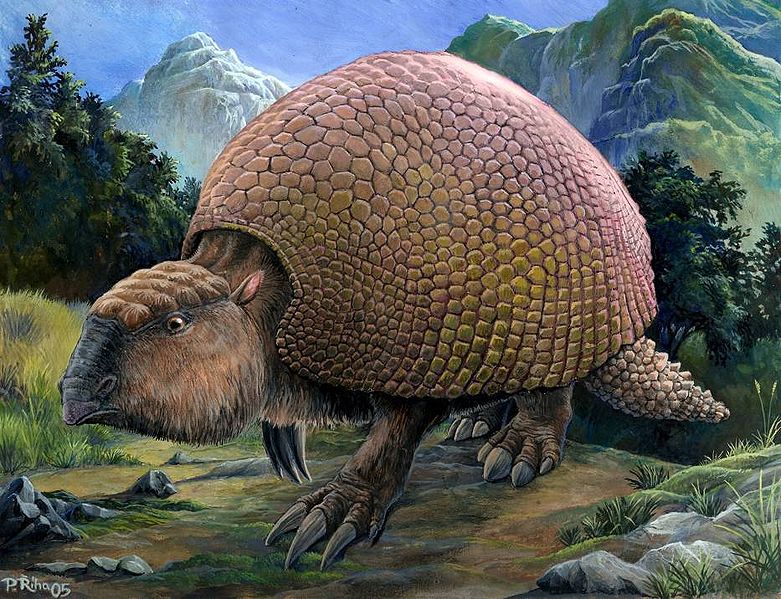
Millions of years ago, long before humans built cities or cultivated crops, the landscapes of the Americas were filled with extraordinary creatures. Giant ground sloths lumbered through forests, saber-toothed predators stalked their prey, and towering mammoths wandered across open plains. Among these remarkable animals was one of the most unusual mammals ever to walk the Earth: Glyptodon, a heavily armored giant that resembled a colossal armadillo.
To imagine Glyptodon is to picture a living fortress moving slowly across prehistoric grasslands. Its body was encased in a thick shell made of hundreds of bony plates fused together into a single dome, much like the shell of a turtle but far heavier. Beneath that armored shield was a massive body supported by powerful legs, and behind it extended a thick, club-like tail. At full size, Glyptodon could grow as large as a small car—comparable in length to a Volkswagen Beetle—and weigh well over a ton.
Despite its intimidating appearance, Glyptodon was not a predator. It was a peaceful herbivore, grazing on vegetation and relying on its armor for protection. This enormous mammal belonged to a group of extinct animals called glyptodonts, distant relatives of modern armadillos. Their fossils reveal a fascinating story about evolution, survival, and extinction—a story that stretches from the ancient plains of South America to the arrival of early humans in the Americas.
Discovery of a Giant Armored Mammal
The scientific story of Glyptodon began in the early nineteenth century, when fossil bones were first discovered in South America. Farmers and explorers occasionally found enormous fossilized shells embedded in riverbanks or buried beneath layers of soil. At first glance, these massive shells looked strikingly similar to those of armadillos, but they were far larger—far too large to belong to any animal living today.
One of the earliest scientists to examine these fossils was the British naturalist Richard Owen. Owen carefully studied the fossilized armor and bones and realized that they belonged to a previously unknown type of mammal. He named the creature Glyptodon, meaning “carved tooth,” a reference to the distinctive patterns found on its teeth.
Even earlier, fossils of giant armored mammals had been collected during expeditions by the young naturalist Charles Darwin. During his famous voyage aboard the HMS Beagle in the 1830s, Darwin explored parts of Argentina and Uruguay. There he encountered enormous fossil shells that looked astonishingly similar to modern armadillos. These discoveries fascinated him because they hinted at a deep connection between extinct animals and those still living in the same region.
Darwin later reflected on how strange it was to see fossils of giant armored mammals in South America while smaller armadillos still roamed the landscape. This observation contributed to his thinking about evolution and the gradual transformation of species over time.
The Evolutionary Roots of Glyptodon
Glyptodon belonged to an ancient group of mammals known as xenarthrans. This group also includes modern armadillos, anteaters, and sloths. Xenarthrans originated in South America more than sixty million years ago, during a time when the continent was isolated from the rest of the world like a giant island.
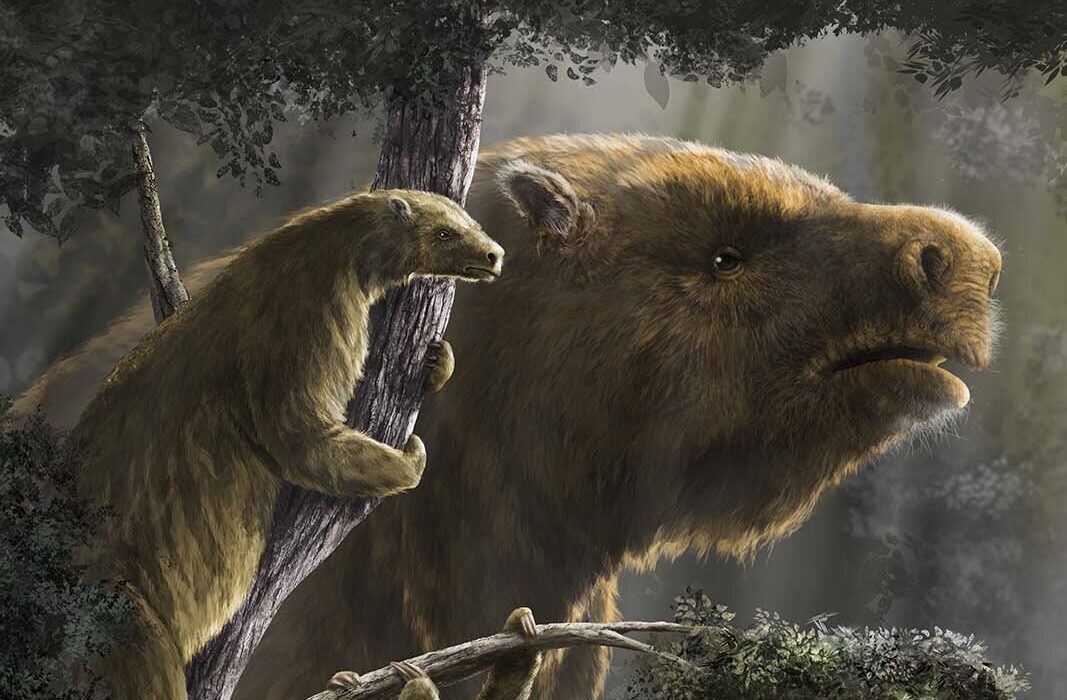
Because of this isolation, South America developed its own unique ecosystems filled with unusual mammals. Over millions of years, xenarthrans evolved into a wide variety of forms, including giant ground sloths that could stand as tall as elephants and heavily armored glyptodonts that resembled living tanks.
The ancestors of glyptodonts were likely small, armadillo-like animals with flexible armor plates. Over time, some of these animals evolved larger bodies and thicker armor. Their shells gradually fused into rigid domes made of interlocking bony plates called osteoderms.
By the time Glyptodon appeared, the evolutionary process had produced one of the most heavily armored mammals in history. Its shell was not flexible like that of a modern armadillo. Instead, it formed a solid protective dome that covered most of the animal’s body.
This massive armor provided protection against predators, which included some of the largest carnivores of the prehistoric Americas.
Anatomy of a Living Fortress
The body of Glyptodon was an extraordinary example of natural engineering. Its shell alone could weigh hundreds of kilograms. This protective dome consisted of hundreds of polygonal osteoderms fused together into a rigid structure that covered the animal’s back and sides.
Each osteoderm was decorated with intricate patterns of ridges and grooves, giving the shell a distinctive texture. These patterns varied between species, allowing paleontologists to identify different types of glyptodonts based on fossilized armor.
Unlike the shells of turtles, which are formed partly from modified ribs and vertebrae, the shell of Glyptodon was made entirely of skin bone. This meant the armor developed within the skin itself rather than being part of the internal skeleton.
The animal’s head was also protected by a bony helmet. Although its face had openings for the eyes, nostrils, and mouth, much of the skull was reinforced with thick bone.
Perhaps the most striking feature of Glyptodon was its tail. Instead of being flexible and slender like the tail of a modern armadillo, Glyptodon’s tail was thick and armored. In some species, the end of the tail formed a blunt club made of solid bone.
This tail may have been used as a defensive weapon. If threatened by a predator, Glyptodon could swing its heavy tail with considerable force.
Supporting all this armor required a powerful skeleton. Glyptodon had strong legs with thick bones capable of bearing enormous weight. Its body was low to the ground, giving it a stable stance.
Although it was massive, Glyptodon was probably capable of steady, if slow, movement across open terrain.
Teeth Designed for Grazing
Despite its intimidating appearance, Glyptodon was a plant eater. Its teeth were uniquely adapted for grinding tough vegetation.
Unlike many mammals, Glyptodon did not have enamel-covered teeth. Instead, its teeth were made of layers of dentin and cementum that formed a series of ridges. These ridges created effective grinding surfaces for chewing fibrous plants.
The teeth were also ever-growing, meaning they continued to grow throughout the animal’s life. This adaptation was useful because constant chewing of tough grasses would quickly wear down normal teeth.
Its broad, rounded snout suggests that Glyptodon fed mainly on low-growing vegetation such as grasses, herbs, and shrubs. Paleontologists believe it likely grazed across open plains much like modern cattle or bison.
Life in the Ancient Grasslands
Glyptodon lived during the Pleistocene epoch, a period spanning from about 2.6 million years ago to around 11,700 years ago. This era is often called the Ice Age because large parts of the Earth experienced repeated glaciations.
Although massive ice sheets covered much of North America and Eurasia, the climates of South America varied widely. Some regions were open grasslands, while others supported forests or wetlands.
These environments provided ample food for large herbivores like Glyptodon. Fossil evidence suggests that the animal roamed widely across South America, especially in regions that are now Argentina, Uruguay, Brazil, and Bolivia.
The prehistoric landscapes of these areas were populated by an astonishing variety of megafauna. Giant ground sloths browsed on leaves and branches, while massive herbivores such as Megatherium moved slowly through the vegetation.
Predators also prowled these ancient ecosystems. Among them were the formidable saber-toothed cats such as Smilodon, whose long canine teeth made them among the most feared hunters of the Ice Age.
In this dangerous world, Glyptodon’s armor was a powerful survival tool.
Defense Against Ice Age Predators
The enormous shell of Glyptodon was not merely decorative—it was essential for survival. Predators that attacked other herbivores would have found Glyptodon a difficult target.
The thick armor protected vital organs from bites and claws. The dome shape also helped distribute impact forces, making it harder for predators to break through.
If threatened, Glyptodon could likely tuck its head close to the ground and rely on its shell as a shield. Its tail club may also have been used to deliver defensive blows.
Even powerful predators would have struggled to penetrate this living fortress.
The Great American Biotic Interchange
For millions of years, South America remained isolated from North America. But around three million years ago, the formation of the Isthmus of Panama connected the two continents.
This geological event triggered a massive exchange of animals known as the Great American Biotic Interchange. Species from North America migrated south, while South American animals moved north.
Glyptodon was among the species that expanded its range into Central America and parts of North America during this period.
Fossils have been found as far north as the southern United States, showing that these armored giants once roamed landscapes far beyond their original homeland.
Encounters With Early Humans
One of the most fascinating chapters in the story of Glyptodon involves its possible interactions with early humans.
Humans arrived in the Americas during the late Ice Age. By this time, many species of megafauna still inhabited the continents.
Archaeological evidence suggests that humans may have hunted glyptodonts. Some fossil shells bear marks that appear to have been made by stone tools.
It has also been proposed that humans used glyptodont shells as shelters after the animals died. Their large dome-shaped shells could provide protection from wind and rain.
Although such uses remain debated among researchers, they illustrate the potential overlap between human expansion and the final days of these armored giants.
The Extinction of Glyptodon
Around 10,000 to 11,000 years ago, Glyptodon disappeared from the fossil record. Its extinction was part of a broader wave that eliminated many large mammals at the end of the Ice Age.
Scientists continue to debate the causes of this mass extinction. Climate change likely played a role, as the end of the last glacial period brought major environmental shifts.
Grasslands may have shrunk or changed in ways that affected large grazing animals. At the same time, human hunting could have added pressure on already vulnerable populations.
The combination of environmental change and human activity is widely considered the most plausible explanation.
Glyptodon in Scientific Research
Today, fossils of Glyptodon continue to fascinate scientists and the public alike. Museums around the world display its massive shells and skeletons, offering glimpses into a vanished world.
Modern research techniques allow paleontologists to study these fossils in remarkable detail. CT scanning can reveal internal structures of bones and armor. Isotopic analysis of fossil teeth can provide clues about diet and climate.
Genetic studies have also revealed surprising insights. Analysis of ancient DNA suggests that glyptodonts were closely related to modern armadillos, even though their appearance was dramatically different.
This discovery highlights the power of evolution to transform organisms over millions of years.
A Symbol of the Lost Megafauna
Glyptodon represents a remarkable chapter in Earth’s natural history. It was a creature shaped by millions of years of evolution in isolation, adapted perfectly to a world filled with giant animals and formidable predators.
Its immense armor tells a story of survival in a dangerous landscape. Its fossils remind us that the planet was once home to creatures far stranger and larger than those we know today.
Standing beside the shell of a Glyptodon in a museum, it is difficult not to feel a sense of wonder. The shell alone can be larger than a small car, a silent reminder of the immense diversity that once existed on our planet.
The Legacy of an Armored Giant
Although Glyptodon vanished thousands of years ago, its legacy lives on in science and imagination. It helps scientists understand how ecosystems evolve, how animals adapt to threats, and how environmental changes can reshape the living world.
Its story also reminds us that extinction is not just a distant phenomenon of the past. The same forces that eliminated Ice Age giants—climate shifts and human activity—still influence the natural world today.
Glyptodon once walked across ancient plains beneath Ice Age skies, armored against predators and adapted to a world that no longer exists. Its fossils are fragments of that lost world, preserved in stone.
Through them, we glimpse a time when enormous armored mammals grazed the grasslands of the Americas, when evolution experimented with forms that seem almost mythical today.
And in that glimpse, we are reminded that the history of life on Earth is vast, mysterious, and endlessly fascinating.