Few places on Earth stir the human imagination quite like Stonehenge. Rising from the rolling plains of southern England, its massive stones stand in quiet defiance of time, weather, and understanding. For thousands of years, people have gazed upon this ancient monument and asked the same haunting question: who built Stonehenge, and why?
It is a question that does not yield a simple answer. Instead, it opens a doorway into a deep and layered past, where prehistoric communities labored across generations, where belief and science intertwined, and where human ingenuity shaped one of the most enduring symbols of mystery in the world.
Stonehenge is not the work of a single builder, nor the creation of a single moment. It is the result of centuries of human effort, evolving ideas, and cultural transformation. To understand who built it, we must journey far back in time, to an era before written history, where clues lie buried in earth, stone, and bone.
The Landscape Before the Stones
Long before the first great stones were raised, the land where Stonehenge now stands was already a place of importance. The Salisbury Plain, with its open grasslands and gentle horizons, was home to communities who lived, hunted, farmed, and buried their dead here.
Archaeological evidence reveals that this landscape was sacred long before Stonehenge took shape. Burial mounds, ceremonial enclosures, and ritual pathways marked the land. People gathered here not just to survive, but to remember, to celebrate, and to connect with forces they could not fully explain.
Around 3000 BCE, the earliest phase of Stonehenge began. But it did not begin with towering stones. It began with earth.
A circular ditch was dug, forming a large enclosure. Inside it, a bank was raised, creating a ring. Within this space, a series of pits—known today as the Aubrey Holes—were carefully arranged. These pits likely held wooden posts or stones, though their exact purpose remains uncertain.
This first phase suggests something profound. Before Stonehenge became a monument of stone, it was already a place of ritual, memory, and meaning. The builders were not creating something from nothing; they were transforming an already sacred landscape into something even more powerful.
The First Builders: Neolithic Communities
The people who began Stonehenge were Neolithic farmers. They lived in small communities, cultivated crops, raised animals, and developed new tools and technologies. They were not primitive in the sense often imagined. They possessed knowledge, organization, and a deep connection to their environment.
These early builders did not leave written records. Their voices do not reach us through words, but through what they created. Their tools, their graves, and their monuments speak in a different language—a language archaeologists must carefully interpret.
What emerges is a picture of a society capable of remarkable coordination. Building even the earliest version of Stonehenge required planning, labor, and shared purpose. People had to gather materials, dig trenches, and organize workforces. This was not the effort of a few individuals, but of a community united by belief or necessity.
These Neolithic builders likely saw the world very differently from us. The boundary between the living and the dead, between the natural and the supernatural, may have been far more fluid. Stonehenge, in its earliest form, may have served as a place where these worlds met.
The Arrival of the Bluestones
Around 2500 BCE, Stonehenge entered a new and dramatic phase. This was when the monument began to take on the form we recognize today. One of the most astonishing developments of this period was the arrival of the bluestones.
These stones were not local. They came from the Preseli Hills in what is now Wales, more than 200 kilometers away. Their transportation remains one of the greatest puzzles associated with Stonehenge.
How did Neolithic people move such massive stones across such a distance without modern machinery? Some theories suggest they used a combination of sledges, rollers, and human effort to drag the stones over land. Others propose that waterways were used, with stones floated on rafts along rivers and coastlines.
Regardless of the method, the effort required would have been immense. This was not simply construction. It was a monumental undertaking that demanded coordination across regions, perhaps even cooperation between different communities.
The decision to bring stones from such a distant place suggests that these materials held special significance. The bluestones may have been chosen for their unique properties, their origins, or their symbolic meaning. Some researchers have suggested that they were believed to possess healing powers, though this remains speculative.
What is clear is that the builders of Stonehenge were not limited by their immediate surroundings. They were connected to a wider world, capable of envisioning and executing projects that stretched across vast distances.
The Sarsen Stones and Monumental Vision
If the bluestones represent mystery, the sarsen stones represent power. These enormous blocks, some weighing over 20 tons, were brought from Marlborough Downs, about 30 kilometers away.
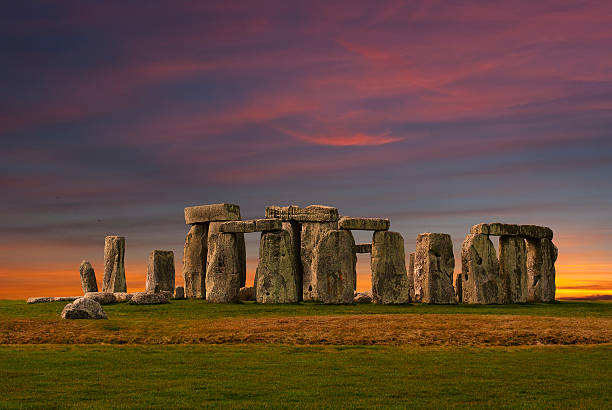
The arrangement of the sarsen stones defines the iconic image of Stonehenge: massive uprights supporting horizontal lintels, forming a circular structure unlike anything else in prehistoric Europe.
This phase of construction required extraordinary engineering skill. The stones were carefully shaped to fit together, with joints that resemble those used in woodworking. Mortise-and-tenon joints held the lintels in place, while tongue-and-groove connections linked the horizontal stones.
This level of craftsmanship reveals something remarkable about the builders. They were not only laborers but skilled engineers and designers. They understood balance, stability, and geometry. They envisioned a structure that would endure, and they executed that vision with precision.
The creation of this stone circle likely took decades, if not generations. It was not a single project but a long-term commitment, passed down from one group to the next. Each generation contributed to a shared legacy, shaping a monument that would outlive them all.
A Place of Ceremony and Meaning
Understanding who built Stonehenge also requires understanding why it was built. The monument was not a random arrangement of stones. It was a place of purpose, deeply tied to the beliefs and practices of its creators.
One of the most compelling aspects of Stonehenge is its alignment with the sun. The structure is oriented so that on the summer solstice, the sun rises directly over the Heel Stone and shines into the center of the circle. On the winter solstice, the setting sun aligns with the opposite direction.
These alignments suggest that Stonehenge functioned as a kind of calendar, marking important moments in the year. But it was likely more than that. The solstices may have held spiritual significance, representing cycles of life, death, and renewal.
Stonehenge may have been a place where people gathered to mark these moments, to celebrate, to mourn, and to connect with something greater than themselves. The movement of the sun, the turning of the seasons, and the rhythm of nature would have been deeply meaningful to Neolithic communities.
In this sense, Stonehenge was not just built by people—it was built by their beliefs, their hopes, and their understanding of the universe.
The People Behind the Stones
Archaeological discoveries have begun to reveal more about the individuals who built and used Stonehenge. Human remains found in and around the site suggest that it was also a place of burial.
Some of the earliest activity at Stonehenge involved cremation burials, making it one of the largest known Neolithic cemeteries in Britain. This reinforces the idea that the site was connected to death and remembrance.
Isotopic analysis of human remains has provided clues about where these people came from. Some individuals buried at Stonehenge appear to have traveled from distant regions, including areas corresponding to modern Wales. This suggests that the monument drew people from across a wide landscape.
Stonehenge may have served as a gathering place, bringing together different communities for shared rituals. It may have been a center of pilgrimage, a place where people came to honor their dead or seek spiritual meaning.
The builders of Stonehenge were not a single tribe or group. They were part of a network of communities, connected by culture, belief, and shared purpose.
Changing Theories Through Time
For centuries, Stonehenge inspired speculation and myth. Before the development of modern archaeology, many believed it was built by ancient druids. Others attributed it to giants or even supernatural beings.
These ideas reflected the mystery of the monument and the lack of historical records. Without evidence, imagination filled the gaps.
The association with druids, in particular, persisted for a long time. However, archaeological evidence now shows that Stonehenge predates the Celtic druids by more than a thousand years. While druids may have used the site later, they were not its original builders.
Modern archaeology has transformed our understanding of Stonehenge. Through careful excavation, scientific analysis, and new technologies, researchers have uncovered details about its construction, use, and evolution.
Radiocarbon dating has established a timeline for the different phases of building. Geological analysis has traced the origins of the stones. DNA studies have provided insights into the people who lived during that time.
Each discovery brings us closer to understanding who built Stonehenge, yet the full story remains complex and incomplete.
The Role of Community and Collaboration
One of the most important insights from modern research is that Stonehenge was not the work of isolated individuals. It was a communal effort on a grand scale.
The construction of Stonehenge required cooperation, organization, and shared vision. People had to come together, coordinate their efforts, and work toward a common goal.
This suggests a society capable of complex social structures. Leaders may have guided the work, while skilled craftsmen shaped the stones and laborers carried out the physical tasks.
The monument itself may have played a role in strengthening social bonds. By participating in its construction, people became part of something larger than themselves. Stonehenge was not just a structure; it was a symbol of unity and identity.
In this way, the question of who built Stonehenge becomes less about individuals and more about collective humanity. It was built by communities, by generations, by a shared belief in something worth creating together.
The Legacy of Stonehenge
Today, Stonehenge stands as one of the most recognizable and studied prehistoric monuments in the world. It has survived thousands of years, witnessing the rise and fall of civilizations, the passage of time, and the enduring curiosity of humanity.
Its builders are long gone, their names unknown, their stories unwritten. Yet their creation remains, continuing to inspire wonder and inquiry.
Stonehenge reminds us that even without modern technology, humans have always possessed creativity, determination, and a desire to understand the world. It is a testament to what people can achieve when they come together with purpose.
The monument also serves as a bridge between past and present. When we stand among its stones, we are connected to those who built it, separated by millennia yet united by curiosity and imagination.
The Continuing Mystery
Despite all that has been discovered, Stonehenge still holds secrets. Questions remain about the exact methods of construction, the full meaning of its design, and the details of the rituals that took place there.
New technologies continue to shed light on these mysteries. Ground-penetrating radar, 3D modeling, and advanced dating techniques are revealing features that were previously hidden.
Each new discovery adds another layer to the story, but also raises new questions. The mystery of Stonehenge is not something to be solved once and for all. It is something to be explored, revisited, and reimagined.
In this way, the question “Who built Stonehenge?” remains alive. It invites us to look deeper, to question assumptions, and to appreciate the complexity of human history.
A Monument to Human Wonder
Ultimately, Stonehenge is more than a puzzle to be solved. It is a reflection of human nature itself. It speaks to our desire to create, to understand, and to leave something behind.
The people who built Stonehenge lived in a world very different from ours, yet their actions reveal something timeless. They looked at the sky, felt the passage of time, and sought to make sense of it all.
They gathered stones, shaped them, and arranged them in a way that captured their understanding of the world. They created a monument that has endured for thousands of years, carrying their legacy into the present.
Stonehenge stands not only as a relic of the past, but as a reminder of what it means to be human. It is a testament to curiosity, cooperation, and the enduring quest to uncover the mysteries of existence.
And so the question remains, echoing across the ages: who built Stonehenge? The answer is both simple and profound. It was built by people—people who dreamed, who believed, and who dared to shape the world around them in ways that still captivate us today.