Long before the first dinosaurs walked on land, before trees formed dense forests across continents, and before mammals or birds even existed, Earth’s oceans were ruled by creatures unlike anything alive today. In the ancient seas of the Devonian Period, roughly 419 to 359 million years ago, one predator stood above nearly all others in both power and presence. Its name was Dunkleosteus.
This extraordinary creature was not a shark, nor was it a typical fish as we imagine them today. Dunkleosteus belonged to a group of prehistoric armored fishes known as placoderms, animals whose heads and upper bodies were encased in thick bony plates. But Dunkleosteus was something even more impressive within that group. It was enormous, fast, and equipped with one of the most devastating bites ever known in the animal kingdom.
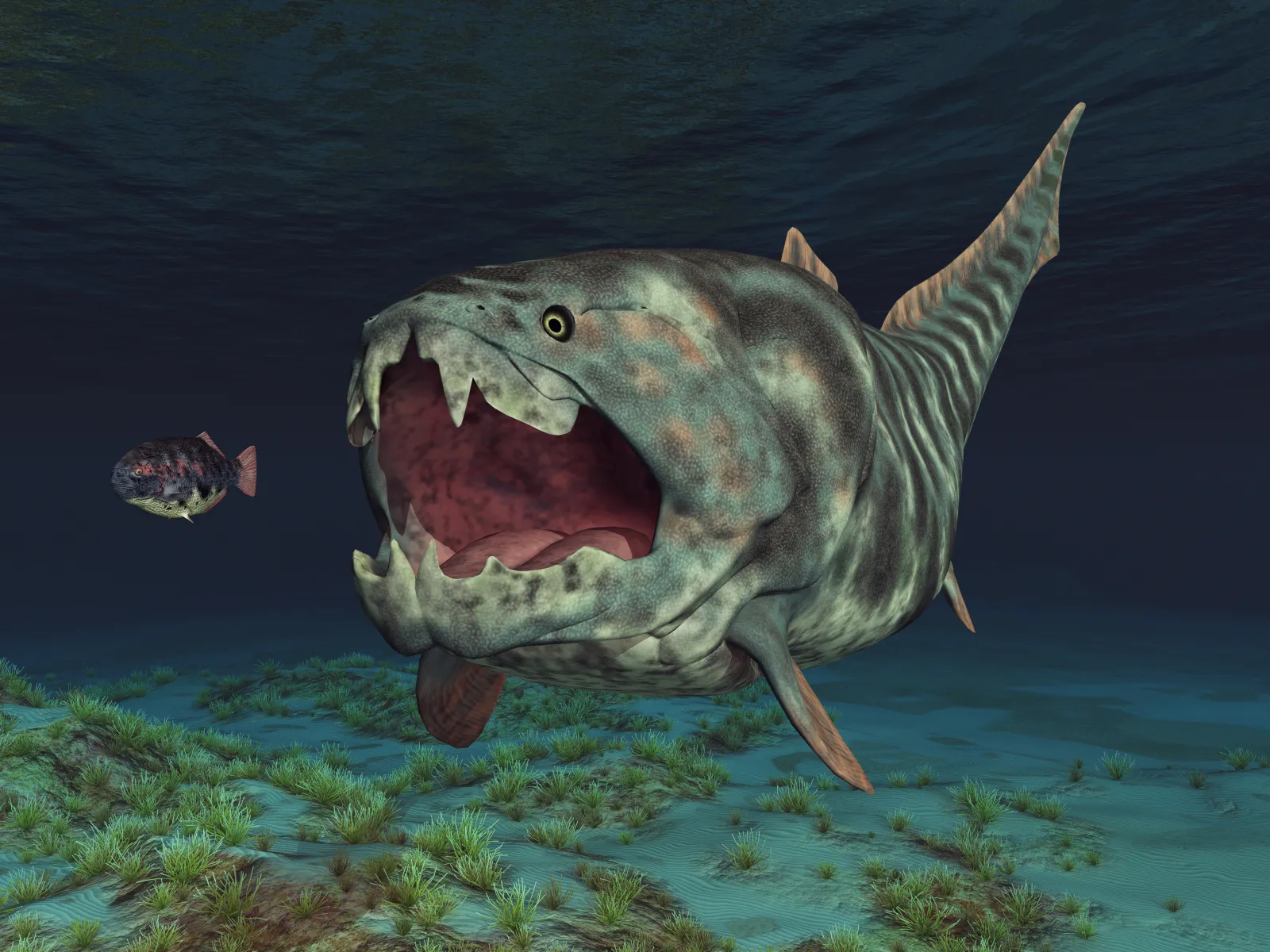
Imagine a predator the length of a large car, with a head sheathed in armor like a medieval knight and jaws capable of slicing through bone and shell with terrifying efficiency. Its bite force rivaled or exceeded that of many later apex predators, including some of the most formidable reptiles and mammals that would appear hundreds of millions of years later.
Dunkleosteus was not just a fish. It was a symbol of a time when vertebrate life was rapidly evolving, experimenting with new body plans, new hunting strategies, and new ecological roles. It was the embodiment of power in the Devonian oceans.
The Devonian World: Age of Fishes
To understand Dunkleosteus, one must first step into the world it inhabited. The Devonian Period is often called the “Age of Fishes,” a time when marine ecosystems were undergoing a dramatic transformation.
Earlier in Earth’s history, oceans had been dominated by invertebrates such as trilobites, brachiopods, and early mollusks. But by the Devonian, vertebrates—animals with backbones—were diversifying rapidly. Jawless fishes, early sharks, ray-finned fishes, and lobe-finned fishes all flourished in the seas.
The continents of the Devonian were arranged very differently from today. Large landmasses such as Gondwana lay in the southern hemisphere, while other continents clustered near the equator. Warm shallow seas spread across much of the planet, creating vast marine habitats filled with reefs, lagoons, and open waters.
These reefs were not built by modern corals but by ancient organisms such as stromatoporoids and tabulate corals. Within these complex underwater cities lived countless species of fish, crustaceans, mollusks, and early vertebrates.
In this environment, predators and prey were locked in an evolutionary arms race. Armor, speed, sharp teeth, and improved sensory systems all emerged as survival strategies. Among these innovations, jaws were perhaps the most transformative development.
Before the evolution of jaws, vertebrates were limited in how they could feed. Jaws opened new possibilities: biting, tearing, crushing, and gripping. Dunkleosteus was one of the most dramatic expressions of this innovation.
The Discovery of Dunkleosteus
The story of Dunkleosteus began not in the Devonian oceans but in the fossil beds of North America. In the 19th century, paleontologists began uncovering strange armored plates preserved in Devonian rock formations.
These fossils were found in places such as Ohio, Pennsylvania, and other regions that had once been covered by shallow seas. At first, scientists struggled to understand what these fragments represented. The bones were thick, irregular, and unlike anything from modern fish.
Eventually, researchers realized that these plates belonged to a gigantic armored fish.
The creature was later named Dunkleosteus in honor of David Dunkle, a curator and paleontologist who studied placoderm fossils extensively during the mid-20th century. The name itself combines Dunkle’s surname with the Greek word “osteus,” meaning bone.
Although complete skeletons of Dunkleosteus are rare, the fossilized armor plates of its head and thorax have been found in numerous locations. These fossils reveal an animal of extraordinary strength and size.
From these fragments, scientists have reconstructed one of the most formidable predators ever to swim in Earth’s oceans.
Anatomy of an Armored Predator
Dunkleosteus possessed a body design that was both strange and powerful. The front portion of its body was covered in thick bony armor plates that formed a rigid protective shield around its head and chest.
These plates interlocked in a way that allowed some movement while still providing exceptional defense. They were composed of dense bone tissue that could resist attacks from other predators.
Behind this armored section, the body of Dunkleosteus likely tapered into a more flexible and streamlined fish-like form. Unlike the front armor, this rear portion was probably covered in scales or softer tissue that rarely fossilized.
This design created a balance between protection and mobility. The armored head allowed Dunkleosteus to engage in violent predatory encounters, while the streamlined body allowed it to move efficiently through the water.
One of the most distinctive features of Dunkleosteus was its jaw structure. Unlike modern fish, which typically possess rows of teeth, Dunkleosteus had sharp bony plates that functioned as cutting blades.
These plates formed a self-sharpening system. As the animal bit into prey, the edges of the plates would wear against each other, maintaining a razor-like sharpness. The result was a pair of natural shears capable of slicing through flesh, bone, and armor.
This unusual feeding apparatus made Dunkleosteus one of the most efficient predators of its time.
The Bone-Crushing Bite
One of the most remarkable aspects of Dunkleosteus was the power of its bite. Modern studies using biomechanical modeling have attempted to estimate how much force this ancient fish could generate.
The results are astonishing.
Researchers believe that Dunkleosteus may have produced a bite force exceeding several thousand newtons, potentially reaching levels comparable to some of the most powerful marine predators that ever lived. This would have allowed it to crush the shells of armored prey and slice through the bodies of other fish with ease.
But the power of the bite was only part of the story. Equally important was the speed at which the jaws could close.
Evidence suggests that Dunkleosteus possessed an extremely rapid jaw-opening and closing mechanism. Specialized muscles and joints allowed the mouth to snap shut with explosive speed. Some scientists believe this mechanism created a powerful suction effect, pulling prey toward the jaws just before the bite landed.
This combination of speed and force made Dunkleosteus a terrifying hunter. Prey would have had very little chance of escape once caught within its reach.
Size and Physical Presence
Determining the exact size of Dunkleosteus has long been a challenge for paleontologists because most fossils consist only of the armored head region.
Early estimates suggested that the largest individuals might have reached lengths of nearly 10 meters, or about 33 feet. However, more recent research indicates that these estimates may have been somewhat exaggerated.
Modern studies often place Dunkleosteus terrelli, the best-known species, at lengths of roughly 5 to 6 meters, though some individuals may have been slightly larger. Even at these revised sizes, it remained an enormous predator for its time.
Its head alone could measure over a meter long, forming a massive armored weapon at the front of the body.
When this creature swam through Devonian waters, it must have presented an intimidating silhouette. The heavy plates of its head glinted in the filtered sunlight of the ancient seas, while its powerful tail propelled it forward with deliberate strength.
In the ecological communities of its time, Dunkleosteus was an apex predator.
Life in the Ancient Seas
The oceans inhabited by Dunkleosteus were filled with a wide variety of life forms. Early sharks glided through the waters, while smaller placoderms, primitive ray-finned fishes, and lobe-finned fishes occupied different ecological niches.
Trilobites still crawled along the seafloor, though their dominance was fading. Ammonoids and other cephalopods drifted through the water column. Coral reefs teemed with invertebrate life.
Within this vibrant ecosystem, Dunkleosteus played the role of top predator.
Its diet likely included a range of animals, from smaller fish to armored invertebrates and possibly even other placoderms. Fossil evidence suggests that Dunkleosteus sometimes engaged in cannibalism, preying upon members of its own species.
This behavior is not unusual among large predators. When resources are limited or opportunities arise, even dominant hunters may turn on their own kind.
Dunkleosteus likely patrolled the open waters near reefs and continental shelves, where prey was abundant.
Its powerful bite and armored head allowed it to attack prey that many other predators could not handle.
Movement and Hunting Strategy
Although Dunkleosteus had heavy armor around its head and torso, it was probably not a slow swimmer. The rear portion of its body likely resembled that of other large fish, with strong muscles and a powerful tail fin.
This design suggests that Dunkleosteus could move with bursts of speed when necessary.
Some researchers believe that it may have used an ambush strategy, lurking near reef structures before lunging at passing prey. Others propose that it was an active hunter that cruised through open water searching for victims.
Its rapid jaw mechanism would have been particularly effective for capturing fast-moving prey. By snapping its jaws open and closed quickly, Dunkleosteus could create suction that drew prey into its mouth before delivering the crushing bite.
In this way, it combined brute force with mechanical efficiency.
Placoderms: The Armored Pioneers
Dunkleosteus was part of a broader group known as placoderms, which flourished during the Devonian Period.
Placoderms were among the earliest jawed vertebrates. Their bodies were often covered in protective plates, giving them a distinctive armored appearance.
These fishes represented an important stage in vertebrate evolution. They were among the first animals to develop complex jaws, paired fins, and advanced feeding strategies.
Placoderms occupied many ecological roles, from small bottom-feeders to large predators like Dunkleosteus.
For tens of millions of years, they dominated marine ecosystems.
Yet despite their success, placoderms would eventually disappear entirely.
The Devonian Extinction
Toward the end of the Devonian Period, Earth experienced a series of environmental crises known collectively as the Late Devonian extinction events.
These events unfolded over millions of years and caused significant disruptions to marine ecosystems. Many reef-building organisms declined, and numerous species of fish disappeared.
The exact causes of these extinctions remain a subject of scientific investigation. Possible factors include changes in sea level, climate shifts, widespread ocean anoxia, and volcanic activity.
Placoderms were among the groups that suffered heavily during this time. By the close of the Devonian, they had vanished from the fossil record.
Dunkleosteus, once a ruler of the seas, disappeared along with them.
Its extinction marked the end of one chapter in vertebrate evolution, clearing ecological space for other groups to rise.
The Legacy of Dunkleosteus
Although Dunkleosteus vanished hundreds of millions of years ago, its legacy lives on in the story of evolution.
It represents a moment when vertebrate life experimented with powerful jaws, heavy armor, and apex predatory lifestyles.
Later predators, including sharks, marine reptiles, and large predatory fish, would take over similar ecological roles. Yet Dunkleosteus was among the earliest giants to dominate the oceans.
Its fossils provide valuable insights into how early jawed vertebrates functioned and how marine ecosystems evolved during the Devonian.
Paleontologists continue to study its anatomy, biomechanics, and evolutionary relationships.
Each new fossil discovery adds another piece to the puzzle.
Dunkleosteus in Human Imagination
Today, Dunkleosteus has captured the imagination of scientists, artists, and the public alike. Museums display reconstructed models showing the armored predator with its fearsome jaws and plated head.
Documentaries and books portray it as one of the earliest “superpredators” in Earth’s history.
Yet beyond its dramatic appearance lies a deeper story about evolution and survival. Dunkleosteus reminds us that the natural world has always been dynamic, filled with strange creatures adapted to environments very different from our own.
The oceans that once held this giant predator are now quiet stone layers beneath our feet.
But through fossils and scientific study, the story of Dunkleosteus continues to emerge.
A Window into Deep Time
When we imagine Dunkleosteus swimming through Devonian waters, we are glimpsing a world unimaginably distant from our own.
The continents were arranged differently. The land was only beginning to be colonized by plants and early animals. Life was experimenting with new forms and strategies.
Dunkleosteus was part of that great evolutionary experiment.
Its armor, its bite, and its predatory dominance all represent solutions shaped by natural selection in a long-vanished ocean.
By studying such creatures, scientists gain insight not only into the past but into the processes that shape life itself.
Evolution is not a straight path but a branching tree filled with successes, failures, and extraordinary experiments.
Dunkleosteus stands as one of the most powerful and fascinating branches of that ancient tree—a reminder that long before humans walked the Earth, the oceans were home to monsters every bit as formidable as the legends of myth.
And in the silent stone of Devonian rock, the armored jaws of Dunkleosteus still tell their story.