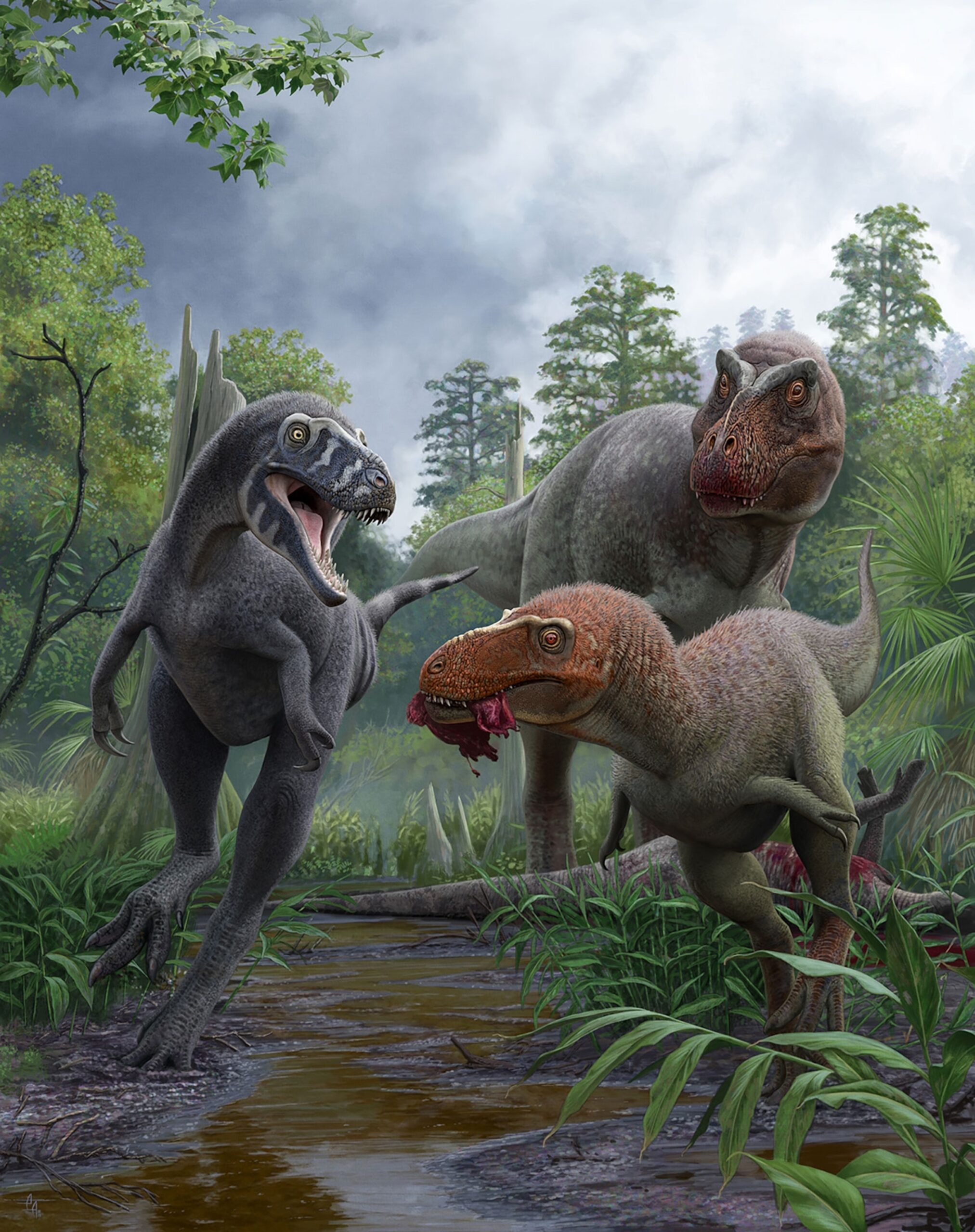
Few dinosaurs have sparked as much curiosity, debate, and fascination as the mysterious creature known as Nanotyrannus. Nicknamed the “pygmy tyrant,” this small tyrannosaur-like predator has long puzzled paleontologists. Was it truly a separate species of dinosaur, a smaller relative of the mighty Tyrannosaurus rex, or simply a juvenile stage of the famous king of the dinosaurs?
The question may sound simple, but the answer opens a doorway into one of the most fascinating scientific debates in modern paleontology. The story of Nanotyrannus touches on fossil discovery, anatomy, dinosaur growth patterns, and the very process of scientific investigation. It is a tale that spans more than seventy years, beginning with a fragmentary fossil and continuing through decades of research, arguments, and discoveries.
Understanding Nanotyrannus requires us to explore the world of Late Cretaceous North America, examine the anatomy of tyrannosaurid dinosaurs, and follow the evolving evidence that scientists have used to interpret this puzzling animal. Along the way, we encounter remarkable fossils, controversial interpretations, and the challenge of reconstructing ancient life from fragments of bone.
The pygmy tyrant may be small compared with its famous relative, but its story is enormous.
The World of Late Cretaceous Predators
To understand Nanotyrannus, we must first travel back roughly 66 to 68 million years, to the final chapter of the Age of Dinosaurs. During this time, North America was divided by a vast inland sea known as the Western Interior Seaway, which stretched from the Arctic Ocean to the Gulf of Mexico.
On the western side of this sea lay a long landmass called Laramidia, a region filled with forests, rivers, floodplains, and swamps. This environment supported an extraordinary diversity of dinosaurs. Massive plant-eaters such as Triceratops and Edmontosaurus roamed the landscape, grazing on lush vegetation.
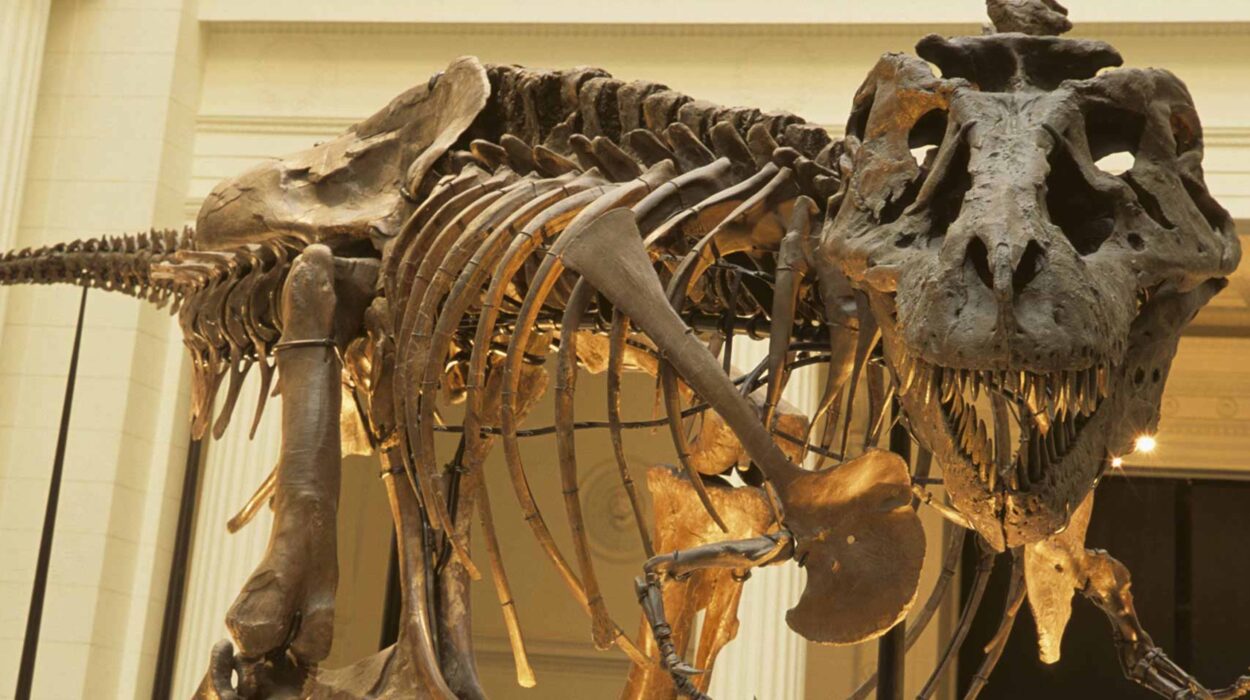
Above them stood the apex predators. At the top of the food chain ruled Tyrannosaurus rex, a giant carnivore that could reach more than twelve meters in length and weigh several tons. With bone-crushing jaws and powerful legs, T. rex dominated the ecosystem.
But ecosystems are rarely built around a single predator. In modern environments, there are usually predators of different sizes occupying different ecological niches. Lions hunt large prey, but smaller carnivores like hyenas and jackals fill other roles. Paleontologists have long wondered whether the dinosaur world followed similar patterns.
This question helped fuel the intrigue surrounding Nanotyrannus.
The First Discovery of the Pygmy Tyrant
The story of Nanotyrannus begins in the mid-20th century with a fossil that did not immediately receive much attention. In 1942, paleontologist Charles W. Gilmore described a partial skull discovered in Montana’s Hell Creek Formation. The fossil was initially assigned to a species of Gorgosaurus and named Gorgosaurus lancensis.
At the time, the specimen was incomplete, and its true identity remained uncertain. The Hell Creek Formation itself was already famous for producing fossils of Tyrannosaurus rex and other Late Cretaceous dinosaurs, but this particular skull appeared unusually small and slender compared with known tyrannosaurs.
For decades, the fossil remained relatively obscure. It sat in museum collections while paleontology gradually advanced. New discoveries and improved understanding of dinosaur anatomy would eventually bring this specimen back into the spotlight.
The Birth of the Name Nanotyrannus
The fossil’s story took a dramatic turn in 1988 when paleontologist Robert T. Bakker and colleagues reexamined the specimen. They concluded that it represented a previously unrecognized genus of small tyrannosaurid dinosaur. They named it Nanotyrannus, meaning “dwarf tyrant.”
The species name became Nanotyrannus lancensis, referencing the Lance Formation where similar fossils were found.
The name captured public imagination instantly. The idea of a miniature tyrant dinosaur roaming alongside the giant T. rex was thrilling. According to this interpretation, Nanotyrannus was a smaller, faster predator that occupied a different ecological niche.
Its anatomy appeared distinct from adult Tyrannosaurus specimens. The skull was more slender, the teeth more numerous and blade-like, and the eye sockets larger. These features suggested a predator built for speed rather than brute force.
For many researchers and dinosaur enthusiasts, Nanotyrannus seemed like a genuine species—a swift, agile hunter that filled a role between smaller carnivorous dinosaurs and the massive T. rex.
Yet not everyone agreed.
The Great Nanotyrannus Debate
Soon after the naming of Nanotyrannus, a major scientific debate began. Some paleontologists argued that the fossil did not represent a new species at all. Instead, they believed it was simply a juvenile Tyrannosaurus rex.
The argument centered on growth. Dinosaurs, like modern animals, change dramatically as they mature. Young individuals often look quite different from adults. Bones fuse together over time, skull proportions shift, and teeth can change in shape and number.
Juvenile tyrannosaurs may have been slimmer and faster than adults. As they grew, their skulls became thicker and their jaws more powerful.
If this interpretation is correct, then Nanotyrannus might not exist as a separate species. Instead, the fossils attributed to it would represent teenage T. rex individuals.
This possibility sparked one of the most persistent controversies in paleontology.
The Anatomy of the Pygmy Tyrant
The fossils attributed to Nanotyrannus show several intriguing features. The skull is relatively narrow and elongated compared with adult Tyrannosaurus specimens. The eye sockets are large, suggesting good vision, possibly useful for hunting.
The teeth are thinner and more numerous than those of adult T. rex. Instead of the thick, banana-shaped teeth designed for crushing bone, these teeth appear more blade-like, suited for slicing flesh.
These anatomical characteristics initially supported the idea that Nanotyrannus was a different species. A faster, more agile predator might rely on slashing bites rather than bone-crushing power.
However, the same features could also represent a growth stage. Young predators often require speed and agility to catch smaller prey before developing the massive strength of adulthood.
This dual interpretation lies at the heart of the controversy.
Growth and Transformation in Tyrannosaurs
Understanding whether Nanotyrannus is real requires studying how tyrannosaurs grew.
Research on tyrannosaur fossils has revealed dramatic changes during development. Young tyrannosaurs appear to have had long legs, slender bodies, and narrow skulls. As they matured, their bodies became bulkier, their skulls thicker, and their teeth stronger.
This transformation suggests that tyrannosaurs may have changed ecological roles as they aged. Juveniles likely hunted smaller animals and relied on speed. Adults dominated large prey with powerful bites.
If this growth pattern is correct, then fossils identified as Nanotyrannus might represent adolescent Tyrannosaurus individuals that had not yet developed the full adult features.
Yet some researchers still argue that differences in skull structure and tooth counts indicate a distinct species.
The debate remains unresolved.
Famous Fossils Associated with Nanotyrannus
Several fossils have played important roles in the Nanotyrannus discussion. Among the most famous is a skeleton known as “Jane,” discovered in 2001 in the Hell Creek Formation.
Jane is a remarkably well-preserved juvenile tyrannosaur skeleton. Its slender build and skull proportions resemble those attributed to Nanotyrannus.
Jane is displayed at the Burpee Museum of Natural History in Illinois and has become one of the most studied juvenile tyrannosaur fossils.
Some paleontologists argue that Jane represents Nanotyrannus, supporting the existence of the pygmy tyrant. Others maintain that Jane is simply a young Tyrannosaurus rex.
Detailed studies of bone growth rings, similar to those found in trees, indicate that Jane was not fully grown at the time of death. This evidence strengthens the argument that the specimen represents a juvenile rather than a separate species.
Still, interpretation remains open.
Hunting and Behavior
If Nanotyrannus were a distinct species, it would have been a smaller predator compared with Tyrannosaurus rex. Estimates suggest a length of roughly five to six meters and a weight of several hundred kilograms.
This size would place it between small theropods and the massive apex predators.
A smaller tyrannosaur might have specialized in different prey. It may have hunted smaller dinosaurs, juvenile herbivores, or fast-moving animals that larger predators struggled to catch.
Its slender build suggests speed and agility. Long legs would allow rapid pursuit across floodplains and forests.
Whether Nanotyrannus truly existed or represents a growth stage, juvenile tyrannosaurs almost certainly filled this ecological role.
Life in the Hell Creek Ecosystem
The environment where Nanotyrannus fossils are found was one of the most dynamic ecosystems in dinosaur history.
The Hell Creek Formation preserves a snapshot of life near the end of the Cretaceous period. Rivers meandered across broad floodplains, depositing sediments that would eventually fossilize bones.
Forests contained flowering plants, conifers, and ferns. Herbivorous dinosaurs grazed across the landscape, while predators stalked them through dense vegetation.
This ecosystem ended abruptly during the Cretaceous–Paleogene extinction event about 66 million years ago, likely triggered by a massive asteroid impact. The extinction wiped out all non-avian dinosaurs and reshaped life on Earth.
Nanotyrannus—or juvenile Tyrannosaurus—was among the last dinosaurs to roam this ancient world.
Scientific Methods in the Debate
The Nanotyrannus controversy highlights how paleontologists investigate ancient life.
Scientists examine bone structure, compare fossils, and analyze growth patterns. They use CT scans to study internal bone structure and search for growth rings that reveal age.
Statistical analysis helps determine whether anatomical differences represent separate species or normal variation within a single species.
This careful process shows that science is rarely simple. Evidence must be gathered, tested, and debated.
Over time, new fossils and techniques gradually refine our understanding.
Why the Debate Matters
To some people, the question of whether Nanotyrannus exists might seem minor. But in paleontology, distinguishing between species has major implications.
Species diversity helps scientists reconstruct ancient ecosystems. If Nanotyrannus were a separate species, it would indicate that Late Cretaceous predator communities were more complex than previously thought.
If the fossils belong to juvenile Tyrannosaurus rex, then T. rex itself may have occupied multiple ecological roles during its lifetime.
Either outcome reveals fascinating insights into dinosaur biology.
The Current Scientific Consensus
Today, many paleontologists lean toward the interpretation that Nanotyrannus is not a separate species but rather a juvenile Tyrannosaurus rex. Evidence from bone growth, anatomy, and new fossil discoveries supports this view.
However, not all researchers agree. Some continue to argue that subtle anatomical differences indicate a distinct genus.
Science does not settle questions by vote. Instead, it evolves as new evidence emerges.
Future discoveries may eventually resolve the debate.
The Legacy of the Pygmy Tyrant
Whether Nanotyrannus ultimately proves to be a real dinosaur or a youthful stage of Tyrannosaurus rex, its story remains important.
It reminds us that fossils rarely provide complete answers. Bones are fragments of ancient lives, and interpreting them requires patience, creativity, and skepticism.
The pygmy tyrant also illustrates the dynamic nature of science. Ideas are proposed, challenged, refined, and sometimes replaced.
Through this process, our understanding grows.
The Endless Quest to Understand Dinosaurs
Dinosaurs capture the imagination because they connect us with a distant past when Earth was ruled by extraordinary creatures.
Each fossil discovery expands our knowledge and raises new questions.
Nanotyrannus stands at the center of one of those questions. Was it truly a small tyrant stalking the forests of Late Cretaceous North America, or was it simply the teenage phase of the most famous predator that ever lived?
The answer may lie buried in rock layers still waiting to be explored.
Until then, the pygmy tyrant continues to intrigue scientists and inspire curiosity.
In that sense, Nanotyrannus represents something larger than a single fossil or species. It represents the mystery of deep time and the human desire to understand the ancient world—bone by bone, clue by clue, story by story.