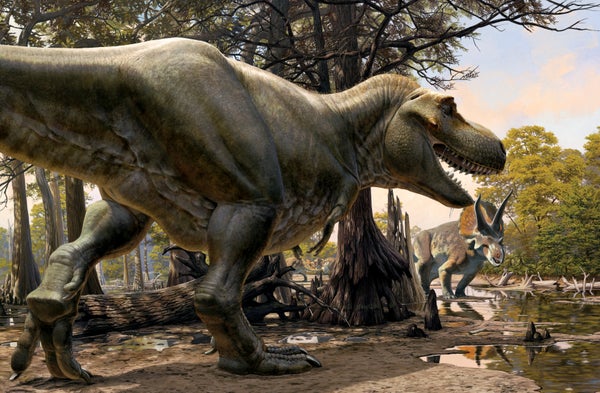
Few creatures from Earth’s deep past have captured the human imagination as powerfully as Tyrannosaurus rex. With a skull nearly as long as a human body, teeth the size of bananas, and a body built like a living tank, T. rex has long been portrayed as the ultimate predator. In popular culture—from museum displays to films like Jurassic Park—it appears as the unstoppable king of dinosaurs.
Yet for decades, scientists have debated a surprisingly fundamental question: was T. rex truly an active hunter, or was it primarily a scavenger that fed on carcasses left by other predators?
The debate has been one of the most fascinating scientific discussions in paleontology. It is not merely about a dinosaur’s diet; it touches on how scientists interpret fossil evidence, reconstruct ancient ecosystems, and challenge long-held assumptions. Through fossils, biomechanics, bite marks, and computer models, researchers have gradually assembled a clearer picture of how this legendary dinosaur lived.
Understanding whether T. rex hunted or scavenged means stepping back into the Late Cretaceous world—a landscape of towering conifers, vast river plains, and a cast of dinosaurs locked in an ancient ecological drama.
Discovering the Tyrant Lizard King
The story begins in the early twentieth century when fossils of an enormous carnivorous dinosaur were discovered in western North America. The dinosaur was formally described in 1905 by the American paleontologist Henry Fairfield Osborn, who gave it the dramatic name Tyrannosaurus rex, meaning “tyrant lizard king.”
From the beginning, the sheer size of the animal suggested a formidable predator. Adults reached lengths of more than twelve meters and weighed up to eight or nine tons. Its skull alone could exceed 1.5 meters in length. Unlike the slender jaws of some carnivorous dinosaurs, the skull of T. rex was massive and reinforced, built to withstand extraordinary forces.
Its teeth were thick, serrated, and designed for crushing bone. Many fossils of T. rex teeth have been found embedded in dinosaur bones, sometimes even healed over, indicating interactions with other animals during life.
Despite these clues, the nature of T. rex’s lifestyle was not always clear. Early reconstructions in the early twentieth century often depicted dinosaurs as sluggish, reptile-like creatures. In that framework, some scientists imagined T. rex as a slow-moving scavenger rather than a fast, active hunter.
But the debate would intensify decades later when new ideas about dinosaur biology began to transform paleontology.
The Rise of the Scavenger Hypothesis
In the 1990s, a provocative argument emerged suggesting that T. rex might not have been a predator at all. The idea was most famously championed by the American paleontologist Jack Horner.
Horner proposed that T. rex was primarily a scavenger, an animal that relied on finding carcasses rather than hunting live prey. His argument was based on several anatomical features that he interpreted as evidence for scavenging behavior.
One of the most frequently cited pieces of evidence involved the dinosaur’s sense of smell. Fossil skulls reveal that T. rex had very large olfactory bulbs—the regions of the brain responsible for processing smells. This suggested that the animal possessed an extremely powerful sense of smell.
Horner argued that such a keen sense of smell would have been ideal for detecting carcasses over long distances. Modern scavengers like vultures also rely heavily on smell to locate dead animals.
Another aspect of the argument concerned the dinosaur’s arms. T. rex had famously small forelimbs compared with its massive body. Some researchers suggested that these tiny arms would have been impractical for grappling with struggling prey, implying that T. rex might not have been well equipped to capture large animals.
Additionally, early interpretations of its body suggested that it might not have been capable of running quickly. If T. rex were slow, Horner argued, it would have had difficulty catching agile herbivorous dinosaurs.
Together, these observations led to the controversial idea that T. rex functioned like a giant hyena or vulture of the Cretaceous ecosystem, relying mainly on scavenging rather than active hunting.
The hypothesis sparked widespread discussion—and intense disagreement among paleontologists.
The Case for an Active Predator
Many scientists quickly challenged the scavenger hypothesis, arguing that T. rex possessed numerous features typical of large predators.
One of the most compelling lines of evidence involves its powerful jaws. Studies of the skull mechanics of T. rex have shown that it possessed one of the strongest bite forces of any land animal that has ever lived. Computer models suggest that its bite force may have exceeded 35,000 newtons, powerful enough to crush bone with ease.
This bone-crushing ability is reflected in the fossil record. Numerous dinosaur bones show deep tooth marks consistent with T. rex bites. In some cases, bones are splintered and crushed in ways that indicate enormous pressure.
Predators that rely purely on scavenging generally do not evolve such specialized killing equipment. A bite capable of pulverizing bone suggests a feeding strategy that included subduing large prey.
Another important clue lies in the dinosaur’s binocular vision. The eyes of T. rex faced forward, providing overlapping fields of view. This arrangement allows for depth perception—an essential trait for animals that must judge distance accurately while attacking prey.
Modern predators such as hawks, lions, and wolves all possess forward-facing eyes that enhance depth perception. Herbivores, by contrast, often have eyes positioned on the sides of their heads to detect predators approaching from different directions.
The visual system of T. rex strongly suggests a lifestyle that involved actively targeting moving animals.
Evidence from Healed Bite Marks
One of the most fascinating pieces of evidence for T. rex predation comes from fossils showing healed injuries.
A famous example involves fossils of Edmontosaurus, a large duck-billed herbivorous dinosaur that lived in the same environment as T. rex. Some Edmontosaurus bones bear bite marks that match the distinctive shape of tyrannosaur teeth.
In several cases, the bones show signs of healing around the bite marks. This indicates that the herbivore survived the attack and lived long enough for the injury to partially recover.
Such evidence is difficult to explain if T. rex was only a scavenger. Scavengers feed on animals that are already dead; they do not leave healed bite wounds. These fossils strongly imply that T. rex sometimes attacked living prey.
Another dramatic fossil shows a tyrannosaur tooth embedded in the tail vertebra of an Edmontosaurus. The bone healed around the tooth fragment, providing a direct snapshot of an unsuccessful predatory strike millions of years ago.
These fossils offer rare glimpses into ancient battles between predator and prey.
Speed, Strength, and the Mechanics of Movement
A key question in the hunting debate concerns how fast T. rex could move. Early depictions often showed it sprinting like a gigantic ostrich. Later studies suggested it might have been slower.
Modern biomechanical analyses use computer modeling to estimate how the dinosaur’s muscles, bones, and tendons would have functioned. These studies indicate that while T. rex was unlikely to be a high-speed runner, it was still capable of moderate speeds.
Most estimates place its top speed somewhere between 15 and 25 kilometers per hour. While not exceptionally fast, this speed would still have been sufficient to pursue large herbivorous dinosaurs that were not built for extreme agility.
The dinosaur’s massive legs were extraordinarily powerful, with large muscle attachment sites visible on fossil bones. These muscles would have generated tremendous force during movement.
Additionally, T. rex possessed a long, heavy tail that acted as a counterbalance to its head and torso. This allowed the dinosaur to maintain stability while moving.
These anatomical features suggest a predator built for power rather than speed—capable of ambushing or overpowering large prey rather than chasing it over long distances.
The Importance of Ecosystem Dynamics
Understanding whether T. rex hunted or scavenged also requires considering the ecology of the Late Cretaceous.
Large terrestrial ecosystems generally contain multiple predators occupying different niches. Some predators specialize in active hunting, while others scavenge opportunistically.
Modern examples illustrate this dynamic. Lions hunt large herbivores, but they also scavenge carcasses when available. Hyenas hunt and scavenge. Even wolves sometimes feed on carrion.
This overlap suggests that the debate between hunter and scavenger may present a false dichotomy.
Many paleontologists now believe that T. rex likely engaged in both behaviors. It probably hunted when the opportunity arose and scavenged when it encountered carcasses.
Such flexibility would have been advantageous in a dynamic ecosystem where food availability varied.
The Role of Sensory Abilities
Recent studies of tyrannosaur braincases have revealed remarkable sensory capabilities.
The large olfactory bulbs suggest an exceptional sense of smell. Rather than proving exclusive scavenging behavior, this ability may have helped T. rex track prey over long distances or detect carcasses hidden in dense vegetation.
Its vision also appears to have been extremely sharp. Some analyses suggest that T. rex had visual acuity comparable to or better than that of modern birds of prey.
Hearing may have been another strength. The structure of its inner ear suggests sensitivity to low-frequency sounds, which could travel long distances across the prehistoric landscape.
Together, these sensory abilities would have made T. rex a formidable hunter capable of locating prey through sight, sound, and smell.
Bite Force and Feeding Behavior
One of the most extraordinary features of T. rex was its bite.
Unlike many predators that slice flesh with blade-like teeth, tyrannosaurs had thick, conical teeth designed to puncture and crush. When the jaws closed, the teeth could penetrate deep into bone.
Fossil bones from various dinosaurs show clear signs of tyrannosaur feeding. In many cases, bones were broken and splintered, indicating that T. rex consumed not only flesh but also bone marrow.
This feeding strategy allowed the dinosaur to extract maximum nutrition from carcasses. Bone marrow is rich in fats and nutrients, providing valuable energy.
Such behavior resembles that of modern bone-crushing carnivores like hyenas. Yet hyenas are both hunters and scavengers, reinforcing the idea that these roles often overlap.
Fossilized Evidence of Predatory Behavior
Additional clues come from trackways and fossilized environments.
Some sites show evidence of predator-prey interactions, where the remains of herbivores are found alongside tyrannosaur teeth or shed teeth fragments.
Teeth from T. rex were frequently lost during feeding and replaced throughout the animal’s life. These shed teeth sometimes remain embedded in fossilized bones, linking tyrannosaurs directly to feeding events.
The sheer abundance of such evidence suggests that T. rex was actively feeding on large animals within its ecosystem.
Changing Perspectives in Paleontology
The debate over T. rex’s lifestyle reflects broader changes in paleontology.
In the past, dinosaurs were often viewed as slow, primitive reptiles. Over the past several decades, new discoveries have transformed that view. Dinosaurs are now understood as dynamic, active animals closely related to birds.
Advances in technology have played a crucial role in this transformation. CT scanning allows scientists to examine the internal structure of fossil bones. Computer simulations help reconstruct movement and muscle function. Chemical analyses reveal details about diet and growth.
These tools have allowed researchers to test ideas about dinosaur behavior with increasing precision.
The Modern Scientific Consensus
Today, most paleontologists agree that the question of whether T. rex was a hunter or scavenger cannot be answered with a simple either-or.
The evidence strongly supports the idea that T. rex was capable of active predation. Healed bite marks, powerful jaws, forward-facing eyes, and strong legs all point toward a predator capable of attacking large prey.
At the same time, its exceptional sense of smell and bone-crushing bite would have made it an effective scavenger when carcasses were available.
Like many modern carnivores, T. rex likely combined both strategies. It was an opportunistic feeder, hunting when possible and scavenging when necessary.
This flexibility may have been one of the keys to its ecological success.
A Glimpse into the Ancient World
Imagining a T. rex in its natural environment brings the Late Cretaceous world to life.
Picture a vast river floodplain in what is now western North America. Ferns and flowering plants grow beneath towering conifers. Herds of duck-billed dinosaurs move slowly across the landscape, feeding on vegetation.
Somewhere nearby, a tyrannosaur waits.
Its senses scan the environment. Its massive head lifts slightly as it catches a scent carried on the wind. Perhaps it has detected a wounded herbivore. Perhaps a carcass lies hidden in the forest.
With slow, deliberate steps, the predator begins to move.
Whether it hunts or scavenges depends on the opportunity. Either way, the tyrant lizard king remains one of the most formidable animals ever to walk the Earth.
The Enduring Mystery of Tyrannosaurus
Despite decades of research, Tyrannosaurus rex still holds many secrets.
New fossils continue to be discovered, revealing unexpected details about its growth, behavior, and ecology. Each discovery adds another piece to the puzzle.
The debate over hunting versus scavenging has gradually shifted from confrontation to synthesis. Instead of asking whether T. rex was one or the other, scientists now explore how it balanced these roles within its ecosystem.
This evolving understanding illustrates the nature of science itself. Ideas are proposed, tested, challenged, and refined as new evidence emerges.
T. rex remains a symbol of both the power of prehistoric life and the enduring curiosity of those who study it.
In the end, the tyrant lizard king was not simply a hunter or a scavenger. It was a complex, adaptable predator navigating a world that vanished sixty-six million years ago—yet continues to inspire awe in the modern imagination.