More than 150 million years ago, long before humans walked the Earth, the oceans were ruled by creatures so powerful and terrifying that even the largest marine predators of today would seem modest by comparison. These giants were not sharks, nor were they dinosaurs. They belonged to an ancient group of marine reptiles known as pliosaurs—massive, muscular hunters that dominated the seas during the Jurassic Period.
Imagine standing on the shoreline of an ancient ocean. The water appears calm, reflecting the warm Jurassic sun. Beneath that quiet surface, however, moves something enormous. A powerful body glides through the water with the grace of a torpedo and the force of a charging predator. Its head alone is longer than a modern human. Its jaws are filled with teeth the size of kitchen knives. When it strikes, there is little chance for escape.
These were the pliosaurs—apex predators of prehistoric seas. Among them, one particular giant captured the imagination of scientists and the public alike: a creature sometimes nicknamed “Predator X,” a pliosaur so massive and powerful that it may have been among the most formidable hunters ever to live in Earth’s oceans.
The story of pliosaurs is not just about monstrous teeth and ancient oceans. It is a story of evolution, discovery, mystery, and the relentless drive of life to adapt and dominate even the most dangerous environments on Earth.
The Jurassic Ocean: A World of Giants
During the Jurassic Period, which lasted from about 201 to 145 million years ago, the world looked dramatically different from today. The continents were arranged in unfamiliar positions, and much of the planet was covered by warm, shallow seas. These oceans teemed with life.
Coral reefs flourished in the warm waters. Schools of fish darted between underwater forests of marine plants. Ammonites—spiral-shelled relatives of modern squid—drifted through the currents. Giant marine reptiles hunted in the depths.
Among these reptiles were several major groups. Long-necked plesiosaurs cruised slowly through the water, using their slender necks to snatch small prey. Ichthyosaurs, shaped somewhat like modern dolphins, were swift swimmers that chased fish and squid.
But towering above them all in power and ferocity were the pliosaurs.
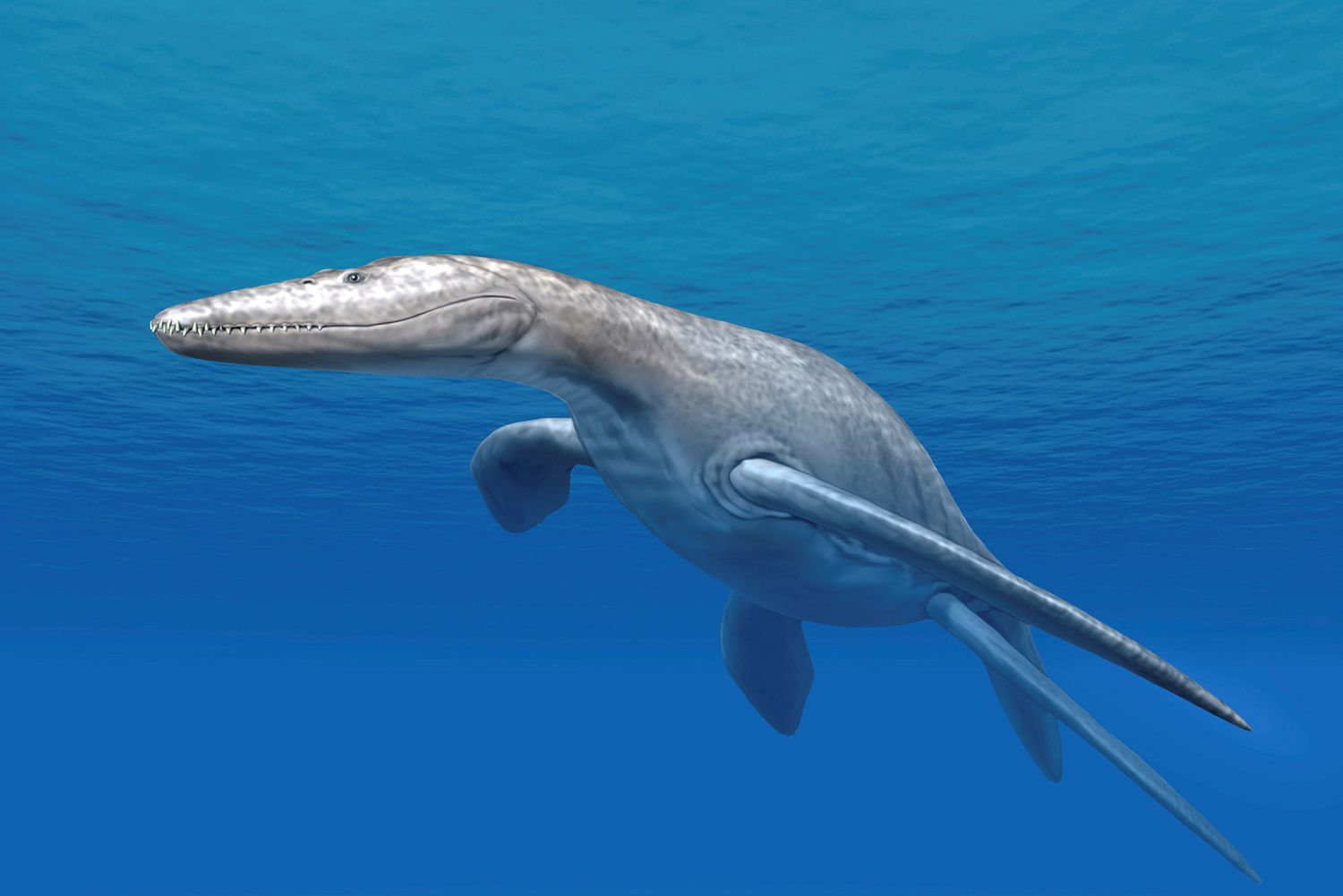
These animals were built for domination. Unlike their long-necked cousins, pliosaurs had enormous heads attached to short, muscular necks. Their bodies were broad and streamlined, with four powerful flippers that propelled them through the water with astonishing speed and strength.
Everything about their anatomy suggested a life devoted to hunting.
What Exactly Were Pliosaurs?
Pliosaurs were marine reptiles belonging to a larger group known as plesiosaurs. The name “pliosaur” actually refers to members of the family Pliosauridae, a group of plesiosaurs that evolved specialized traits suited for powerful predation.
While many plesiosaurs had small heads and long necks, pliosaurs evolved the opposite design. Their heads became enormous, their necks shortened, and their jaws grew incredibly strong. These changes transformed them into some of the most formidable marine predators of the Mesozoic Era.
Despite their reptilian heritage, pliosaurs were perfectly adapted for life in water. Their limbs evolved into large flippers, similar to those of sea turtles but even more powerful. These flippers did not simply paddle back and forth like oars. Instead, they moved in coordinated strokes, generating lift and thrust much like the wings of a bird flying underwater.
This method of locomotion allowed pliosaurs to maneuver quickly and efficiently in pursuit of prey.
Their bodies were covered in smooth skin, reducing drag as they swam. Their massive tails likely provided additional steering and stability. Combined with their immense muscle power, these features made pliosaurs highly effective hunters.
Giants of the Deep
Pliosaurs varied in size, but some species reached truly astonishing proportions. Many were between 8 and 12 meters long, but the largest individuals may have exceeded 15 meters in length. Their skulls alone could measure more than two meters.
Among the most famous pliosaurs is Pliosaurus funkei, the creature often referred to as “Predator X.” Fossils of this animal were discovered in Arctic regions, revealing a predator of extraordinary size and strength.
Another well-known pliosaur is Liopleurodon ferox, which lived in European seas during the Jurassic Period. Although popular media once exaggerated its size dramatically, it was still an enormous predator capable of taking down large prey.
These animals were the marine equivalents of terrestrial apex predators like the famous Tyrannosaurus rex. At the top of the food chain, pliosaurs likely had few natural enemies.
The ocean belonged to them.
The Power of the Pliosaur Skull
One of the most striking features of pliosaurs was their massive skulls. Unlike the delicate heads of many marine animals, pliosaur skulls were heavily built, with thick bones and powerful muscle attachments.
Their jaws were lined with long, conical teeth designed for gripping and tearing prey. These teeth were not serrated like those of many dinosaurs. Instead, they were smooth and sharply pointed, ideal for piercing flesh and holding struggling animals.
Some teeth could reach lengths of more than 20 centimeters.
The bite force of large pliosaurs may have been among the strongest of any known marine predator. Their jaws could snap shut with tremendous power, capable of crushing bone and ripping apart even large animals.
Fossil evidence suggests that pliosaurs fed on a wide range of prey. Fish, squid-like cephalopods, marine reptiles, and even other pliosaurs may have been on the menu.
In some fossil specimens, scientists have discovered bite marks on bones that appear to match the teeth of pliosaurs. These marks tell a story of violent encounters in the ancient seas.
Hunting in the Ancient Ocean
To survive as an apex predator, a pliosaur needed more than size and teeth. It needed keen senses and effective hunting strategies.
Pliosaurs likely relied heavily on vision to detect prey. Their eyes were large and forward-facing, giving them good depth perception in the underwater world.
Their powerful bodies allowed them to accelerate rapidly when pursuing prey. Once close enough, their enormous jaws would snap shut with devastating force.
Scientists believe that pliosaurs may have hunted in a manner similar to modern crocodiles or killer whales—ambushing prey with sudden bursts of speed.
Imagine a long-necked plesiosaur gliding slowly through Jurassic waters. Suddenly, from the shadows of the deep, a pliosaur lunges forward. The water erupts in chaos. Within seconds, the hunt is over.
In the brutal ecosystem of the Jurassic ocean, survival depended on speed, strength, and relentless efficiency.
The Discovery of “Predator X”
The discovery of the pliosaur known as “Predator X” captured global attention. Fossils of this enormous reptile were found in Arctic regions of Norway, in rocks dating back roughly 147 million years.
The discovery site lies within the archipelago of Svalbard, a remote and icy region where ancient marine sediments are exposed in dramatic cliffs.
These rocks once formed the bottom of a Jurassic sea.
When paleontologists excavated the fossils, they uncovered parts of a massive skull and skeleton belonging to a gigantic pliosaur. The creature’s size and apparent bite power quickly made headlines.
The nickname “Predator X” was coined by researchers to describe the animal’s extraordinary predatory capabilities.
Later studies formally described the species as Pliosaurus funkei.
Although the dramatic nickname captured public imagination, scientists remain cautious about exact measurements and capabilities. Fossil remains are often incomplete, making it difficult to reconstruct the full size of extinct animals with absolute certainty.
Still, the discovery confirmed what paleontologists already suspected: pliosaurs included some of the most powerful marine predators in Earth’s history.
Life Cycle and Reproduction
For a long time, scientists debated how marine reptiles such as pliosaurs reproduced. Early theories suggested that they might crawl onto land like sea turtles to lay eggs.
However, fossil discoveries eventually provided a different answer.
Evidence from related plesiosaurs indicates that these animals gave birth to live young in the water. This adaptation allowed them to remain fully aquatic throughout their lives, without needing to return to land.
If pliosaurs shared this reproductive strategy—and most evidence suggests they did—it would have made them even more efficient ocean dwellers.
Young pliosaurs likely began life already capable of swimming. They may have been relatively large at birth, increasing their chances of survival in a dangerous environment filled with predators.
Parental care remains uncertain. Some scientists speculate that large marine reptiles may have protected their young for a period after birth, but direct fossil evidence is limited.
The Fall of the Pliosaurs
Despite their dominance during much of the Jurassic Period, pliosaurs did not remain at the top of the ocean forever.
By the Late Jurassic and into the Cretaceous Period, marine ecosystems began to change. New predators appeared, including advanced mosasaurs—large marine reptiles related to modern monitor lizards.
Environmental changes, competition, and evolutionary pressures gradually reduced the diversity of pliosaurs.
Over millions of years, their numbers declined.
By the end of the Cretaceous Period, around 66 million years ago, the great marine reptiles of the Mesozoic—including pliosaurs—vanished during the same mass extinction event that ended the age of non-avian dinosaurs.
The seas would never again host predators quite like them.
Fossils and the Reconstruction of Ancient Giants
Our understanding of pliosaurs comes entirely from fossils—bones preserved in rock over tens of millions of years.
Paleontologists carefully excavate these fossils, often in remote or difficult environments. Each bone is studied in detail, compared with known species, and used to reconstruct the anatomy of long-extinct creatures.
Sometimes only fragments are found. A single tooth or piece of jaw may hint at a massive predator lurking in ancient oceans.
Advances in technology have greatly improved how scientists study fossils. CT scanning allows researchers to examine the internal structure of bones without damaging them. Digital modeling helps reconstruct skeletons and simulate movement.
These tools allow scientists to better understand how pliosaurs lived, hunted, and moved through their environment.
Even so, many mysteries remain.
The Legacy of the Jurassic Sea Predators
Today, no creature alive fully matches the raw power and design of a giant pliosaur. Modern marine predators such as great white sharks and killer whales are formidable, but the pliosaurs occupied a unique place in evolutionary history.
They ruled the oceans during a time when reptiles—not mammals—dominated the seas.
Their fossils remind us that Earth’s history is filled with extraordinary life forms, many stranger and more powerful than anything we see today.
The study of pliosaurs continues to evolve as new fossils are discovered and new technologies reveal hidden details within ancient bones.
Each discovery adds another chapter to the story of these magnificent predators.
The Ocean’s Forgotten Rulers
When we imagine prehistoric life, our minds often turn to towering dinosaurs roaming ancient forests and plains. Yet the oceans of the same era were equally dramatic, filled with creatures that rivaled land predators in size and ferocity.
Pliosaurs were among the greatest of them all.
With massive skulls, bone-crushing jaws, and bodies built for explosive speed, they were the undisputed rulers of Jurassic seas.
The nickname “Predator X” may sound dramatic, but in many ways it captures the essence of these animals. They were the ultimate marine hunters of their time—products of millions of years of evolution, perfectly shaped for life as oceanic predators.
Though they vanished millions of years ago, their fossils continue to fascinate scientists and ignite the imagination of anyone who encounters their story.
Because buried within ancient rock are the remains of creatures that once ruled the oceans with terrifying power.
And through the science of paleontology, the ghosts of those Jurassic seas continue to rise again.