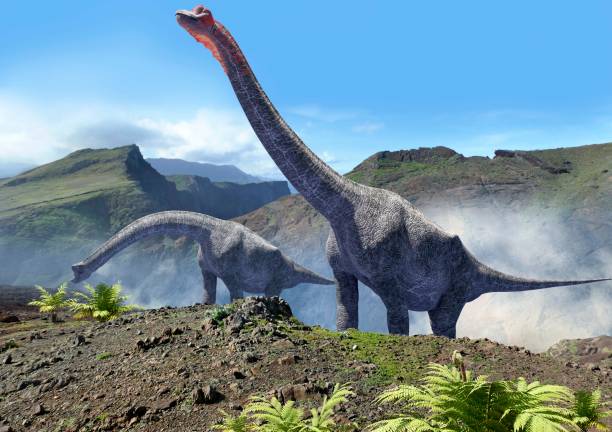
Imagine standing in the vast floodplains of South America roughly 125 million years ago during the Early Cretaceous period. The landscape is warm and humid, filled with low forests, fern-covered ground, and winding rivers cutting through wide valleys. Herds of herbivorous dinosaurs move slowly through the vegetation, browsing on shrubs and soft plants. Among them walks a creature whose appearance is unlike almost any other dinosaur known. Its long neck rises above its body like that of many sauropods, yet something unusual runs along the top of its spine. Two rows of long, narrow spikes extend upward from its neck, forming a dramatic crest that gives the animal a silhouette both elegant and mysterious.
This dinosaur is known as Amargasaurus cazaui, one of the most distinctive plant-eating dinosaurs ever discovered. Though not the largest member of the long-necked dinosaur family, it is certainly one of the most visually striking. The unusual spines along its neck have fascinated scientists since its discovery, raising questions about their function, appearance, and evolutionary purpose.
Amargasaurus represents more than just an unusual fossil. It offers a glimpse into the diversity of dinosaur anatomy and the complex ways evolution shapes living organisms. Through the study of this remarkable animal, paleontologists have gained insight into dinosaur biology, prehistoric ecosystems, and the evolutionary creativity that existed long before humans appeared on Earth.
Discovery in the Patagonian Wilderness
The story of Amargasaurus begins in the rugged landscapes of southern South America, specifically in what is now northern Patagonia in Argentina. In this region lies a geological formation known as the La Amarga Formation, a sequence of sedimentary rocks that preserves fossils from the Early Cretaceous period.
During the late twentieth century, paleontologists working in this area uncovered the remains of a dinosaur unlike any previously known. The fossils included an unusually well-preserved vertebral column, particularly in the neck region, where elongated spines projected dramatically upward. These structures immediately captured the attention of scientists.
The dinosaur was formally described in 1991 by Argentine paleontologist José Bonaparte along with collaborator Leonardo Salgado. They named the animal Amargasaurus, meaning “La Amarga lizard,” referencing the geological formation in which it was discovered. The species name, cazaui, honors a local scientist who assisted in the research.
The discovery was significant not only because of the dinosaur’s unusual anatomy but also because relatively complete sauropod fossils from this time period were rare. The remains of Amargasaurus allowed scientists to reconstruct much of the animal’s body and to understand its place within the larger family of long-necked dinosaurs.
Understanding the Sauropod Family
To appreciate the uniqueness of Amargasaurus, it is helpful to understand the broader group to which it belongs. Amargasaurus was a sauropod, a type of dinosaur famous for its long neck, long tail, small head, and massive body. Sauropods include some of the largest animals ever to walk the Earth.
Many people are familiar with giants such as Brachiosaurus or Diplodocus, whose enormous size and towering necks have made them icons of prehistoric life. These animals dominated terrestrial ecosystems during much of the Jurassic and Cretaceous periods, grazing on vast amounts of vegetation and shaping their environments in ways similar to large herbivores today.
However, not all sauropods were enormous. Some lineages evolved smaller body sizes, specialized features, or unusual skeletal adaptations. Amargasaurus belongs to a group known as dicraeosaurids, a family of relatively small and lightly built sauropods that lived primarily during the Late Jurassic and Early Cretaceous.
Members of this family had shorter necks compared with many other sauropods, as well as distinctive vertebral structures. Among these relatives was Dicraeosaurus, a dinosaur discovered in Africa whose vertebrae also possessed elongated spines. Yet even compared with Dicraeosaurus, the spines of Amargasaurus were extraordinary in both length and arrangement.
Anatomy of an Unusual Dinosaur
Amargasaurus was not a giant by sauropod standards. Estimates suggest that it measured roughly 9 to 10 meters in length and weighed perhaps 2 to 3 tons. In comparison with colossal sauropods that could exceed 30 meters in length, Amargasaurus was relatively modest in size.
Despite its smaller stature, the dinosaur retained the classic sauropod body plan. Its long neck allowed it to reach vegetation above ground level, while its long tail likely served as a counterbalance. The head was small and narrow, equipped with simple peg-like teeth designed for stripping leaves from plants rather than chewing them thoroughly.
Like other sauropods, Amargasaurus probably swallowed plant material largely unchewed. Inside its digestive system, tough vegetation would have been broken down through fermentation and possibly with the help of swallowed stones known as gastroliths.
The most distinctive anatomical feature of Amargasaurus, however, lies in the vertebrae of its neck and back. Each cervical vertebra possessed elongated neural spines—thin bony projections that extended upward from the top of the vertebra. In Amargasaurus, these spines were exceptionally long and formed paired structures running along the length of the neck.
In some vertebrae, the spines reached lengths exceeding half a meter. Rather than forming a single row, they were arranged in two parallel lines, creating a double crest that would have been immediately visible even from a distance.
The Mystery of the Spiny Sail
The function of the elongated spines remains one of the most intriguing questions surrounding Amargasaurus. Because soft tissues rarely fossilize, scientists must rely on comparisons with living animals, biomechanical analysis, and indirect evidence to infer how these structures might have appeared in life.
One possibility is that the spines supported a sail-like structure made of skin. In this scenario, a thin membrane could have stretched between the spines, forming a tall crest along the neck. Such sails are known in other prehistoric animals, including the famous synapsid Dimetrodon.
If Amargasaurus possessed a sail, it might have served several functions. It could have played a role in thermoregulation by helping the animal absorb or release heat. Alternatively, the sail might have been used for visual display, allowing individuals to signal dominance, attract mates, or communicate within their species.
Another possibility is that the spines supported keratinous sheaths—similar to horns or spikes in modern animals—rather than a continuous membrane. In this interpretation, the neck would have appeared covered in sharp projections forming a defensive barrier against predators.
Biomechanical studies have explored whether the spines were strong enough to function as rigid spikes. Some researchers suggest that the bones were relatively thin and might not have withstood heavy impacts, which could favor the sail hypothesis. Others argue that even slender spikes might still deter predators by making the neck difficult to attack.
The true appearance of the structure remains uncertain, and it is possible that the spines supported a combination of tissues, perhaps including both skin and keratin.
Evolutionary Origins of the Neck Spines
The distinctive spines of Amargasaurus did not appear suddenly in evolutionary history. They represent an exaggerated version of a feature already present in its relatives.
In dicraeosaurid sauropods such as Dicraeosaurus, the neural spines were split into two prongs at their tips. This bifurcation likely supported strong ligaments that helped hold up the neck. Over time, evolutionary pressures may have favored individuals with slightly longer spines, gradually producing the extreme structures seen in Amargasaurus.
Evolution often operates by modifying existing features rather than inventing entirely new ones. In this case, a structural component originally associated with neck support may have been repurposed for display or defense.
Natural selection could have amplified the trait if individuals with larger spines gained advantages in survival or reproduction. For example, prominent neck crests might have made individuals more attractive to potential mates, a process known as sexual selection.
Such evolutionary pathways demonstrate how unusual anatomical features can arise gradually over millions of years through small changes accumulated across generations.
Life in the Early Cretaceous Ecosystem
To understand Amargasaurus fully, it is important to place it within the environment in which it lived. The Early Cretaceous landscapes of Patagonia were dynamic ecosystems shaped by rivers, seasonal rainfall, and diverse vegetation.
The plant life included conifers, cycads, ferns, and early flowering plants. These plants formed the primary food source for herbivorous dinosaurs like Amargasaurus.
Large predators also inhabited the region. Among them was the formidable theropod Carnotaurus, although this particular predator lived slightly later in the Cretaceous. Earlier theropods and other carnivorous dinosaurs likely filled similar ecological roles during the time of Amargasaurus.
Living in such an environment required constant vigilance. The elongated neck of Amargasaurus would have allowed it to scan the surroundings while feeding, increasing the chance of detecting approaching predators.
Herd behavior is also a possibility. Many paleontologists believe that sauropods lived in groups, which would have provided protection through collective awareness and coordinated movement.
Feeding Strategies and Diet
Although the dramatic neck spines capture most of the attention, the feeding behavior of Amargasaurus was equally important to its survival.
Its teeth were relatively small and shaped like pegs, an adaptation common among sauropods. These teeth were well suited for stripping leaves and soft plant material but not for chewing. Instead, the dinosaur likely relied on a digestive system capable of breaking down tough vegetation over long periods.
The moderately long neck allowed Amargasaurus to browse across a range of heights without moving its entire body. It could sweep its head through vegetation, collecting leaves and branches from shrubs and low trees.
Because sauropods required enormous quantities of food, they probably spent much of their day feeding. Continuous grazing would have allowed them to process large volumes of plant matter and sustain their large bodies.
The presence of different herbivorous dinosaurs in the same environment suggests that each species may have specialized in slightly different feeding strategies. Such ecological partitioning reduces competition and allows multiple species to coexist within the same ecosystem.
Growth and Life Cycle
Like other dinosaurs, Amargasaurus began life as a hatchling emerging from an egg. Although no eggs definitively attributed to this species have been discovered, the reproductive behavior of sauropods provides clues about its early life.
Sauropods likely laid clutches of eggs in shallow nests. The eggs were probably buried or covered with vegetation to protect them and regulate temperature. After hatching, the young dinosaurs would have been much smaller than adults but already capable of walking.
Growth in sauropods was relatively rapid. Bone studies from related species indicate that many individuals reached adult size within a few decades. During this time, the distinctive neck spines of Amargasaurus would gradually develop as the vertebrae grew.
Young individuals may have faced significant risks from predators. Living in groups could have provided some protection, allowing juveniles to remain near larger adults.
The Role of Display in Dinosaur Evolution
The striking neck structures of Amargasaurus raise an important question in evolutionary biology: why do animals evolve elaborate features that appear unnecessary for survival?
In many species, such features arise through display and communication. Animals often develop bright colors, large crests, horns, or other exaggerated structures that help them signal strength, health, or reproductive fitness.
Although direct evidence is difficult to obtain for extinct animals, similar principles likely applied to dinosaurs. If the neck crest of Amargasaurus was visually prominent, it might have helped individuals recognize members of their own species or attract mates during breeding seasons.
Large display structures can also play a role in competition between individuals of the same species. Rival animals may engage in visual displays to establish dominance without resorting to physical combat.
Thus the spiny crest of Amargasaurus may have been part of a complex system of social signaling within dinosaur communities.
Fossils and the Reconstruction of Ancient Life
The study of Amargasaurus demonstrates how paleontologists reconstruct ancient organisms from fragmentary evidence. Fossils rarely preserve complete skeletons, and soft tissues almost never survive.
Scientists must therefore analyze bones carefully, comparing them with those of related species and with structures found in modern animals. By examining the shape of muscle attachment sites, joint surfaces, and bone textures, researchers can infer how an animal moved, fed, and interacted with its environment.
Computer modeling and biomechanical simulations have become increasingly important tools in this process. These methods allow scientists to test hypotheses about movement, posture, and structural strength.
Through such techniques, the fossilized remains of Amargasaurus have been transformed into detailed reconstructions of a living dinosaur that once roamed prehistoric landscapes.
Amargasaurus in Modern Culture
Although not as widely known as some dinosaurs, Amargasaurus has captured the imagination of artists, educators, and enthusiasts around the world. Its dramatic neck crest makes it a favorite subject in paleoart, where illustrators attempt to visualize prehistoric life based on scientific evidence.
Museums often display replicas or skeletal reconstructions of Amargasaurus to illustrate the diversity of sauropod anatomy. These displays remind visitors that dinosaurs were not uniform creatures but a remarkably varied group with many unique adaptations.
In documentaries and books about prehistoric life, Amargasaurus frequently appears as an example of evolutionary experimentation—a species whose unusual anatomy demonstrates the creative power of natural selection.
Continuing Research and Future Discoveries
Despite decades of study, many aspects of Amargasaurus remain uncertain. Paleontologists continue to debate the function of its spines, the appearance of its soft tissues, and its precise evolutionary relationships within the sauropod family.
New fossil discoveries could shed light on these questions. Additional specimens might reveal variations between individuals or provide evidence of skin impressions that clarify the structure of the crest.
Advances in technology may also play a role. Techniques such as CT scanning allow scientists to examine the internal structure of bones without damaging them, providing insights into growth patterns and biomechanical properties.
Each new discovery contributes to a deeper understanding of this remarkable dinosaur and the world it inhabited.
A Window into Evolutionary Creativity
Amargasaurus stands as a reminder that evolution often produces forms that appear surprising or even bizarre. Yet every unusual structure reflects a long history of adaptation shaped by environmental pressures and biological competition.
The double row of neck spines that defines this dinosaur represents millions of years of evolutionary experimentation. Whether used for display, defense, or thermoregulation, the structure demonstrates how natural selection can transform ordinary anatomical features into extraordinary ones.
By studying animals like Amargasaurus, scientists gain insight into the processes that generate biological diversity. The fossil record reveals that life on Earth has never been static; it is a dynamic system constantly producing new forms and adaptations.
The Enduring Fascination of a Spiny Giant
More than one hundred million years have passed since Amargasaurus walked across the floodplains of Patagonia. The rivers that once flowed beside it have long since changed course, and the forests it browsed have vanished.
Yet the fossilized bones preserved within ancient rocks continue to tell its story. From those silent remains, scientists have reconstructed a creature that once moved through prehistoric landscapes with a graceful stride and a dramatic crown of spines rising from its neck.
Amargasaurus reminds us that the history of life is far richer and stranger than imagination alone might suggest. Within the deep past of our planet lie countless forms waiting to be discovered—each one revealing another chapter in the vast evolutionary narrative of Earth.
The dinosaur with the spiny sail is not merely an oddity of prehistoric anatomy. It is a symbol of the endless creativity of evolution and a testament to the power of scientific inquiry to bring lost worlds back into human understanding.