When people imagine the Ice Age, certain images appear almost instantly. Vast frozen plains stretch beneath pale skies. Herds of shaggy mammoths march across snowy grasslands. Saber-toothed cats lurk in the shadows. Early humans, wrapped in furs, watch the landscape with careful eyes.
These famous animals have become icons of prehistoric life. Yet the Ice Age was far stranger, far more diverse, and far more surprising than the familiar mammoth-and-saber-tooth story suggests. Beneath the frozen winds of the Pleistocene epoch lived a cast of animals so unusual that they seem almost invented—creatures that looked like evolutionary experiments, blending features that modern animals rarely share.
Some had claws longer than a human forearm but moved slowly like peaceful grazers. Others resembled gigantic armored tanks. There were deer with antlers wider than a car, beavers the size of black bears, and rhino-like beasts covered in thick fur. These animals were real. They walked the Earth as recently as ten or twenty thousand years ago.
The Ice Age, scientifically known as the Pleistocene epoch, lasted from about 2.6 million years ago until roughly 11,700 years ago. During this time, enormous glaciers advanced and retreated repeatedly across continents. Climate shifted dramatically. Ecosystems changed again and again.
Yet despite the cold reputation of the Ice Age, many regions were not buried in snow. Large parts of Eurasia and North America formed a unique ecosystem called the “mammoth steppe,” a vast grassland that supported enormous herbivores and the predators that hunted them.
Within this dynamic world evolved some of the strangest mammals the planet has ever seen—animals that remain unfamiliar even to many people fascinated by prehistory.
The Giant Sloths That Walked Like Monsters
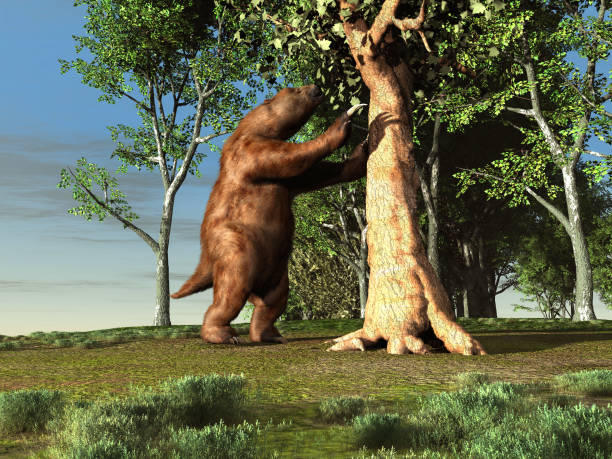
One of the most bizarre Ice Age animals looked as though it belonged in a fantasy film rather than in Earth’s past. Giant ground sloths were enormous relatives of the small tree sloths that still live in South America today. But unlike their modern cousins, these ancient creatures were massive, powerful, and built for life on the ground.
One famous species, Megatherium, could grow as large as an elephant. Standing upright on its hind legs, it might reach six meters tall. Its body was bulky and muscular, supported by thick limbs and huge curved claws.
At first glance those claws appear terrifying, suggesting a fearsome predator. But the giant sloth was not a hunter. It was a plant-eater.
The claws were tools. They helped the animal pull branches toward its mouth, strip leaves from trees, and dig for roots. When threatened, however, those same claws could become formidable weapons. A defensive swipe from a giant sloth could likely fend off even large predators.
Walking across the ancient plains of South America and North America, giant sloths must have been extraordinary sights. Some species had bony plates embedded in their skin, forming a kind of natural armor. Their slow movements and massive bodies made them resemble living tanks.
Their relatives included even stranger forms. Some ground sloths developed powerful tails that acted like a third leg, allowing them to balance while reaching high vegetation. Others lived in caves, leaving behind enormous fossilized dung deposits that scientists still study today.
Despite their size and success, giant sloths disappeared around the end of the Ice Age. Climate changes and human hunting likely both played roles in their extinction.
Yet their fossils remind us that the Ice Age landscape contained animals far stranger than the modern world.
The Armored Giants Called Glyptodonts
Imagine an animal that looked like a cross between an armadillo and a Volkswagen Beetle. Its body was protected by a huge dome of armor made of interlocking bone plates. Its tail ended in a heavy club or spiked ball.
This was the glyptodont.
One famous genus, Glyptodon, lived throughout South America and parts of North America during the Ice Age. Glyptodonts were distant relatives of modern armadillos, but they were vastly larger.
A fully grown glyptodont could weigh more than a small car. Its shell, composed of hundreds of fused bone plates called osteoderms, formed a protective dome over its back. The structure resembled a natural fortress.
Predators attempting to attack such an animal faced a daunting challenge. The shell was incredibly strong, and the glyptodont’s tail could deliver powerful blows. Some species evolved tails ending in heavy clubs covered with spikes.
Despite their intimidating appearance, glyptodonts were gentle herbivores. They grazed on grasses and low plants across open landscapes.
Their presence reveals an important truth about Ice Age ecosystems: herbivores evolved extraordinary defenses not just against predators but also as part of evolutionary competition with other species.
In some parts of South America, early humans may even have used abandoned glyptodont shells as shelters, though the evidence remains debated among archaeologists.
What is certain is that these armored giants once roamed widely across prehistoric landscapes.
The Deer With Antlers Like Forests
Modern deer are graceful animals, known for elegant antlers that grow and fall each year. But during the Ice Age, one species took this design to astonishing extremes.
Megaloceros, often called the Irish elk, possessed the largest antlers ever evolved by any deer species. These enormous structures could stretch over 3.5 meters from tip to tip.
To picture this size, imagine antlers wider than a small car mounted atop the head of a towering deer.
Despite the nickname “Irish elk,” this species was not an elk and was not limited to Ireland. Fossils have been found across Europe and Asia, revealing that the animal thrived across large regions of the Ice Age world.
The antlers likely evolved through sexual selection. Male deer used them to compete for mates and display strength. Larger antlers signaled health and genetic fitness.
Yet carrying such enormous structures required enormous energy. The animal needed a rich diet to grow them each year.
For a long time scientists believed that the giant deer went extinct because their antlers became too large for survival. Modern research suggests a more complex story. Climate changes at the end of the Ice Age likely altered vegetation patterns, reducing the nutrients available for such massive antler growth.
Without the ecological conditions that once supported them, these spectacular animals gradually vanished.
Still, their fossil antlers remain among the most breathtaking relics of Ice Age evolution.
The Beaver the Size of a Bear
Beavers today are impressive engineers. They build dams, shape wetlands, and transform ecosystems. But during the Ice Age, North America hosted a beaver that dwarfed its modern relatives.
Castoroides was a rodent of astonishing scale. It could reach lengths over two meters and weigh more than one hundred kilograms. That makes it comparable in size to a black bear.
Despite its enormous size, this giant beaver looked broadly similar to modern beavers, though with some key differences. Its teeth were massive, powerful chisels capable of slicing through tough vegetation. Its tail, however, appears to have been narrower and less paddle-shaped than that of modern beavers.
Scientists believe giant beavers lived around lakes and wetlands across North America. Fossils are often found in ancient pond deposits and peat bogs.
Curiously, there is little evidence that giant beavers built dams the way modern beavers do. Their lifestyle may have been somewhat different, perhaps focusing more on feeding in wetlands rather than actively engineering them.
Imagine encountering such a creature in a misty Ice Age marsh. A rodent as large as a bear slipping silently through the water would have been both astonishing and intimidating.
The giant beaver disappeared roughly 10,000 years ago, near the end of the Ice Age. Like many large mammals of the time, it vanished during a period of dramatic environmental change.
The Predator With a Built-In Chainsaw Mouth
Among Ice Age predators, few were as strange as a carnivore that combined the body of a wolf with jaws designed like precision cutting tools.
Epicyon belonged to a group sometimes called “bone-crushing dogs.” These animals lived in North America before and during the early Ice Age.
Epicyon was enormous. Some species weighed as much as modern lions. Its jaws were incredibly powerful, capable of crushing bones to reach the nutritious marrow inside.
The skull of this predator reveals thick teeth and powerful jaw muscles. Instead of slicing meat delicately like many modern predators, bone-crushing dogs could devour entire carcasses.
Their ecological role resembled that of modern hyenas. They were scavengers as well as hunters, capable of exploiting food sources that other predators could not access.
The existence of such animals shows how Ice Age ecosystems supported a wide range of specialized carnivores. Predators evolved different strategies to survive in environments filled with gigantic herbivores.
Epicyon eventually disappeared millions of years ago, but its legacy reveals a fascinating evolutionary path among the dog family.
The Woolly Rhino of the Frozen Plains
While mammoths dominate popular imagination, another massive Ice Age herbivore roamed the same icy landscapes.
Coelodonta antiquitatis was a rhinoceros adapted perfectly for life in the cold steppes of Eurasia. Its thick fur protected it from frigid temperatures, while its massive body conserved heat.
Unlike modern rhinos, the woolly rhinoceros had a long, flattened horn at the front of its nose. Scientists believe this shape helped the animal sweep snow away from vegetation during winter.
Its body was sturdy and powerful, built for grazing on tough grasses that dominated the Ice Age steppe.
Cave paintings created by early humans depict woolly rhinos with remarkable accuracy. These artworks provide glimpses into encounters between humans and the formidable animals that shared their world.
Despite their strength, woolly rhinos vanished around the same time as mammoths. Changing climate and human expansion likely contributed to their extinction.
The Enormous Short-Faced Bear
Among Ice Age predators, one of the most intimidating was the giant short-faced bear.
Arctodus simus lived in North America during the Pleistocene. When standing upright, it may have reached heights over three meters.
Its limbs were long and powerful, suggesting it could run surprisingly fast for its size. The bear’s face appeared shorter than that of modern bears, giving it a distinctive skull shape.
Scientists debate its lifestyle. Some evidence suggests it was an active predator capable of chasing prey across open plains. Other studies indicate it may have relied heavily on scavenging.
Either way, its presence must have inspired caution among other Ice Age animals.
A creature the size of a small car, able to stand taller than most humans could reach, would have dominated the prehistoric landscape.
The Camel That Lived in North America
Many people associate camels with deserts in the Middle East or Africa. But their evolutionary history tells a surprising story.
Camels actually originated in North America millions of years ago. During the Ice Age, several camel species roamed the continent’s grasslands.
One example is Camelops, a tall and long-legged camel that lived across western North America.
These animals likely resembled modern camels but may have lacked the large humps associated with desert species. They were adapted to open environments where they browsed on vegetation.
Eventually some camel ancestors migrated into Asia via the Bering land bridge, giving rise to the camels known today.
But the North American species disappeared at the end of the Ice Age, leaving behind fossils that reveal their unexpected homeland.
The Mystery of Ice Age Extinctions
The disappearance of so many strange animals near the end of the Ice Age remains one of the great mysteries of natural history.
Across continents, enormous mammals vanished in what scientists call the Late Pleistocene extinction. Mammoths, giant sloths, giant beavers, glyptodonts, saber-toothed cats, and many others disappeared within a relatively short period.
Several explanations have been proposed.
Climate change is one factor. As glaciers retreated and temperatures rose, ecosystems transformed dramatically. Grasslands shrank, forests expanded, and habitats shifted.
Another factor may have been the spread of humans. Early human populations developed increasingly effective hunting tools and strategies. Even modest levels of hunting pressure could have pushed vulnerable species toward extinction.
Many researchers believe the extinction resulted from a combination of both forces. Environmental change stressed animal populations, while human hunting delivered the final blow.
Whatever the exact cause, the result was a dramatic loss of biodiversity.
Echoes of a Vanished World
Today, the strange creatures of the Ice Age survive only in fossils, ancient DNA, and the imaginations of scientists who reconstruct their lives.
But their legacy still shapes our world. Many ecosystems evolved in the presence of giant herbivores that are now gone. Grasslands once maintained by mammoths and giant sloths changed dramatically after their disappearance.
Some researchers even explore the idea of “rewilding,” restoring ecological roles once filled by extinct megafauna using modern species.
Whether such efforts succeed or not, they highlight a profound truth: the Ice Age was not merely a frozen chapter of Earth’s past. It was a time of extraordinary biological creativity.
The weird animals that roamed those ancient landscapes remind us that evolution is capable of producing forms far stranger than we expect.
And beneath the quiet layers of rock and sediment, their fossils continue to whisper stories from a world that once existed—a world where armored giants grazed, bear-sized rodents swam through wetlands, and towering sloths pulled branches from prehistoric forests.
It was a world lost to time, yet still alive in the deep history of our planet.