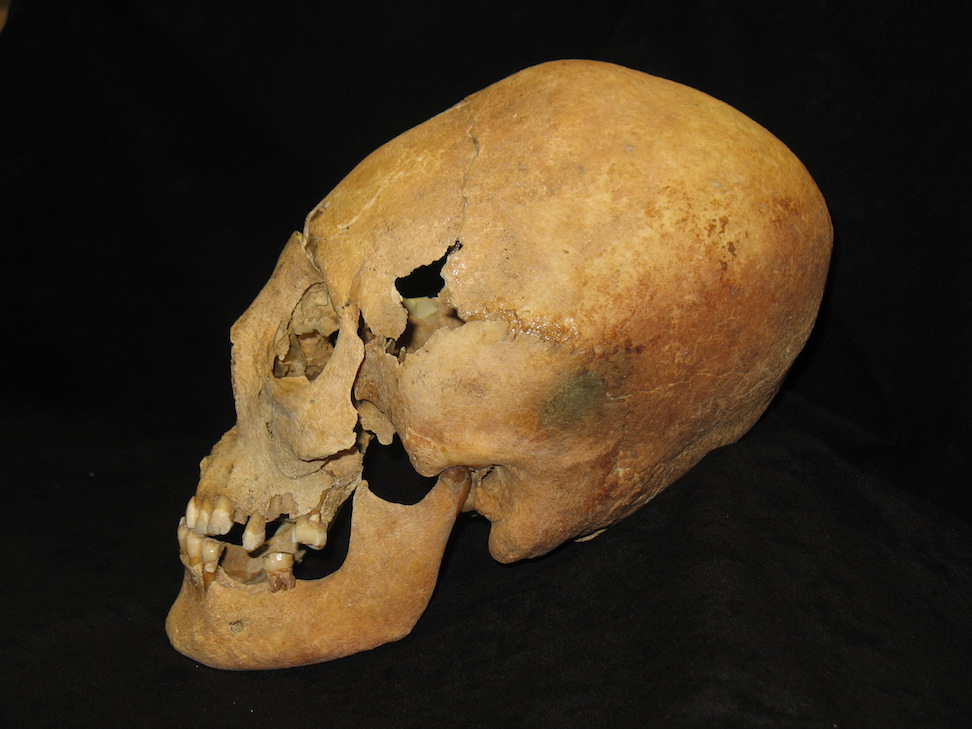
Across continents and millennia, human beings have shaped not only their tools, their homes, and their landscapes, but sometimes their own bodies in ways that still astonish us today. One of the most striking examples is cranial deformation, also known as artificial cranial modification. This practice involved intentionally altering the shape of an infant’s skull through binding, wrapping, or the use of boards during the early months of life, when the cranial bones were still soft and malleable.
To modern eyes, the elongated or flattened skulls uncovered in archaeological sites may seem unsettling. Yet for the people who practiced cranial deformation, these shapes were not distortions. They were ideals. They represented beauty, identity, status, ancestry, or spiritual alignment. They were visible declarations of belonging.
Cranial deformation did not arise in one place or time. It appeared independently in many parts of the world, suggesting a recurring human impulse to mark identity on the body itself. Importantly, scientific evidence shows that when performed carefully in infancy, cranial deformation generally did not impair cognitive function. The skull changed shape, but the brain adapted to the new form without significant loss of capacity.
What follows is an exploration of five ancient civilizations and cultural traditions that practiced cranial deformation. Each story reveals not only a distinctive aesthetic, but a deeper worldview encoded in bone.
1. The Paracas Culture of Ancient Peru
Along the arid southern coast of what is now Peru, the Paracas culture flourished between approximately 800 BCE and 100 BCE. Archaeologists working in the Paracas Peninsula have uncovered some of the most dramatically elongated skulls ever found in the ancient world. These remains, preserved by the desert climate, provide powerful testimony to a society that regarded head shape as a central marker of identity.
The Paracas people used binding techniques that involved wrapping an infant’s head tightly with cloth bands, sometimes combined with small pads or boards to guide the growth of the skull upward and backward. Over time, this produced an elongated, conical shape known as tabular or annular deformation, depending on the specific method used.
What makes the Paracas skulls especially remarkable is the degree of elongation achieved. Some skulls display extreme vertical extension, far beyond what is seen in many other cultures. Despite modern speculation that such shapes might indicate a different species or mysterious origins, scientific analysis confirms that these skulls are fully human. They reflect intentional cultural modification rather than biological anomaly.
Why did the Paracas practice cranial deformation? Archaeological evidence suggests that it was associated with social hierarchy. Many elongated skulls have been found in elaborate burials containing fine textiles, intricate embroidery, and ceremonial objects. These contexts imply that cranial modification may have been a marker of elite status or noble lineage.
The Paracas were master textile artists, producing some of the most sophisticated woven fabrics in the ancient Americas. In the same way that their textiles displayed complex patterns of identity and symbolism, their bodies may have been treated as living expressions of cultural meaning. The skull, as the most visible and symbolically powerful part of the body, became a canvas for social distinction.
2. The Maya Civilization of Mesoamerica
In the lush landscapes of Mesoamerica, the Maya civilization rose to prominence between roughly 250 and 900 CE during what scholars call the Classic Period, though its cultural roots stretch back much earlier. Among the many distinctive features of Maya society—hieroglyphic writing, monumental architecture, advanced astronomy—was the practice of cranial deformation.
Maya cranial modification typically aimed to produce a flattened or elongated forehead. Parents would gently bind an infant’s head between two boards, applying consistent pressure over time. This method created a sloping forehead that resembled the profile of maize, a sacred crop central to Maya cosmology.
The association with maize is not incidental. In Maya mythology, humans were formed from maize dough by the gods. To shape a child’s skull to resemble the maize plant may have symbolized divine origin or alignment with cosmic order. The modified head became a visible sign of cultural and spiritual belonging.
Iconography from Maya art supports this interpretation. Sculptures and painted vessels frequently depict rulers and elites with elongated heads. The shape was considered beautiful and noble. It distinguished the refined from the ordinary. In some cases, cranial deformation appears to have been more common among higher-status individuals, though it was not limited exclusively to them.
Importantly, skeletal evidence shows that the Maya practiced cranial deformation in infancy, when the cranial sutures had not yet fused. The process was gradual and typically completed within the first few years of life. Studies of skeletal remains indicate that while the skull’s external shape changed significantly, the internal cranial volume generally remained within normal human ranges.
For the Maya, the altered skull was not an aberration. It was an embodiment of culture, agriculture, religion, and aesthetics fused into one enduring form.
3. The Huns of Central Asia and Europe
In the vast steppes of Central Asia, a confederation of nomadic groups known as the Huns emerged as a formidable force in the late fourth and fifth centuries CE. Under the leadership of figures such as Attila, they expanded westward into Europe, leaving a deep imprint on the late Roman world.
Among the archaeological traces associated with Hunnic and related steppe populations is the practice of cranial deformation. Numerous graves from Central Asia and Eastern Europe contain skulls that have been artificially elongated through binding techniques.
The Huns appear to have favored annular deformation, achieved by wrapping the infant’s head with bands of cloth to create a cylindrical shape. This method produced a smooth, rounded elongation without the pronounced flattening seen in some Mesoamerican examples.
As the Huns moved into Europe, cranial deformation spread to neighboring populations. Archaeological sites in regions corresponding to modern-day Hungary, Romania, and Germany reveal skulls showing similar modifications. In some cases, local groups adopted the practice, possibly as a sign of alliance, imitation, or assimilation.
For steppe societies, cranial deformation may have functioned as a powerful ethnic marker. In highly mobile and multi-ethnic environments, visible physical traits could serve as immediate indicators of group identity. An elongated skull was not merely aesthetic. It signaled belonging to a particular cultural sphere.
Historical sources from the Roman world sometimes describe the Huns as physically distinct, though such accounts must be treated cautiously due to bias and exaggeration. What the skeletal record confirms is that cranial deformation was a deliberate and widespread practice among certain steppe groups, embedded in patterns of migration, conquest, and cultural exchange.
4. The Mangbetu of Central Africa
In the forests and savannas of Central Africa, the Mangbetu people developed a striking artistic and cultural tradition that included cranial deformation. Although the Mangbetu flourished more recently than many ancient civilizations discussed here, their practice provides important insight into the persistence and meaning of head shaping.
Mangbetu cranial modification, known locally as lipombo, involved wrapping an infant’s head tightly with cloth to create a tall, elongated form. The result was a smooth, vertical extension that became a defining feature of Mangbetu identity.
European explorers who encountered the Mangbetu in the nineteenth century documented both the cranial shapes and the elaborate hairstyles that accentuated them. The elongated head was considered beautiful and refined. It was associated with intelligence, elegance, and high status.
Unlike some other societies where cranial deformation may have been restricted to elites, among the Mangbetu it became a broader cultural practice, though still linked to prestige. Artistic representations, including sculptures and decorative objects, frequently depict elongated heads, reinforcing the aesthetic ideal.
Anthropological research emphasizes that lipombo was performed in early childhood and required careful attention to avoid harm. As in other regions, the brain adapted to the altered skull shape. The practice was gradually abandoned in the twentieth century under colonial pressure and changing social norms.
The Mangbetu example reminds us that cranial deformation was not a single phenomenon confined to distant antiquity. It was a living tradition shaped by local values and sustained across generations.
5. The Ancient Peoples of the Caucasus and Eastern Europe
In regions spanning the Caucasus and parts of Eastern Europe, archaeological evidence reveals widespread cranial deformation during Late Antiquity and the early medieval period. This area became a crossroads of cultures, including steppe nomads, local agrarian communities, and emerging political entities.
Sites in present-day Georgia, Armenia, and southern Russia have yielded skulls showing clear signs of intentional modification. The techniques varied, but many examples reflect tabular deformation, in which boards were used to flatten the front and back of the skull.
The practice in this region appears closely linked to interactions with steppe groups such as the Huns and later nomadic confederations. Cranial deformation may have signaled affiliation with powerful newcomers or served as a marker of hybrid identity in multicultural settings.
Bioarchaeological studies of skeletal remains from the Caucasus indicate that both males and females underwent cranial modification. The practice was not random; it followed consistent cultural patterns. Grave goods and burial contexts suggest that modified skulls were associated with particular social groups or statuses.
As political landscapes shifted and new religious traditions spread, cranial deformation gradually declined. By the early medieval period, the custom had largely disappeared in much of Europe.
Yet the skeletal evidence remains, silent but eloquent. It speaks of communities negotiating identity in times of change, using the human body itself as a sign of belonging.
The Science Behind Cranial Deformation
Cranial deformation relies on a biological reality: the infant skull is not a single solid bone but a collection of plates connected by sutures and fontanelles. These flexible joints allow the skull to pass through the birth canal and accommodate rapid brain growth during early life.
By applying consistent pressure during the first months or years, caregivers could guide the growth of these plates. The skull would gradually assume a new shape. Once the sutures fused, the form became permanent.
Modern medical research distinguishes between pathological cranial deformities, which result from premature suture fusion, and intentional cultural modification. In the latter case, the sutures remain open during the shaping process, allowing normal brain expansion. While extreme forms may have posed risks, most archaeological evidence suggests that individuals with modified skulls lived normal lifespans.
CT scans and morphometric analyses of ancient skulls demonstrate that cranial volume typically remained within standard human ranges. The brain adapted to the altered geometry without obvious impairment.
This scientific understanding is crucial. It dispels sensational myths and situates cranial deformation within the realm of cultural practice rather than biological abnormality.
Identity Written in Bone
Why did so many societies, separated by oceans and centuries, practice cranial deformation? There is no single answer. In some cases, it marked elite status. In others, it expressed beauty or ethnic identity. It could signal spiritual alignment, ancestral heritage, or political affiliation.
The skull is a powerful symbol. It houses the brain, the organ associated with thought, memory, and selfhood. To shape the skull is, in a sense, to shape identity itself.
Cranial deformation also reveals a broader truth about humanity. Across time and space, people have modified their bodies to express cultural values. Tattoos, scarification, foot binding, neck rings, and other practices all reflect the human impulse to inscribe meaning onto flesh.
What makes cranial deformation especially striking is its permanence. Unlike clothing or jewelry, it could not be removed. It marked an individual from infancy to death.
Echoes in the Present
Today, cranial deformation is largely a subject of archaeological and anthropological study rather than living tradition. Museums display elongated skulls in glass cases. Scientists measure angles and volumes, seeking patterns in bone.
Yet the deeper lesson is not about strangeness. It is about familiarity. The ancient parents who bound their infants’ heads believed they were giving them beauty, status, or spiritual alignment. They were acting within a cultural framework that defined what was admirable and desirable.
In that sense, cranial deformation invites reflection. It challenges modern assumptions about normality and difference. It reminds us that the human body has long been a site of cultural expression.
The five civilizations and cultural traditions explored here—the Paracas of Peru, the Maya of Mesoamerica, the Huns of Central Asia and Europe, the Mangbetu of Central Africa, and the ancient peoples of the Caucasus and Eastern Europe—demonstrate the remarkable diversity of human practice. Each shaped the skull in its own way, guided by its own meanings.
Across deserts, forests, steppes, and mountains, parents gently wrapped cloth around their infants’ heads, not to harm, but to mold identity. Over generations, those identities hardened into bone, carrying stories that would outlast empires.
When archaeologists lift an elongated skull from the earth, they are not uncovering a curiosity. They are encountering a human life shaped by love, belief, and belonging. And through the silent language of bone, those ancient lives continue to speak.