Human history is usually reconstructed like a vast and intricate mosaic. Archaeologists piece together fragments of pottery, inscriptions, architectural remains, and environmental evidence to understand how civilizations developed. Over time, patterns emerge. Technologies evolve gradually. Cultural practices spread along trade routes. Materials reflect known capabilities of particular eras.
But occasionally, something appears that does not seem to fit.
An artifact emerges from the ground—or from an archive, a shipwreck, or a forgotten chamber—that appears strangely advanced, misplaced, or difficult to explain within established historical frameworks. These objects are often called “out-of-place artifacts,” or OOPArts. The term does not imply that science has failed. Rather, it highlights moments when interpretation is incomplete, contested, or evolving.
What makes these objects fascinating is not that they overturn scientific knowledge—most do not—but that they force careful re-examination of assumptions. Some reveal underestimated technological sophistication. Others reflect misinterpretation, forgery, or natural processes mistaken for artificial design. Many persist in a gray zone where evidence is incomplete and debate continues.
Science does not reject anomalies. It investigates them. When an artifact challenges expectations, it becomes an opportunity to refine chronology, improve dating techniques, and deepen understanding of ancient knowledge systems.
The following ten objects have stirred intense curiosity, debate, and research. Each raised questions about technological capability, cultural transmission, or historical interpretation. Some have been explained convincingly. Others remain partially unresolved. All have contributed to a deeper, more nuanced understanding of the past.
1. The Mechanism from the Depths: The Antikythera shipwreck Device
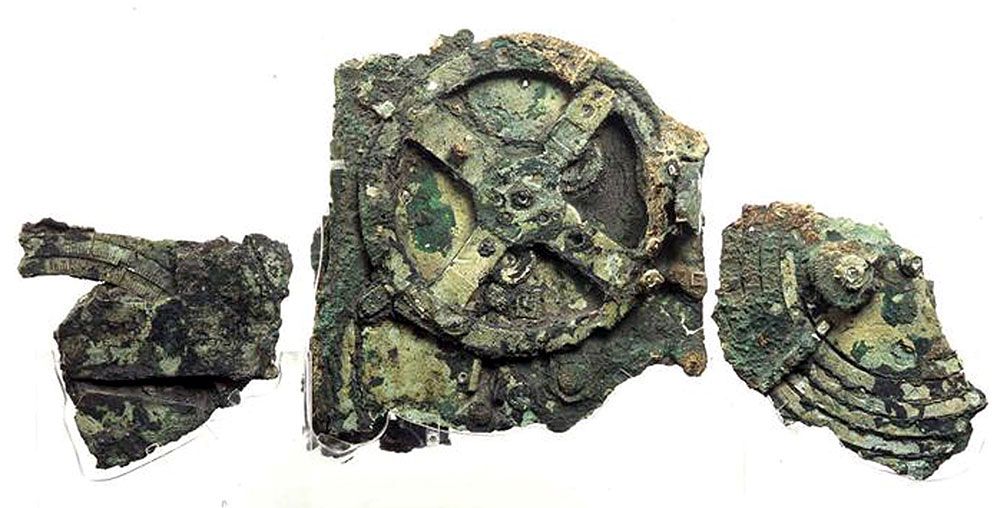
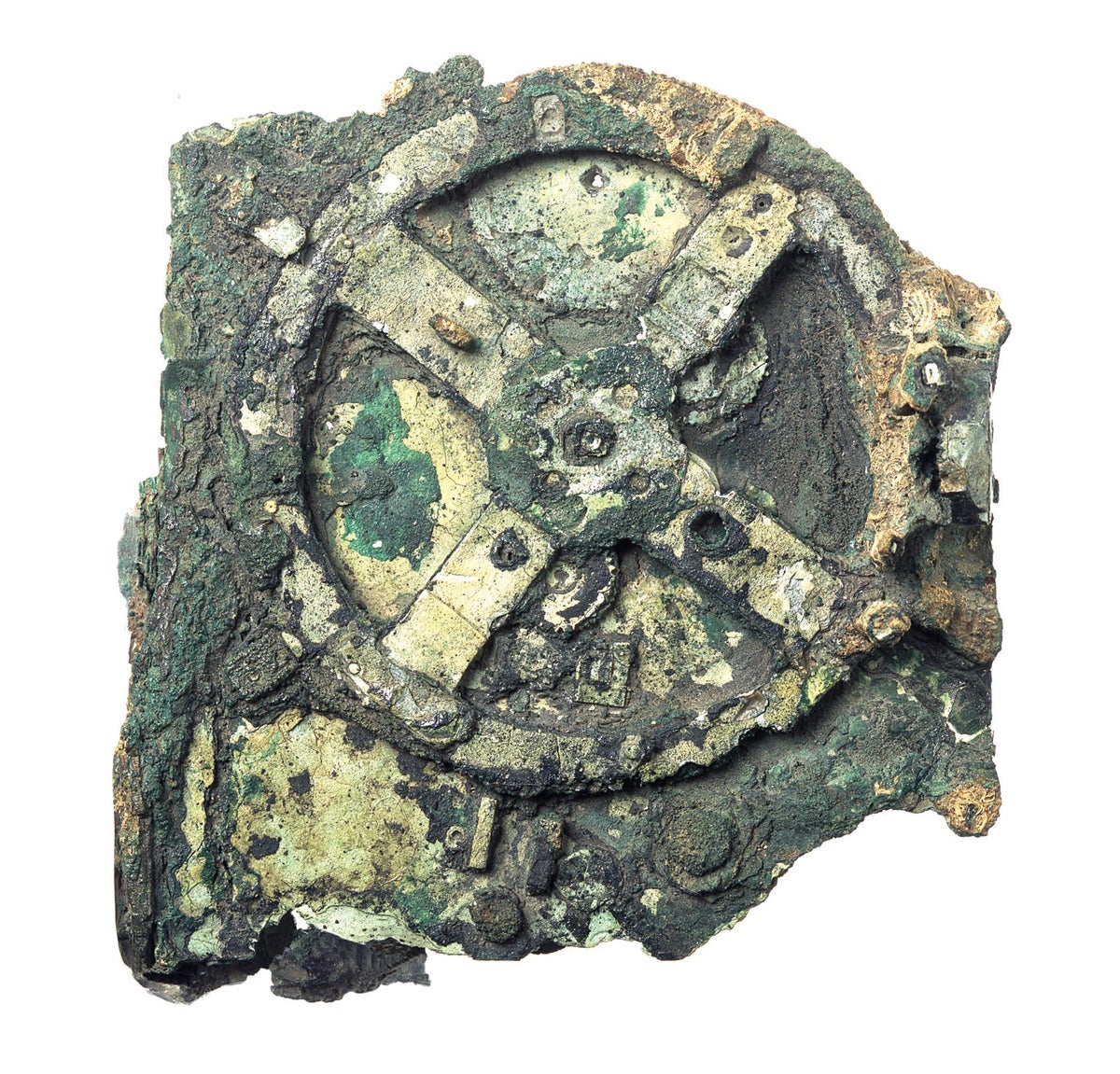
In 1901, sponge divers exploring a Roman-era shipwreck off a small Greek island recovered corroded bronze fragments. At first, the pieces seemed unremarkable. Only later did researchers notice gear teeth embedded within them.
What emerged from careful reconstruction was astonishing: a complex mechanical device consisting of interlocking gears designed to model astronomical cycles. Known today as the Antikythera mechanism, it is widely regarded as the world’s earliest known analog computer.
Radiographic imaging and three-dimensional reconstruction revealed gear systems capable of predicting eclipses, tracking lunar phases, and modeling planetary motions. The precision of its engineering suggests advanced knowledge of astronomy and mechanical design.
The shock was not that ancient Greeks studied the heavens—that was well known—but that they built such sophisticated machinery to simulate celestial motion. Comparable mechanical complexity did not reappear in Europe for more than a millennium.
Yet scientific analysis shows that the device fits within the intellectual environment of Hellenistic science, where mathematical astronomy flourished. It does not overturn history; it reveals how advanced ancient knowledge truly was.
The mystery lies less in impossibility and more in rarity. Why did such devices not survive in greater numbers? Were they luxury instruments for elite scholars? Were others lost to corrosion and war?
The mechanism challenges assumptions not by contradicting science, but by expanding our understanding of ancient engineering.
2. Electricity Before Its Time? The Khujut Rabu archaeological site Vessel
In the 1930s, archaeologists excavating near Baghdad uncovered small ceramic jars containing copper cylinders and iron rods. When assembled with an acidic liquid, the arrangement could produce a small electrical charge.
These objects became known as the “Baghdad batteries.”
Some researchers proposed that they were primitive galvanic cells capable of electroplating metals. Experimental reconstructions confirmed that they could generate voltage. If used intentionally for electricity, they would represent remarkably early experimentation with electrochemical processes.
However, the interpretation remains debated. Many archaeologists argue that the jars likely served non-electrical purposes, perhaps as containers for scrolls or ritual objects. There is no clear evidence of wires, electrical devices, or systematic electroplating from the same context.
Scientific investigation does not confirm ancient electrical technology—but neither does it dismiss the curiosity entirely. The objects demonstrate that the materials and structure capable of producing electricity existed, even if their intended use remains uncertain.
The artifact challenges interpretation rather than physics. It reminds us that function cannot always be inferred from structure alone.
3. A Hammer Encased in Stone: The London Texas fossil site Tool
In 1936, a couple walking near London, Texas reportedly discovered a hammer partially embedded in rock. The surrounding material appeared geologically ancient, leading to speculation that the tool predated known human metallurgy.
The so-called “London Hammer” became widely discussed as an object supposedly millions of years old.
Scientific examination offers more grounded explanations. Mineral concretions can form rapidly around objects in sedimentary environments, encasing relatively recent artifacts within hard stone-like shells. Similar processes preserve bones, shells, and even modern debris.
Metallurgical analysis suggests that the hammer’s composition resembles nineteenth-century iron technology rather than ancient or anomalous metallurgy.
This case illustrates how geological processes can create misleading impressions of extreme antiquity. The artifact challenges interpretation of formation processes rather than historical timelines.
It demonstrates how easily natural mineralization can transform ordinary objects into apparent anomalies.
4. A Map Beyond Its Era: The Chart Preserved in Topkapi Palace Museum
In 1929, scholars examining Ottoman archives discovered a sixteenth-century world map drawn by the Ottoman admiral Piri Reis. The map included detailed coastlines of Africa and South America and appeared to depict landmasses with striking accuracy.
Some interpretations claimed that it showed Antarctica centuries before its official discovery.
Historical cartography provides a more nuanced explanation. The map is a compilation based on multiple earlier sources, including Portuguese navigation charts. Apparent Antarctic features may represent distorted extensions of South America or speculative geography common in Renaissance mapping.
The significance of the map lies not in impossible knowledge but in the remarkable synthesis of global navigation data during an era of rapid exploration.
It reveals how information circulated across cultures and empires, producing unexpectedly sophisticated geographic representations.
The artifact challenges assumptions about early modern knowledge exchange rather than the chronology of discovery.
5. Geometry Across the Desert: The Nazca Lines
Across Peru’s arid desert stretch enormous geometric figures and animal shapes etched into the ground. Some extend hundreds of meters. They are visible most clearly from the air.
When first studied in detail during the twentieth century, the scale and precision of these designs seemed inexplicable. How could ancient people create such vast images without aerial perspective?
Archaeological research revealed a simple yet effective technique: removing dark surface stones to expose lighter soil beneath. Surveying methods using ropes and stakes could produce large-scale designs from ground level.
The desert’s extreme dryness preserved the lines for centuries by preventing erosion.
The mystery here is not technological impossibility but cultural purpose. Hypotheses include ritual pathways, astronomical alignment markers, or symbolic landscape art. Evidence suggests ceremonial and social significance rather than functional infrastructure.
The Nazca Lines challenge assumptions about artistic scale and environmental adaptation, demonstrating how monumental expression can emerge without advanced machinery.
6. A Book No One Can Read: The Manuscript in the Beinecke Rare Book and Manuscript Library
Among the world’s most enigmatic documents is the Voynich Manuscript, a richly illustrated book written in an unknown script. Its pages contain botanical drawings, astronomical diagrams, and mysterious text that has resisted decipherment for over a century.
Radiocarbon dating places the parchment in the early fifteenth century. Ink analysis confirms historical authenticity. Yet no known language corresponds to its writing system.
Cryptographers, linguists, and computer scientists have attempted analysis using statistical modeling. The text exhibits structured patterns consistent with meaningful language rather than random symbols. However, no translation has been universally accepted.
Hypotheses range from encoded herbal knowledge to constructed language or elaborate hoax. Scientific study continues through digital imaging, computational linguistics, and material analysis.
The manuscript challenges understanding of medieval communication systems and encryption practices. It represents not an impossibility, but an unresolved puzzle of interpretation.
7. A Wooden Object That Looks Like Flight: The Saqqara necropolis Model
In an Egyptian tomb dated around the third century BCE, archaeologists found a small wooden object shaped somewhat like a bird—or perhaps a glider. Its wings are straight, and its tail resembles that of certain aircraft stabilizers.
Some observers proposed that it represented ancient knowledge of aerodynamics or flight technology.
Experimental replicas tested in wind tunnels show that the object can glide under certain conditions when modified slightly. However, its original form lacks essential aerodynamic features.
Most Egyptologists interpret it as a stylized bird or ceremonial object rather than a technical model.
The artifact challenges interpretation shaped by modern technological expectations. Humans often project familiar designs onto ancient forms. Scientific analysis suggests symbolic craftsmanship rather than experimental aviation.
8. Discs from a Remote Mountain Range: The Bayan Har Mountains Stones
Reports emerged in the twentieth century describing stone discs with spiral grooves discovered in remote caves. These so-called “Dropa stones” were claimed to contain microscopic inscriptions describing extraterrestrial visitors.
However, documentation is sparse, original specimens are largely unavailable, and published research cannot be independently verified.
Most scholars regard the story as folklore or modern fabrication. Geological formations with natural concentric patterns are common. Without verifiable provenance, scientific evaluation remains impossible.
This case demonstrates how claims can circulate without empirical support. Science does not dismiss anomalies lightly—but it requires reproducible evidence.
The artifact challenges the boundary between archaeological discovery and narrative invention.
9. Objects Without Known Purpose: The Roman Polyhedral Forms Found Across Europe
Hundreds of small bronze objects with multiple faces and circular openings have been found throughout Roman territories. Known as Roman dodecahedra, they date from the second to fourth centuries CE.
Despite extensive study, their function remains unknown. Hypotheses include measuring devices, ritual objects, knitting tools, or military instruments.
Their consistent geometry suggests intentional design, yet no ancient text describes their use.
This mystery challenges the assumption that all widespread tools leave explanatory records. Some cultural practices vanish entirely, leaving only objects without context.
Scientific investigation continues through comparative analysis and experimental reconstruction, but definitive answers remain elusive.
10. A Spark Plug in Stone? The Object from the Coso Mountains
In 1961, rock collectors reportedly discovered a geode containing an object resembling a spark plug. Some interpreted this as evidence of advanced technology in deep prehistory.
Later investigation suggests that the object is likely a twentieth-century spark plug encased within a mineral concretion. Geological processes can form hard nodules around modern objects, producing misleading appearances of great age.
This case highlights the importance of context. Without controlled excavation and stratigraphic documentation, dating becomes unreliable.
The artifact challenges interpretation shaped by visual resemblance rather than geological evidence.
How Science Responds to Anomalies
Objects that appear to contradict established knowledge do not threaten science—they activate it. Scientists analyze materials, apply dating methods, reconstruct environments, and test hypotheses experimentally.
Sometimes anomalies reveal genuine discoveries, such as underestimated technological sophistication. Sometimes they expose misinterpretation, contamination, or fraud. Often they remain unresolved due to incomplete evidence.
The strength of science lies in its willingness to revise conclusions when new data emerges.
Why These Artifacts Matter
Out-of-place artifacts capture imagination because they seem to suggest hidden knowledge, forgotten civilizations, or mysterious events. But their deeper value lies in methodological refinement.
Each puzzling object forces more careful excavation, more precise dating, and more rigorous interpretation. They remind researchers that evidence must always be contextualized within geological, cultural, and historical frameworks.
They also reveal the complexity of human ingenuity. Ancient societies were often more technologically capable than modern observers assume.
The Boundary Between Mystery and Understanding
Some artifacts once considered inexplicable are now well understood. Others remain uncertain. A few exist primarily in legend rather than verifiable record.
What unites them is the tension between expectation and evidence.
Science does not fear that tension. It thrives on it.
The Enduring Fascination of the Unresolved
Human curiosity is drawn to the unexplained. When an object appears to challenge established knowledge, it invites imagination to explore possibilities beyond current understanding.
Yet the true story of these artifacts is not that they overturn science. It is that they deepen it.
Each anomaly becomes a doorway—sometimes to revelation, sometimes to correction, sometimes to humility. Together they remind us that history is not a finished narrative but an evolving investigation shaped by discovery, skepticism, and evidence.
And beneath the surface of the Earth, countless objects still wait—silent, buried, and patient—ready to reshape what we think we know about the human past.