There are places in northern Europe where the earth does not fully give back its dead. In these quiet wetlands—blanketed in mist, layered with sphagnum moss, saturated with dark, tea-colored water—time behaves differently. Here, the past does not always decay into dust. It lingers. It waits. It preserves.
Bog bodies are among the most haunting archaeological discoveries ever made. These are human remains, often astonishingly intact, recovered from peat bogs in countries such as Denmark, Germany, Ireland, the Netherlands, and the United Kingdom. Unlike skeletons found in dry soil, many bog bodies retain skin, hair, fingernails, and even the contents of their stomachs. Some still wear expressions that seem eerily lifelike. Their hands are curled. Their faces are peaceful—or twisted in final pain. They look less like ancient remains and more like people who have been sleeping beneath the earth.
Most of these individuals lived during the Iron Age, roughly between 800 BCE and 400 CE, though some are older. Their preservation is not magic but chemistry. Peat bogs are acidic, cold, low in oxygen, and rich in sphagnum moss, which releases compounds that inhibit bacterial growth. These conditions slow decomposition dramatically. The same processes that tan leather can preserve human skin. Bone, however, often dissolves in the acidic environment, leaving behind leathery tissue wrapped around fragile internal structures.
Yet preservation is only part of the mystery. Many bog bodies show signs of violent death—strangulation, throat cutting, blunt force trauma. Some were carefully placed in the bog. Others appear to have been bound. These details have led scholars to debate who these people were and why they were deposited in wetlands. Were they criminals executed by their communities? Victims of ritual sacrifice? Social outcasts? Or something even more complex?
Each discovery adds a new voice to a silent chorus from the distant past. Among the many bog bodies unearthed over the centuries, several stand out for their remarkable state of preservation and the depth of insight they offer into ancient lives. These are seven of the best-preserved finds—individuals whose stories continue to stir both scientific inquiry and human emotion.
1. Tollund Man
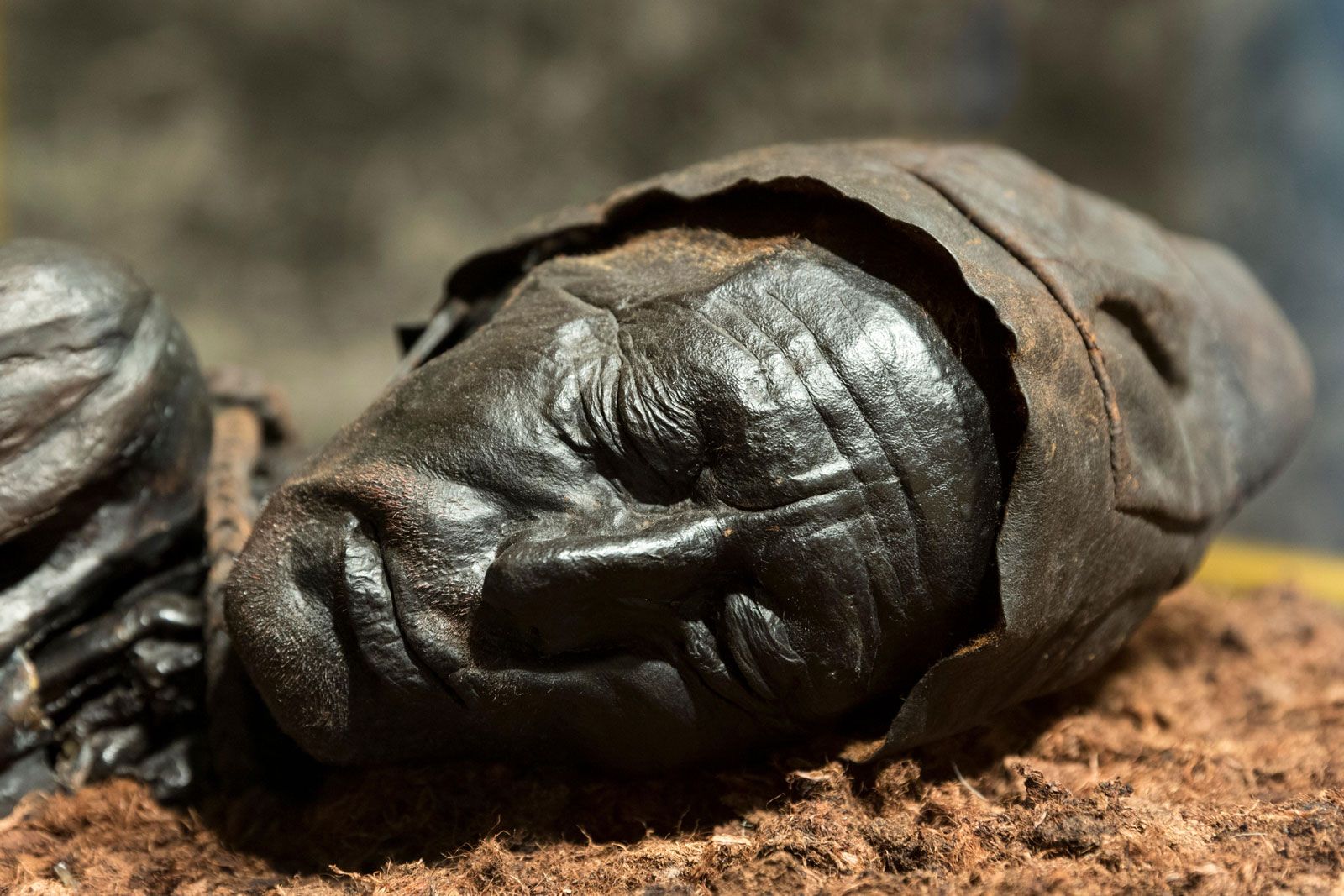
In 1950, in a peat bog near Silkeborg, Denmark, two brothers cutting peat made a discovery that would astonish the world. They uncovered a face in the dark soil—a man with closed eyes and a faint, almost serene expression. The skin was so well preserved that they believed they had found a recent murder victim. Police were called. Only later did experts realize that this man had died more than two thousand years earlier.
This individual became known as Tollund Man. Radiocarbon dating places his death in the early Iron Age, around the 4th century BCE. His preservation is extraordinary. His face is intact, with stubble still visible on his chin. He wore a pointed sheepskin cap and a leather belt. No other clothing survived.
A braided leather noose was found around his neck. Careful examination revealed that he died by hanging. The position of his body—placed gently on his side—suggests deliberation rather than casual disposal. His last meal, preserved in his stomach, consisted of a porridge made from barley, flax, and wild seeds. Analysis of the grains has provided valuable insight into Iron Age agriculture and diet.
Tollund Man’s expression has fascinated observers for decades. His closed eyes and relaxed features give him an almost peaceful appearance. Yet his death was violent. Was he sacrificed to appease deities? Was he executed under tribal law? There is no definitive answer. What remains is the haunting image of a man suspended between life and legend, preserved by the silent chemistry of the bog.
2. Grauballe Man
Only a few years after Tollund Man’s discovery, another remarkable body emerged from a Danish bog near the village of Grauballe. Grauballe Man, dating to the 3rd century BCE, is considered one of the most completely preserved bog bodies ever found.
His body was naked, his skin stained dark by centuries in peat. The most striking feature is the deep cut across his throat, extending from ear to ear. This wound severed his trachea and major blood vessels. It is clear that he died from this injury.
Grauballe Man’s hands are particularly well preserved, allowing researchers to study his fingerprints. His hair, now reddish due to chemical changes in the bog, was originally dark. Scientific examination has revealed signs of malnutrition in his final months. His last meal included a mixture of grains and seeds, similar to that of Tollund Man.
The careful placement of his body and the violence of his death have led many scholars to consider ritual sacrifice as a possible explanation. In Iron Age Europe, wetlands may have been seen as liminal spaces—boundaries between the human world and the divine. Offerings of weapons, animals, and perhaps even humans have been found in similar environments.
Grauballe Man’s twisted posture and slashed throat speak of a dramatic end. Yet his preserved face and hands create an intimate connection across millennia. He is no longer merely an archaeological specimen; he is a human being whose final moments continue to provoke reflection.
3. Lindow Man
In 1984, in Lindow Moss near Manchester, England, peat cutters uncovered human remains that would become known as Lindow Man. Dating to the 1st century CE, during the period of Roman influence in Britain, Lindow Man is one of the most important bog bodies found in the United Kingdom.
His preservation is remarkable, though not as complete as some Danish examples. His beard and moustache are visible. His skin retains texture. His body shows evidence of what has been called a “triple death.” He was struck on the head, garroted with a cord, and had his throat cut. Such multiple injuries have fueled speculation about ritual practices.
Lindow Man’s last meal included partially charred bread made from wheat and barley. Pollen grains found in his stomach suggest he died in late winter or early spring. His fingernails were neatly trimmed, and he showed no signs of hard manual labor, leading some to speculate that he may have been of relatively high status.
The debate over Lindow Man’s death remains unresolved. Some scholars argue for ritual sacrifice, possibly connected to Celtic religious practices. Others suggest judicial execution. The absence of clear written records from Iron Age Britain leaves interpretation open.
What is undeniable is the emotional impact of his discovery. Lindow Man’s face, with closed eyes and slightly parted lips, seems almost contemporary. He bridges a gap of nearly two thousand years, reminding us that ancient societies were composed of individuals with thoughts, fears, and lives as vivid as our own.
4. Yde Girl
In 1897, in a peat bog near Yde in the Netherlands, the body of a young girl was discovered. She became known as Yde Girl. Radiocarbon dating indicates she lived during the Roman Iron Age, around the 1st century CE.
Yde Girl was between 16 and 20 years old at the time of her death. She had long hair, one side of her head shaved. A woolen cloak was wrapped around her body. A woolen band was found around her neck, suggesting strangulation.
CT scans and forensic analysis have revealed that she suffered from scoliosis, a curvature of the spine. This physical difference has led to speculation about her social status. Some researchers have wondered whether her condition made her vulnerable in her community.
Her face, reconstructed through forensic techniques, presents the image of a young woman with delicate features. Seeing her likeness evokes a powerful emotional response. She was not a warrior or a king but a teenager whose life ended violently.
Yde Girl’s story deepens the mystery of bog bodies. Why would a young woman be placed in a bog? Was she sacrificed, punished, or marginalized? The answers remain elusive. What remains is her preserved presence, an ancient life rediscovered in the damp embrace of peat.
5. Windeby Girl
For many years, a body found in 1952 near Windeby, Germany, was believed to be that of a young girl. The individual, known as Windeby Girl, was thought to have been around 14 years old and possibly executed for adultery due to a blindfold covering one eye.
However, modern scientific analysis, including improved osteological examination and imaging techniques, has revised this interpretation. Researchers now believe the individual was likely male and slightly older than originally thought.
The body dates to the 1st century CE. It was found partially clothed, with a woolen band and other textile fragments nearby. The initial narrative of a punished adulteress captured public imagination, but it illustrates how interpretation can evolve with new evidence.
Windeby’s case demonstrates the importance of scientific rigor in archaeology. Early conclusions, influenced by cultural assumptions, can be corrected through careful reanalysis. The bog preserved not only physical remains but also the opportunity to refine our understanding.
Even stripped of earlier dramatic interpretations, Windeby remains a poignant figure. The preservation of hair, skin, and clothing fragments offers a glimpse into Iron Age life. The correction of earlier assumptions underscores that the mystery of bog bodies is not static. It evolves as science advances.
6. Huldremose Woman
Discovered in 1879 in a Danish bog, Huldremose Woman lived during the 2nd century BCE. Her body is exceptionally well preserved, and she was found wearing multiple garments, including a woolen skirt and scarf.
Unlike many other bog bodies, Huldremose Woman’s clothing survived in remarkable condition. The textiles have provided invaluable information about Iron Age weaving techniques and fashion. Her garments were patched and repaired, suggesting practical use rather than ceremonial attire.
Her body shows signs of violence. One of her arms had been severed, possibly after death due to peat cutting, but there are also indications of trauma that may have occurred before deposition. A cord around her neck suggests strangulation.
The combination of preserved clothing and bodily remains makes Huldremose Woman particularly significant. She offers insight not only into death rituals but also into everyday life—how people dressed, how textiles were crafted, how garments were maintained.
Her presence in the bog suggests intentional placement. Like others, she may have been part of a ritual practice. Yet her patched clothing reminds us that she lived an ordinary life before her extraordinary preservation.
7. Clonycavan Man
In 2003, during peat extraction in Ireland, the remains of Clonycavan Man were discovered. Radiocarbon dating places him in the Iron Age, around the 4th to 3rd century BCE.
Clonycavan Man is notable for his distinctive hairstyle. His hair was styled into a tall, elaborate crest using a substance identified as plant oil mixed with pine resin. Chemical analysis suggests that the resin may have originated from southern Europe, indicating long-distance trade connections.
He was in his early twenties at the time of death and relatively short in stature. His body shows signs of violent trauma, including blows to the head and chest. The brutality of his injuries suggests a deliberate killing.
The care taken with his appearance raises intriguing questions. Was he of high status? Did his elaborate hairstyle signify rank or identity? The evidence of imported materials hints at a society engaged in broader networks of exchange.
Clonycavan Man’s preserved hair and dramatic injuries create a vivid image. He appears as both fashionable and tragic—a young man styled for display, whose life ended in violence and whose body was surrendered to the bog.
Science, Preservation, and Interpretation
The preservation of bog bodies is a complex chemical process. Sphagnum moss releases acids that lower the pH of the water. The cold, anaerobic environment slows microbial activity. Tannins from the peat bind to proteins in skin, effectively tanning it. Bones often lose their calcium and become soft or dissolve entirely.
Modern scientific techniques have transformed the study of bog bodies. Radiocarbon dating provides chronological placement. CT scanning reveals internal structures without damaging fragile remains. Stable isotope analysis can indicate diet and geographic origin. Pollen analysis helps determine the season of death.
Yet despite these tools, interpretation remains challenging. Written records from Iron Age northern Europe are sparse or nonexistent. Archaeologists must piece together narratives from physical evidence alone.
The recurring signs of violence and careful placement suggest ritual behavior in many cases. Wetlands may have been sacred spaces where offerings were made to deities associated with fertility, war, or the natural world. At the same time, some individuals could have been executed criminals or social outsiders.
The truth may not be singular. Different bog bodies may represent different circumstances. Each individual must be evaluated within their specific archaeological context.
The Human Connection
What makes bog bodies so powerful is not only their scientific value but their emotional impact. To look into the face of Tollund Man or Yde Girl is to encounter a person, not an abstraction. Their preserved features collapse time. They remind us that history is not merely dates and events but lived experience.
Their hair, their skin, their final meals—all speak of lives once active and meaningful. They walked, ate, spoke, and dreamed. They belonged to communities, to families. They felt fear and hope.
The bog preserved more than flesh. It preserved humanity.
An Enduring Mystery
The mystery of the bog bodies endures because it touches something deep within us. It blends science and story, chemistry and culture, violence and reverence. These individuals were shaped by their societies, and their deaths—whether ritual, punitive, or tragic—reflect complex social worlds.
Archaeology continues to uncover new evidence, refining our understanding. Yet some questions may never be answered fully. The bog keeps its secrets even as it reveals its treasures.
In the quiet wetlands of northern Europe, beneath layers of peat formed over millennia, the past remains astonishingly present. The seven individuals described here are among the best preserved, but they are not alone. They are part of a larger narrative—a testament to the strange partnership between nature and time.
The bog bodies remind us that history is not lost. Sometimes, it waits patiently beneath our feet, preserved in darkness, ready to rise again and tell its silent story.