Few creatures from Earth’s deep past ignite the imagination as powerfully as Tyrannosaurus rex. The very name evokes images of thunderous footsteps, towering jaws lined with dagger-like teeth, and a predator ruling an ancient world long before humans ever existed. Often called the “King of the Dinosaurs,” Tyrannosaurus rex was one of the most formidable land predators that ever walked the planet. Yet behind its terrifying reputation lies a fascinating scientific story—one that reveals how paleontologists reconstruct the lives of animals that vanished millions of years ago.
The name Tyrannosaurus rex translates from Greek and Latin as “tyrant lizard king.” It was first formally described by the American paleontologist Henry Fairfield Osborn in 1905, based on fossils discovered in North America. Since then, Tyrannosaurus rex has become one of the most studied and recognizable dinosaurs in the world. Museums proudly display its skeletons, scientists continue to analyze its bones with new technology, and its image dominates popular culture.
But beyond the cinematic roars and dramatic portrayals lies a real animal that lived roughly sixty-six million years ago, near the end of the age of dinosaurs. Understanding Tyrannosaurus rex requires stepping back into a prehistoric world—an ecosystem filled with strange plants, colossal herbivores, and other predators.
The World of the Late Cretaceous
Tyrannosaurus rex lived during the final chapter of the Cretaceous Period, about 68 to 66 million years ago. At that time, the continents were arranged differently from today. Much of North America was split by a vast inland sea called the Western Interior Seaway, dividing the continent into eastern and western landmasses.
The western region, known as Laramidia, was where Tyrannosaurus rex thrived. This land was warm, humid, and rich with forests of conifers, flowering plants, and ferns. Rivers wound through broad floodplains, creating fertile ecosystems that supported enormous populations of dinosaurs.
Large herbivores roamed these landscapes in herds. Horned dinosaurs such as Triceratops grazed on vegetation, while duck-billed dinosaurs like Edmontosaurus browsed along riverbanks and wetlands. Massive armored ankylosaurs lumbered through the forests, protected by heavy plates and clubbed tails.
In this vibrant ecosystem, Tyrannosaurus rex occupied the role of apex predator. It stood at the top of the food chain, capable of hunting or scavenging large prey. The presence of such a dominant carnivore shaped the entire ecosystem, influencing the behavior and evolution of other species.
Discovery of the Tyrant King
The story of Tyrannosaurus rex begins with the early days of dinosaur exploration in North America. During the late nineteenth and early twentieth centuries, fossil hunters scoured the badlands of Montana, Wyoming, and South Dakota, searching for bones preserved in ancient rock layers.
In 1902, fossil collector Barnum Brown discovered a partial skeleton of a massive carnivorous dinosaur in Montana. Brown was working for the American Museum of Natural History, where Osborn would later analyze the specimen.
Osborn recognized that the fossils represented a new and extraordinary species. In 1905, he named it Tyrannosaurus rex. The discovery captured public imagination almost immediately. A creature so enormous and powerful seemed almost mythical, yet its bones lay preserved in stone.
Over the decades, additional skeletons were uncovered across western North America. Some of the most famous specimens include “Sue,” one of the most complete Tyrannosaurus rex skeletons ever found, discovered in South Dakota in 1990. These fossils allow scientists to study the anatomy, growth, and behavior of the species in remarkable detail.
Anatomy of a Giant Predator
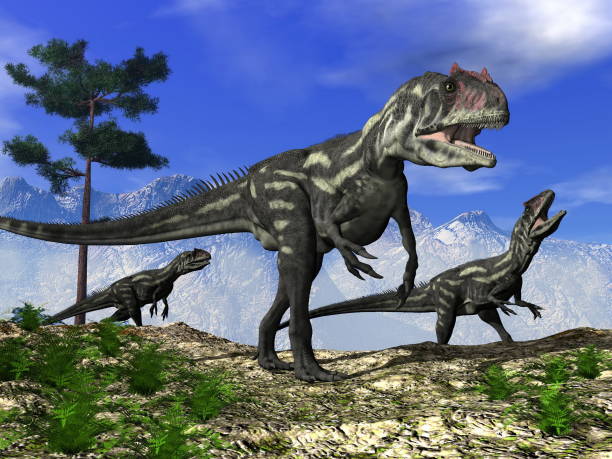
Tyrannosaurus rex was a giant among land predators. An adult could reach lengths of about twelve to thirteen meters and stand around four meters tall at the hips. Its body mass may have exceeded eight tons, making it one of the largest carnivorous dinosaurs ever discovered.
Despite its size, Tyrannosaurus rex was not merely a lumbering giant. Its skeleton reveals an animal built for power and balance. The massive skull alone could measure over one and a half meters long. This skull housed around sixty thick, serrated teeth designed not simply to slice flesh but to crush bone.
Unlike the slender, blade-like teeth of many other theropod dinosaurs, the teeth of Tyrannosaurus rex were robust and banana-shaped. This design allowed them to withstand tremendous force during bites. When the jaws closed, they delivered one of the most powerful bite forces known among terrestrial animals.
The neck muscles of Tyrannosaurus rex were also incredibly strong, anchoring the skull and enabling the predator to rip chunks of flesh from prey. Its ribcage was deep and barrel-shaped, housing powerful lungs that fueled its enormous body.
Perhaps the most famous—and sometimes misunderstood—feature of Tyrannosaurus rex is its tiny forelimbs. Compared to its enormous body, its arms were remarkably short. Yet these limbs were not useless. They were muscular and ended in two large claws, suggesting they may have been used to grasp prey or assist in rising from a resting position.
Balancing the massive head was a long, muscular tail. This tail acted as a counterweight, allowing Tyrannosaurus rex to maintain stability while walking or running.
Movement and Speed
One of the long-standing questions about Tyrannosaurus rex is how fast it could move. Early portrayals imagined it sprinting at high speeds across the landscape, chasing prey in dramatic fashion.
Modern research paints a more nuanced picture. Computer simulations of its skeleton and muscles suggest that Tyrannosaurus rex may have been capable of moderate speeds, perhaps around twenty kilometers per hour. While this is slower than earlier estimates, it still would have made the dinosaur a formidable hunter.
The structure of its legs supports the idea of powerful but not extremely rapid movement. The bones are thick and strong, designed to support enormous weight. Running too quickly could have risked injury.
Instead of relying purely on speed, Tyrannosaurus rex likely depended on strength, endurance, and strategic ambush. Its keen senses and immense bite force made it an efficient predator even without extreme speed.
Teeth and Bite Force
The jaws of Tyrannosaurus rex represent one of the most remarkable adaptations in the history of vertebrate predators. Studies of fossilized skulls and tooth wear indicate that its bite force could exceed 30,000 newtons—several times stronger than the bite of a modern lion.
This immense power allowed Tyrannosaurus rex to puncture bone with ease. Fossilized bones from herbivorous dinosaurs sometimes bear deep tooth marks that match Tyrannosaurus rex teeth. In some cases, fragments of teeth have even been found embedded in bones.
Such evidence suggests that Tyrannosaurus rex not only consumed flesh but also crushed and swallowed bone. This feeding behavior would have allowed it to extract nutrients from marrow and minerals.
The teeth themselves were constantly replaced throughout the animal’s life. If a tooth broke during feeding, a new one would grow to replace it. This regenerative process ensured that the predator’s most important weapon remained effective.
Senses and Intelligence
For a predator, detecting prey is as important as catching it. Tyrannosaurus rex appears to have possessed well-developed senses.
The skull features large eye sockets, indicating excellent vision. The positioning of the eyes suggests that Tyrannosaurus rex had binocular vision, meaning the fields of vision from each eye overlapped. This would have allowed it to judge distance accurately, an important ability for hunting.
Its sense of smell was also highly developed. The region of the brain responsible for olfaction—the detection of odors—is unusually large in Tyrannosaurus rex. This suggests that it could detect scents from great distances.
Such a powerful sense of smell would have been useful both for locating prey and for finding carcasses. Even if Tyrannosaurus rex did not make a kill itself, it could detect the scent of dead animals and scavenge them.
Studies of the braincase also suggest that Tyrannosaurus rex had relatively advanced neurological capabilities compared to many other dinosaurs. While it was not intelligent in the human sense, it likely possessed enough cognitive ability to coordinate movement, track prey, and respond to complex environments.
Predator or Scavenger?
One of the most debated questions in paleontology has been whether Tyrannosaurus rex was primarily a predator or a scavenger. Some scientists once suggested that it might have relied mostly on scavenging, using its keen sense of smell to locate carcasses.
However, most modern evidence supports the idea that Tyrannosaurus rex was both hunter and scavenger. This dual strategy is common among large predators today. Animals such as lions and bears will hunt when possible but also scavenge when the opportunity arises.
Fossil evidence supports active predation. Some herbivore bones show healed bite marks from Tyrannosaurus rex teeth, indicating that the prey survived an attack. This suggests that Tyrannosaurus rex did indeed hunt living animals.
Given its size, strength, and powerful jaws, Tyrannosaurus rex was certainly capable of bringing down large prey. Yet scavenging would have been an efficient supplement to its diet.
Growth and Life Cycle
One of the most fascinating discoveries about Tyrannosaurus rex is how dramatically it changed as it grew. Young individuals looked quite different from adults.
Juvenile Tyrannosaurus rex were lighter and more slender. Their legs were proportionally longer, suggesting they may have been faster runners. Their teeth were more blade-like, suited for slicing flesh rather than crushing bone.
As the animal matured, its skull became broader and stronger. The teeth thickened, and the body grew massive. These changes suggest a shift in ecological role as the animal aged. Younger individuals may have hunted smaller prey, while adults targeted larger animals.
Growth rings in fossilized bones indicate that Tyrannosaurus rex experienced rapid growth during adolescence. In its teenage years, it may have gained several hundred kilograms each year.
Most individuals likely lived around twenty to thirty years. Fossil evidence suggests that the largest adults were around their late twenties when they died.
Feathers and Appearance
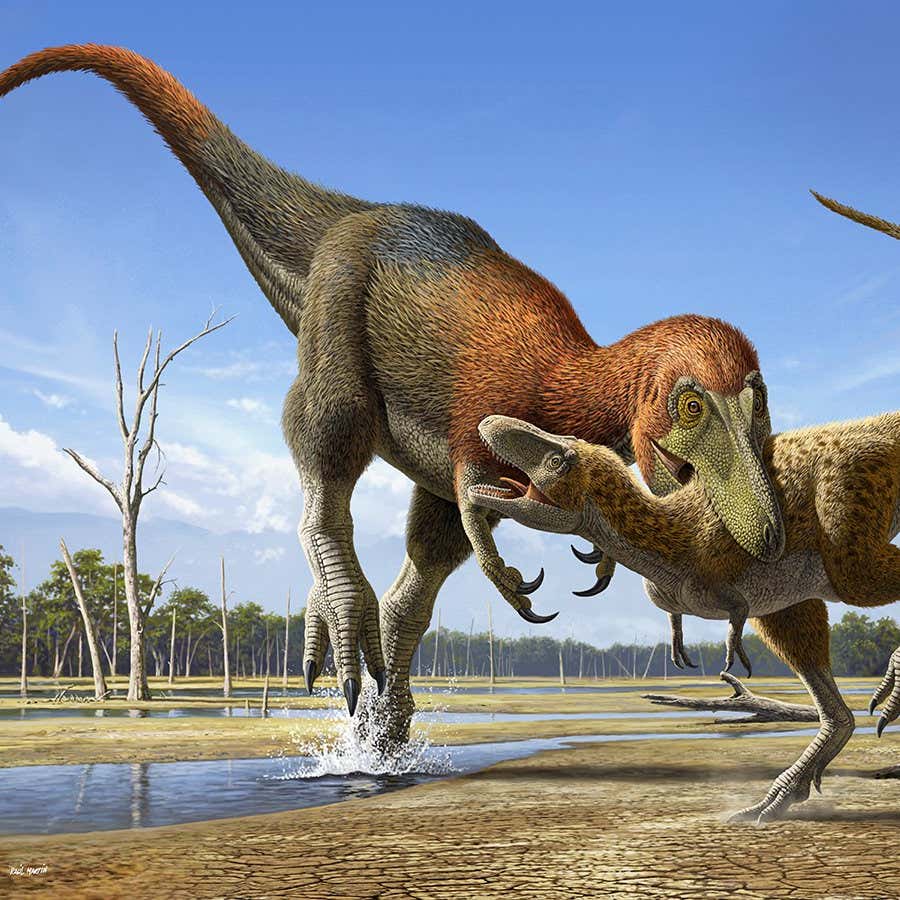
For many years, Tyrannosaurus rex was imagined as a reptilian creature with scaly skin. However, discoveries of feathered dinosaurs closely related to Tyrannosaurus rex have raised new questions about its appearance.
Some tyrannosaur relatives, particularly smaller species, possessed feathers or feather-like structures. This suggests that Tyrannosaurus rex ancestors may also have been feathered.
Direct fossil evidence of Tyrannosaurus rex skin impressions indicates that at least parts of its body were covered in scales. Whether it had patches of feathers remains uncertain. Some scientists propose that young Tyrannosaurus rex may have had feather-like coverings that were reduced as adults grew larger.
If feathers were present, they might have served functions such as insulation or display.
The Extinction Event
Tyrannosaurus rex lived during the final moments of the age of dinosaurs. Around 66 million years ago, a catastrophic event reshaped life on Earth: the Cretaceous–Paleogene extinction event.
Evidence suggests that a massive asteroid impact near present-day Mexico triggered global environmental changes. Fires, darkness, and climate disruption followed, devastating ecosystems.
The extinction wiped out non-avian dinosaurs, including Tyrannosaurus rex. Yet not all dinosaurs disappeared. Birds—descendants of small feathered dinosaurs—survived and eventually diversified into the thousands of species alive today.
In a sense, dinosaurs never truly vanished. Their legacy lives on in the birds that fill modern skies.
Tyrannosaurus rex in Science and Culture
Few prehistoric animals have captured human imagination like Tyrannosaurus rex. It has appeared in books, films, museums, and educational programs around the world. One of the most famous cinematic portrayals appears in the film Jurassic Park, where the dinosaur’s dramatic appearance helped redefine special effects in cinema.
While popular culture sometimes exaggerates its behavior, these portrayals have also inspired generations to learn about paleontology and the history of life.
In scientific research, Tyrannosaurus rex remains an important subject. New technologies such as CT scanning and computer modeling allow scientists to study its bones without damaging them. These tools reveal details about muscle attachments, brain structure, and growth patterns.
Each new discovery adds another piece to the puzzle of how this remarkable animal lived.
Why Tyrannosaurus rex Still Fascinates Us
The fascination with Tyrannosaurus rex goes beyond its size or ferocity. It represents a window into deep time—a reminder that Earth has hosted worlds radically different from our own.
When we stand before a Tyrannosaurus rex skeleton in a museum, we are looking at the remains of a creature that walked the planet tens of millions of years before humans appeared. Its bones survived unimaginable stretches of time, buried in sediment and slowly transformed into stone.
Through science, we reconstruct its life. We imagine the forests it roamed, the prey it pursued, and the thunder of its footsteps across ancient floodplains.
Tyrannosaurus rex reminds us that life on Earth is constantly evolving, changing, and adapting. Entire empires of creatures rise and fall across geological ages.
Yet the quest to understand them continues. Every fossil discovered, every bone studied, every new analysis brings us closer to understanding the true nature of this legendary predator.
The “tyrant lizard king” may have vanished millions of years ago, but its story continues to unfold in laboratories, museums, and the imaginations of people everywhere. And as science advances, the picture of Tyrannosaurus rex grows richer, more detailed, and even more awe-inspiring than the myths that first made it famous.