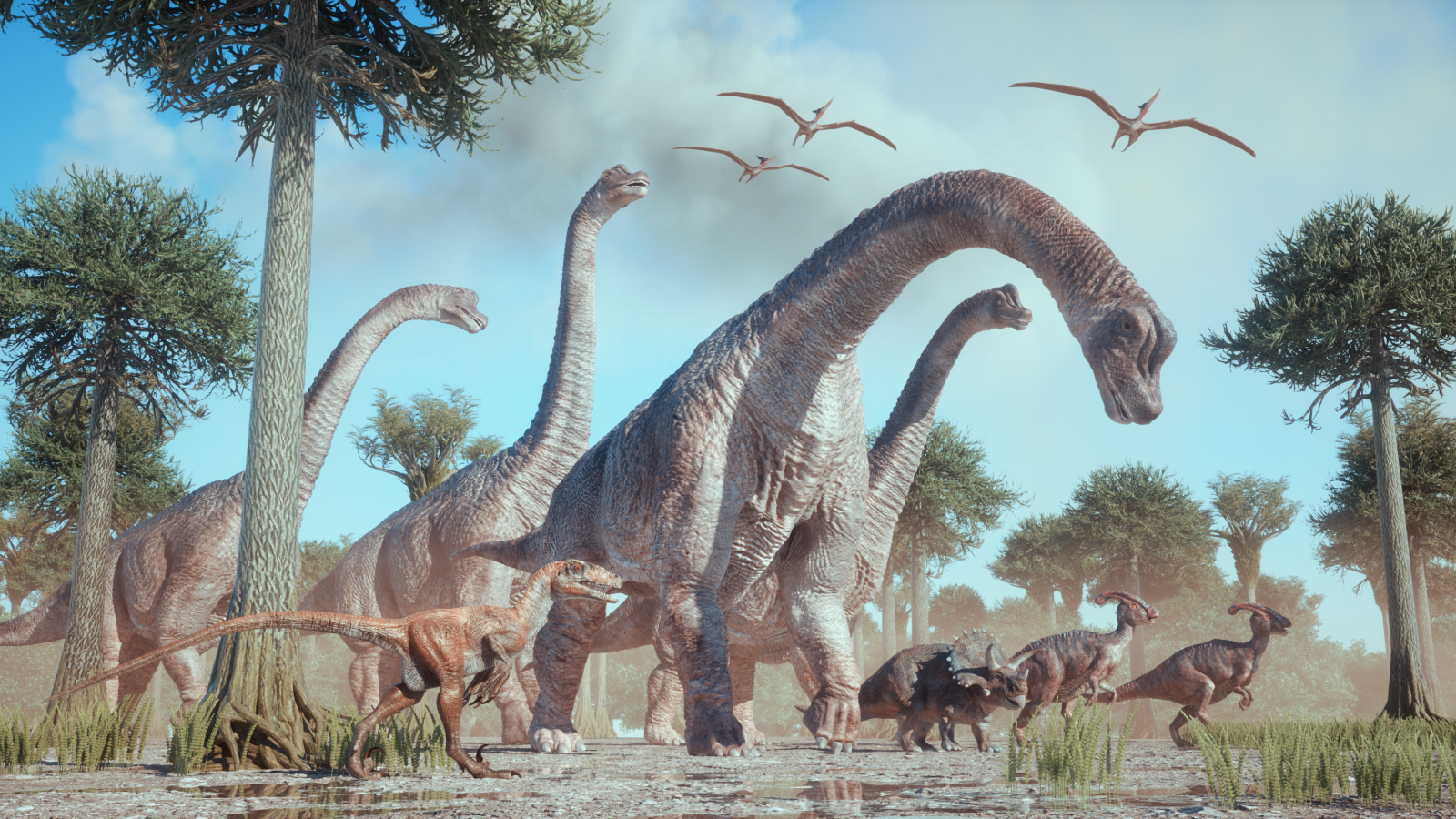
For more than 160 million years, dinosaurs dominated life on Earth. Long before humans appeared, long before mammals rose to prominence, these remarkable creatures ruled forests, plains, deserts, and ancient coastlines. They evolved into an astonishing diversity of forms—towering giants weighing more than airplanes, feathered hunters that sprinted like birds, armored herbivores that resembled living tanks, and creatures with horns, crests, and sails that seemed almost mythical.
When the first dinosaur fossils were discovered in the early nineteenth century, scientists and the public alike were stunned. Here were bones from creatures unlike anything alive today. As paleontology developed, each new discovery added pieces to a lost world that once flourished on our planet.
Today, thanks to modern science—fossil analysis, advanced imaging, geochemistry, and even molecular studies—we know far more about dinosaurs than people could have imagined a century ago. We know how they walked, what they ate, how they grew, and how some of them may have cared for their young. We even know that dinosaurs are not truly gone.
Dinosaurs are stranger, more complex, and more fascinating than the monsters of old illustrations. Their story is filled with surprising twists that reveal how life evolves, adapts, and sometimes disappears.
Here are ten scientifically grounded facts about dinosaurs that continue to astonish researchers and ignite the imagination.
1. Dinosaurs Lived on Earth for Over 160 Million Years
Human civilization feels ancient to us, yet the entire span of recorded history is only a few thousand years long. Even the earliest members of the human species appeared roughly 300,000 years ago. Compared to dinosaurs, humanity is a blink of an eye.
Dinosaurs first appeared during the Late Triassic Period, around 230 million years ago. At that time, Earth looked very different. The continents were joined together in a supercontinent called Pangaea, and reptiles dominated ecosystems across land and sea.
Early dinosaurs were relatively small and not yet the rulers of the planet. They shared their environment with many other reptilian groups, including crocodile relatives that competed with them for ecological dominance.
But during the Triassic–Jurassic extinction event, around 201 million years ago, many competing species disappeared. Dinosaurs survived and rapidly diversified. Over the next 160 million years, they spread across every continent and evolved into a huge range of species.
This long reign spanned three major geological periods: the Triassic, Jurassic, and Cretaceous. Throughout that immense stretch of time, dinosaurs adapted to changing climates, shifting continents, and evolving ecosystems.
Their dominance finally ended about 66 million years ago, during the Cretaceous–Paleogene extinction event. Even then, they had ruled Earth for a period far longer than mammals—or humans—have existed.
2. Birds Are Living Dinosaurs
One of the most astonishing discoveries in paleontology is that dinosaurs are not completely extinct. In fact, they are still all around us.
Modern birds are direct descendants of a group of theropod dinosaurs. This means that every sparrow, eagle, penguin, and hummingbird is technically a living dinosaur.
This idea once seemed radical, but the evidence is overwhelming. Fossils show clear evolutionary links between non-avian dinosaurs and early birds. Skeletons reveal shared features such as hollow bones, three-toed limbs, wishbones, and similar hip structures.
Feathers, once thought to be unique to birds, have been discovered in many dinosaur fossils. Some dinosaurs had simple hair-like filaments, while others possessed complex feather structures similar to those of modern birds.
Perhaps the most famous transitional fossil is the ancient bird-like creature Archaeopteryx, which lived around 150 million years ago. It had feathers and wings but also possessed teeth, a long bony tail, and clawed fingers.
Over millions of years, certain theropod dinosaurs gradually evolved lighter bodies, stronger flight muscles, and other features that enabled powered flight.
When the mass extinction struck 66 million years ago, most dinosaurs vanished. But some small, bird-like species survived and continued evolving into the birds we see today.
In a very real sense, dinosaurs never disappeared. They simply changed form and took to the skies.
3. Some Dinosaurs Were Larger Than Any Land Animal Today
When people imagine dinosaurs, they often picture enormous creatures towering over the landscape. While many species were small, some dinosaurs truly were the largest land animals that have ever existed.
One of the most famous examples is Patagotitan, a gigantic titanosaur discovered in Argentina. Estimates suggest it may have reached lengths of around 37 meters and weighed as much as 70 tons.
These immense herbivores belonged to a group called sauropods. Sauropods were characterized by extremely long necks, long tails, and small heads relative to their bodies. Famous examples include creatures like Brachiosaurus and Diplodocus.
Their immense size offered advantages. Large bodies helped deter predators and allowed them to process enormous amounts of vegetation. Their long necks allowed them to reach high foliage or sweep across wide feeding areas without moving their massive bodies.
Despite their size, sauropods appear to have grown rapidly, reaching adult size within a few decades. Fossilized bones show growth rings similar to those in trees, allowing scientists to estimate growth rates.
The existence of such massive animals raises fascinating biological questions about metabolism, circulation, and skeletal support. Even today, researchers continue studying how these giants managed to live and thrive.
4. Many Dinosaurs Had Feathers
For much of the twentieth century, dinosaurs were depicted as scaly reptiles similar to giant lizards. But modern discoveries have dramatically changed that picture.
In the 1990s, spectacular fossil discoveries in northeastern China revealed dinosaurs preserved with feather impressions. These fossils included small theropods covered in filament-like structures that closely resembled early feathers.
Since then, dozens of feathered dinosaur species have been discovered. Some had fluffy insulation similar to down feathers. Others possessed complex feathers used for display, temperature regulation, or possibly gliding.
Feathers likely evolved long before flight. They may have first served as insulation, helping dinosaurs regulate body temperature. Brightly colored feathers may also have played roles in communication, courtship, or camouflage.
Certain dinosaurs even had wing-like structures but were too heavy to fly. These features may have helped them glide or assisted in maneuvering while running.
The discovery of feathered dinosaurs has transformed our understanding of dinosaur biology. Instead of dull reptilian creatures, many dinosaurs were likely vibrant animals with colorful plumage.
5. Some Dinosaurs Were Incredibly Fast
Not all dinosaurs were slow-moving giants. Many species were agile and fast, capable of running at impressive speeds.
Certain theropod dinosaurs, such as Velociraptor and its relatives, had long legs built for speed and balance. Their lightweight skeletons and powerful muscles allowed them to move quickly across their environments.
Trackways—fossilized footprints preserved in ancient sediments—provide valuable clues about dinosaur movement. Some tracks show evidence of running dinosaurs with long strides and narrow footprints.
Scientists estimate that certain small to medium-sized theropods may have reached speeds of 40 to 60 kilometers per hour.
Speed would have been essential for both predators and prey. Carnivorous dinosaurs needed agility to hunt effectively, while herbivores required quick reflexes and rapid movement to escape danger.
These running dinosaurs were more like athletic birds than lumbering reptiles.
6. Dinosaurs Laid Eggs and Built Nests
Reproduction is one of the most important aspects of any species, and dinosaurs had fascinating reproductive behaviors.
Many dinosaur fossils have been discovered alongside eggs and nests. These discoveries reveal that dinosaurs laid eggs rather than giving birth to live young.
In Mongolia, scientists discovered nests belonging to a dinosaur called Oviraptor. Initially, researchers believed the animal had been stealing eggs. Later evidence showed that it was actually sitting on its own nest, likely protecting and incubating the eggs.
This finding suggested that some dinosaurs exhibited parental care similar to that of modern birds.
Eggshell structures indicate that certain species buried their eggs in sediment or vegetation, while others may have incubated them through body heat.
Some nests contain multiple layers of eggs arranged in careful patterns. These arrangements suggest organized nesting behavior rather than random egg-laying.
Such discoveries reveal that dinosaurs were not merely primitive reptiles. Many displayed complex reproductive strategies and parental behaviors.
7. The Largest Dinosaur Predators Were Apex Hunters
Dinosaurs occupied every level of the food chain, including the top.
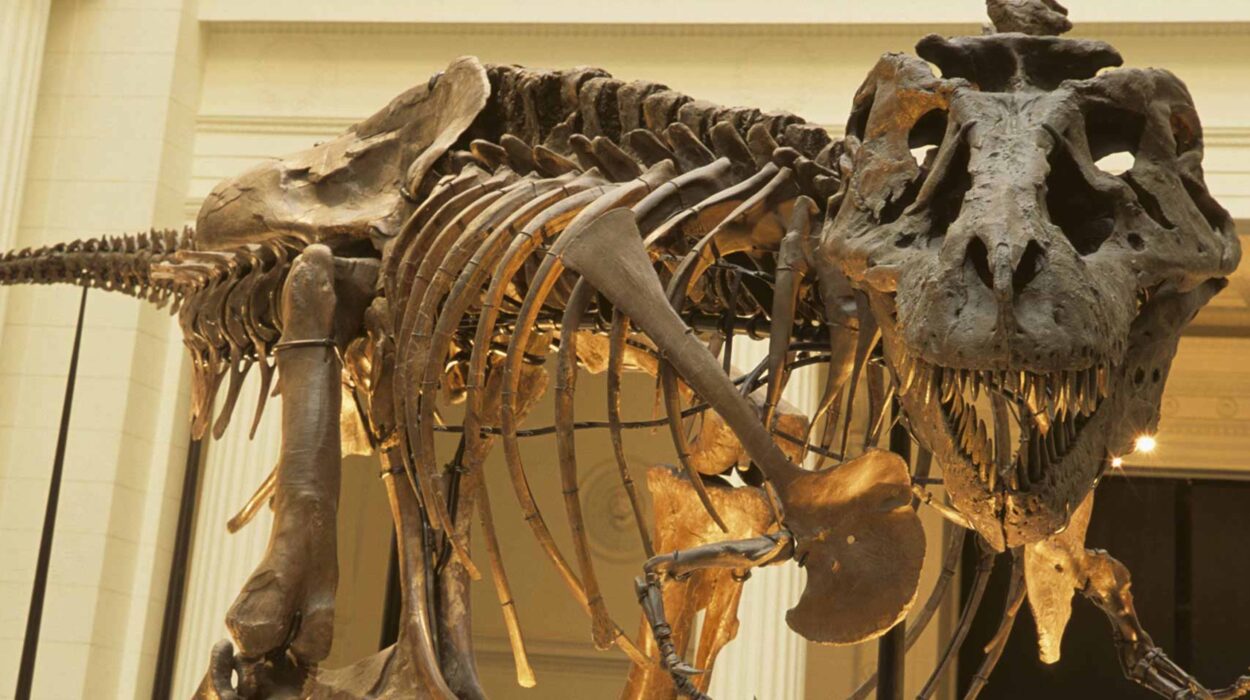
One of the most famous predators was Tyrannosaurus rex. This enormous theropod lived near the end of the Cretaceous Period and could grow more than 12 meters long.
T. rex possessed powerful jaws capable of exerting one of the strongest bite forces of any land animal. Fossilized bones show clear bite marks consistent with its teeth.
Its skull was reinforced with thick bones, allowing it to withstand tremendous pressure during feeding.
Although some early researchers proposed that T. rex was primarily a scavenger, most evidence suggests it was an active predator capable of hunting large herbivores.
Other formidable predators included Spinosaurus, which had a long crocodile-like snout and likely hunted fish in river environments, and Giganotosaurus, another giant theropod that rivaled T. rex in size.
These predators dominated their ecosystems and shaped the evolutionary paths of herbivorous dinosaurs.
8. Dinosaurs Lived on Every Continent
Today, fossils of dinosaurs have been discovered on all seven continents, including Antarctica.
During the time of the dinosaurs, Earth’s continents were arranged differently. Many landmasses were connected, allowing animals to spread across vast regions.
As the continents slowly drifted apart through plate tectonics, dinosaur populations became isolated. This led to the evolution of unique species adapted to specific environments.
Fossils from Antarctica reveal that dinosaurs lived even in polar regions. Although the climate was warmer than today, these areas still experienced long seasonal darkness.
Some dinosaurs may have migrated seasonally, while others adapted to survive cold conditions.
The global distribution of dinosaur fossils shows that these animals were extraordinarily adaptable.
9. The Dinosaur Extinction Was Caused by a Catastrophic Asteroid Impact
One of the most dramatic events in Earth’s history occurred 66 million years ago, when a massive asteroid struck the planet.
The impact created the Chicxulub crater in what is now the Yucatán Peninsula of Mexico. The asteroid is estimated to have been about 10 kilometers wide.
The collision released enormous amounts of energy, equivalent to billions of nuclear bombs. It triggered massive wildfires, earthquakes, and tsunamis.
Dust and debris were blasted into the atmosphere, blocking sunlight and causing global cooling. Photosynthesis collapsed, food chains broke down, and ecosystems were devastated.
Approximately 75 percent of all species on Earth went extinct, including most dinosaurs.
Yet the extinction also opened ecological opportunities. With the dinosaurs gone, mammals began diversifying rapidly, eventually leading to the rise of humans.
10. Scientists Are Still Discovering New Dinosaurs
Despite more than two centuries of research, paleontologists continue discovering new dinosaur species every year.
Many regions of the world still contain unexplored fossil deposits. Advances in technology allow scientists to detect fossils hidden beneath rock layers and analyze them in greater detail.
New species often reveal unexpected features—unusual horns, elaborate crests, feathers, or previously unknown body shapes.
Each discovery helps scientists understand how dinosaurs evolved and interacted within ancient ecosystems.
The fossil record is like an enormous puzzle, and many pieces remain buried beneath the Earth’s surface.
The story of dinosaurs is far from complete.
The Legacy of the Dinosaurs
Dinosaurs were not merely gigantic reptiles from a distant past. They were complex, dynamic creatures that shaped life on Earth for millions of years.
They evolved feathers, developed intricate behaviors, spread across continents, and gave rise to modern birds. Their extinction reshaped ecosystems and allowed mammals to flourish.
Today, when we watch birds soar through the sky or hear them singing in forests, we are witnessing the living descendants of a lineage that once ruled the planet.
Dinosaurs remind us that life is resilient, adaptable, and constantly evolving.
Their story is not just about extinction. It is about transformation—and about the deep history of the world we inhabit today.