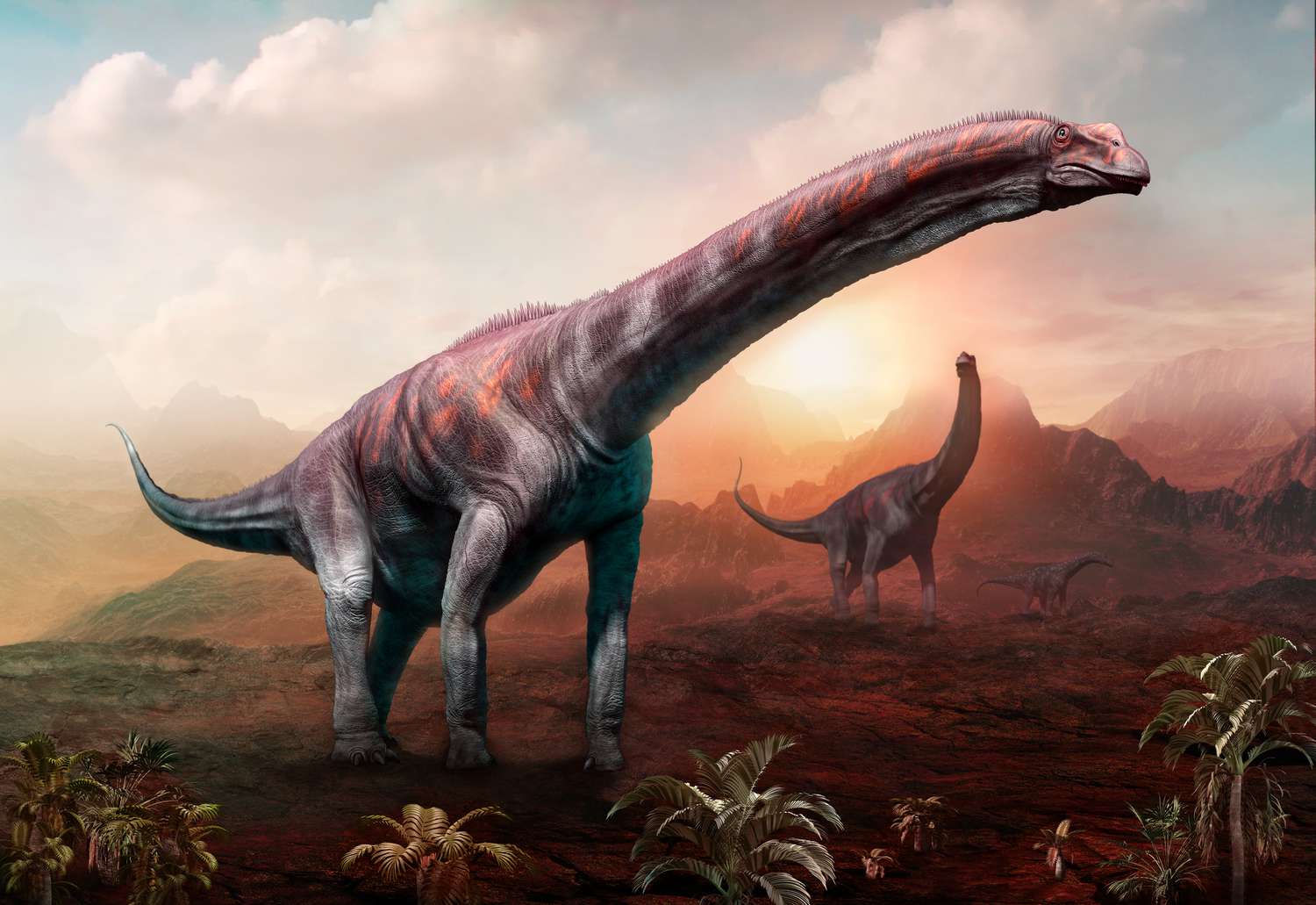
Imagine standing on a wide floodplain in what is now Patagonia, Argentina, about ninety-five million years ago during the Late Cretaceous period. The air is warm and heavy, filled with the scent of damp vegetation. Giant conifers and flowering plants stretch toward the sky, and insects hum among thick ferns and cycads. In the distance, the ground begins to tremble.
At first, it sounds like distant thunder. Then the shaking grows stronger, and a colossal silhouette emerges from the forest canopy. A neck longer than a bus rises above the trees. A tail like a living bridge sweeps slowly behind it. Each step leaves a deep imprint in the earth.
You are witnessing one of the most extraordinary animals that ever walked on land.
This creature is Argentinosaurus.
Often regarded as the largest land animal ever discovered, Argentinosaurus is a dinosaur so immense that it challenges the limits of imagination. It dwarfs elephants, surpasses the length of the largest whales if laid on land, and represents the absolute extremes of biological size. Yet despite its gigantic reputation, this dinosaur remains one of the most mysterious giants of the prehistoric world.
Only fragments of its bones have ever been found. From those pieces, scientists have reconstructed a creature of staggering proportions. Argentinosaurus is not just a dinosaur; it is a symbol of how enormous life on Earth once became, and how much of that ancient world we are still trying to understand.
The Discovery in Patagonia
The story of Argentinosaurus begins not in a laboratory, but in the windswept landscapes of southern Argentina. Patagonia is famous among paleontologists because its rocky layers preserve fossils from the age of dinosaurs, particularly the Late Cretaceous period.
In the late twentieth century, a rancher named Guillermo Heredia noticed something unusual while working on his land. Protruding from the ground were enormous fossilized bones unlike anything he had seen before. The discovery eventually reached paleontologists José Bonaparte and Rodolfo Coria, two researchers deeply involved in studying South American dinosaurs.
When the scientists arrived at the site, they quickly realized they were dealing with something extraordinary. The bones were enormous—far larger than those of most dinosaurs known at the time. Excavations revealed vertebrae, ribs, and other skeletal elements of a titanic herbivore.
In 1993, Bonaparte and Coria formally described the new species and gave it a name that honored its homeland: Argentinosaurus huinculensis. The name means “the Argentine lizard from Plaza Huincul,” referring to the nearby region where the fossils were found.
Even from the incomplete remains, it was clear that Argentinosaurus represented one of the largest animals ever to live on land.
The World of the Late Cretaceous
To understand Argentinosaurus, we must step into the world it inhabited.
During the Late Cretaceous, roughly 100 to 66 million years ago, Earth looked very different from today. Continents were still shifting after the breakup of the ancient supercontinent Gondwana. South America was isolated from many other landmasses, allowing unique ecosystems to evolve.
The climate was generally warmer than today. Polar ice caps were minimal or absent, and sea levels were high. Vast forests, river systems, and floodplains covered much of the landscape.
Patagonia during this time was a lush and dynamic environment. Rivers carved through fertile plains where towering plants thrived. These habitats provided enormous quantities of vegetation—enough to sustain gigantic herbivores.
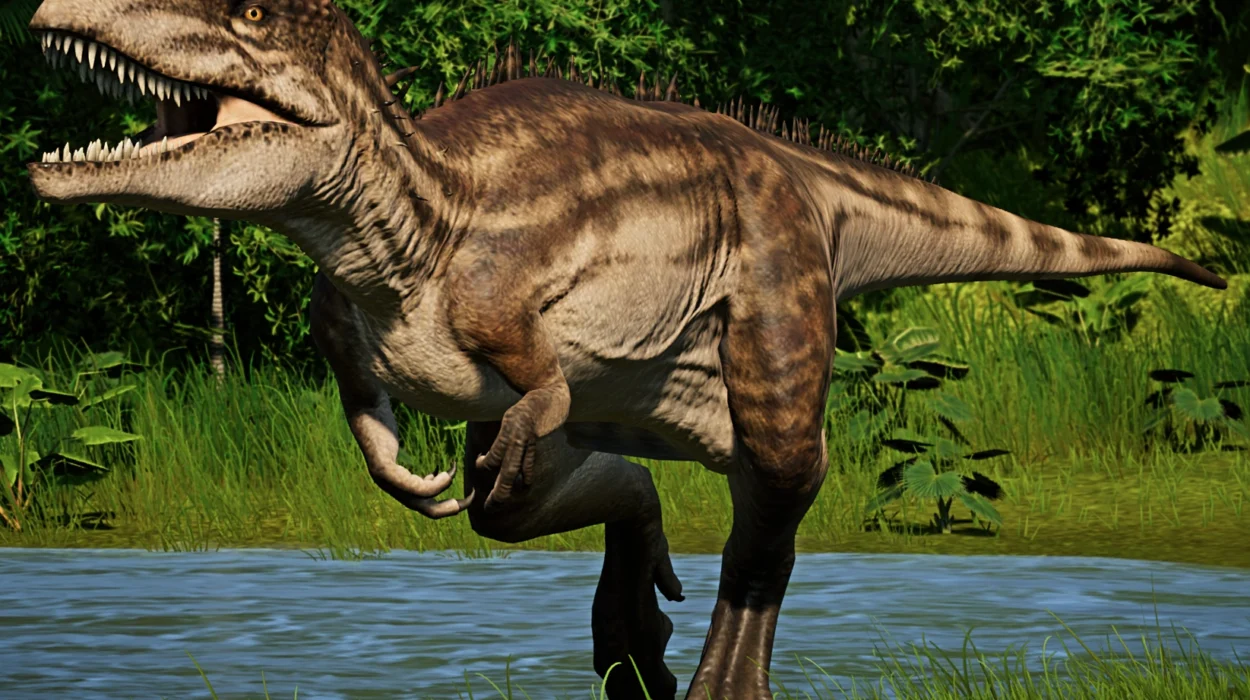
But Argentinosaurus did not live alone. The ecosystem also included massive predators such as Giganotosaurus, one of the largest carnivorous dinosaurs ever discovered. Other herbivores, smaller sauropods, armored dinosaurs, and birdlike theropods shared the landscape.
It was a world of giants, and Argentinosaurus stood at the very top of the scale.
The Titanosaur Family
Argentinosaurus belonged to a group of dinosaurs known as titanosaurs.
Titanosaurs were long-necked, long-tailed herbivores within the larger group of sauropods. Sauropods are famous for their enormous bodies, pillar-like legs, and incredibly long necks. Classic examples include dinosaurs like Diplodocus, Brachiosaurus, and Apatosaurus.
Titanosaurs appeared later in dinosaur history and became the dominant sauropods during the Cretaceous period. They evolved on multiple continents and displayed a wide range of body sizes. Some were relatively small by sauropod standards, measuring only a few meters long, while others reached colossal proportions.
Argentinosaurus belongs to the largest end of this spectrum.
Titanosaurs had several distinctive features. Their vertebrae were often hollow or filled with air spaces, which helped reduce the weight of their massive bodies. Their limbs were strong and column-like, supporting enormous weight while maintaining stability. Many titanosaurs also had armor-like plates embedded in their skin, although it is uncertain whether Argentinosaurus possessed such features.
This group of dinosaurs represents the pinnacle of sauropod evolution, pushing the boundaries of size and survival.
Reconstructing a Giant
One of the most fascinating aspects of Argentinosaurus is that scientists have reconstructed its immense size using only partial remains.
The fossil evidence for Argentinosaurus is surprisingly limited. Only a handful of bones have been found, including vertebrae, a rib, and parts of the pelvis. However, these bones are gigantic. Some vertebrae measure more than 1.5 meters in height.
To estimate the dinosaur’s total size, paleontologists compare these bones with the skeletons of better-known sauropods. By scaling up proportions, they can approximate the full body.
Most estimates suggest that Argentinosaurus reached lengths of around 30 to 35 meters, or roughly 100 to 115 feet. Some estimates even propose lengths approaching 40 meters.
Weight estimates vary widely because mass is difficult to calculate from partial skeletons. However, many scientists believe Argentinosaurus weighed between 60 and 90 metric tons. Some calculations push the upper range beyond 100 tons.
To put this in perspective, the largest modern land animals, African elephants, weigh about 6 tons. Argentinosaurus may have been more than ten times heavier.
Anatomy of a Colossus
The body structure of Argentinosaurus reflects the engineering required to support such extreme size.
Its neck was extraordinarily long, allowing the dinosaur to reach vegetation across a wide area without moving its entire body. This adaptation was important because moving such a massive animal would have required tremendous energy.
The neck vertebrae contained air-filled cavities that reduced weight while maintaining strength. This system is similar to the air sacs found in modern birds.
The torso of Argentinosaurus was immense, housing a gigantic digestive system necessary to process vast quantities of plant matter. Sauropods likely relied on fermentation in their guts to break down tough vegetation.
Its legs were thick, column-like structures designed to bear incredible weight. The bones were dense and robust, functioning like natural pillars supporting a living skyscraper.
The tail served as a counterbalance to the long neck and may also have been used for communication or defense.
Every aspect of Argentinosaurus’s anatomy reveals the delicate balance required to sustain such extraordinary size.
Feeding the Giant
One of the biggest mysteries surrounding Argentinosaurus is how it fed itself.
An animal weighing tens of tons would require enormous amounts of food. Estimates suggest that large sauropods may have consumed hundreds of kilograms of vegetation each day.
Fortunately, the Late Cretaceous landscape offered abundant plant life. Forests and floodplains produced large quantities of leaves, ferns, and conifer branches.
Argentinosaurus likely used its long neck to browse from tall trees as well as mid-level vegetation. Unlike modern mammals that chew their food extensively, sauropods probably swallowed vegetation quickly and relied on gut microbes to digest it.
Some scientists believe sauropods may have swallowed stones, known as gastroliths, which helped grind plant material in the stomach.
Feeding strategies may have allowed Argentinosaurus to sustain its immense body without spending excessive energy searching for food.
Growth and Life Cycle
Another intriguing question is how Argentinosaurus grew to such enormous size.
Like many dinosaurs, titanosaurs likely hatched from eggs. Fossil evidence from other titanosaur species shows that they laid clutches of eggs in nests buried in soil.
Baby titanosaurs would have been tiny compared to adults—perhaps only the size of a small dog. Yet they grew rapidly.
Bone studies from related species suggest that sauropods experienced incredibly fast growth rates. Within a few decades, a hatchling could transform into a creature weighing tens of tons.
This rapid growth may have helped young dinosaurs avoid predators. A baby Argentinosaurus would have been vulnerable, but within a few years it could become too large for most predators to attack.
Predators and Survival
Even a giant like Argentinosaurus did not live in a world free from danger.
The Late Cretaceous ecosystems of South America contained enormous carnivorous dinosaurs. One of the most famous was Giganotosaurus, a massive predator that rivaled or exceeded Tyrannosaurus rex in length.
Could such predators hunt Argentinosaurus?
Most scientists believe adult Argentinosaurus individuals were likely too large for even giant predators to attack alone. However, juveniles and smaller individuals may have been vulnerable.
Some researchers speculate that large carnivores may have hunted in groups, targeting weaker members of a herd.
Sauropods may have relied on their sheer size, strong tails, and herd behavior to deter attacks.
The Mystery of Maximum Size
Argentinosaurus raises a fascinating question: how did animals become so large?
The size of sauropods represents the upper limit of what land animals can achieve. Several factors likely contributed to their gigantism.
Their efficient respiratory system allowed them to obtain enough oxygen for large bodies. Their bird-like air sacs reduced weight while improving breathing efficiency.
Their reproductive strategy allowed rapid population recovery, since they laid many eggs rather than giving birth to a few live young.
Their herbivorous diet provided a consistent food supply, especially in lush prehistoric environments.
Finally, their skeletal structure evolved to support extreme mass without collapsing under its own weight.
Argentinosaurus represents the culmination of these evolutionary advantages.
Comparing the Largest Dinosaurs
Although Argentinosaurus is often called the largest dinosaur, the competition for that title remains active.
Other giant titanosaurs have been discovered in South America and elsewhere, including Patagotitan, Dreadnoughtus, and Futalognkosaurus.
These dinosaurs rival Argentinosaurus in size, and new discoveries may eventually surpass it.
Because fossil remains are often incomplete, determining the true “largest dinosaur” is difficult. Each discovery adds new clues but also new uncertainties.
Nevertheless, Argentinosaurus remains one of the most iconic giants in paleontology.
The Legacy of Argentinosaurus
Argentinosaurus captures the imagination because it represents the extreme possibilities of life.
It reminds us that Earth’s history is filled with creatures beyond anything we see today. For millions of years, giant dinosaurs dominated landscapes across the planet.
Their disappearance at the end of the Cretaceous period, about 66 million years ago, opened ecological opportunities that eventually allowed mammals to flourish—and ultimately led to the rise of humans.
The bones of Argentinosaurus are silent witnesses to that ancient world. Each fossil fragment carries the story of a creature that once walked across vast floodplains under a prehistoric sky.
A Window Into Deep Time
The study of Argentinosaurus is more than the study of a single dinosaur. It is an exploration of deep time.
When paleontologists uncover fossils in Patagonia, they are uncovering moments frozen in stone. Each bone is a message from a world long vanished.
Through careful analysis, scientists reconstruct ecosystems, climates, and evolutionary histories. They reveal how life adapts, expands, and sometimes reaches astonishing extremes.
Argentinosaurus stands as one of the most powerful reminders of how vast and mysterious Earth’s past truly is.
The Giant That Still Inspires Wonder
More than ninety million years after it walked the Earth, Argentinosaurus continues to inspire awe.
It challenges our imagination. It pushes the limits of biology. It reminds us that the natural world once produced animals of unimaginable scale.
Yet despite decades of research, many mysteries remain. New fossils may someday reveal the complete skeleton of Argentinosaurus or an even larger species.
Until then, this colossal dinosaur remains a symbol of the endless quest to understand the past.
The ground may no longer tremble beneath its footsteps, but in museums, laboratories, and the minds of scientists and dreamers alike, the giant still walks.