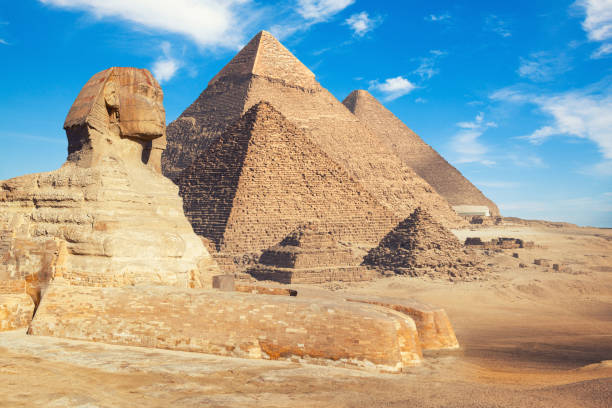
Across the golden sands of northern Africa, where the desert stretches endlessly beneath a blazing sun, monumental shapes rise from the horizon like stone mountains crafted by human hands. These are the pyramids of ancient Egypt—structures so immense, so precise, and so enduring that they continue to captivate scientists, historians, engineers, and dreamers thousands of years after they were built.
Among them stands the most famous: the Great Pyramid of Giza, built during the reign of the Pharaoh Khufu around 2560 BCE. For more than 3,800 years, it was the tallest man-made structure on Earth. Even today, its limestone blocks—some weighing several tons—remain stacked with astonishing precision.
Modern archaeology has uncovered much about the pyramids. We know they were royal tombs, built during Egypt’s Old Kingdom by highly organized labor forces. We know the builders used copper tools, sledges, ramps, and brilliant engineering. Yet despite decades of research and technological advances—from satellite mapping to particle physics scanning—many aspects of the pyramids remain mysterious.
The pyramids are not supernatural artifacts. They were created by human intelligence and effort. But the scale, precision, and hidden architectural details continue to puzzle researchers.
Below are seven of the most fascinating mysteries surrounding the ancient Egyptian pyramids—questions that science is still trying to fully answer.
1. The Extraordinary Precision of the Great Pyramid
The Great Pyramid at Giza Pyramid Complex is not simply large. It is astonishingly precise.
Its base covers about 13 acres, and the sides of the pyramid align almost perfectly with the four cardinal directions—north, south, east, and west. The alignment error is incredibly small, within a fraction of a degree. Achieving such accuracy today would require advanced surveying equipment.
Yet the builders lived more than 4,500 years ago.
Ancient Egyptian engineers had no compasses, no GPS, and no laser measuring tools. They relied on simple instruments: plumb lines, sighting rods, and careful observation of the sky.
Many researchers believe the Egyptians aligned the pyramid using the stars. Some studies suggest they may have used pairs of circumpolar stars—stars that rotate around the celestial pole—to determine true north. By observing when these stars aligned vertically in the sky, surveyors could establish accurate directional lines.
Even if this explanation is correct, it still leaves questions. Maintaining perfect alignment across such a massive base would have required extraordinary skill and careful planning. The construction team would have needed to measure repeatedly and adjust their work with remarkable precision.
The fact that such accuracy was achieved with ancient tools remains one of the most impressive engineering accomplishments in human history.
2. How Were the Massive Stones Transported?
The Great Pyramid originally contained about 2.3 million stone blocks. Many weighed between two and fifteen tons. Some granite blocks used in interior chambers weighed up to eighty tons.
These stones came from multiple locations. Limestone was quarried locally near Giza, but granite for the inner chambers was transported from Aswan, roughly 800 kilometers away along the Nile.
How did ancient workers move such enormous stones without modern machinery?
The most widely accepted theory involves sledges pulled across sand. Archaeological evidence and ancient drawings show large statues and stones being dragged on wooden sledges by teams of workers. Experiments have demonstrated that wetting the sand in front of a sledge significantly reduces friction, making it easier to move heavy loads.
River transport also played a major role. During the annual Nile flood, canals allowed boats to carry massive stones close to the construction site. In fact, papyrus documents discovered in recent years describe shipments of limestone blocks transported by boat during the reign of Khufu.
Yet even with these explanations, the logistics remain staggering. Moving millions of stones required precise coordination, large labor forces, and consistent organization over decades.
The pyramids were not built by slaves, as once believed. Archaeological discoveries reveal that the workers were skilled laborers who lived in nearby villages, received food and medical care, and worked in rotating teams.
Still, the scale of the operation continues to astonish modern engineers.
3. The Mystery of the Construction Ramps
Moving stones to the pyramid site is only part of the puzzle. The greater challenge was lifting them to heights exceeding 140 meters.
How did ancient builders raise multi-ton blocks to the upper levels of the pyramid?
The most widely supported explanation involves ramp systems. However, the exact design of these ramps remains debated among researchers.
One theory proposes a massive straight ramp built against one side of the pyramid. While simple in concept, this ramp would have required an enormous volume of material—possibly even more than the pyramid itself.
Another idea suggests a spiral ramp wrapping around the pyramid’s exterior. This would reduce material requirements but might obstruct precise alignment of the outer stones.
A third hypothesis proposes internal ramps built inside the pyramid’s structure. According to this model, workers transported stones through internal corridors as the pyramid rose higher.
Each theory has strengths and weaknesses, and no single explanation has been universally accepted.
Archaeologists continue to investigate the surrounding landscape for evidence of ancient ramp structures, but much of the construction infrastructure may have been dismantled or eroded over time.
The exact method by which stones were lifted to the pyramid’s summit remains one of the most intriguing engineering mysteries of ancient Egypt.
4. The Hidden Chambers Discovered by Modern Technology
For centuries, researchers believed the internal structure of the Great Pyramid was well understood. It contains the King’s Chamber, the Queen’s Chamber, and the Grand Gallery—passages and rooms carved within the stone mass.
But recent discoveries have shown that the pyramid still holds secrets.
In 2017, scientists using muon tomography—a technique that detects cosmic-ray particles passing through stone—identified a previously unknown void within the pyramid. This space, located above the Grand Gallery, appears to be a large chamber or corridor at least thirty meters long.
The discovery was made by the international research project known as ScanPyramids.
Muon tomography works somewhat like an X-ray, using naturally occurring cosmic particles to map density differences inside massive structures. The technique revealed that the pyramid contains a large hollow space that had never been detected before.
The purpose of this chamber remains unknown. It could be a structural feature designed to reduce weight above the gallery. It could be part of a construction corridor. Or it could be an undiscovered chamber connected to the pyramid’s symbolic architecture.
Until researchers find a way to safely explore the void, its purpose will remain a mystery hidden within the heart of the pyramid.
5. The Strange Air Shafts
Two narrow shafts extend from both the King’s Chamber and the Queen’s Chamber inside the Great Pyramid. Each shaft is only about twenty centimeters wide, far too small for human passage.
The shafts from the King’s Chamber extend all the way to the pyramid’s exterior, while the shafts from the Queen’s Chamber stop short and end with small stone “doors” sealed by copper handles.
Why were these shafts built?
One possibility is ventilation during construction. However, the shafts’ precise angles suggest a symbolic or astronomical purpose.
Some researchers believe the shafts were aligned with specific stars important in ancient Egyptian religion. For example, one shaft points roughly toward the belt stars of the constellation known today as Orion, which was associated with the god Osiris. Another aligns roughly with Sirius, linked to the goddess Isis.
These alignments may have symbolized the pharaoh’s soul traveling to join the gods in the afterlife.
Robotic probes sent into the shafts have revealed additional sealed doors and small chambers. Yet the full purpose of these passages remains unclear.
They appear to serve a ritual or symbolic function rather than a practical one, adding another layer of mystery to the pyramid’s internal design.
6. The Mathematical Patterns in Pyramid Geometry
Many researchers have noticed fascinating mathematical relationships in the proportions of the Great Pyramid.
For example, the ratio between the pyramid’s perimeter and its height approximates the value of pi, the mathematical constant describing the relationship between a circle’s circumference and diameter. Some measurements also suggest relationships involving the golden ratio, another famous mathematical proportion.
Did ancient Egyptian architects intentionally encode advanced mathematics into the pyramid’s design?
Most historians believe these patterns may result from practical design choices rather than deliberate mathematical symbolism. The pyramid’s slope was determined by construction methods and structural stability rather than abstract mathematical goals.
However, the fact that these relationships appear in the structure continues to intrigue mathematicians and historians.
Ancient Egyptians were highly skilled in geometry and measurement. Their knowledge was practical and sophisticated, especially in land surveying and architecture.
Whether intentional or coincidental, the mathematical elegance of the Great Pyramid contributes to its enduring fascination.
7. The Purpose of the Pyramid Complex
The pyramids were not isolated monuments. They formed part of vast ceremonial landscapes that included temples, causeways, smaller pyramids, and burial sites.
The entire Giza Pyramid Complex was carefully planned to reflect Egyptian beliefs about life, death, and the afterlife.
Each pyramid served as the tomb of a pharaoh, designed to ensure his transformation into a divine being after death. The pyramid’s shape itself may have symbolized the rays of the sun, helping the king ascend to the heavens.
But the pyramids also served political and cultural purposes. Their construction demonstrated the power of the pharaoh and the organizational strength of the Egyptian state.
Building a pyramid required tens of thousands of workers, skilled craftsmen, engineers, priests, and administrators. The project united the kingdom in a massive cooperative effort.
Yet many details about how these complexes functioned in religious ceremonies remain uncertain. Ancient texts describe elaborate rituals, but the precise role of each architectural element is still being studied.
The pyramids were not just tombs. They were cosmic monuments designed to connect the earthly realm with the divine.
The Pyramids as a Testament to Human Ingenuity
The ancient pyramids of Egypt are not mysterious because they were built by unknown forces. They are mysterious because human beings—without modern technology—achieved something so extraordinary.
Stone by stone, block by block, generation after generation of workers shaped these monuments under the command of powerful rulers. They combined engineering skill, religious devotion, and national organization to create structures that still dominate the landscape after four and a half millennia.
Every new archaeological discovery brings us closer to understanding how the pyramids were built. Yet the deeper we look, the more we appreciate the brilliance of the civilization that created them.
The pyramids remind us that ancient societies were not primitive. They were sophisticated, creative, and capable of achievements that still inspire awe today.
Even now, as satellites map the desert and advanced instruments probe the pyramid’s interior, some mysteries remain locked within those silent stones.
And perhaps that is part of their magic.
They stand not only as tombs of ancient kings, but also as monuments to humanity’s enduring curiosity—the desire to build, to understand, and to leave something behind that will outlast the centuries.