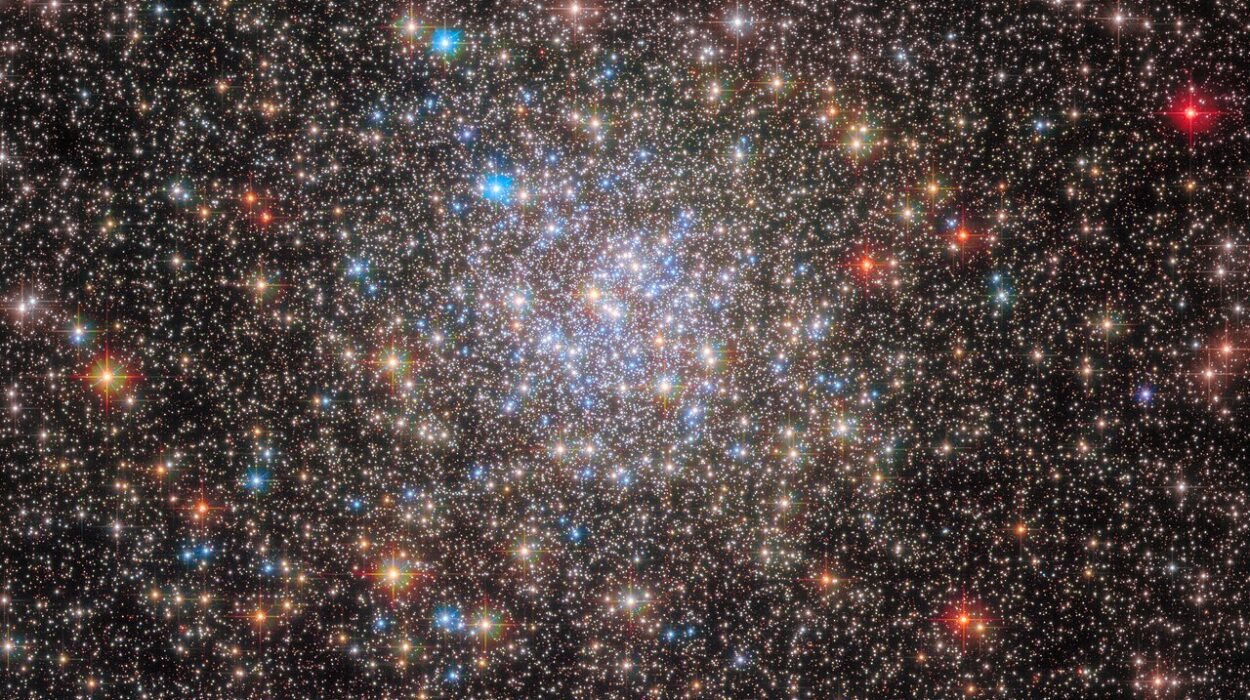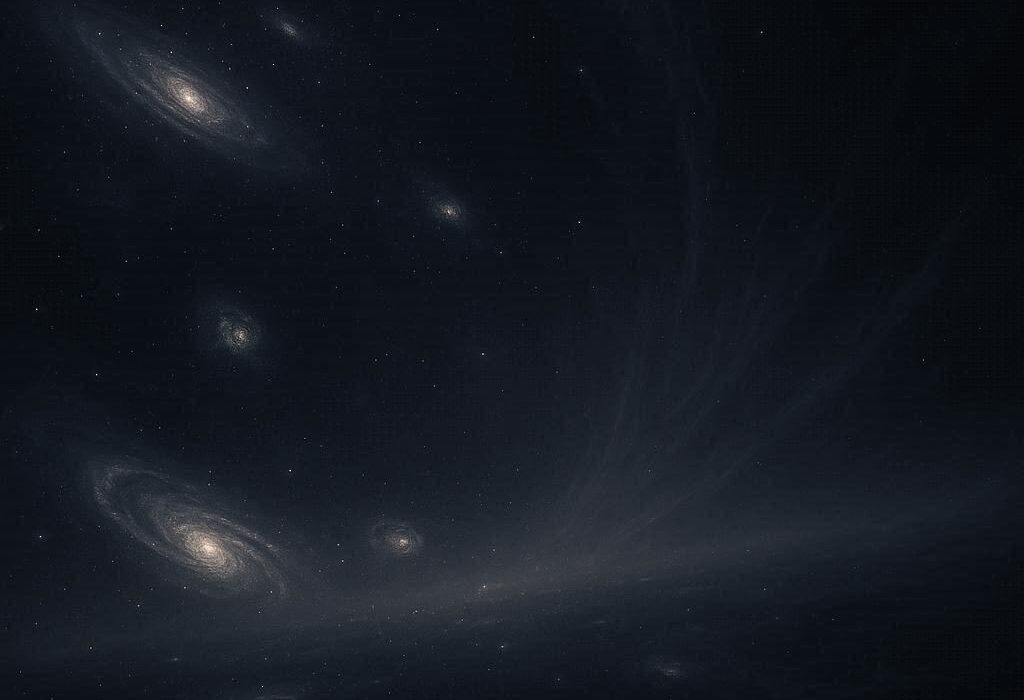
Look up at the night sky on a clear evening. Thousands of stars glitter like tiny lanterns scattered across a vast black ocean. With telescopes, the number grows to billions. Entire galaxies swirl in magnificent spirals, nebulae glow with cosmic color, and distant clusters stretch across unimaginable distances.
For centuries, humanity believed that everything in the universe was made from the matter we could see—stars, planets, gas, dust, and galaxies. It seemed logical. Light revealed the structure of the cosmos, and wherever we looked, luminous matter appeared to shape the universe.
But in the twentieth century, astronomers began discovering something deeply unsettling.
The universe we can see—the stars blazing across galaxies, the glowing clouds of cosmic gas, even entire clusters of galaxies—makes up only a tiny fraction of what actually exists.
The vast majority of the universe is invisible.
Roughly eighty-five percent of the matter in the cosmos is something mysterious, something that does not emit light, reflect light, or interact with electromagnetic radiation in any detectable way. It neither glows nor casts a shadow. It does not shine in telescopes.
Yet its gravitational pull shapes the universe on the largest scales.
Scientists call it dark matter.
Dark matter is one of the greatest mysteries in modern physics. It surrounds galaxies, binds clusters together, and determines how cosmic structures form. Without it, the universe we observe today simply could not exist in its current form.
And yet, despite decades of research, no one has directly seen it.
The First Signs of Something Missing
The story of dark matter begins not with a grand theory, but with a puzzling observation. In the early twentieth century, astronomers began carefully measuring how galaxies move.
In the 1930s, Swiss astronomer Fritz Zwicky studied the Coma Cluster, a massive group of galaxies bound together by gravity. By measuring how fast the galaxies were moving, he attempted to estimate how much mass the cluster contained.
What he discovered shocked him.
The galaxies were moving far too quickly. According to Newton’s laws of gravity, the cluster should have flown apart unless it contained far more mass than what telescopes revealed.
Zwicky concluded that the cluster must contain large amounts of unseen matter. He called it “dunkle Materie,” the German term for dark matter.
At the time, his idea was largely ignored. The astronomical community did not yet realize how profound his observation was.
Decades later, new evidence would bring the mystery back with overwhelming force.
Galaxies That Should Fly Apart
In the 1970s, astronomer Vera Rubin began studying the rotation of spiral galaxies. She carefully measured how stars orbit their galactic centers.
According to classical physics, stars closer to the center of a galaxy should orbit faster than stars far away. This is similar to how planets in our solar system behave. Mercury orbits the Sun much faster than Neptune because it is closer to the Sun’s gravitational pull.
But Rubin discovered something astonishing.
Stars at the outer edges of galaxies were moving just as fast as stars near the center.
These flat rotation curves implied that galaxies contained far more mass than visible stars and gas could account for. If only visible matter existed, the outer stars should drift away into intergalactic space.
Yet galaxies remained stable.
The only explanation was that enormous halos of invisible matter surrounded them, providing the extra gravitational pull needed to hold them together.
Dark matter was no longer a speculative idea. It had become a necessary component of cosmic structure.
The Shape of Invisible Halos
Astronomers now believe that every large galaxy sits inside a vast halo of dark matter. These halos extend far beyond the visible edges of galaxies.
In fact, the luminous part of a galaxy—the stars and glowing gas we see—represents only a small island within a much larger invisible structure.
Dark matter halos can stretch hundreds of thousands of light-years across. They contain far more mass than the visible galaxy itself.
Without these halos, galaxies could not maintain their shape. Spiral arms would disperse. Stars would escape into intergalactic space.
Dark matter acts as a gravitational skeleton, giving galaxies their structure and stability.
Gravitational Lensing: Seeing the Invisible
One of the most powerful pieces of evidence for dark matter comes from a phenomenon predicted by Albert Einstein in his theory of general relativity.
Einstein showed that massive objects warp spacetime, bending the path of light. When light from a distant galaxy passes near a massive object like a galaxy cluster, its path curves, producing distorted or magnified images. This effect is called gravitational lensing.
Astronomers can measure how strongly light bends and use it to calculate the mass responsible for the distortion.
Again and again, the results reveal something startling.
Galaxy clusters contain far more mass than visible matter can explain.
The gravitational lensing maps show enormous concentrations of invisible matter surrounding galaxies and clusters. In many cases, the dark matter distribution can be mapped directly by analyzing how background galaxies are distorted.
It is as if we can see the shadow of something that itself remains invisible.
The Cosmic Web
Dark matter does not simply sit around galaxies like a quiet halo. It forms an immense cosmic structure stretching across the universe.
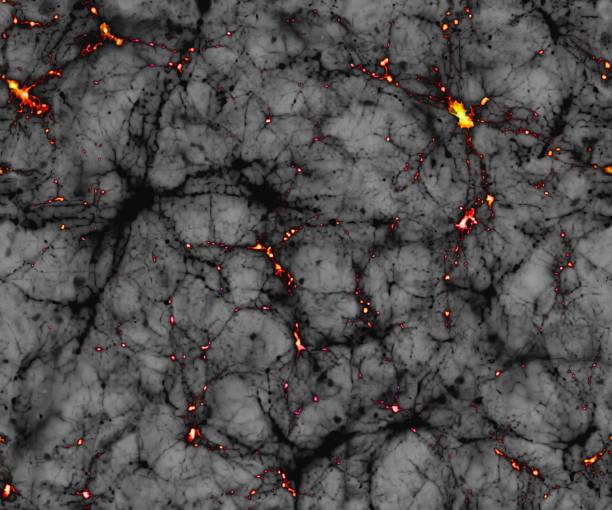
Computer simulations of cosmic evolution reveal that dark matter organizes itself into filaments, nodes, and vast sheets. This structure is known as the cosmic web.
Galaxies form where these filaments intersect, like dew collecting at the crossing points of spider threads.
The gravitational pull of dark matter draws ordinary matter—gas and dust—into these regions. Over billions of years, the gas collapses, forming stars and galaxies.
In this sense, dark matter built the architecture of the universe. Without it, galaxies might never have formed.
The stars we see are simply luminous decorations hanging upon an invisible framework.
The Early Universe and Dark Matter
Evidence for dark matter also comes from studying the early universe.
Observations of the cosmic microwave background—the faint radiation left over from the Big Bang—provide a snapshot of the universe about 380,000 years after its birth.
This radiation has been mapped in extraordinary detail by missions such as Planck satellite.
Tiny temperature fluctuations in the cosmic microwave background reveal how matter was distributed in the early universe. These fluctuations acted as seeds for future galaxy formation.
When scientists analyze these patterns, they find that the universe must contain far more matter than can be explained by atoms alone.
The data show that ordinary matter accounts for only about five percent of the universe’s total energy content. Dark matter makes up roughly twenty-seven percent. The rest is something even more mysterious known as dark energy.
The conclusion is unavoidable.
Most of the universe is made of something we cannot see.
What Dark Matter Is Not
Before asking what dark matter might be, scientists first determined what it cannot be.
At first, astronomers wondered if dark matter might simply be ordinary matter that emits little or no light. Perhaps faint stars, cold gas clouds, or rogue planets filled the universe in large numbers.
But careful observations ruled this out.
If dark matter were made of normal atoms, it would interact with light in subtle ways that telescopes could detect. It would also affect the chemistry of the early universe in ways inconsistent with measurements of hydrogen and helium abundances.
These observations show that dark matter cannot be composed primarily of ordinary baryonic matter.
It must be something fundamentally different.
The Leading Particle Candidates
Many physicists believe dark matter consists of unknown particles that interact weakly with normal matter.
One leading candidate is the WIMP, or Weakly Interacting Massive Particle. These hypothetical particles would have mass but interact only through gravity and the weak nuclear force, making them extremely difficult to detect.
Another possibility involves axions, extremely light particles originally proposed to solve a problem in quantum chromodynamics.
Some theories suggest sterile neutrinos—particles related to neutrinos but interacting even more weakly.
These particles would permeate the universe, forming enormous halos around galaxies.
Despite decades of experiments, however, none of these particles has been definitively detected.
Searching Deep Underground
Detecting dark matter directly is extraordinarily challenging.
Because dark matter interacts so weakly with ordinary matter, it can pass through planets, stars, and even entire galaxies without leaving a trace.
To search for rare interactions, scientists build detectors deep underground where layers of rock shield them from cosmic radiation.
One such facility is the Gran Sasso National Laboratory. Hidden beneath the Apennine Mountains, it houses experiments designed to capture the faint signals of dark matter particles colliding with atomic nuclei.
Other experiments use ultra-pure crystals, liquid xenon chambers, or cryogenic detectors cooled to extremely low temperatures.
So far, these experiments have not conclusively observed dark matter interactions.
But each new experiment improves sensitivity, narrowing the possibilities.
Dark Matter at Particle Accelerators
Another approach involves creating dark matter particles in high-energy collisions.
At CERN, scientists use the Large Hadron Collider to smash protons together at enormous energies. These collisions can produce new particles not normally found in nature.
If dark matter particles are created in such collisions, they would escape the detectors without interacting, leaving behind missing energy signatures.
Physicists analyze collision data carefully for these clues.
While no confirmed dark matter particle has yet been discovered, the search continues.
The Bullet Cluster: A Cosmic Clue
One of the most striking pieces of evidence for dark matter comes from a cosmic collision known as the Bullet Cluster.
This system consists of two galaxy clusters that passed through each other millions of years ago.
When astronomers studied the collision, they noticed something remarkable.
The hot gas from the clusters—visible in X-rays—slowed down and remained near the collision center. But gravitational lensing revealed that most of the mass had moved ahead of the gas.
The invisible mass had passed through the collision almost unaffected.
This behavior matches predictions for dark matter particles that interact weakly with ordinary matter. It provides compelling evidence that dark matter is a real physical substance rather than simply a modification of gravity.
Could Gravity Be Wrong?
Not all scientists are convinced dark matter exists.
Some propose that our understanding of gravity may be incomplete. Modified gravity theories attempt to explain galaxy rotation curves without invoking invisible matter.
One well-known example is MOND, Modified Newtonian Dynamics.
These theories can explain certain observations but struggle to account for the full range of evidence, particularly gravitational lensing and cosmic microwave background data.
For now, the majority of cosmologists consider dark matter the most consistent explanation.
But the debate continues, reminding us that science evolves through questioning and testing ideas.
Dark Matter and the Fate of the Universe
Dark matter influences not only the structure of galaxies but also the evolution of the entire universe.
Its gravitational pull helped amplify small fluctuations in the early cosmos, allowing galaxies to form quickly after the Big Bang.
Even today, dark matter shapes how galaxy clusters merge and how cosmic structures evolve over billions of years.
Yet dark matter alone does not determine the ultimate fate of the universe. Another mysterious component—dark energy—appears to be accelerating cosmic expansion.
Together, dark matter and dark energy dominate the cosmos.
The ordinary matter that forms stars, planets, oceans, and living beings is a tiny minority.
The Philosophical Impact
The discovery of dark matter has profound philosophical implications.
For centuries, humans believed the visible universe represented reality itself. Now we know that most of existence lies hidden from direct observation.
The atoms in our bodies, the stars in our sky, the galaxies we photograph with powerful telescopes—all belong to a small minority of cosmic substance.
The majority of matter remains unseen, unidentified, and mysterious.
It is a humbling realization.
But it is also thrilling.
Every unanswered question opens a doorway to discovery.
The Future of the Search
The quest to understand dark matter continues across the globe.
New detectors are becoming more sensitive than ever before. Astronomers are mapping dark matter distributions through gravitational lensing surveys. Particle physicists are exploring new theories that might reveal the nature of this elusive substance.
Upcoming telescopes and observatories may provide further clues about how dark matter behaves on cosmic scales.
At the same time, theoretical physicists are exploring ideas that extend beyond the Standard Model of particle physics, searching for a deeper understanding of the universe’s hidden components.
The mystery of dark matter remains one of the greatest scientific challenges of our time.
A Universe Still Full of Secrets
Dark matter reminds us that knowledge is always incomplete.
Even after centuries of scientific progress—after telescopes, satellites, particle accelerators, and supercomputers—we still understand only a small fraction of the universe.
The cosmos is deeper and stranger than we imagined.
Somewhere, silently shaping galaxies and bending the paths of light, dark matter continues its invisible work. It surrounds us, passes through us, and binds the universe together.
Yet we cannot see it.
Not yet.
But science thrives on mysteries like this. The question of dark matter drives new technologies, new theories, and new generations of curious minds determined to uncover the truth.
One day, perhaps, humanity will finally reveal the nature of this invisible substance.
And when that day comes, our understanding of the universe may change once again—just as dramatically as when we first realized that most of reality is hidden in the dark.