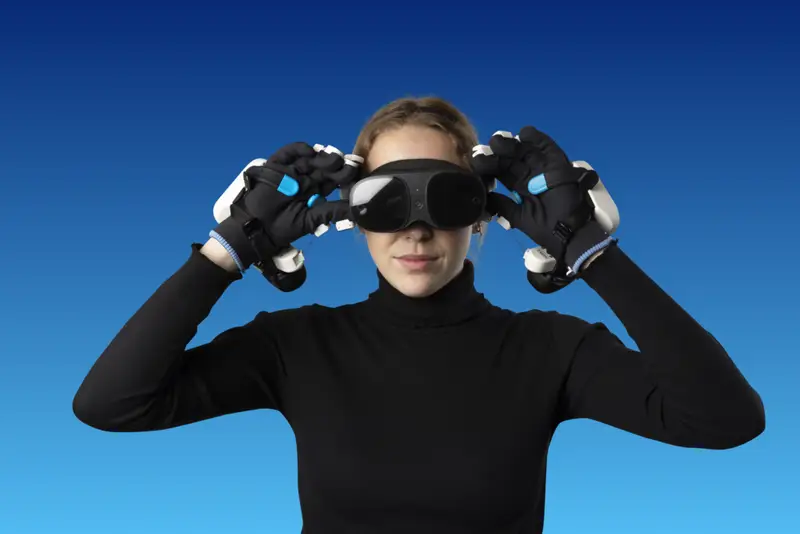
To touch is to know. Long before humans learned to write or calculate, we reached out with our hands to understand the world. We pressed our fingers into soil to judge its moisture, traced the contours of stone tools, and felt the reassuring weight of objects that meant safety or survival. Touch is the most intimate of senses. It is the sense that confirms reality. You can close your eyes and still know something is there because you can feel it. Haptics is the science and technology that attempts something once thought impossible: giving that sense of touch to the digital world.
Haptics allows machines to communicate through force, vibration, motion, and texture. It is the reason your phone buzzes when a message arrives, the reason a game controller resists your hand when you crash into a wall, and the reason surgeons can practice delicate operations in virtual environments that feel uncannily real. At its deepest level, haptics is an effort to bridge the gap between physical reality and digital abstraction, to make pixels and code feel as solid and meaningful as objects you can hold.
This is not merely a story of gadgets and innovation. It is a story about the human nervous system, about perception and illusion, and about how technology reshapes the way we experience reality itself.
The Human Sense of Touch and Its Hidden Complexity
Touch seems simple. You place your hand on a surface, and you feel it. Yet beneath this apparent simplicity lies one of the most sophisticated sensory systems in the human body. The skin is not a uniform sensor but a living network of specialized receptors embedded in layers of tissue. Some respond to pressure, others to vibration, others to stretching or temperature. Together, they create a rich, multidimensional picture of the world.
When you run your fingers across a surface, your brain is not merely detecting contact. It is interpreting patterns of pressure over time, tiny vibrations caused by microscopic textures, and the resistance offered by the object. This information travels through nerves to the spinal cord and then to the brain, where it is combined with memory, expectation, and context. Touch is never just physical. It is cognitive and emotional as well.
Haptics technology works by exploiting this complexity. It does not need to recreate every detail of an object to convince you it is real. Instead, it stimulates key aspects of the touch system in ways that the brain interprets as meaningful contact. In this sense, haptics is not about copying reality perfectly but about creating convincing illusions of touch.
The Meaning of Haptics and Its Scientific Roots
The word “haptics” comes from the Greek term meaning “to touch.” In scientific usage, it refers to both the study of touch perception and the technologies that engage it. Haptics sits at the intersection of physics, neuroscience, engineering, and psychology. It requires an understanding of how forces are generated and transmitted, how sensors detect motion and pressure, and how the brain turns physical signals into experience.
Early scientific interest in touch focused on understanding how humans perceive texture, weight, and shape. Researchers discovered that touch is an active sense. We do not passively receive information through our skin; we actively explore objects by moving our hands and fingers. This insight was crucial for the development of haptics. A system that merely presses against the skin is far less convincing than one that responds dynamically to a user’s movements.
Modern haptics builds on decades of research into sensory perception. It draws from classical mechanics to generate forces, from materials science to design actuators, and from neuroscience to determine what patterns of stimulation produce specific sensations. The result is a field that blends hard science with subtle artistry.
From Vibrations to Forces: How Haptics Works
At the most basic level, haptics involves delivering physical stimuli to the body. These stimuli can take many forms, but they generally fall into two broad categories: tactile feedback and force feedback. Tactile feedback targets the skin, creating sensations like vibration, tapping, or texture. Force feedback engages muscles and joints, producing resistance, weight, or motion.
When your smartphone vibrates, it is using a small motor to generate oscillations that stimulate receptors in your skin. Your brain interprets these vibrations as alerts or confirmations. This is a simple form of haptics, but it is surprisingly powerful. A brief buzz can feel urgent, reassuring, or even emotional, depending on context.
More advanced systems use motors, actuators, and sensors to create forces that respond to your actions. When you push against a virtual object in a simulation and feel resistance, the system is measuring your input and calculating how the object should respond according to physical rules. It then applies forces back to your hand in real time. The illusion works because the feedback is immediate and consistent with your expectations.
The success of haptics depends on timing and precision. Delays of even a few milliseconds can break the illusion. Forces that are slightly too strong or too weak can feel unnatural. Designing effective haptic systems requires an intimate understanding of both machines and human perception.
The Emotional Power of Touch in Digital Spaces
Touch carries emotional weight in a way that sight and sound often do not. A handshake can convey trust, a gentle squeeze can offer comfort, and a sudden impact can trigger fear. Haptics taps into this emotional dimension, giving digital experiences a new depth.
Consider the difference between watching a virtual explosion and feeling the shock through a controller or wearable device. The added sensation makes the event feel more real and more personal. Your body reacts, not just your eyes. This embodied response can enhance engagement, immersion, and memory.
In communication, haptics opens new possibilities. A simple vibration pattern can serve as a private signal between people, conveying presence or attention without words. In virtual environments, haptic feedback can restore a sense of closeness that is often lost in digital interaction. Touch, even simulated touch, has the power to humanize technology.
Haptics in Everyday Technology
Haptics has quietly become part of daily life. Smartphones, tablets, and laptops use subtle vibrations to confirm actions like typing or tapping. These small cues make interfaces feel responsive and alive. Without them, digital interactions can feel flat and disconnected.
Gaming has been one of the most visible drivers of haptic innovation. Controllers that vibrate or resist movement create a physical connection between players and virtual worlds. When a vehicle skids on ice or a weapon recoils, the feedback enhances realism and emotional impact. Players do not just see what is happening; they feel it.
Automotive technology also relies on haptics. Steering wheels that vibrate to warn of lane departures, pedals that resist when a collision is imminent, and touchscreens that provide tactile confirmation all use haptic principles to communicate information quickly and intuitively. In situations where attention is limited, touch can be more effective than sound or visual alerts.
Virtual Reality and the Return of the Body
Virtual reality promises immersive digital worlds, but without touch, those worlds can feel hollow. Haptics plays a crucial role in making virtual environments believable. Gloves, suits, and handheld devices can simulate contact, texture, and force, allowing users to interact with virtual objects as if they were real.
When you reach out to grasp a virtual object and feel its shape and resistance, your brain integrates visual and haptic information into a unified experience. This sensory coherence is essential for immersion. Without it, the illusion breaks, and the virtual world feels artificial.
Haptics also helps address a deeper challenge in virtual reality: the disconnect between what you see and what your body feels. By providing physical feedback that matches visual cues, haptics reduces disorientation and enhances presence. The body, once sidelined by screens, becomes central again.
Augmented Reality and Touching the Invisible
Augmented reality overlays digital information onto the physical world. Haptics can make this information tangible. Imagine touching a virtual button floating in the air and feeling it click, or tracing a holographic map and sensing its contours. These experiences blur the boundary between real and virtual in ways that feel natural and intuitive.
In industrial and medical contexts, augmented reality combined with haptics can guide complex tasks. A technician might feel resistance when assembling parts incorrectly, or a surgeon might feel the texture of virtual tissue during training. Touch adds a layer of understanding that visuals alone cannot provide.
The challenge in augmented reality is subtlety. Haptic feedback must align precisely with physical space and user movement. When done well, it can make digital elements feel like natural extensions of the environment.
Haptics in Medicine and Healing
Few areas reveal the power of haptics more clearly than medicine. Touch is central to diagnosis, treatment, and care. Surgeons rely on tactile cues to judge tissue stiffness and tension. Physical therapists guide patients through movements using hands-on feedback. Haptics technology seeks to preserve and extend these skills in digital contexts.
In surgical training, haptic simulators allow students to practice procedures repeatedly without risk to patients. By feeling resistance, texture, and force, trainees develop muscle memory and intuition that cannot be learned from visuals alone. These systems can simulate rare or complex scenarios, preparing surgeons for real-world challenges.
Haptics also plays a role in rehabilitation. Devices that provide guided resistance or vibration can help patients regain motor control after injury or illness. By engaging the sense of touch, therapy becomes more interactive and motivating. The body learns by doing and feeling, even when guided by machines.
Prosthetics and the Restoration of Touch
One of the most profound applications of haptics lies in prosthetics. Modern prosthetic limbs can move with remarkable precision, but without sensation, they remain incomplete. Touch provides feedback that allows users to adjust grip, judge force, and interact naturally with objects.
Haptic prosthetics use sensors to detect pressure and motion, translating this information into stimuli delivered to the user’s skin or nervous system. The goal is not just functionality but embodiment. When a prosthetic feels like part of the body, the user’s sense of self changes. The device becomes less of a tool and more of an extension.
This work touches on deep questions about identity and perception. What does it mean to feel through a machine? How does the brain adapt to new sensory pathways? Research shows that the nervous system is remarkably flexible, capable of incorporating artificial feedback into its internal map of the body. Haptics, in this context, becomes a bridge between biology and technology.
The Physics Behind Simulated Touch
At its core, haptics is grounded in physics. Forces must be generated, transmitted, and controlled with precision. Actuators convert electrical energy into mechanical motion. Sensors measure position, velocity, and force. Control systems calculate responses in real time.
The physics of friction, elasticity, and inertia plays a central role. To simulate the feel of a rough surface, a system might generate high-frequency vibrations that mimic the microscopic interactions between skin and texture. To simulate weight, it might apply downward force proportional to the virtual object’s mass. These effects rely on well-understood physical principles, carefully tuned to match human perception.
Yet physics alone is not enough. The brain’s interpretation of sensory input introduces nonlinearities and biases. A physically accurate simulation may not feel right if it does not align with expectations. Haptics designers must therefore balance physical realism with perceptual effectiveness, sometimes exaggerating or simplifying forces to achieve the desired sensation.
Neuroscience and the Illusion of Reality
The brain does not passively receive touch signals; it actively constructs experience. This fact is central to haptics. By understanding how the brain processes tactile information, engineers can design stimuli that evoke specific sensations.
For example, the sensation of texture often arises from vibrations created when the skin moves across a surface. By replicating these vibrations artificially, a smooth surface can be made to feel rough, or vice versa. Similarly, the sense of weight can be influenced by timing and resistance, even if no actual mass is involved.
These illusions reveal something profound about perception. What we feel is not a direct reflection of the external world but a best guess constructed by the brain. Haptics takes advantage of this, crafting experiences that feel real enough to be convincing, even when they are entirely synthetic.
Ethical and Psychological Dimensions of Haptics
As haptics becomes more immersive, it raises ethical and psychological questions. Touch is deeply personal, and simulated touch can evoke strong emotional responses. How should haptic communication be designed to respect boundaries and consent? What happens when digital experiences become indistinguishable from physical ones?
There is also the question of dependence. If digital touch becomes more satisfying or controllable than real-world interaction, how might that affect human relationships? These concerns are not unique to haptics, but touch amplifies them because of its emotional power.
Responsible development of haptics requires sensitivity to these issues. Designers must consider not only what is possible but what is appropriate. As with all transformative technologies, the goal should be to enhance human experience, not replace or diminish it.
The Future of Feeling in a Digital World
The future of haptics promises experiences that are richer, more nuanced, and more integrated into daily life. Advances in materials, such as flexible electronics and soft actuators, are enabling wearable devices that feel natural and unobtrusive. Improved sensors and algorithms are increasing precision and responsiveness.
In the long term, haptics may move beyond external devices to direct neural interfaces, stimulating the nervous system more directly. Such developments could offer unprecedented realism and accessibility, particularly for individuals with sensory impairments. They also raise profound questions about the nature of experience and the boundaries of the self.
What remains constant is the human desire to feel connected. In a world increasingly mediated by screens and code, haptics offers a way to restore the body to the center of experience. It reminds us that understanding and meaning are not purely intellectual but sensory and emotional as well.
Why Haptics Matters
Haptics matters because it acknowledges something fundamental about being human. We are not just minds processing information; we are bodies interacting with the world. Touch grounds us in reality. It reassures, warns, and connects. By bringing touch into the digital realm, haptics makes technology more humane.
This field is not about replacing reality but about enriching interaction. It allows digital tools to speak a language the body understands. It transforms abstract data into something you can feel, making learning, communication, and creativity more intuitive.
In the end, haptics is a reminder that technology is at its best when it respects and enhances human nature. By giving digital objects the ability to be felt, we are not just adding another feature. We are redefining the relationship between humans and machines, making it more physical, more emotional, and more real.