There is something quietly radical about the idea of a spacecraft that moves without fire. No roaring engines, no violent expulsion of fuel, no thunderous launch beyond Earth’s atmosphere once it is free. Instead, a fragile, shimmering sheet unfurls in the darkness of space, catching sunlight the way a sail catches wind. The push is gentle, almost imperceptible, yet relentless. Over days, months, and years, that faint pressure becomes destiny. This is the promise of solar sails: traveling the cosmos by riding sunlight itself.
Solar sails sound like science fiction, but they are rooted in deep, well-tested physics. They draw on a simple truth that is easy to overlook because it feels so intangible. Light carries momentum. Even though photons have no rest mass, they exert pressure when they strike a surface. On Earth, this pressure is too small to notice. In space, where there is no air resistance and gravity can be delicately balanced, it becomes a powerful tool. Solar sails transform one of the universe’s most abundant resources—sunlight—into a means of propulsion.
To understand solar sails is to glimpse a different philosophy of space travel. It is slower, more patient, and more elegant than traditional rocketry. It trades brute force for persistence and invites us to imagine journeys measured not in minutes or hours, but in years of continuous acceleration. In doing so, it reshapes our vision of exploration and our relationship with the Sun itself.
The Physics of Light as a Propulsive Force
At the heart of solar sailing lies a deceptively simple idea: light can push. This fact emerges naturally from the principles of physics, particularly from the relationship between energy and momentum. Photons, the fundamental particles of light, carry momentum proportional to their energy. When they strike a surface and are absorbed or reflected, they transfer some of that momentum to the object they hit.
The effect is known as radiation pressure. On Earth, radiation pressure is utterly dwarfed by everyday forces like gravity and air resistance. A flashlight shining on your hand will not move it. But in space, where spacecraft float in near-perfect vacuum and forces accumulate over long periods, radiation pressure becomes significant.
The Sun emits an enormous stream of photons in all directions. At Earth’s distance, the pressure exerted by sunlight is tiny, but constant. A solar sail, designed to be extremely lightweight and highly reflective, can capture this pressure efficiently. When photons bounce off the sail’s surface, they reverse direction, imparting twice as much momentum as they would if absorbed. This reflection is key to maximizing thrust.
Unlike a rocket engine, which delivers a strong but short-lived push, a solar sail provides continuous acceleration as long as sunlight falls upon it. The acceleration is small, often measured in fractions of a millimeter per second squared, but it never stops. Over time, this steady push can build enormous speeds, surpassing what chemical rockets can achieve once their fuel is spent.
A Concept Older Than the Space Age
The idea of using light for propulsion predates modern spaceflight by centuries. In the seventeenth century, Johannes Kepler speculated that comet tails were pushed away from the Sun by some kind of solar influence. He even imagined ships equipped with sails navigating space using sunlight. Though Kepler lacked the physics to formalize the idea, his intuition was strikingly close to the truth.
In the late nineteenth and early twentieth centuries, as electromagnetic theory matured, scientists began to understand radiation pressure more rigorously. James Clerk Maxwell’s equations implied that electromagnetic waves carry momentum. Experimental confirmation followed, proving that light could indeed exert force.
The dream of solar sailing gained renewed interest in the twentieth century as space exploration became a reality. Visionary thinkers recognized that while rockets were essential for escaping Earth’s gravity, alternative propulsion methods might be better suited for long-duration missions. Solar sails promised fuel-free propulsion, theoretically allowing spacecraft to travel indefinitely as long as they remained in sunlight.
For decades, the idea remained largely theoretical. The challenges were formidable. Building a sail large enough to capture meaningful thrust while keeping it light and durable seemed beyond the reach of available materials. Controlling such a delicate structure in space also posed daunting engineering problems. Yet the allure of the concept never faded.
The Anatomy of a Solar Sail
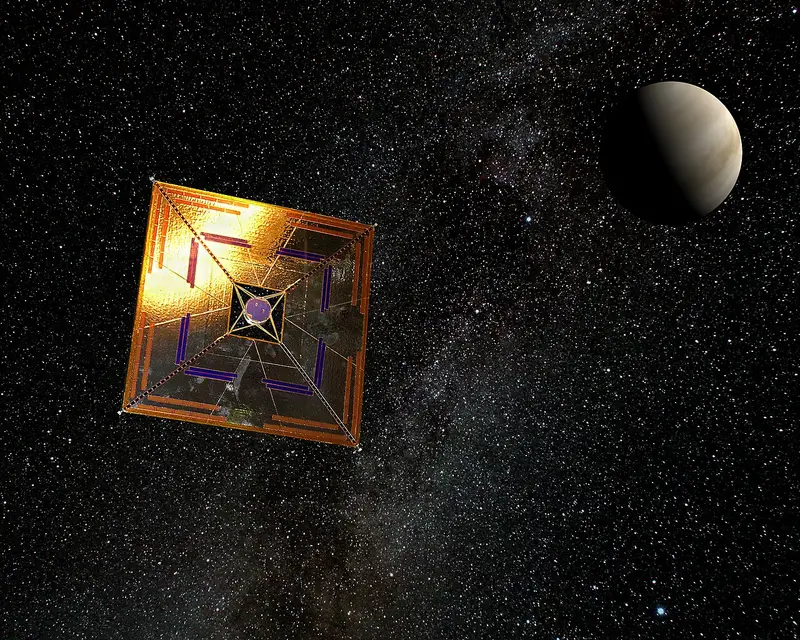
A solar sail is, at its core, a large reflective surface attached to a spacecraft. The sail must be extremely thin and lightweight, often made of materials measured in micrometers. Modern designs typically use polymers coated with reflective metals such as aluminum. These materials strike a delicate balance between reflectivity, strength, and resistance to degradation from solar radiation.
The size of the sail is critical. Because radiation pressure is so weak, larger sails collect more momentum. Some proposed sails span hundreds or even thousands of square meters, dwarfing the spacecraft they propel. Despite their size, these sails weigh very little, allowing the faint push of sunlight to have a noticeable effect.
Equally important is the spacecraft’s mass. Solar sailing works best when the ratio of sail area to mass is as high as possible. This requirement drives engineers to design spacecraft that are minimalistic, shedding unnecessary weight wherever possible. The result is a new aesthetic in spacecraft design, one that values delicacy over robustness and elegance over power.
Deploying a solar sail is one of the most challenging moments of a mission. The sail must unfold smoothly in microgravity without tearing, tangling, or collapsing. Once deployed, it must maintain its shape and orientation with exquisite precision. Small changes in angle can dramatically affect the direction and magnitude of the thrust.
Steering with Sunlight
One of the most fascinating aspects of solar sails is how they are controlled. Unlike rockets, which steer by redirecting thrust, solar sails steer by changing the angle at which they reflect sunlight. By tilting the sail relative to the incoming photons, the spacecraft can adjust the direction of the force it experiences.
This ability allows solar sails to do something counterintuitive: they can move inward toward the Sun or outward away from it, depending on how they are oriented. By carefully adjusting the sail’s angle, a spacecraft can gain or lose orbital energy, climbing to higher orbits or spiraling closer to the Sun.
The mathematics of solar sail navigation is subtle and beautiful. Trajectories are not simple arcs or straight lines but graceful spirals shaped by the continuous interplay between gravity and radiation pressure. Planning such paths requires sophisticated modeling and an intuitive understanding of orbital mechanics.
Solar sails also offer remarkable flexibility. They can change course without expending fuel, allowing for extended missions with evolving objectives. In principle, a solar-sail spacecraft could wander through the solar system for decades, adjusting its path as new discoveries or priorities arise.
Early Experiments and Proof of Concept
For many years, solar sails remained an idea waiting for its moment. That moment arrived in the early twenty-first century, when advances in materials science and space engineering finally made practical demonstrations possible.
One of the first successful solar sail missions was launched by the Japan Aerospace Exploration Agency. The spacecraft deployed a large sail and demonstrated measurable acceleration due to solar radiation pressure. It also showed that solar sails could be used for navigation and attitude control, validating decades of theoretical work.
Other missions followed, including experimental spacecraft designed to test sail deployment and maneuvering techniques. These early successes were modest in scale, but they were profound in implication. They proved that solar sailing was not just a dream but a viable method of propulsion.
Each mission faced challenges. Sails had to survive the harsh environment of space, including temperature extremes, micrometeoroid impacts, and prolonged exposure to ultraviolet radiation. Control systems had to be refined to manage the sail’s orientation without destabilizing the spacecraft. Every success was hard-won, but each brought solar sailing closer to maturity.
Solar Sails and the Art of Patience
Perhaps the most profound shift required to embrace solar sails is a psychological one. Traditional spaceflight emphasizes speed and power. Rockets blast away from Earth, delivering payloads on carefully timed trajectories. Solar sailing demands patience. Acceleration is slow, and progress can feel almost imperceptible at first.
Yet this patience is rewarded over time. Because solar sails do not run out of fuel, they can continue accelerating long after a rocket-powered spacecraft has coasted into inertial motion. Over months and years, a solar sail can reach extraordinary speeds, potentially exceeding those achievable by conventional propulsion for deep-space missions.
This slow, steady approach mirrors natural processes more than human engineering traditions. It resembles the way planets form, the way stars evolve, and the way galaxies drift through cosmic time. Solar sails invite us to align our ambitions with the rhythms of the universe rather than forcing our will upon it.
In this sense, solar sailing is not just a technology but a philosophy of exploration. It asks us to think in longer timeframes, to value sustainability, and to trust in the power of gentle forces acting persistently.
Missions Within the Solar System
Solar sails are particularly well suited for certain types of missions within our solar system. They can maintain positions that would otherwise require continuous propulsion, such as hovering at unusual vantage points relative to the Sun and Earth. They can also reach high-inclination orbits that are difficult to achieve with rockets alone.
One promising application is the study of the Sun itself. Solar sails can enable spacecraft to travel closer to the Sun or maintain polar orbits that provide unique perspectives on solar activity. Because the sail’s thrust increases as it approaches the Sun, such missions can take advantage of stronger radiation pressure to maneuver efficiently.
Solar sails are also attractive for missions to asteroids and comets. Their fuel-free propulsion allows for extended reconnaissance, rendezvous with multiple targets, or gradual adjustments to orbit that would be prohibitively expensive with chemical propulsion. In the long term, solar sails could play a role in planetary defense, enabling spacecraft to intercept and study potentially hazardous objects.
These applications highlight a key strength of solar sailing: endurance. Where rockets offer bursts of capability, solar sails offer longevity, opening up mission profiles that would otherwise remain impractical.
Reaching Beyond the Sun’s Domain
As powerful as sunlight is within the inner solar system, its intensity diminishes with distance. This raises an obvious question: can solar sails take us beyond the Sun’s reach, toward the stars?
The answer is cautiously optimistic. While solar radiation pressure weakens with distance, a solar sail can build up significant speed while still close to the Sun. By diving inward and then unfurling its sail at the right moment, a spacecraft can use the intense sunlight near the Sun to gain a powerful push outward. This maneuver, sometimes called a solar photonic assist, can send a spacecraft hurtling toward the outer solar system at remarkable velocities.
Once far from the Sun, the sail’s thrust becomes negligible, but the spacecraft retains the speed it gained. In this way, solar sails could enable fast missions to the outer planets, the Kuiper Belt, and even interstellar space.
Some visionary proposals extend the concept further by imagining sails propelled not by sunlight, but by powerful lasers. In such schemes, a laser array based near Earth or in space would shine on a sail, providing a much stronger and more focused push. This idea, while technologically challenging, could theoretically accelerate tiny spacecraft to a significant fraction of the speed of light, opening the door to interstellar exploration within human lifetimes.
The Emotional Power of Solar Sailing
Beyond engineering and physics, solar sails carry a deep emotional resonance. They transform sunlight, something we experience as warmth and illumination, into a vehicle for exploration. The same rays that sustain life on Earth become the wind that carries our machines into the unknown.
There is poetry in the image of a sail unfurled against the blackness of space, glinting faintly as it catches the Sun’s light. It evokes humanity’s maritime past, when explorers crossed oceans guided by wind and stars. Solar sails extend that tradition into the cosmic ocean, suggesting continuity between our ancient instincts and our most advanced technologies.
This emotional connection matters. Exploration is not driven by practicality alone but by imagination and longing. Solar sails remind us that progress does not always require domination or exploitation. Sometimes, it comes from learning to move with the forces already present in nature.
Challenges and Limitations
Despite their promise, solar sails are not a universal solution. Their low thrust makes them unsuitable for missions requiring rapid acceleration or heavy payloads. They are delicate structures, vulnerable to damage and degradation over time. Their performance depends strongly on distance from the Sun, limiting their effectiveness in the outer solar system unless combined with other strategies.
Control and navigation remain complex. Managing a vast, flexible sail in space demands precision and robust autonomy. Even small errors can lead to unwanted rotations or loss of control. Engineers must also account for perturbations from solar wind, gravitational influences, and the spacecraft’s own dynamics.
These challenges are real, but they are not insurmountable. Each experimental mission provides new data and experience, refining designs and techniques. As materials improve and control algorithms advance, the practical limitations of solar sails continue to shrink.
Solar Sails and the Future of Space Exploration
Solar sails occupy a unique niche in the evolving landscape of space propulsion. They complement, rather than replace, traditional rockets and emerging technologies like electric propulsion. Together, these systems form a diverse toolkit, each suited to different missions and goals.
In the coming decades, solar sails may enable ambitious projects that would otherwise remain dreams. Long-duration observatories positioned far from Earth, persistent monitors of space weather, and exploratory missions to the solar system’s frontier all stand to benefit from fuel-free propulsion.
More speculatively, solar sails may help humanity take its first tentative steps toward the stars. Even if interstellar travel remains far beyond our current reach, the act of sending a sail-driven probe into interstellar space would carry immense symbolic weight. It would mark the moment when humanity truly began to navigate the cosmos using the universe’s own energy.
A New Relationship with the Sun
Solar sails invite us to rethink our relationship with the Sun. For most of human history, the Sun has been a source of light, warmth, and life, but also a distant, untouchable presence. Through solar sailing, it becomes something more intimate: a partner in exploration.
The Sun’s photons, born in nuclear reactions deep within its core, travel millions of kilometers to reach a sail. In that moment of reflection, energy forged in stellar fire nudges a human-made object onto a new path. This connection spans space, time, and scale, linking the processes of a star to the aspirations of a species.
There is humility in this vision. Solar sails do not overpower the Sun; they rely on it. They do not defy nature; they cooperate with it. In doing so, they embody a vision of exploration that is both scientifically grounded and deeply human.
Riding Sunbeams to the Stars
Solar sails stand at the intersection of physics, engineering, and imagination. They are born from a precise understanding of light and momentum, shaped by advances in materials and control systems, and inspired by humanity’s enduring desire to explore.
They remind us that even the gentlest forces can achieve extraordinary things if given enough time. They teach us patience in a culture obsessed with speed. They offer a vision of space travel that is sustainable, elegant, and profoundly connected to the natural world.
As sunlight continues to stream outward from the Sun, filling the solar system with invisible pressure, the possibility remains open. A sail can be unfurled. A trajectory can be chosen. And with no fuel to burn and no engine to exhaust, a spacecraft can begin its long, silent journey, riding sunbeams toward the stars.