Stars are not born fully formed, nor do they live forever. They are dynamic, evolving entities, shaped by gravity, time, and nuclear fire. Every star carries a story written across millions or billions of years—a story that begins in cold darkness and ends in quiet fading. The journey from a diffuse cloud of gas to a dense stellar remnant is one of the most beautiful and emotionally stirring narratives in astronomy, because it mirrors life itself: birth, struggle, balance, aging, and legacy.
The life cycle described here follows the path of a low- to medium-mass star, like our Sun. Massive stars live very different, more violent lives, ending in supernovae and neutron stars or black holes. But stars like the Sun take a slower, gentler path, concluding their existence as white dwarfs—cosmic embers glowing softly long after their fuel is gone.
This is the story of those stars, told in eight stages.
1. Stellar Nebula: The Womb of Stars
Every star begins its life in a nebula, a vast cloud of gas and dust drifting through space. These stellar nurseries are composed primarily of hydrogen and helium, with traces of heavier elements forged in earlier generations of stars. Nebulae can span dozens or even hundreds of light-years, appearing serene and ghostly from afar, yet they are places of constant motion and subtle violence.
Gravity is the quiet architect here. Within the nebula, tiny fluctuations in density cause some regions to become slightly denser than others. Over time, these denser pockets begin to pull in more material, growing heavier and more compact. Shockwaves from nearby supernovae, collisions between clouds, or the intense radiation of nearby stars can trigger this collapse, nudging the nebula toward creation.
At this stage, there is no star yet—only potential. The material is cold, dark, and invisible to the human eye. But within these clouds lies the raw substance of suns, planets, and possibly life itself. Every atom of calcium in your bones and iron in your blood once drifted through such a nebula. This is not just the beginning of stars; it is the beginning of cosmic history repeating itself.
2. Protostar: Gravity Ignites the Process
As gravity continues to pull material inward, a dense core forms within the nebula. This growing object is known as a protostar. It is not yet a true star, because it does not produce energy through nuclear fusion. Instead, it shines faintly due to gravitational energy—the heat generated as gas and dust slam together under immense pressure.
The protostar is chaotic and unstable. Material continues to fall inward, while excess angular momentum causes the forming star to spin faster. A rotating disk of gas and dust often forms around it, known as a protoplanetary disk, which may later give rise to planets, moons, asteroids, and comets.
Inside the protostar, temperature and pressure rise relentlessly. As the core grows hotter and denser, it approaches a critical threshold. This is a moment of tension in stellar evolution: if the protostar gathers enough mass, fusion will begin. If it does not, it will fail and become a brown dwarf—a star that never truly ignites.
For stars like the Sun, this threshold is crossed. Deep within the core, hydrogen atoms are forced so close together that they begin to fuse. At that moment, the star is born.
3. Main Sequence Star: The Long, Stable Life
The ignition of hydrogen fusion marks the beginning of the main sequence phase, the longest and most stable period in a star’s life. This is when a star becomes what most people imagine when they think of a star: a steady, shining sphere of light and heat.
In the core, hydrogen nuclei fuse into helium through nuclear fusion, releasing enormous amounts of energy. This energy pushes outward, creating pressure that balances the inward pull of gravity. This delicate balance, known as hydrostatic equilibrium, keeps the star stable for millions or billions of years.
The mass of the star determines nearly everything about its life. Lower-mass stars burn their fuel slowly and can remain on the main sequence for tens or even hundreds of billions of years. Stars like the Sun will spend about ten billion years in this phase. More massive stars burn hotter and faster, racing through their fuel in far shorter times.
During this stage, the star may host planets, influence the chemistry of nearby space, and provide the energy necessary for life to arise. For any living beings that orbit such a star, this phase feels eternal. Yet even this apparent stability is temporary. Slowly, quietly, the star’s core changes as hydrogen is consumed.
4. Subgiant Phase: The Beginning of Change
Eventually, the star exhausts the hydrogen fuel in its core. Fusion does not stop entirely, but it shifts location. Hydrogen continues to fuse in a shell surrounding the inert helium core. This change marks the beginning of the subgiant phase, a transitional period that signals the star’s departure from its long equilibrium.
Without fusion in the core to counter gravity, the core begins to contract and heat up. At the same time, the outer layers of the star expand. The star grows larger and brighter, though not yet dramatically so. Its surface temperature may begin to drop, causing subtle changes in color.
This stage is relatively brief compared to the main sequence, but it is crucial. The star is reorganizing itself internally, preparing for a more dramatic transformation. The quiet balance that once defined it is gone, replaced by structural instability and internal tension.
From the outside, the star still looks calm. From the inside, it is changing irrevocably.
5. Red Giant: The Star Swells and Glows
As the core continues to contract and heat up, the outer layers of the star expand enormously. The star becomes a red giant, swelling to many times its original size. If the Sun enters this phase—as it will in about five billion years—it will expand far enough to engulf Mercury and Venus, and possibly Earth.
Despite its enormous size, a red giant’s surface is cooler than it was during the main sequence. This cooler temperature gives the star a reddish hue. Yet the total energy output of the star increases dramatically due to its vast surface area.
Inside the core, temperatures eventually rise high enough to ignite helium fusion. In stars the size of the Sun, this happens suddenly in an event known as the helium flash. Helium nuclei fuse into carbon and oxygen, releasing energy and temporarily stabilizing the star.
The red giant phase is a time of intense mass loss. Stellar winds grow stronger, carrying away the outer layers of the star into space. These winds enrich the surrounding interstellar medium with heavier elements, contributing to the formation of future stars and planets.
In this way, even as the star approaches the end of its life, it gives back to the universe, seeding space with the ingredients for new beginnings.
6. Asymptotic Giant Branch: The Final Expansion
After helium in the core is exhausted, fusion shifts again to shells around the core. The star enters the asymptotic giant branch phase, becoming even larger and more unstable than before. Its core, now composed mostly of carbon and oxygen, is too cool to ignite further fusion.
The star pulsates, expanding and contracting rhythmically. Each pulse sheds more material into space. The outer layers become increasingly tenuous, barely held together by gravity. The star glows brightly but erratically, like a candle flickering in its final moments.
This stage is emotionally poignant in stellar terms. The star is nearing the end of its ability to generate energy through fusion. Its internal structure is fragile, and its mass is steadily leaking away. Yet this mass loss plays a crucial role in cosmic recycling.
The elements expelled during this phase—carbon, nitrogen, oxygen, and more—become part of the interstellar medium. These atoms may one day form new stars, planets, and living organisms. The star’s death is not an ending, but a transformation.
7. Planetary Nebula: The Star Reveals Its Core
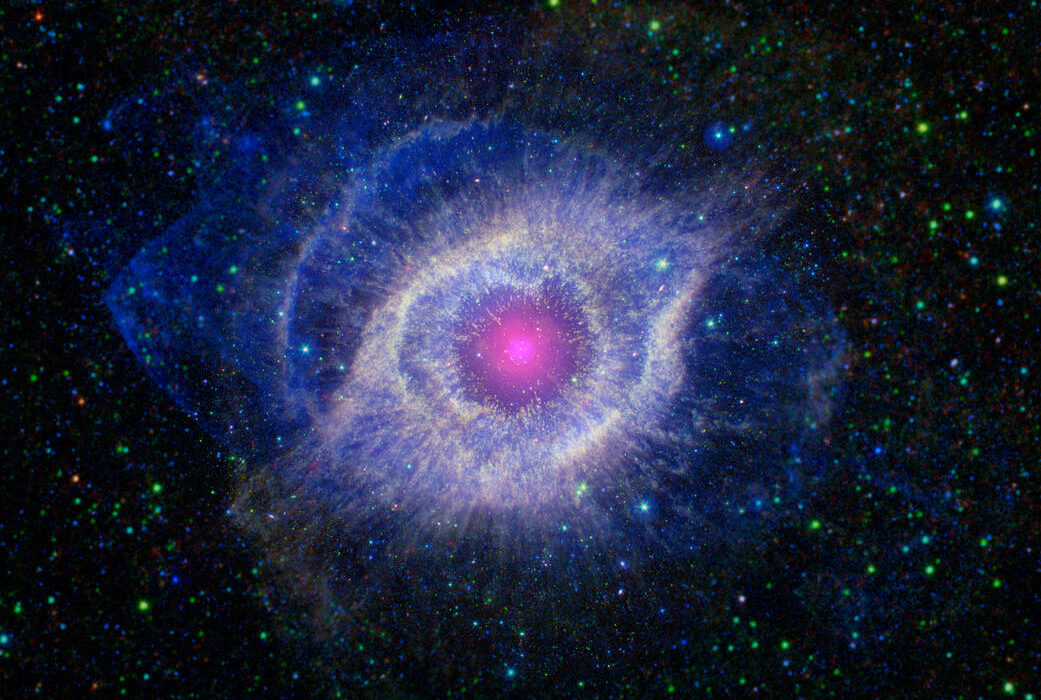
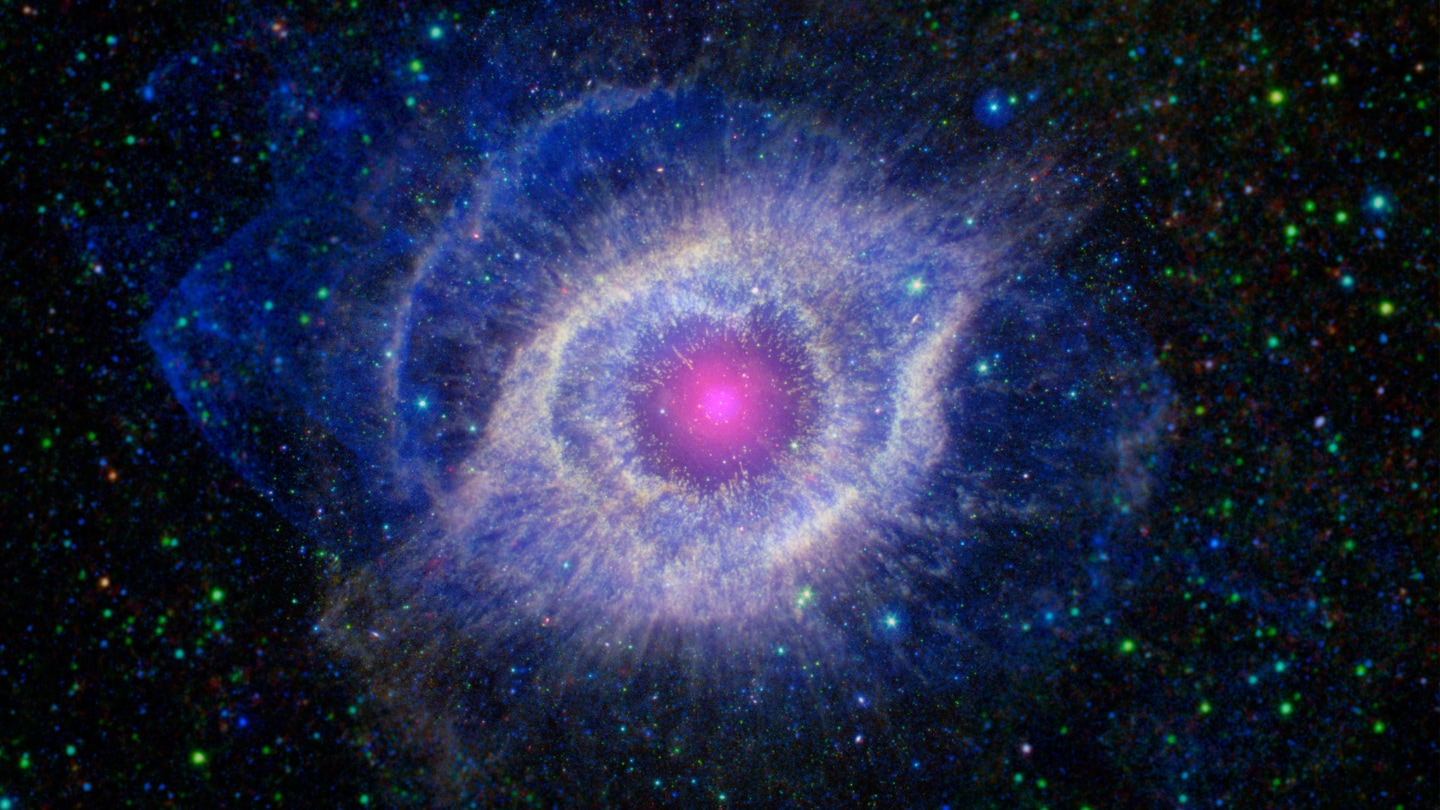
Eventually, the star sheds its outer layers completely, leaving behind a glowing shell of gas known as a planetary nebula. Despite the name, planetary nebulae have nothing to do with planets. Early astronomers used the term because these objects appeared round and planet-like through small telescopes.
At the center of the nebula lies the exposed core of the star, incredibly hot and intensely luminous. Ultraviolet radiation from this core excites the surrounding gas, causing it to glow in vivid colors. Each element emits light at specific wavelengths, creating intricate patterns of reds, blues, and greens.
Planetary nebulae are among the most visually stunning objects in the universe, yet they are fleeting. Over tens of thousands of years, the gas disperses into space, blending back into the interstellar medium.
This phase is a moment of cosmic revelation. The star’s hidden interior is briefly laid bare, illuminating the material it once held close. It is both an ending and a gift—a final act of creation before the star fades.
8. White Dwarf: The Quiet Remnant
What remains after the planetary nebula dissipates is a white dwarf, the dense core of the original star. Roughly the size of Earth but containing about half the mass of the Sun, a white dwarf is an object of astonishing density. A teaspoon of its material would weigh tons on Earth.
The white dwarf no longer undergoes nuclear fusion. It shines only because of residual heat, slowly cooling over billions of years. Supported by a quantum mechanical effect known as electron degeneracy pressure, it resists further collapse despite its immense gravity.
Over unimaginable spans of time, the white dwarf will cool and fade, eventually becoming a black dwarf—a cold, dark remnant. The universe is not old enough for any black dwarfs to exist yet, so white dwarfs remain as silent witnesses to ancient stellar lives.
Though the star itself is gone, its influence persists. The material it shed has enriched the galaxy. The energy it once radiated may have nurtured life. The white dwarf is not a failure or a corpse, but a monument to endurance and transformation.
The Meaning of a Star’s Life Cycle
The journey from nebula to white dwarf is not just an astronomical process; it is a story about change, balance, and impermanence. Stars are born from chaos, find stability, and eventually surrender to entropy. In doing so, they create the conditions for new stars, new worlds, and possibly new life.
Every atom heavier than hydrogen in your body was forged in stars like these. You are not merely looking at their story—you are part of it. The calcium in your bones, the oxygen you breathe, the iron in your blood all trace their origins to stellar evolution.
In understanding the life cycle of a star, we glimpse our own place in the universe. We are made of the remnants of ancient suns, living briefly in the light of one star, while the cosmos continues its endless cycle of birth, transformation, and quiet renewal.
From nebula to white dwarf, a star’s life is a reminder that even in the vastness of space, nothing is wasted. Everything changes, everything contributes, and everything, in some way, continues.