For most of human history, intelligence has been reserved for creatures with brains, eyes, and nervous systems. Plants, rooted in place and silent, were treated as passive backdrops to animal life—beautiful, useful, but fundamentally simple. Yet modern science has been quietly dismantling this assumption. Beneath their stillness, plants are sensing, communicating, remembering, and responding to the world in ways that challenge our definition of intelligence itself.
Plant intelligence does not look like human intelligence. There are no thoughts, no consciousness in the way we experience it, no deliberate planning. Instead, plant intelligence is decentralized, chemical, electrical, and exquisitely tuned to survival. It is slow by our standards but astonishingly effective. These organisms make decisions, solve problems, and adapt to changing environments without a brain at all.
Here are ten plants that reveal just how intelligent the green world truly is—and why rethinking plant life changes how we understand life itself.
1. The Venus Flytrap
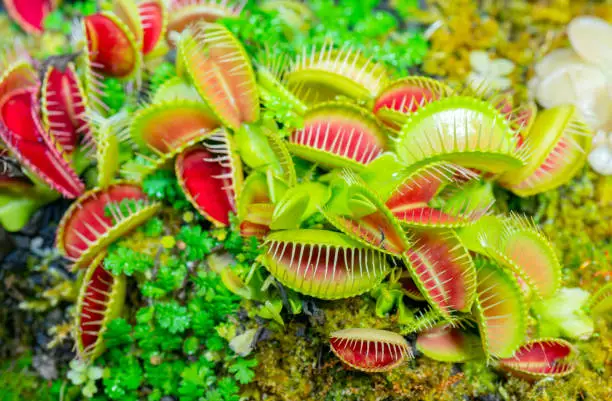
The Venus flytrap has become the iconic symbol of plant intelligence, and for good reason. This carnivorous plant does something that seems almost animal-like: it hunts. Native to nutrient-poor soils, the Venus flytrap compensates for its environment by capturing insects and digesting them for nitrogen and other essential nutrients.
What makes it intelligent is not merely the trap, but how the trap works. Each trap contains tiny trigger hairs. Touching one hair is not enough. The plant only closes if two hairs are triggered within a specific time window, or if the same hair is touched twice. This prevents the plant from wasting energy on raindrops or debris. It is a form of decision-making based on sensory input and timing.
Once closed, the trap does not immediately digest its prey. It waits, monitoring the movements inside. The more the insect struggles, the more digestive enzymes are released. If the movement stops too soon, the trap may reopen, having decided the prey is too small to be worth the effort. This is cost-benefit analysis without a brain, driven by electrical signals and chemical feedback.
The Venus flytrap demonstrates that intelligence does not require neurons. It requires the ability to sense, evaluate, and respond adaptively—and this plant does all three with eerie precision.
2. Mimosa Pudica (The Sensitive Plant)
Mimosa pudica looks unremarkable until it is touched. At the slightest disturbance, its leaves fold inward and droop as if collapsing in fear. This rapid movement, rare in the plant world, is a defense mechanism meant to deter herbivores by making the plant appear wilted and unappealing.
What elevates Mimosa pudica from curiosity to intelligence is its capacity for learning. Experiments have shown that when the plant is repeatedly dropped without harm, it eventually stops folding its leaves. It “learns” that the stimulus is not dangerous. Even more astonishing, this learned response can last for weeks, suggesting a form of memory.
This memory is not stored in neurons but in changes to cellular signaling pathways. The plant alters how it responds to repeated stimuli, conserving energy by ignoring harmless disturbances. That is learning in its most fundamental form.
Mimosa pudica reminds us that intelligence can be quiet and subtle. It doesn’t announce itself with dramatic displays but reveals itself through adaptation and restraint.
3. The Pea Plant
Pea plants may seem like humble agricultural staples, but they have surprised scientists with their problem-solving abilities. In controlled experiments, pea plants have demonstrated the ability to associate environmental cues with future outcomes, a behavior similar to associative learning in animals.
For example, pea plants exposed to a fan consistently paired with light began growing toward the fan even when the light was removed. The plant had learned to associate the airflow with the presence of light, adjusting its growth accordingly.
This behavior challenges the long-held belief that learning requires a nervous system. Instead, it suggests that plants can process information over time, recognize patterns, and modify future behavior based on past experience.
The intelligence of pea plants lies in their growth decisions. Growth is costly. Once a plant commits resources in a particular direction, it cannot easily undo that choice. The fact that pea plants can anticipate where resources will be and grow accordingly reveals a sophisticated internal assessment of risk and reward.
4. The Dodder Plant
Dodder is a parasitic plant that looks like a tangle of yellow-orange threads wrapped around its host. It lacks chlorophyll and cannot photosynthesize, so it must steal nutrients from other plants to survive. What makes dodder remarkable is how it chooses its victims.
Before attaching itself, dodder samples the air, detecting chemical signals emitted by nearby plants. It can distinguish between different species and preferentially target hosts that are more nutritious. Once attached, it reallocates growth toward the most rewarding parts of the host, abandoning less productive connections.
This behavior is not random. It reflects a form of chemical sensing and decision-making that maximizes survival. Dodder does not blindly latch onto the nearest plant. It assesses, selects, and adjusts its strategy based on environmental feedback.
In a world without eyes or ears, dodder demonstrates that intelligence can flow through chemistry, allowing plants to “smell” opportunity and danger with astonishing accuracy.
5. Sunflowers
Sunflowers are famous for their bright faces tracking the Sun across the sky, a behavior known as heliotropism. This movement is not just poetic—it is purposeful. By following the Sun during the day, young sunflowers maximize photosynthesis, fueling faster growth and greater reproductive success.
What is truly intelligent about sunflowers is how they coordinate this movement internally. The plant uses a circadian rhythm, an internal biological clock, to anticipate the Sun’s movement even on cloudy days. Growth hormones redistribute across the stem in response to light and time, bending the plant toward where the Sun will be, not just where it is.
As sunflowers mature, they stop tracking the Sun and permanently face east. This orientation helps warm the flowers in the morning, attracting pollinators earlier in the day. The plant’s behavior changes with age, optimizing different goals at different life stages.
Sunflowers reveal intelligence as timing, anticipation, and life-stage awareness—qualities we often associate only with animals.
6. The Mycorrhizal Network (Fungal-Plant Intelligence)
While not a single plant, the mycorrhizal network represents one of the most astonishing forms of plant intelligence on Earth. Beneath forests lies a vast underground web of fungi connecting the roots of trees and plants. This network allows plants to share nutrients, water, and chemical signals.
Through this system, plants can warn one another of pests, share carbon with struggling neighbors, and even support younger plants by redirecting resources. Older, larger trees—sometimes called “mother trees”—play a central role, distributing nutrients strategically throughout the network.
This is not altruism in a moral sense, but it is coordinated behavior that enhances ecosystem survival. Plants connected through mycorrhizae behave less like isolated individuals and more like parts of a distributed intelligence.
The network functions as a decentralized information system, processing environmental data across vast areas. It challenges the idea that intelligence must reside within a single organism. Here, intelligence emerges from connection.
7. The Pitcher Plant
Pitcher plants are carnivorous plants that lure insects into deep, fluid-filled cavities where they are digested. At first glance, they seem passive, relying on gravity and slippery surfaces. But closer inspection reveals a far more strategic organism.
Pitcher plants produce nectar with specific chemical compositions that attract certain insects while repelling others. Some even alter the viscosity of their digestive fluid depending on environmental conditions, ensuring prey remains trapped.
Certain species form symbiotic relationships with animals like bats or ants, providing shelter in exchange for nutrients. The plant adjusts its structure and chemistry to maintain these relationships, balancing predation and cooperation.
The intelligence of pitcher plants lies in their adaptability. They do not rely on a single strategy but adjust their behavior based on ecological context, demonstrating flexibility that is a hallmark of intelligent systems.
8. The Stinging Nettle
The stinging nettle is infamous for the painful reaction it causes when touched. Tiny needle-like hairs inject a cocktail of chemicals that produce burning, itching, and inflammation. This defense mechanism is highly effective against herbivores.
What makes the nettle intelligent is how targeted this response is. The plant does not waste energy on constant chemical release. The sting is activated only when mechanical pressure breaks the fragile tip of the hair, triggering chemical injection.
Even more intriguingly, nettles can alter their chemical composition based on environmental stress. Plants exposed to frequent grazing can increase the potency of their stings, effectively “learning” that their environment is dangerous.
This dynamic defense system reflects a sophisticated assessment of risk, showing that plants can fine-tune their responses rather than relying on static defenses.
9. Orchids
Orchids are masters of deception. Some species have evolved flowers that mimic the appearance, texture, and even scent of female insects. Male insects attempt to mate with the flower, inadvertently pollinating it in the process.
This is not simple mimicry but highly specialized manipulation. Orchids produce precise chemical signals that exploit the sensory biases of their pollinators. Some species even adjust their flowering time and scent profile to match local insect populations.
The intelligence of orchids lies in their evolutionary problem-solving. Pollination is a challenge, and orchids have solved it not through brute force but through psychological manipulation of another species.
They reveal that intelligence can operate across generations, encoded in form and chemistry rather than thought.
10. The Boquila Trifoliolata (The Shape-Shifting Vine)
Perhaps the most mind-bending example of plant intelligence is Boquila trifoliolata, a vine native to South America. This plant can mimic the leaves of the host plant it climbs, altering its shape, size, color, and vein pattern to match its surroundings.
What makes this astonishing is that Boquila can mimic multiple host species, even when no physical contact exists between the vine and the model plant. This suggests the plant is detecting chemical or visual cues in ways scientists do not yet fully understand.
By blending in, the vine reduces the risk of being eaten by herbivores that recognize specific leaf shapes. This is camouflage without eyes, perception without a brain.
Boquila trifoliolata forces us to confront how limited our understanding of plant sensing truly is. Its behavior suggests forms of environmental awareness that stretch the boundaries of current science.
Rethinking Intelligence Through Plants
These ten plants reveal a profound truth: intelligence is not a single trait but a spectrum of abilities. Sensing, learning, memory, communication, anticipation, and adaptation can exist without consciousness or neurons. Plants embody a different kind of intelligence—one that is slower, quieter, but deeply integrated with the environment.
Recognizing plant intelligence does not mean anthropomorphizing them. It means expanding our understanding of life’s possibilities. Plants solve problems under constraints vastly different from ours, yet their solutions are elegant, efficient, and often astonishingly effective.
In a world facing ecological crisis, this realization matters. When we see plants as intelligent participants in ecosystems rather than passive resources, our relationship with the natural world begins to shift. Respect replaces dominance. Curiosity replaces indifference.
The green world beneath our feet is not asleep. It is thinking—just not in a language we were taught to hear.