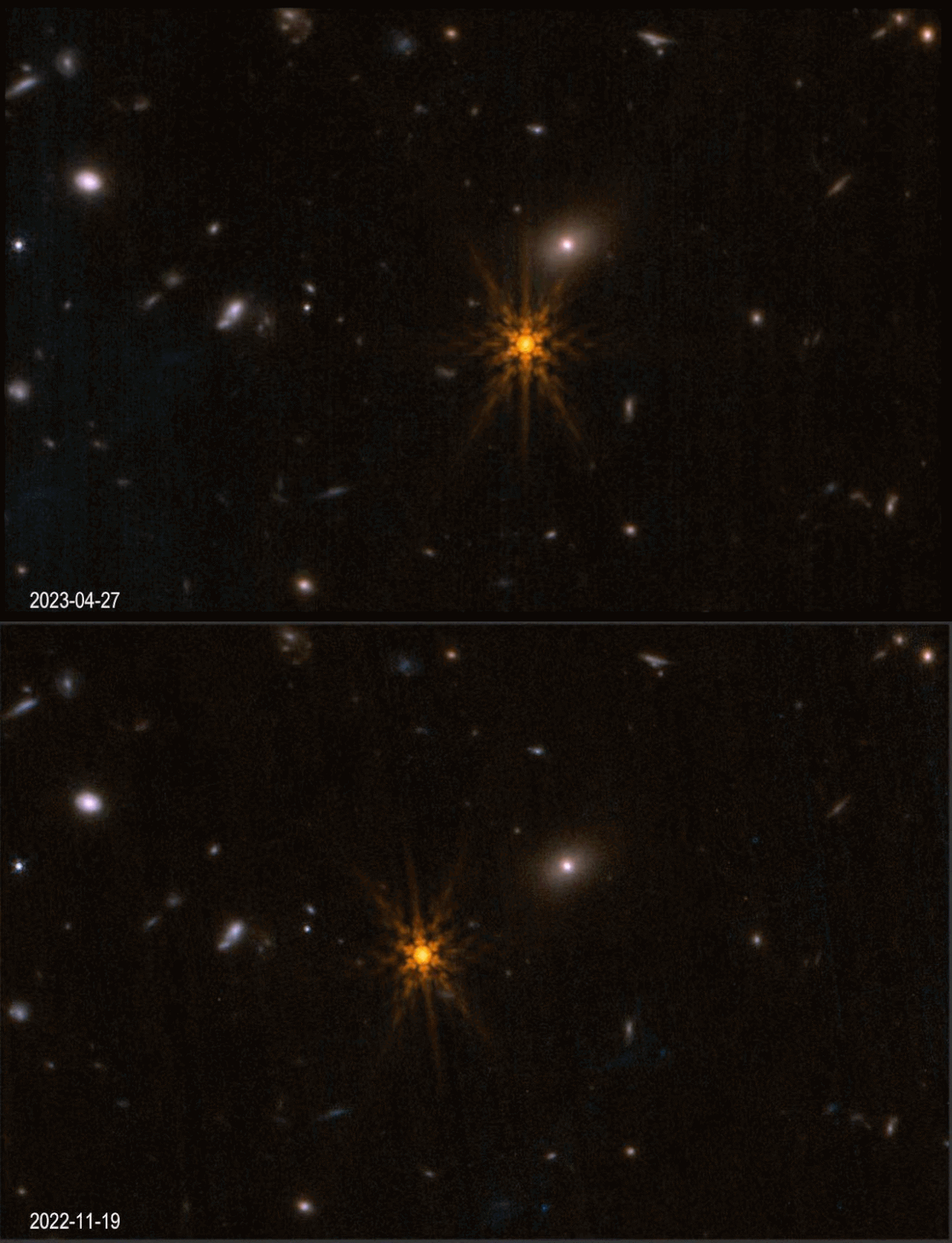
The universe is not as orderly as it sometimes appears. Our solar system seems calm and predictable: planets orbit the Sun in stable paths, comets follow long but calculable trajectories, and the stars appear fixed in the sky. Yet beyond this comforting structure lies a darker, far more chaotic reality. Throughout the galaxy drift countless planetary bodies that belong to no star at all. These are rogue planets—worlds that wander through interstellar space, invisible and cold, traveling alone through the cosmic darkness.
Unlike Earth, Mars, or Jupiter, rogue planets do not circle a sun. Many were once part of planetary systems but were violently ejected by gravitational chaos. Others may have formed independently from collapsing gas clouds that never grew massive enough to ignite as stars. Estimates suggest that the Milky Way could contain billions of these wandering planets, possibly even more than the number of stars.
Most of them will forever remain distant travelers, drifting silently through the galaxy. But astronomy teaches us an unsettling truth: space is vast, yet not empty. Objects move. Orbits shift. Gravitational interactions reshape cosmic landscapes over millions and billions of years. In rare circumstances, a rogue planet could pass dangerously close to a star system like ours. If the trajectory were unfortunate enough, such a world could disturb planetary orbits—or in the most catastrophic scenario, collide with a planet.
Astronomers track potential threats from asteroids and comets within our solar system. Rogue planets, however, are far more difficult to detect. They emit little or no light. Many are only visible through faint infrared radiation or subtle gravitational effects.
While the probability of a rogue planet crashing into Earth is extraordinarily small, the possibility cannot be dismissed entirely over cosmic timescales. Scientists have already identified several rogue or near-rogue planetary objects traveling through space, some relatively close in astronomical terms.
These seven wandering worlds represent some of the most fascinating—and unsettling—examples of rogue planets that remind us how dynamic and unpredictable the universe can be.
1. OTS 44 — A Lonely Planet in the Darkness
One of the most intriguing rogue planets ever discovered is OTS 44, a free-floating planetary object located in a star-forming region known as the Chamaeleon I molecular cloud.
OTS 44 has a mass roughly eleven times that of Jupiter, placing it near the boundary between planets and brown dwarfs. What makes this object particularly fascinating is that it appears to have formed in a similar way to stars, collapsing from a cloud of gas rather than forming within a protoplanetary disk around a star.
Observations using infrared telescopes revealed that OTS 44 is surrounded by a disk of gas and dust. This discovery stunned astronomers because disks are typically associated with young stars that form planets around them. Yet here was a planetary-mass object with its own miniature disk, suggesting that even rogue planets may host complex formation processes.
Though OTS 44 lies hundreds of light-years away and poses absolutely no danger to Earth, its existence reveals something profound: planetary-mass objects can exist entirely independent of stars. The galaxy may be filled with such wandering worlds.
If enough of them drift through interstellar space, the odds that some could pass through star systems—including ours—become nonzero.
2. PSO J318.5−22 — A Planet Without a Sun
PSO J318.5−22 is one of the closest known rogue planets to Earth, located about eighty light-years away in the constellation Capricornus. Discovered in 2013, this mysterious object has a mass about six times that of Jupiter.
What makes PSO J318.5−22 remarkable is that it appears very similar to giant exoplanets observed orbiting distant stars—except it has no star of its own. It drifts freely through space, glowing faintly from residual heat left over from its formation.
Astronomers believe this object may have been ejected from its original planetary system millions of years ago. Gravitational interactions between massive planets can create chaotic conditions that fling one world into interstellar exile.
PSO J318.5−22 travels through the galaxy as a solitary wanderer. Although it is extremely unlikely ever to approach our solar system closely, its existence demonstrates that planetary ejections are a real and common process in the cosmos.
Our solar system itself may have experienced violent gravitational rearrangements early in its history. Some models suggest that a fifth giant planet could have once existed before being thrown out into deep space.
If that is true, our Sun may have created rogue planets of its own long ago.
3. WISE 0855−0714 — The Coldest Known Rogue Planet
Among the most mysterious objects in the solar neighborhood is WISE 0855−0714, a frigid rogue planet located just over seven light-years from Earth. That makes it one of the closest known planetary-mass objects beyond our solar system.
This object is incredibly cold by cosmic standards. Its temperature is estimated to be around minus 48 degrees Celsius, comparable to the coldest regions of Earth’s polar environments. In astronomical terms, that is astonishingly chilly.
WISE 0855−0714 emits almost no visible light, making it extremely difficult to observe. Astronomers detect it primarily through infrared radiation—the faint heat signature of its atmosphere.
Despite its proximity, this object remains enigmatic. Its mass is thought to be between three and ten times that of Jupiter, but its exact classification is debated. Some scientists consider it a rogue planet, while others think it may be an extremely low-mass brown dwarf.
Although WISE 0855−0714 poses no threat to Earth, it reminds us that massive planetary objects can drift surprisingly close to our solar system without being easily noticed.
If a similar object were traveling on a collision course with the inner solar system, detecting it early enough could prove extremely challenging.
4. CFBDSIR 2149−0403 — A Planet on the Move
CFBDSIR 2149−0403 is another fascinating rogue planetary candidate drifting through interstellar space roughly one hundred light-years from Earth.
This object has a mass estimated between four and seven times that of Jupiter and appears to be relatively young in astronomical terms. Observations suggest it may once have belonged to a stellar association—a loose group of stars born from the same molecular cloud.
If that is the case, gravitational interactions likely ejected it from its birthplace, sending it wandering alone through the galaxy.
Astronomers have studied its atmosphere using spectroscopy, revealing clouds and chemical compounds similar to those found in gas giant planets. These atmospheric studies help scientists understand how planets behave without the influence of nearby stars.
CFBDSIR 2149−0403 demonstrates how planetary systems can become unstable. A single gravitational disturbance—perhaps from a passing star or a massive neighboring planet—can launch entire worlds into the void.
Given billions of years and countless planetary systems, such ejections must happen frequently across the Milky Way.
5. SIMP J01365663+0933473 — A Rapidly Rotating Drifter
One of the most unusual rogue planets discovered so far is SIMP J01365663+0933473. Located about twenty light-years from Earth, this object has drawn intense interest because of its rapid rotation and dynamic atmosphere.
SIMP J01365663+0933473 rotates extremely quickly—completing a full rotation in just a few hours. This rapid spin drives enormous atmospheric storms, similar in scale to the giant weather systems seen on Jupiter but likely far more powerful.
Infrared observations reveal dramatic changes in brightness as clouds swirl across its atmosphere. These variations allow astronomers to study weather patterns on a world that orbits no star.
While SIMP J01365663+0933473 is unlikely ever to come near Earth, its existence shows that rogue planets can be dynamic environments rather than frozen, lifeless rocks.
They may possess storms, magnetic fields, and internal heat sources that keep them geologically active even in the darkness of interstellar space.
6. Cha 110913−773444 — A Planetary Outcast
Cha 110913−773444 is a planetary-mass object found in the Chamaeleon star-forming region. With a mass roughly eight times that of Jupiter, it exists right at the boundary between planets and brown dwarfs.
Like OTS 44, this object appears to possess a disk of dust and gas, suggesting that planetary-mass bodies can form complex systems of their own.
The presence of such disks raises fascinating questions. Could moons form around rogue planets? Could small bodies orbit them in miniature solar systems drifting through space?
Cha 110913−773444 also provides insight into how rogue planets might form directly from collapsing gas clouds rather than being ejected from planetary systems.
If both formation mechanisms are common, then rogue planets may be extraordinarily abundant.
Some estimates suggest there could be trillions of them in the Milky Way.
7. The Hypothetical Planet Nine
Among the most intriguing potential rogue worlds connected to our solar system is the hypothetical Planet Nine.
Planet Nine has not yet been directly observed, but multiple lines of evidence suggest that a massive unseen planet may lurk in the distant outer reaches of the solar system. Its estimated mass could be five to ten times that of Earth, orbiting far beyond Neptune on an elongated path.
The idea emerged after astronomers noticed unusual clustering in the orbits of distant Kuiper Belt objects. Their trajectories appear influenced by the gravity of a large, unseen body.
If Planet Nine exists, it may not be a traditional rogue planet today—but it could have originated as one. Some theories suggest it formed around another star and was later captured by the Sun’s gravity during the early days of the solar system.
Alternatively, it may have formed near the giant planets and been flung outward into a distant orbit.
In either case, Planet Nine represents a reminder that planetary systems can exchange worlds through gravitational interactions.
Cosmic neighborhoods are not as isolated as they may appear.
The Real Risk of Rogue Planet Collisions
The idea of a rogue planet crashing into Earth sounds like science fiction, but physics allows the possibility. Fortunately, the probability is extraordinarily small.
The distances between stars are immense, and the volume of space is vast. Even if rogue planets are common, the chances of one intersecting the inner solar system in a catastrophic way are extremely low.
However, if such an event occurred, the consequences would be unimaginable. A planet-sized impact would release energy far beyond anything humanity has ever experienced.
More likely scenarios involve gravitational disturbances rather than direct collisions. A rogue planet passing through the outer solar system could disrupt the orbits of comets and asteroids, sending them inward toward the Sun.
Such disturbances could potentially trigger waves of impacts across the inner planets.
Fortunately, the timescales for such events span millions or billions of years.
The Hidden Population of the Galaxy
Modern astronomical surveys suggest that rogue planets may be incredibly common. Some studies indicate that the Milky Way might contain as many rogue planets as stars—or possibly even more.
These worlds wander unseen through the darkness, illuminated only by faint internal heat or reflected starlight when they pass near stellar systems.
Many may carry frozen oceans beneath icy crusts, warmed by internal heat. Some might even host microbial life in isolated subsurface environments.
If so, the galaxy could be filled with hidden ecosystems drifting silently between the stars.
The Cosmic Perspective
The discovery of rogue planets has transformed our understanding of planetary systems. The orderly model of planets calmly orbiting their stars has given way to a more chaotic vision of cosmic evolution.
Planets can migrate, collide, and be ejected into interstellar space. Gravitational encounters can reshape entire systems. Worlds can be born, lost, or captured.
Our solar system, stable though it appears today, is part of this dynamic cosmic environment.
Somewhere in the vast darkness between the stars, countless rogue planets drift alone—silent travelers in a galaxy filled with motion.
Most will never encounter another star. Most will wander forever through the cold void.
But their existence reminds us of a profound truth: the universe is not static, and even planets can become nomads.
In that realization lies both wonder and unease, a reminder that our place in the cosmos is far more dynamic—and mysterious—than we once imagined.