For most of human history, the Sun has been seen as a symbol of warmth, life, and stability. It rises every morning with comforting predictability, bathing the Earth in light and energy that sustains plants, animals, and civilizations. Without the Sun, life on Earth would not exist.
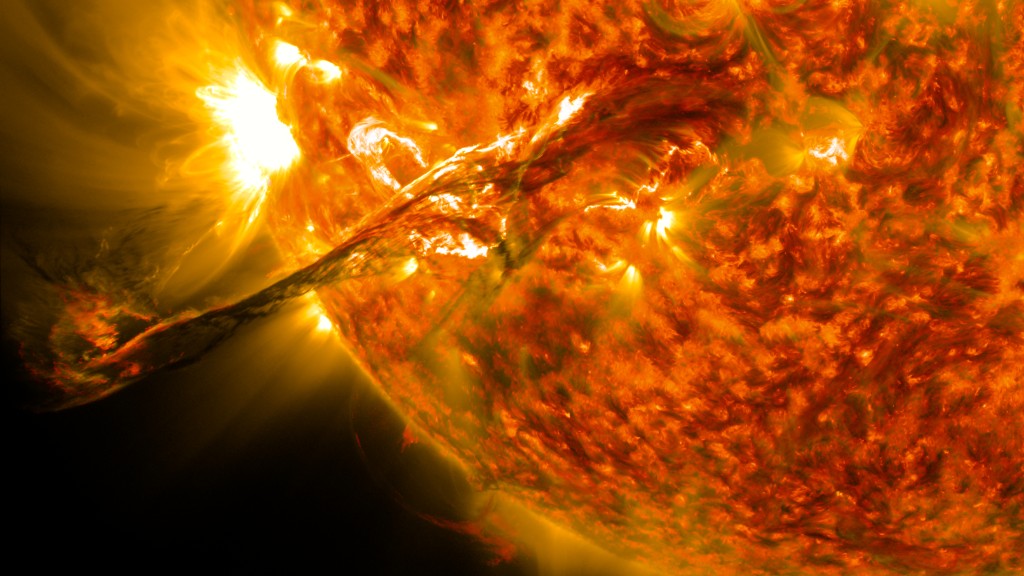
Yet the Sun is not a gentle lantern hanging in the sky. It is a colossal, violent nuclear furnace—an immense sphere of plasma nearly 1.4 million kilometers wide, where temperatures reach millions of degrees and magnetic forces twist and snap with unimaginable power. Beneath its calm golden glow lies a restless engine capable of unleashing storms so powerful they can shake the very technological foundations of human civilization.
Solar storms are eruptions of energy and charged particles from the Sun. When directed toward Earth, they interact with our planet’s magnetic field and atmosphere, producing dazzling auroras but also potentially catastrophic consequences. In extreme cases, these storms can disrupt satellites, disable power grids, damage communication systems, and cripple the digital infrastructure upon which modern society depends.
Scientists know that such events have happened before—and they will happen again. Some solar storms have been so powerful that if they occurred today, they could shut down global electricity networks, destroy satellites, collapse internet systems, and plunge technologically dependent societies into chaos.
Below are seven solar storms—some historical, some hypothetical but scientifically plausible—that reveal just how vulnerable our civilization may be to the Sun’s explosive temper.
1. The Carrington Event of 1859
The most powerful solar storm ever recorded occurred in September 1859. Known as the Carrington Event, it remains the benchmark against which all other solar storms are measured.
The event began when astronomer Richard Carrington observed an intense flash of light on the surface of the Sun—a massive solar flare. Within hours, an enormous coronal mass ejection, or CME, blasted toward Earth. When the cloud of magnetized plasma struck our planet’s magnetic field, it triggered the most extreme geomagnetic storm ever documented.
Auroras appeared across the globe in places where they had never been seen before. The northern lights glowed over Cuba, Hawaii, and the Caribbean. In parts of North America, the night sky became so bright that people could read newspapers outdoors at midnight.
But the real impact was on the technology of the era: telegraph systems. Electrical currents induced in telegraph wires caused sparks to leap from equipment, shocking operators and setting paper on fire. Some telegraph systems continued to transmit messages even after their power supplies were disconnected, powered solely by geomagnetic currents flowing through the lines.
In 1859, humanity had only a few electrical technologies. If a storm of similar strength struck today, the consequences would be far more severe. Modern power grids could collapse, satellites could fail, GPS systems could be disabled, and communication networks could break down.
Estimates suggest that a modern Carrington-level event could cause trillions of dollars in damage and take years to recover from fully.
2. The Solar Storm of 1921
Another major geomagnetic storm struck Earth in May 1921. Though less famous than the Carrington Event, it was still extremely powerful and caused significant technological disruptions.
At the time, electrical infrastructure had expanded far beyond telegraph lines. Railways, telephone systems, and early power grids were now part of everyday life. When the solar storm struck, electrical currents surged through these systems.
Telegraph service across large parts of the United States and Europe was severely disrupted. Fires reportedly broke out in telegraph stations, including a major fire at a railway control tower in New York. Long-distance communication lines experienced massive interference.
Auroras were observed as far south as Texas. Magnetic disturbances were so strong that instruments measuring Earth’s magnetic field were pushed beyond their recording limits.
Had a storm of this magnitude occurred in the modern era—with our dependence on satellites, computers, and vast electrical networks—the damage could have been enormous.
The 1921 event served as a warning that the Sun is capable of producing repeated extreme storms, not just one extraordinary event in history.
3. The Near-Miss Solar Superstorm of 2012
In July 2012, Earth narrowly avoided what could have been one of the most devastating solar storms in modern history.
On July 23, the Sun unleashed an enormous coronal mass ejection traveling at extraordinary speed. The eruption carried a massive cloud of magnetized plasma capable of producing an extreme geomagnetic storm.
Fortunately for Earth, the storm was not directed toward our planet. Instead, it passed through the orbit Earth had occupied about a week earlier. Had the eruption occurred just days sooner, the CME would have slammed directly into Earth’s magnetosphere.
Later analysis by scientists suggested that the storm had characteristics comparable to the Carrington Event. If it had struck Earth, it might have triggered widespread power grid failures, satellite destruction, and global communication disruptions.
Modern civilization depends heavily on space-based infrastructure. Hundreds of satellites provide navigation, internet connectivity, weather forecasting, and financial synchronization. A severe solar storm could damage many of these systems simultaneously.
The 2012 near miss was a sobering reminder. The Sun is still capable of producing storms powerful enough to threaten modern technological society.
4. The Quebec Blackout of 1989
On March 13, 1989, a solar storm demonstrated how vulnerable modern electrical infrastructure can be.
A powerful CME struck Earth’s magnetic field, generating geomagnetically induced currents that flowed through power lines and transformers. In the Canadian province of Quebec, these currents overwhelmed the electrical grid.
Within seconds, the entire province experienced a massive blackout. Six million people lost power in the middle of winter. The outage lasted for nine hours, but the event caused serious concern among scientists and engineers.
Transformers are particularly vulnerable to geomagnetic currents because they are designed for steady alternating currents, not unpredictable surges from space weather. If enough transformers fail simultaneously, replacement becomes extremely difficult. Large transformers are custom-built and can take months or even years to manufacture.
The Quebec blackout was relatively mild compared to what a stronger storm could do. Yet it demonstrated that space weather can reach deep into terrestrial infrastructure.
5. The Hypothetical Superflare Scenario
While the Sun produces regular solar flares and coronal mass ejections, astronomers studying other stars have discovered something far more powerful: superflares.
Superflares are enormous stellar eruptions releasing hundreds or even thousands of times more energy than typical solar flares. Observations of Sun-like stars suggest that such events may occur rarely, but they are not impossible.
If the Sun were to produce a true superflare directed at Earth, the consequences could be catastrophic. Satellite systems could be destroyed outright. Power grids across continents could fail simultaneously. Radiation could damage spacecraft and pose serious risks to astronauts.
Even Earth’s upper atmosphere could be affected. Increased radiation might alter atmospheric chemistry and damage ozone layers temporarily.
Scientists believe the probability of a solar superflare is extremely low, but the possibility cannot be entirely ruled out. In cosmic terms, even rare events eventually occur.
6. The Global Satellite Collapse Scenario
Modern civilization relies on satellites more than most people realize. Navigation systems, telecommunications, banking networks, weather prediction, military operations, and internet services all depend on space-based technology.
A powerful solar storm could flood near-Earth space with energetic particles capable of damaging satellite electronics and solar panels. Increased atmospheric drag during geomagnetic storms can also pull satellites out of orbit prematurely.
In recent years, smaller solar storms have already caused satellite malfunctions and orbital losses. A sufficiently large storm could disable dozens or even hundreds of satellites simultaneously.
Without satellites, GPS navigation would fail. Aircraft routing would become difficult. Ships crossing oceans would lose positioning systems. Financial networks that rely on precise timing signals could experience disruptions.
The invisible infrastructure orbiting our planet forms a delicate web. Solar storms have the potential to tear through it.
7. The Global Power Grid Collapse Scenario
Perhaps the most frightening scenario involves a massive geomagnetic storm overwhelming power grids across multiple continents.
Electrical grids are interconnected networks of generators, transformers, and transmission lines. Long conductive lines can act like antennas during geomagnetic storms, allowing currents induced by solar activity to flow into the grid.
If a storm stronger than the 1989 Quebec event struck today, it could cause transformers to overheat and fail across large regions. Because these components are expensive and difficult to replace, recovery could take months or even years.
Without electricity, modern civilization quickly grinds to a halt. Water treatment plants stop functioning. Refrigeration fails. Hospitals lose critical equipment. Communication networks collapse.
The ripple effects would spread through every sector of society. Transportation systems, food distribution networks, and emergency services would struggle to operate.
In extreme cases, large populations could face prolonged blackouts lasting weeks or months.
Why Solar Storms Are So Dangerous Today
In earlier centuries, solar storms created beautiful auroras and disrupted primitive communication systems. Today, the stakes are far higher.
Our civilization depends on a fragile technological ecosystem built on electricity, electronics, and satellite networks. The digital world, the internet, global trade, financial systems, and even basic infrastructure rely on stable power and communication.
Solar storms represent one of the few natural phenomena capable of simultaneously affecting space-based systems and ground-based electrical infrastructure on a global scale.
Unlike earthquakes or hurricanes, which are localized, extreme solar storms can impact the entire planet at once.
How Scientists Are Preparing
Fortunately, scientists and engineers are actively studying space weather to better understand and mitigate these risks.
Spacecraft such as solar observatories continuously monitor the Sun for signs of eruptions. When solar flares or coronal mass ejections occur, scientists can track their trajectory and estimate when they might reach Earth.
In some cases, this provides several hours or even days of warning. Power grid operators can temporarily reduce loads, reconfigure systems, or shut down vulnerable components to minimize damage.
New satellite designs incorporate better radiation shielding. Researchers are also developing improved forecasting models for solar activity.
While these measures cannot eliminate the risk entirely, they can significantly reduce the potential damage from major solar storms.
Living Under a Variable Star
The Sun has sustained life on Earth for billions of years. It powers photosynthesis, drives weather patterns, and stabilizes the climate. Yet it is also a dynamic star capable of violent eruptions.
Solar storms remind us that our planet exists within a larger cosmic environment. Space is not empty. It is filled with magnetic fields, energetic particles, and radiation that can interact with Earth in powerful ways.
As humanity becomes increasingly dependent on advanced technology, understanding and preparing for space weather becomes ever more important.
We often imagine cosmic threats as distant asteroids or exotic gamma-ray bursts from faraway galaxies. But one of the most powerful forces capable of disrupting our civilization lies only 150 million kilometers away.
Every sunrise reminds us of the Sun’s life-giving power. Hidden within that same glowing sphere is a potential for storms that could reshape the modern world in a matter of hours.
The challenge for our species is simple but profound: to learn enough about our star that we can live safely beneath its brilliance without being caught unprepared when it unleashes its fury.