The universe often appears calm when viewed from Earth. Stars twinkle softly in the night sky, galaxies drift slowly through cosmic space, and planets orbit their stars with elegant precision. But this peaceful appearance hides a violent reality. Across the cosmos, unimaginable forces are constantly at work—collisions of stars, the collapse of massive suns, and the formation of black holes.
Among the most terrifying of all cosmic phenomena are gamma-ray bursts, often abbreviated as GRBs. These events are the most powerful explosions known in the universe since the Big Bang itself. In just a few seconds, a gamma-ray burst can release more energy than our Sun will produce during its entire 10-billion-year lifetime.
Gamma rays are the most energetic form of electromagnetic radiation. They carry enormous power, capable of penetrating matter and altering atomic structures. When a gamma-ray burst erupts somewhere in the distant universe, its radiation travels across billions of light-years at the speed of light.
Most of these bursts occur far away, posing no threat to Earth. Yet their sheer scale and power reveal something unsettling: the universe is capable of violence beyond anything we can truly imagine. These events remind us that cosmic beauty often hides extreme danger.
Below are fifteen scientifically grounded yet deeply unsettling facts about gamma-ray bursts—phenomena so powerful that they can reshape entire regions of space.
1. Gamma-Ray Bursts Are the Most Powerful Explosions in the Universe
Gamma-ray bursts hold a terrifying title: they are the most energetic explosions known in the observable universe, second only to the Big Bang itself.
When a GRB occurs, it releases an enormous amount of energy in the form of gamma radiation. In a matter of seconds, the burst can emit as much energy as our Sun will radiate over its entire lifetime of billions of years.
To grasp the scale of this power, imagine converting a large portion of a star’s mass directly into pure energy. According to Einstein’s equation (E = mc^2), even a tiny amount of mass can produce staggering energy when converted fully.
Gamma-ray bursts essentially unleash that principle on a cosmic scale. The explosion releases a focused beam of radiation so intense that it can briefly outshine the entire galaxy in which it occurs.
For a few fleeting moments, a single dying star can become brighter than hundreds of billions of others combined.
2. They Can Be Seen Across the Entire Observable Universe
Despite occurring billions of light-years away, gamma-ray bursts are still detectable by instruments orbiting Earth.
This is because their energy output is so enormous that their radiation can travel across the entire observable universe. Satellites designed to detect gamma rays regularly observe bursts from distances exceeding 10 billion light-years.
In fact, some of the most distant objects ever detected by humans were gamma-ray bursts. Their light began traveling toward us when the universe was still extremely young.
These bursts act like cosmic beacons from the deep past. They illuminate regions of the universe that would otherwise remain invisible.
The fact that an explosion on the other side of the universe can still reach our detectors reveals just how unimaginably powerful these events truly are.
3. A Single Burst Can Last From Milliseconds to Several Minutes
Gamma-ray bursts are not all the same. Scientists classify them into two major categories: short bursts and long bursts.
Short bursts typically last less than two seconds, sometimes only a few milliseconds. Long bursts can continue for several seconds or even minutes.
Despite the brief duration, these events release enormous energy during their short lifetimes. It is like compressing the power of billions of years into the blink of an eye.
The difference in duration reflects different physical origins. Short bursts are thought to arise from the collision of neutron stars, while long bursts usually occur when massive stars collapse into black holes.
Regardless of their cause, the burst itself is only the beginning. After the initial flash, a fading afterglow can linger across multiple wavelengths—from X-rays to radio waves—for days or weeks.
4. They Are Often Born When Massive Stars Collapse Into Black Holes
One of the most dramatic origins of a gamma-ray burst occurs when a massive star reaches the end of its life.
Stars much larger than our Sun burn through their nuclear fuel quickly. When fusion in the core stops producing enough pressure to counteract gravity, the star collapses catastrophically.
In some cases, the collapsing core forms a black hole. As matter spirals inward at incredible speeds, enormous amounts of energy are released.
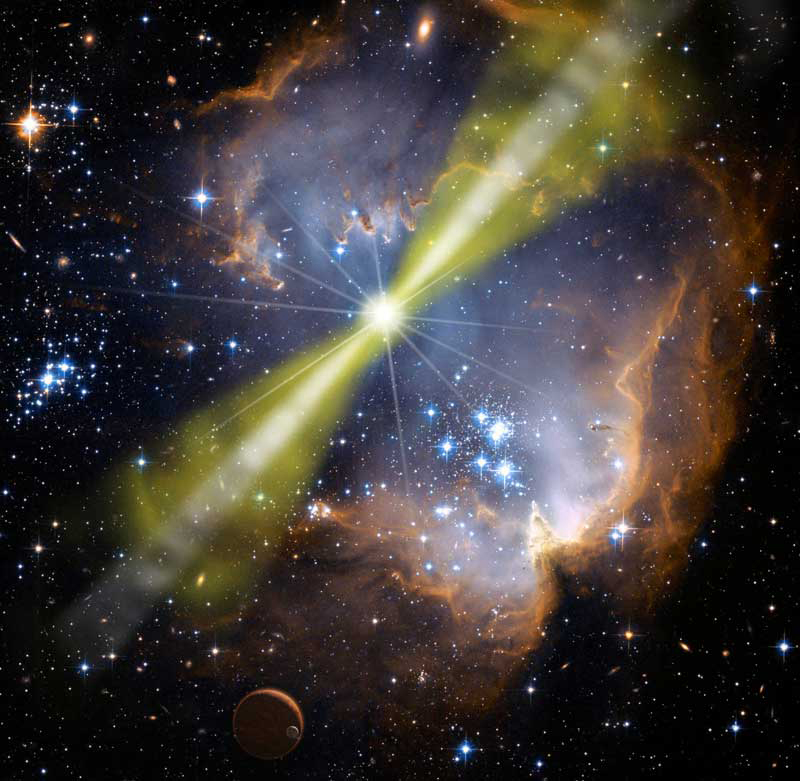
Two narrow jets of gamma radiation shoot out from the poles of the collapsing star at nearly the speed of light. If one of those jets happens to point toward Earth, we detect it as a gamma-ray burst.
This process is sometimes called a collapsar event. It represents one of the most violent deaths a star can experience.
5. Neutron Star Collisions Can Also Produce Gamma-Ray Bursts
Not all gamma-ray bursts originate from collapsing stars. Some occur when two neutron stars collide.
Neutron stars are incredibly dense remnants of supernova explosions. A single teaspoon of neutron star material would weigh billions of tons on Earth.
When two neutron stars orbit each other in a binary system, they gradually spiral inward as they lose energy through gravitational waves. Eventually they collide.
The collision produces a violent explosion that ejects matter at relativistic speeds and creates a brief but intense gamma-ray burst.
These events are also responsible for producing many heavy elements in the universe, including gold and platinum.
In other words, the jewelry we wear may have been forged in the aftermath of cosmic collisions powerful enough to shake the fabric of spacetime.
6. The Radiation Travels at Nearly the Speed of Light
The jets produced by gamma-ray bursts are among the fastest-moving structures in the universe.
Material in these jets moves at speeds extremely close to the speed of light—more than 99.99 percent of light speed.
At such velocities, strange effects predicted by Einstein’s theory of relativity begin to dominate. Time dilation, relativistic beaming, and extreme energy amplification occur.
Because the radiation is tightly focused into narrow beams, the observed brightness can be enormously amplified if the beam is directed toward Earth.
This relativistic focusing makes gamma-ray bursts appear even more powerful than they already are.
7. If One Occurred Close to Earth, It Could Devastate Our Planet
Most gamma-ray bursts occur far away, safely beyond our galactic neighborhood. But if one happened close enough and its jet pointed directly at Earth, the consequences could be catastrophic.
A burst occurring within a few thousand light-years could severely damage our planet’s atmosphere.
The intense gamma radiation would break apart nitrogen and oxygen molecules in the upper atmosphere, leading to the formation of nitrogen oxides. These chemicals could destroy much of the ozone layer.
Without the protective ozone shield, harmful ultraviolet radiation from the Sun would reach the surface in large quantities.
This could trigger mass extinctions across ecosystems.
Some scientists have even proposed that a gamma-ray burst may have contributed to extinction events in Earth’s distant past.
8. They Produce Afterglows Across the Electromagnetic Spectrum
After the initial flash of gamma radiation, the explosion does not simply disappear.
As the relativistic jets slam into surrounding gas and dust, they create shock waves that emit radiation across many wavelengths.
This radiation forms what astronomers call an afterglow. It can appear in X-rays, visible light, infrared, and radio waves.
These afterglows gradually fade over time but provide crucial information about the environment around the burst and the physics of the explosion.
Through these fading signals, astronomers reconstruct the story of one of the most violent events in the cosmos.
9. They Help Scientists Study the Early Universe
Because gamma-ray bursts are so bright, they can be detected from extremely distant galaxies.
Their light passes through vast regions of intergalactic space before reaching Earth. Along the way, it carries information about the gas and matter it encounters.
By studying the absorption patterns in GRB afterglows, astronomers can investigate the composition of the early universe.
In this way, gamma-ray bursts act as cosmic flashlights illuminating ancient galaxies that formed billions of years ago.
They allow scientists to study epochs of cosmic history that would otherwise remain hidden.
10. Some Bursts Release Energy Equal to Several Supernovae
A typical supernova is already one of the most powerful explosions a star can produce.
Yet some gamma-ray bursts release even more energy—sometimes comparable to the combined output of several supernova explosions.
This extraordinary energy is concentrated into narrow jets rather than spreading evenly in all directions.
The focused nature of the blast means that the energy density along the jet’s path can be unimaginably intense.
Wherever that beam travels, the surrounding region of space is transformed by radiation and shock waves.
11. Gamma Rays Are the Most Dangerous Type of Light
Gamma rays occupy the highest-energy end of the electromagnetic spectrum.
Their wavelengths are extremely short and their photon energies extremely high. This allows them to penetrate deeply into matter and ionize atoms.
On Earth, gamma radiation is associated with nuclear reactions and radioactive decay.
In cosmic environments, gamma rays originate from the most extreme processes in nature.
When produced in a gamma-ray burst, they become a torrent of radiation powerful enough to alter entire planetary atmospheres.
12. They Were Discovered Accidentally
Gamma-ray bursts were first detected in the late 1960s by satellites designed for an entirely different purpose.
During the Cold War, the United States launched the Vela satellites to monitor nuclear explosions on Earth and in space.
Instead of detecting secret weapons tests, the satellites observed mysterious flashes of gamma radiation coming from deep space.
At first, scientists were baffled. The signals did not match known astrophysical sources.
Eventually, further observations revealed that the bursts originated from distant galaxies.
One of the universe’s most violent phenomena had been discovered by accident.
13. Some Gamma-Ray Bursts Last Long Enough to Destroy Their Own Stars
In certain collapsar events, the gamma-ray jets punch through the outer layers of the collapsing star.
As the jets escape, they carve tunnels through the stellar material, releasing enormous energy.
The explosion that follows can destroy the star completely, producing a powerful supernova alongside the gamma-ray burst.
In these cases, the dying star effectively tears itself apart while simultaneously launching a beam of radiation across the universe.
The violence of the event reshapes the surrounding interstellar environment for thousands of years.
14. They Create Heavy Elements Essential for Life
The same cosmic events that appear terrifying can also be creative.
Collisions between neutron stars—one of the sources of gamma-ray bursts—produce enormous amounts of heavy elements through a process called rapid neutron capture.
Elements such as gold, platinum, and uranium are believed to form during these explosive events.
These elements are then scattered into space, eventually becoming part of new stars and planets.
The atoms in our own world may have originated in ancient cosmic explosions similar to gamma-ray bursts.
15. They Remind Us How Violent the Universe Truly Is
The quiet night sky can give the impression that the universe is peaceful.
But gamma-ray bursts reveal a deeper truth. The cosmos is filled with events so energetic that they can reshape galaxies and threaten entire planetary systems.
Stars collapse into black holes. Neutron stars collide. Jets of radiation travel at nearly the speed of light across billions of light-years.
These events occur regularly somewhere in the universe, even if we rarely witness them nearby.
Gamma-ray bursts are reminders that the universe is not merely beautiful—it is also incredibly powerful and sometimes terrifying.
The Cosmic Fireworks We Barely Survive
Despite their destructive potential, gamma-ray bursts are also among the most fascinating phenomena in astrophysics.
They reveal the extremes of gravity, nuclear physics, and relativity. They illuminate the distant universe and help scientists understand how stars live and die.
Perhaps most importantly, they remind us that Earth exists in a fragile cosmic environment.
Our planet has survived for billions of years in a universe capable of unleashing explosions that outshine entire galaxies.
For now, we observe these cosmic cataclysms safely from afar, studying their light as it reaches our telescopes.
But every gamma-ray burst we detect carries the same message from the depths of space: the universe is far more powerful, mysterious, and dangerous than it appears from our quiet world.