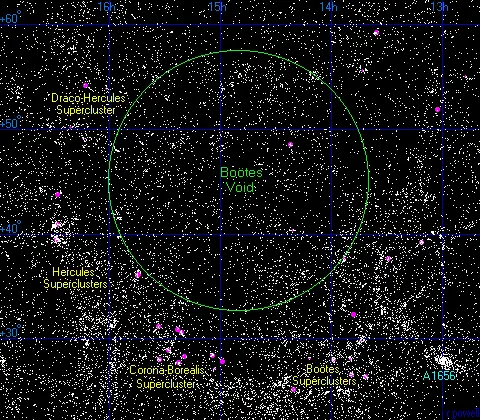
On the largest scales imaginable, the universe does not resemble a smooth, evenly sprinkled field of galaxies. Instead, it looks like a vast cosmic web, a grand architecture of filaments, sheets, and clusters separated by enormous empty regions. These empty regions, known as cosmic voids, are not entirely devoid of matter, but they are astonishingly sparse compared to the galaxy-rich regions surrounding them. Among all known voids, one stands out for its sheer scale and unsettling emptiness: the Boötes Void. Often described as one of the largest and most striking voids ever discovered, it challenges our understanding of how structure formed in the universe and why matter arranged itself in such an uneven way.
The Boötes Void lies roughly 700 million light-years from Earth, in the direction of the constellation Boötes. It spans an immense region of space, approximately 330 million light-years in diameter. Within this colossal volume, galaxies are extraordinarily rare. Where thousands of galaxies would be expected based on average cosmic density, only a few dozen have been found. This absence is not merely a curiosity; it is a profound clue about the physics that shaped the universe after the Big Bang. To ask why space is so empty there is to ask how the universe itself came to be structured.
Discovering an Absence in the Cosmos
The Boötes Void was discovered in the early 1980s during surveys designed to map the large-scale distribution of galaxies. At that time, astronomers were beginning to realize that galaxies are not randomly scattered through space. Redshift surveys, which measure how fast galaxies are moving away due to cosmic expansion, allowed researchers to construct three-dimensional maps of the universe. These maps revealed patterns: dense clusters, elongated filaments, and vast empty regions in between.
When astronomers examined the region toward Boötes, they found something extraordinary. Over an enormous volume of space, there were almost no galaxies at all. This was not an observational artifact or a failure of instruments. The absence persisted even as surveys improved and deeper observations were conducted. The Boötes Void emerged as a genuine cosmic feature, a region where matter had failed to assemble into the luminous structures that dominate other parts of the universe.
The discovery was unsettling because it forced astronomers to confront the fact that the universe’s structure is far more uneven than previously imagined. The existence of such a vast void suggested that gravity, dark matter, and cosmic expansion had interacted in complex ways over billions of years, sculpting matter into patterns that included not only richness but also profound emptiness.
The Cosmic Web and the Nature of Voids
To understand the Boötes Void, it is essential to understand the cosmic web. After the Big Bang, the universe was nearly uniform, with only tiny fluctuations in density. These small variations, imprinted in the early universe, grew over time under the influence of gravity. Regions slightly denser than average attracted more matter, becoming denser still, while underdense regions lost matter to their surroundings.
As this process unfolded, matter flowed along gravitational gradients, forming a network of filaments and clusters. Between these structures, large regions were left relatively empty. These are cosmic voids. They are not completely empty; they contain dark matter, diffuse gas, and occasional faint galaxies. However, their density is far below the cosmic average.
The Boötes Void represents an extreme case of this general process. Its size and depth suggest that the initial density fluctuations in that region were unusually low, or that subsequent evolution amplified the emptiness more than elsewhere. Studying such an extreme void allows physicists and astronomers to test theories of structure formation under the most demanding conditions.
The Scale of Emptiness
The sheer size of the Boötes Void is difficult to comprehend. Light, traveling at its maximum speed, would take hundreds of millions of years to cross it. Within this region, the average separation between galaxies is vastly larger than in galaxy clusters or filaments. From the perspective of a hypothetical observer inside the void, the universe would appear eerily empty, with galaxies faint and distant in every direction.
This emptiness is not absolute. A small number of galaxies have been detected within the void, but they are unusual. Many are faint, low-mass, and isolated, often lacking the rich interactions that shape galaxies in denser environments. Their existence suggests that even in extreme underdensities, some matter manages to collapse into luminous structures, albeit slowly and inefficiently.
The low density of the Boötes Void has implications for its internal dynamics. With little matter present, gravitational interactions are weak. Structures evolve more slowly, and galaxies experience fewer mergers and interactions. In this sense, the void preserves a kind of cosmic youth, offering a glimpse of how galaxies might evolve in near-isolation over cosmic time.
Dark Matter and the Hidden Structure of Voids
Although galaxies are rare in the Boötes Void, dark matter is still present. Dark matter, which does not emit or absorb light, makes up most of the universe’s matter content and plays a central role in structure formation. Simulations of cosmic evolution show that even voids contain a diffuse network of dark matter, forming faint filaments and halos too small to host many luminous galaxies.
In the Boötes Void, dark matter density is significantly lower than average, but it is not zero. This residual dark matter provides the gravitational scaffolding for the few galaxies that do exist there. The properties of these galaxies offer important clues about how dark matter behaves in extreme environments.
Studying voids like Boötes allows physicists to test models of dark matter. Different theories predict different distributions of dark matter on small scales. If dark matter interacts only through gravity, as in the standard model, voids should have certain characteristic properties. Deviations from these predictions could hint at new physics beyond the current understanding.
The Role of Dark Energy and Cosmic Expansion
Dark energy, the mysterious force driving the accelerated expansion of the universe, also plays a role in shaping cosmic voids. As the universe expands, underdense regions expand faster than denser ones. This effect amplifies voids over time, making them larger and emptier.
In the case of the Boötes Void, cosmic expansion has likely exaggerated an initially underdense region into the vast emptiness observed today. As matter flowed out toward surrounding filaments and clusters, the void expanded, becoming increasingly isolated from the structures around it.
This process highlights an important aspect of cosmic evolution: emptiness is not static. Voids grow, merge, and evolve over time. The Boötes Void is not simply a region where nothing happened; it is a dynamic structure shaped by the same physical laws that formed galaxies and clusters elsewhere.
Why So Few Galaxies Formed There
One of the central questions about the Boötes Void is why galaxy formation was so inefficient there. Galaxy formation requires matter to collapse under gravity, cooling and condensing into stars. In underdense regions, gravity is weaker, and matter is more easily pulled away by the expansion of the universe.
In the Boötes Void, the initial density may have been so low that matter never reached the critical threshold needed for efficient collapse. As nearby regions grew denser and more gravitationally attractive, matter flowed outward, further depleting the void. This feedback process left behind a region where galaxy formation was strongly suppressed.
The few galaxies that did form likely did so early, before the void became too empty, or in small pockets where local conditions briefly favored collapse. Their survival in such an environment makes them valuable laboratories for studying star formation and galactic evolution under minimal external influence.
The Boötes Void and the Standard Cosmological Model
The existence of the Boötes Void is broadly consistent with the standard cosmological model, which combines general relativity, dark matter, and dark energy. Large-scale simulations of the universe naturally produce voids of various sizes, including rare, extremely large ones.
However, the Boötes Void sits near the upper extreme of what such models predict. Its size and depth make it a valuable test case. If voids of this scale were significantly more common than expected, it could indicate problems with the standard model or suggest the need for new physics.
So far, observations suggest that while the Boötes Void is exceptional, it is not incompatible with current theories. Instead, it represents the tail end of a statistical distribution, a reminder that even in a universe governed by simple laws, rare and dramatic structures can emerge.
Observing Emptiness: Challenges and Techniques
Studying a void is inherently challenging because it involves observing what is not there. Astronomers rely on extensive galaxy surveys to map the distribution of matter and identify underdense regions. Redshift measurements allow them to distinguish true emptiness from mere gaps in two-dimensional projections.
In addition to visible light, astronomers use radio observations, infrared surveys, and gravitational lensing to probe voids. Gravitational lensing, in particular, offers a way to map dark matter by observing how it subtly distorts the light from background galaxies. Even in voids, these distortions can reveal the presence of diffuse matter.
The Boötes Void has been studied using these techniques, gradually refining our understanding of its structure. Each new observation adds detail to a picture defined as much by absence as by presence.
Life Inside a Void: A Thought Experiment
Imagining life inside the Boötes Void invites reflection on the relationship between environment and cosmic experience. An observer within the void would see a sky far emptier than ours. Galaxies would be distant and faint, with few nearby neighbors. The night sky would lack the dense tapestry of light familiar to observers in galaxy-rich regions.
From a scientific perspective, such an environment would shape the evolution of any potential galaxies and stars. Lower interaction rates could lead to quieter galactic histories, with fewer bursts of star formation triggered by mergers. The chemical evolution of galaxies might proceed more slowly, affecting the availability of heavy elements.
Although this is a speculative exercise, it underscores the diversity of cosmic environments and the ways in which large-scale structure influences local conditions. The Boötes Void is not merely empty; it represents an alternative cosmic context, governed by the same laws but yielding different outcomes.
Voids as Windows into Fundamental Physics
Cosmic voids are increasingly recognized as powerful tools for probing fundamental physics. Because they are less affected by complex nonlinear processes than dense regions, voids offer cleaner environments for testing theoretical predictions.
Measurements of how voids grow and evolve can constrain the properties of dark energy and the geometry of the universe. The shapes and distributions of voids can test models of gravity on large scales. In this sense, the emptiness of the Boötes Void becomes a source of information, not a lack of it.
By comparing observations of voids with simulations, physicists can refine their understanding of the universe’s composition and evolution. The Boötes Void, as an extreme example, plays a special role in this effort.
The Emotional Power of Cosmic Emptiness
Beyond its scientific significance, the Boötes Void carries an emotional weight. It confronts us with the vastness of the universe and the insignificance of familiar scales. The idea that a region hundreds of millions of light-years across can contain so little challenges human intuition and evokes a sense of cosmic solitude.
Yet this emptiness is not meaningless. It is the result of physical processes unfolding over billions of years, governed by laws that we can study and understand. The void is not a failure of the universe to create, but a natural outcome of its evolution.
In this way, the Boötes Void invites reflection on the balance between fullness and emptiness, structure and simplicity. It reminds us that absence can be as informative as presence, both in science and in broader human understanding.
Open Questions and Future Exploration
Despite decades of study, many questions about the Boötes Void remain. How typical is its internal dark matter structure? Do the galaxies within it differ fundamentally from those elsewhere, or are they simply shaped by their environment? Could subtle deviations in void properties reveal new physics?
Future surveys, using more sensitive instruments and covering larger volumes of space, will provide more detailed maps of cosmic voids. Advances in simulation and data analysis will allow scientists to compare theory and observation with increasing precision.
As our view of the universe becomes more complete, the Boötes Void will continue to serve as a benchmark for understanding cosmic emptiness. It stands as a reminder that even in a universe filled with matter and energy, vast regions remain quiet, shaped by the same laws but telling a different story.
Emptiness as a Feature of the Universe
The mystery of the Boötes Void is not simply why space is empty there, but what that emptiness reveals about the universe as a whole. It tells us that structure formation is an uneven process, sensitive to initial conditions and cosmic expansion. It shows that the universe is capable of producing extremes, from dense galaxy clusters to immense voids.
In confronting the Boötes Void, physics extends beyond counting galaxies or measuring distances. It grapples with the architecture of reality on the largest scales. The void’s silence speaks volumes about gravity, dark matter, and the deep history of the cosmos.
Ultimately, the Boötes Void reminds us that the universe is not obligated to be uniform or intuitive. It is shaped by simple laws acting over vast expanses of time and space, producing patterns that are at once elegant and startling. In seeking to understand why space is empty there, we deepen our understanding of why the universe looks the way it does everywhere.