The idea of a warp drive occupies a unique place in human imagination. It is a symbol of ultimate freedom from cosmic isolation, a promise that the vast distances between stars might one day be crossed not over centuries, but over days or even moments. Popular culture has made the concept feel familiar, almost inevitable, as if it were merely a technological milestone waiting patiently in the future. Yet when examined through the lens of modern physics, the warp drive becomes something far more complex and far more intriguing: not simply an engineering challenge, but a profound test of our understanding of space, time, and the fundamental structure of reality.
To ask how close we are to building a warp drive is to ask how well we truly understand the universe. It requires navigating the boundary between speculative theory and established science, between mathematical possibility and physical feasibility. The answer is neither a simple “soon” nor a definitive “never.” Instead, it is a story of bold ideas, severe constraints, and an ongoing struggle to reconcile human ambition with the laws of nature.
The Problem of Distance in the Universe
Interstellar travel is not difficult because space is hostile or empty, though it is both. It is difficult because space is unimaginably vast. Even the nearest star system beyond our own, Alpha Centauri, lies more than four light-years away. A light-year is not a casual unit of distance; it represents how far light itself travels in an entire year, moving at roughly 300,000 kilometers per second. At the speeds achievable by current spacecraft, reaching even the closest stars would take tens of thousands of years.
This cosmic scale creates a fundamental barrier. According to Einstein’s theory of special relativity, nothing with mass can travel faster than the speed of light in a vacuum. This is not merely a technological limit, but a structural feature of spacetime itself. As an object approaches the speed of light, its energy requirements grow without bound. Infinite energy would be required to reach or exceed light speed, rendering conventional faster-than-light travel impossible.
The warp drive emerges as a conceptual escape from this dilemma. Rather than accelerating a spacecraft through space faster than light, the idea proposes manipulating space itself. If space can be stretched behind a ship and compressed in front of it, the ship could effectively travel faster than light relative to distant observers, while locally remaining stationary or moving slowly. This distinction lies at the heart of the warp drive concept and explains why physicists take it seriously, at least at the level of equations.
What a Warp Drive Actually Is in Physics
In scientific terms, a warp drive is not a propulsion system in the traditional sense. It does not rely on engines pushing against exhaust or reaction mass. Instead, it is a hypothetical spacetime configuration allowed, in principle, by the equations of general relativity. General relativity describes gravity not as a force, but as the curvature of spacetime caused by mass and energy. Crucially, the theory allows spacetime itself to expand, contract, and distort in ways that are not constrained by the speed of light.
This is not speculation. The expansion of the universe already demonstrates that spacetime can move faster than light without violating relativity. Distant galaxies recede from one another at effective speeds greater than light due to the expansion of space, not because the galaxies themselves are traveling through space at those speeds. The warp drive concept borrows this insight and applies it locally.
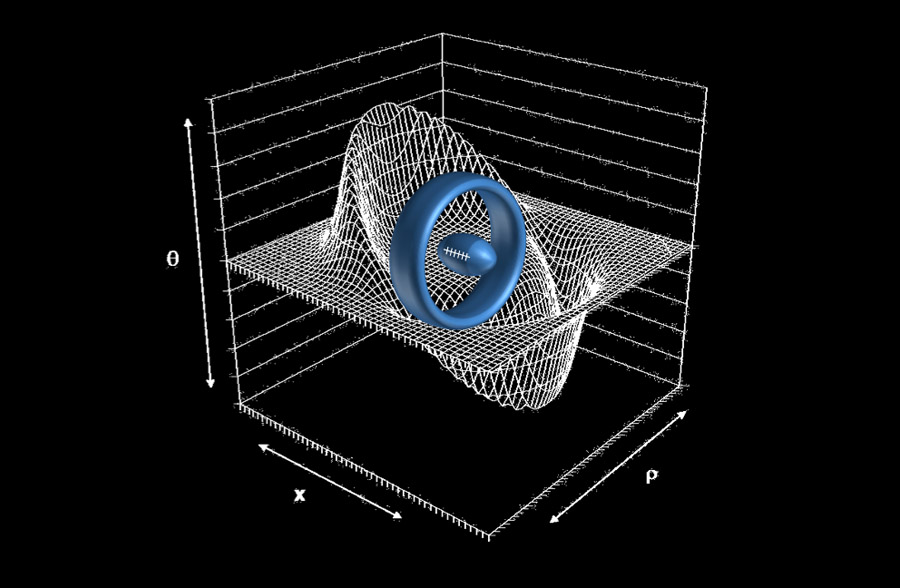
The most famous theoretical model of a warp drive was proposed in 1994 by physicist Miguel Alcubierre. His solution to Einstein’s field equations described a “warp bubble” of spacetime. Inside this bubble, a spacecraft would remain in a flat, locally inertial region, experiencing no extreme acceleration. Space behind the bubble would expand, while space in front would contract, allowing the bubble to move arbitrarily fast relative to distant observers.
From a purely mathematical standpoint, Alcubierre’s solution was valid. It did not explicitly violate the known laws of physics. This alone was enough to ignite serious scientific interest. However, mathematical validity does not guarantee physical realizability, and it is here that the warp drive encounters its most formidable obstacles.
The Tyranny of Energy Requirements
The first and most severe problem with the Alcubierre warp drive is energy. Early calculations showed that generating a warp bubble large enough to contain a spacecraft would require an amount of energy comparable to the mass-energy of entire stars, or even the observable universe. This energy would also need to be arranged in an extraordinarily precise and exotic configuration.
In physics, energy and mass are equivalent, as described by Einstein’s famous equation E = mc². The energy requirements implied by the warp drive were not just impractically large; they were cosmologically absurd. No conceivable civilization, even one far more advanced than ours, could marshal such resources.
Later refinements to the model reduced these estimates significantly, sometimes by many orders of magnitude. By altering the shape of the warp bubble or the mathematical form of spacetime distortion, researchers found ways to lower the energy cost from “universe-sized” to “planet-sized” or even “asteroid-sized.” While these reductions are mathematically impressive, they do not change the fundamental reality. Even the most optimistic versions still demand energy far beyond anything humanity can generate or control.
Moreover, the issue is not merely total energy, but energy density. The warp drive requires enormous amounts of energy concentrated into extremely small regions of spacetime. Such densities would likely produce gravitational effects strong enough to form black holes, destroying the very structure the drive is meant to create.
The Problem of Exotic Matter
Even more troubling than energy magnitude is energy type. The Alcubierre drive and its variants require a form of matter or energy with negative energy density, often referred to as exotic matter. In simple terms, this means energy that behaves in the opposite way to all known forms of matter and energy. Instead of attracting gravitationally, it would repel. Instead of adding positive mass-energy to spacetime, it would subtract from it.
Negative energy density is not entirely foreign to physics. Quantum field theory allows small, fleeting violations of classical energy conditions, such as those observed in the Casimir effect. In this phenomenon, closely spaced conducting plates experience an attractive force due to changes in vacuum energy. However, these effects are extraordinarily small and tightly constrained. There is no known way to accumulate or stabilize negative energy in the vast quantities required for a warp drive.
This presents a deep theoretical challenge. While general relativity permits spacetime geometries involving negative energy, quantum physics strongly resists their large-scale existence. Any realistic warp drive would need to reconcile these two frameworks, a task that remains unsolved. Without exotic matter, the warp drive collapses from a theoretical curiosity into a mathematical artifact with no physical counterpart.
Causality and the Threat to Time Itself
A less intuitive but equally serious issue is causality. In physics, causality refers to the principle that causes precede effects. Faster-than-light travel threatens this principle by allowing scenarios in which signals or objects arrive before they depart, at least from certain reference frames. This is not a philosophical concern; it arises directly from the structure of spacetime described by relativity.
Warp drives, if unrestricted, could in principle be arranged to form closed timelike curves, paths through spacetime that loop back on themselves. Such curves would permit time travel into the past, creating paradoxes that challenge the consistency of physical law. While some physicists speculate that unknown principles might prevent such scenarios, no definitive mechanism has been established.
Stephen Hawking proposed the idea of a “chronology protection conjecture,” suggesting that the laws of physics may prevent the formation of time machines. If true, this would imply that warp drives capable of faster-than-light travel might be forbidden by deeper, as-yet-unknown constraints. The absence of a complete theory of quantum gravity makes it impossible to settle this question definitively, but it remains a significant reason for skepticism.
Quantum Gravity and the Incomplete Picture
At its core, the warp drive problem exposes a fundamental gap in modern physics. General relativity governs the behavior of spacetime at large scales, while quantum mechanics governs the behavior of matter and energy at small scales. These two frameworks are both extraordinarily successful within their domains, yet they are mathematically incompatible in extreme conditions.
A warp drive operates precisely in the regime where both theories must apply simultaneously. It requires manipulating spacetime geometry at quantum scales with enormous energy densities. Without a unified theory of quantum gravity, predictions about such regimes are inherently uncertain. Effects that appear permissible in classical general relativity may be prohibited once quantum corrections are taken into account.
Current approaches to quantum gravity, such as string theory and loop quantum gravity, have not yet produced testable predictions about warp drives. However, many researchers suspect that a complete theory would impose additional constraints that render large-scale spacetime manipulation either impossible or fundamentally unstable.
Modern Research and Incremental Progress
Despite these daunting challenges, research into warp drives has not ceased. In recent years, physicists have revisited the problem with more sophisticated mathematical tools and a greater awareness of physical constraints. Some studies explore warp-like solutions that operate at subluminal speeds, avoiding causality violations while still offering potential advantages over conventional propulsion.
These subluminal warp concepts would not enable faster-than-light travel, but they could, in principle, reduce travel time by altering spacetime geometry in more modest ways. Even here, however, energy requirements remain extreme, and the need for exotic matter has not been eliminated entirely.
Experimental efforts have also emerged, though they are often misunderstood. Small laboratory experiments claiming to test warp drive principles typically investigate subtle spacetime effects or quantum vacuum phenomena. They do not create warp bubbles or demonstrate spacetime manipulation at meaningful scales. Their value lies in improving measurement techniques and exploring foundational physics, not in bringing warp drives closer to practical realization.
Engineering Versus Physics
It is essential to distinguish between engineering challenges and physical impossibilities. Many technologies once considered impossible, such as powered flight or nuclear energy, became realities once the underlying physics was understood and engineering solutions were developed. Warp drives, however, may lie on the other side of this boundary.
The obstacles facing warp drive construction are not merely technical. They are rooted in the fundamental structure of physical law as we currently understand it. Unlike building a faster engine or a stronger material, building a warp drive would require forms of matter, energy, and spacetime control that may not exist in nature.
This does not mean the concept is meaningless. On the contrary, exploring warp drives has deepened our understanding of general relativity, energy conditions, and the limits of spacetime geometry. Even if warp drives are never built, the research surrounding them contributes to fundamental physics.
The Psychological Power of the Warp Drive
The enduring fascination with warp drives reveals something important about human nature. The concept embodies a refusal to accept cosmic isolation as a permanent condition. It reflects a desire to belong to the universe not just as observers, but as participants capable of crossing its vast expanses.
In this sense, warp drives function as scientific myths, not in the sense of falsehoods, but as guiding narratives that inspire exploration. They push physicists to ask uncomfortable questions and to test the boundaries of established theory. Many breakthroughs in science have emerged from ideas that initially seemed unrealistic or extravagant.
However, inspiration must be tempered by honesty. Overstating the plausibility of warp drives risks undermining public understanding of science. A clear distinction must be maintained between theoretical possibility and practical likelihood.
How Close Are We, Really?
Measured against human timescales, we are not close to building a warp drive. No known physical mechanism allows the creation or control of the required spacetime geometries. The energy demands remain astronomical, the need for exotic matter unresolved, and the implications for causality deeply troubling.
Measured against the history of physics, however, the question becomes more nuanced. The warp drive sits at the frontier of our knowledge, illuminating the gaps in our understanding of gravity, quantum mechanics, and spacetime. If future discoveries radically alter these foundations, what seems impossible today may be reclassified as merely difficult.
Yet such a transformation would require breakthroughs comparable to, or greater than, those of relativity and quantum mechanics themselves. It would likely involve new principles that reshape our conception of reality. There is no guarantee that such principles exist, or that they would permit warp drives even if they do.
The Value of the Question Itself
Perhaps the most important aspect of the warp drive debate is not whether it will ever be built, but what it teaches us about science. It demonstrates that physics is not a closed book, but an evolving conversation between imagination and evidence. It shows how speculative ideas can coexist with rigorous analysis, provided their limitations are acknowledged.
The question of warp drives forces physicists to confront the ultimate limits of spacetime manipulation. It encourages humility by reminding us how much remains unknown. At the same time, it celebrates the human capacity to envision possibilities far beyond immediate reach.
A Future Written in Spacetime
The dream of a warp drive may never materialize as a functioning machine. Humanity’s path to the stars may instead rely on slower, more patient methods, or on technologies not yet imagined. Nevertheless, the warp drive remains a powerful symbol of scientific ambition.
In contemplating how close we are to building one, we are really asking how deeply we understand the universe and how far that understanding can take us. For now, the answer is clear in its uncertainty. We are close enough to write the equations, to test the limits of theory, and to appreciate the extraordinary flexibility of spacetime. We are not close enough to bend it to our will.
Between those two truths lies the essence of physics itself: a discipline that advances by daring to ask impossible questions, even when the most honest answer is that the universe may not oblige.