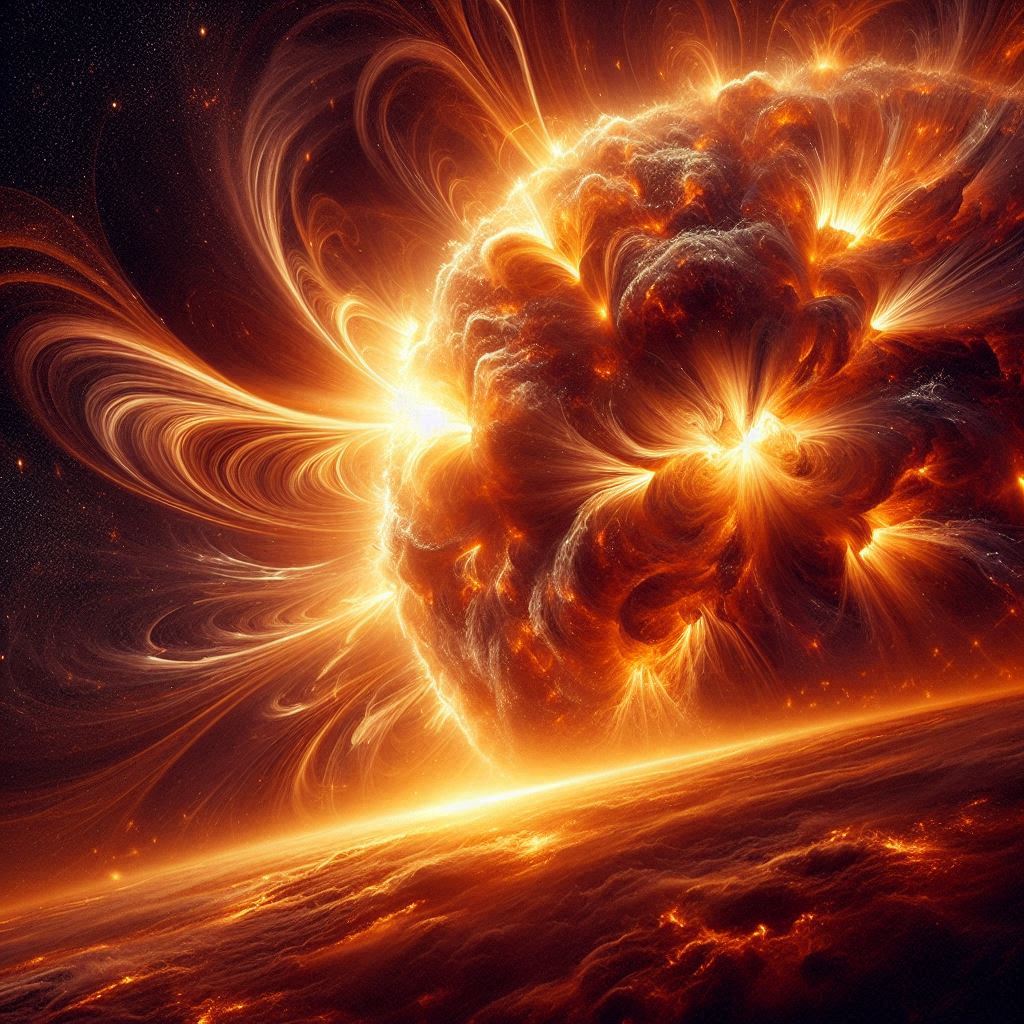
The Sun, our life-giving star, appears calm and steady from Earth’s surface—a blazing, constant ball of light that rises and sets each day. Yet beneath this apparent serenity lies a restless, dynamic powerhouse of magnetic energy. The Sun is far from quiet. It roils, pulses, and occasionally “burps,” ejecting vast clouds of plasma and radiation into space. When scientists say the Sun “burps,” they are referring to immense eruptions known as coronal mass ejections (CMEs) or powerful solar flares—sudden releases of magnetic energy that can affect everything from satellites to power grids on Earth.
These solar “burps” are not random. They are part of the Sun’s natural behavior, driven by its intense magnetic fields and turbulent interior. They are dramatic, often beautiful, and occasionally dangerous. Understanding what happens when the Sun burps gives us insight not only into our own solar system but also into the workings of stars across the universe.
The Sun as a Dynamic Star
The Sun is a massive sphere of glowing plasma—a fourth state of matter in which atoms are stripped of their electrons, forming a sea of charged particles. It is composed primarily of hydrogen and helium, powered by nuclear fusion reactions in its core. Every second, the Sun converts about 600 million tons of hydrogen into helium, releasing energy in the form of light, heat, and radiation.
While the Sun seems steady, its surface and atmosphere are in constant motion. Hot plasma rises and falls in vast convection currents, magnetic fields twist and snap, and energy continuously builds and releases. This activity follows an approximately 11-year cycle, known as the solar cycle, during which the Sun’s magnetic field flips polarity and solar activity increases and decreases. During periods of high activity, the Sun produces more sunspots, flares, and coronal mass ejections—the cosmic equivalents of solar burps.
The Sun’s magnetic fields are the real engines behind these outbursts. They are generated by the movement of charged particles within the solar interior. When these magnetic fields become tangled and stressed, they can suddenly rearrange themselves, unleashing enormous bursts of energy.
The Nature of a Solar Burp
When scientists use the playful term “solar burp,” they are usually referring to a coronal mass ejection, a solar flare, or sometimes both occurring together. Though they are related, these phenomena are distinct in origin and effect.
A solar flare is an intense flash of radiation produced when magnetic energy near the Sun’s surface is suddenly released. This radiation spans the entire electromagnetic spectrum—from radio waves to X-rays and gamma rays. A coronal mass ejection (CME), on the other hand, involves the actual expulsion of billions of tons of solar plasma into space, carried by magnetic fields.
Both types of solar activity originate in the Sun’s atmosphere, particularly in regions known as active regions—areas of concentrated magnetic fields often visible as sunspots. When these magnetic field lines become twisted or crossed, they can suddenly snap and reconnect in an explosive process called magnetic reconnection. This process converts stored magnetic energy into heat, light, and kinetic energy, driving the solar burp.
The Build-Up Before the Burp
The Sun’s surface, or photosphere, is not smooth or static. It’s a seething layer of plasma with temperatures around 5,500 degrees Celsius, constantly bubbling with convection cells known as granules. Above this layer lies the chromosphere and, farther out, the corona—a vast outer atmosphere extending millions of kilometers into space.
Within the photosphere, magnetic field lines emerge through the surface, forming sunspots—dark, cooler regions where the magnetic field is particularly strong. These magnetic fields twist and interact due to the Sun’s differential rotation (the equator rotates faster than the poles), which causes the magnetic lines to tangle and store tremendous amounts of energy.
As the stress increases, the magnetic configuration becomes unstable, like a tightly coiled spring ready to snap. When this happens, the field lines suddenly realign in a violent release of energy. Depending on the configuration and intensity, this can produce a flare, a CME, or both—a true solar “burp.”
The Moment of the Eruption
When a solar burp occurs, it is a breathtakingly energetic event. In a fraction of a second, magnetic reconnection releases energy equivalent to millions of nuclear bombs detonating simultaneously. The plasma in the region is superheated to tens of millions of degrees Celsius, emitting intense light and radiation across the spectrum.
If the event involves a CME, a massive bubble of plasma and magnetic field is hurled away from the Sun at speeds ranging from a few hundred to several thousand kilometers per second. These clouds can contain billions of tons of charged particles—mostly protons and electrons—embedded in magnetic fields that stretch across millions of kilometers.
From Earth, astronomers observe these events using space-based observatories such as NASA’s Solar Dynamics Observatory (SDO) and the Solar and Heliospheric Observatory (SOHO). The eruptions appear as brilliant flashes followed by expanding halos of glowing plasma racing away from the Sun.
Solar Flares: The Flash of Energy
A solar flare is the immediate flash of light and radiation that occurs when magnetic energy is released. These flares are classified according to their X-ray brightness, from relatively weak C-class flares to powerful M-class and X-class events. An X-class flare can release up to 10³² ergs of energy—roughly equivalent to 10 billion one-megaton hydrogen bombs.
Solar flares emit energy across the electromagnetic spectrum. The most energetic flares produce gamma rays and X-rays, which can travel through space at the speed of light. When they reach Earth, they can disrupt communication systems, interfere with radio signals, and pose risks to astronauts.
The radiation from a solar flare reaches Earth in just over eight minutes—the time it takes light to travel the 150 million kilometers between the Sun and our planet. Because of this, there is no way to prevent its immediate effects once a flare occurs, though space agencies can mitigate its impact with early warnings.
Coronal Mass Ejections: The Solar Windstorm
While flares are intense but brief, coronal mass ejections are colossal, slow-moving clouds of plasma and magnetic field that can take one to three days to reach Earth. They are the true “burps” of the Sun, ejecting vast amounts of material into space.
A typical CME can carry up to 10 billion tons of solar plasma traveling at speeds of over 1,000 kilometers per second. These ejections expand as they move outward, forming giant bubbles of charged particles spanning millions of kilometers.
When a CME is directed toward Earth, it collides with our planet’s magnetic field, known as the magnetosphere. The magnetosphere normally shields us from the steady flow of charged particles emitted by the Sun—the solar wind—but a strong CME can compress and disturb it dramatically.
This interaction triggers geomagnetic storms, which can produce dazzling auroras but also cause disruptions to technology. The intensity of these storms depends on the strength and orientation of the magnetic fields carried by the CME. If the CME’s magnetic field is aligned opposite to Earth’s, the interaction is especially powerful, allowing charged particles to penetrate deep into the magnetosphere.
The Beautiful Side of a Solar Burp: Auroras
One of the most enchanting effects of a solar burp is the appearance of auroras—the Northern and Southern Lights. When a CME or strong solar wind reaches Earth, charged particles spiral along the planet’s magnetic field lines toward the polar regions.
As these particles collide with atoms in Earth’s upper atmosphere, they transfer energy that is released as light. Oxygen emits green and red hues, while nitrogen produces purples and blues, creating shimmering curtains and waves of color in the night sky.
Auroras are not just beautiful; they are a visible reminder of the invisible connection between Earth and the Sun. Each time the Sun “burps,” it sends energy that dances across our atmosphere, painting the skies with cosmic artistry.
The Dangerous Side: Space Weather and Its Impacts
While auroras are harmless, the same solar activity that causes them can also have disruptive and potentially damaging effects on human technology. The term space weather refers to the conditions in space caused by solar activity that can affect Earth’s environment and infrastructure.
When a strong CME strikes Earth, the resulting geomagnetic storm can induce electrical currents in power lines and pipelines, potentially damaging transformers and causing widespread blackouts. The most famous example occurred in 1859—the Carrington Event—when a massive solar storm knocked out telegraph systems across the world and caused auroras visible near the equator.
In our modern era, a storm of similar magnitude would be far more disruptive, as our civilization depends heavily on electronics, satellites, and power grids. GPS systems could be thrown off, communication satellites could malfunction, and high-frequency radio communication could be interrupted.
Spacecraft and astronauts are particularly vulnerable. Outside Earth’s protective atmosphere, the radiation from solar flares and CMEs can damage electronics and pose serious health risks to astronauts. That is why agencies like NASA and the European Space Agency closely monitor the Sun for signs of eruptive activity.
How Scientists Monitor and Predict Solar Burps
Solar monitoring has become an essential part of space weather forecasting. Scientists use a fleet of space-based observatories to track the Sun’s activity in real time. Instruments such as NASA’s Solar Dynamics Observatory (SDO), the Parker Solar Probe, and the European Space Agency’s Solar Orbiter provide continuous data on solar flares, CMEs, and magnetic field changes.
When a CME is detected, scientists estimate its speed, direction, and magnetic field orientation to determine whether it is likely to impact Earth. The Deep Space Climate Observatory (DSCOVR) and the ACE spacecraft, located about 1.5 million kilometers from Earth at the L1 Lagrange point, act as sentinels that measure solar wind conditions before they reach our planet.
These observations allow forecasters to issue warnings hours before a geomagnetic storm arrives, giving operators of power grids, satellites, and communication systems time to take preventive measures. While predicting the exact timing and strength of solar events remains difficult, advances in heliophysics—the study of the Sun and its influence—are steadily improving our forecasting capabilities.
The Sun’s 11-Year Cycle: Predicting Periods of Burping
The Sun’s magnetic field undergoes a repeating cycle roughly every 11 years, during which the number of sunspots and solar eruptions rises and falls. The peak of this cycle is known as solar maximum, when the Sun’s magnetic activity is most intense and solar burps are most frequent. During solar minimum, the Sun’s surface appears relatively calm with few eruptions.
Scientists track the solar cycle by counting sunspots and monitoring changes in magnetic fields. As of the mid-2020s, the Sun is in Solar Cycle 25, which is expected to reach its peak around 2025–2026. During this time, more flares and CMEs are likely, meaning Earth’s space weather will be more active.
Understanding the solar cycle helps scientists and engineers prepare for potential impacts on technology and space missions. For instance, astronauts aboard the International Space Station or planned missions to the Moon and Mars must consider periods of higher radiation exposure during solar maximum.
The Physics Behind the Burps: Magnetic Reconnection
At the heart of every solar burp lies the process of magnetic reconnection—a phenomenon where magnetic field lines break and reconnect in new configurations. This process converts stored magnetic energy into heat, light, and kinetic energy, launching plasma into space.
Reconnection occurs when magnetic field lines with opposite orientations are forced together in the Sun’s corona. When they reconnect, they release an explosive burst of energy that accelerates particles to near-light speeds. Understanding this process is one of the great challenges in plasma physics, not only for explaining solar activity but also for advancing technologies like fusion energy on Earth.
Laboratory experiments and computer simulations help scientists model magnetic reconnection, but observing it directly in the Sun’s corona remains difficult. Missions like NASA’s Parker Solar Probe are getting closer than ever before, flying through the Sun’s outer atmosphere to measure the environment where these events originate.
When the Burps Interact with Other Planets
The Sun’s influence extends far beyond Earth. Each planet in the solar system experiences the effects of solar activity differently, depending on its distance from the Sun and the strength of its magnetic field.
For instance, Mercury, which has a weak magnetic field and no atmosphere, is directly exposed to solar radiation and wind, experiencing extreme space weather. Venus, with its thick atmosphere but no intrinsic magnetic field, sees its upper atmosphere stripped away by the solar wind.
Mars once had a strong magnetic field but lost it billions of years ago, leaving its atmosphere vulnerable. The continuous solar burps over eons have gradually eroded Mars’s once-thick atmosphere, transforming it from a warm, wet world into the cold desert planet we see today.
On the other hand, gas giants like Jupiter and Saturn have powerful magnetic fields that generate spectacular auroras, even more intense than those on Earth. Observing how solar eruptions affect these planets helps scientists understand the broader dynamics of stellar-planetary interactions throughout the universe.
The Role of Solar Burps in Cosmic Evolution
While solar burps can seem violent and destructive, they also play an important role in shaping planetary environments and the evolution of life. The energetic radiation and particles from the Sun influence the chemistry of planetary atmospheres, driving complex reactions that can affect habitability.
On early Earth, higher levels of solar activity may have contributed to the formation of organic molecules that led to life. Even today, solar radiation sustains the ozone layer and drives climate patterns. Thus, the Sun’s temperamental behavior, though potentially hazardous, is also part of the delicate balance that makes Earth a living planet.
In a broader cosmic sense, the Sun’s activity reflects a universal behavior of stars. Many stars exhibit similar eruptions—stellar flares and mass ejections—that can shape the atmospheres of surrounding planets. By studying our own Sun, scientists gain insights into the habitability of exoplanets orbiting distant stars.
The Future of Solar Burps and Humanity’s Response
As humanity expands its presence into space, understanding solar activity becomes ever more critical. Future missions to the Moon and Mars will expose astronauts to higher levels of solar radiation, especially during solar maximum. Space agencies are developing protective habitats and forecasting systems to safeguard astronauts from solar storms.
On Earth, improving the resilience of technological infrastructure is equally important. Engineers are designing power grids and satellites that can withstand geomagnetic disturbances. The more we understand about the timing and structure of solar burps, the better we can prepare for their effects.
Projects like the Parker Solar Probe and Solar Orbiter are revolutionizing solar science by directly sampling the Sun’s atmosphere and magnetic fields. These missions will help answer fundamental questions about how and why the Sun erupts, and how we can predict these events with greater precision.
Conclusion
When the Sun “burps,” it is not a trivial event—it is a monumental release of energy from the heart of our solar system. These solar eruptions, whether flares or coronal mass ejections, are both beautiful and powerful, capable of lighting up the skies with auroras or disrupting the technologies that sustain our modern world.
Yet, these outbursts are also vital reminders that we live in an interconnected cosmic environment. The same processes that occasionally threaten our satellites and power systems are the very ones that make life on Earth possible. The Sun’s energy, both gentle and fierce, is woven into the fabric of our existence.
Understanding what happens when the Sun burps is more than a study of stellar tantrums—it is an exploration of the delicate balance between creation and destruction that shapes every world illuminated by a star. As our knowledge deepens, we move closer to coexisting harmoniously with the star that gave us life, respecting its power, beauty, and unpredictable nature.