Among the most mysterious and awe-inspiring phenomena in the universe are supermassive black holes—colossal gravitational monsters that lurk at the centers of galaxies, including our own Milky Way. These cosmic giants possess masses ranging from millions to billions of times that of our Sun, yet they are often confined within regions no larger than our solar system. Their gravitational pull is so intense that nothing, not even light, can escape once it crosses a boundary known as the event horizon.
Supermassive black holes (SMBHs) are not only fascinating because of their sheer size and power but also because of their fundamental role in shaping galaxies, influencing star formation, and possibly determining the evolution of the universe itself. They represent the ultimate triumph of gravity over all other forces, bending space and time to extremes that challenge our deepest understanding of physics.
Understanding these objects requires bridging two of the most important theories in science: Einstein’s general theory of relativity, which describes gravity and spacetime, and quantum mechanics, which governs the behavior of particles at the smallest scales. Yet, despite decades of observation and theory, supermassive black holes continue to pose profound mysteries—how they formed, how they grow, and what lies beyond their event horizons remain among the greatest questions in modern astrophysics.
The Nature of Black Holes
To understand supermassive black holes, it is essential first to grasp what a black hole is. A black hole is a region of spacetime where gravity is so strong that nothing—not even light—can escape its pull. This happens because matter has been compressed into an incredibly dense point called a singularity, where spacetime curvature becomes infinite and the known laws of physics break down. Surrounding this singularity is the event horizon, the invisible boundary beyond which escape is impossible.
Black holes are predicted by Einstein’s equations of general relativity, first formulated in 1915. Just months later, Karl Schwarzschild found a solution to Einstein’s equations describing a non-rotating black hole—a concept that was initially regarded as a mathematical curiosity rather than a physical reality. It wasn’t until the mid-20th century that scientists began to consider that black holes might actually exist in the universe.
There are generally three categories of black holes known today: stellar-mass black holes, which form from the collapse of massive stars; intermediate-mass black holes, which may bridge the gap between stellar and supermassive types; and supermassive black holes, which reside at the centers of galaxies. Among these, the supermassive variety remains the most mysterious due to their enormous scale and uncertain origin.
The Scale and Power of Supermassive Black Holes
The defining feature of a supermassive black hole is its mass, which can range from a few million to tens of billions of solar masses. For example, the black hole at the center of the Milky Way, known as Sagittarius A* (pronounced “Sagittarius A-star”), has a mass of about four million Suns. In contrast, the giant black hole at the heart of the galaxy M87, famously imaged by the Event Horizon Telescope (EHT) in 2019, weighs nearly 6.5 billion solar masses.
Despite their tremendous mass, supermassive black holes are not much larger than our solar system. A black hole’s size is defined by its Schwarzschild radius, which scales linearly with its mass. For Sagittarius A*, this radius is about 12 million kilometers—roughly the distance from the Sun to Mercury—while for the M87 black hole, the event horizon spans nearly the size of our entire solar system.
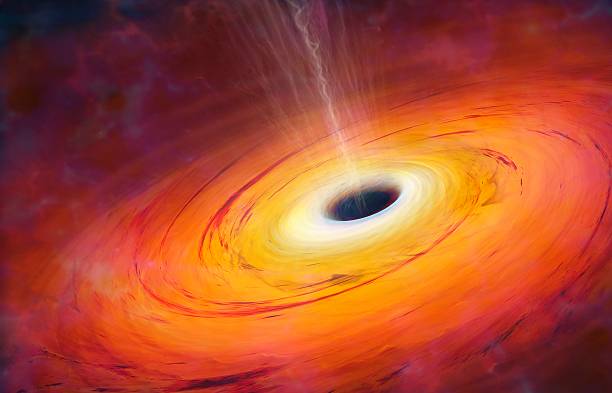
Supermassive black holes exert immense gravitational influence over their surroundings. They anchor entire galaxies, shaping their structure and evolution. Material orbiting too close to a black hole forms a accretion disk—a swirling, flattened structure of gas, dust, and stellar debris heated to millions of degrees. As this material spirals inward, it emits enormous amounts of radiation, often outshining the rest of the galaxy. When this occurs, the black hole is called an active galactic nucleus (AGN), and in its most extreme form, a quasar.
The Discovery and Observation of Supermassive Black Holes
The existence of supermassive black holes was long suspected before it was observationally confirmed. In the early 1960s, astronomers detected strange, extremely bright celestial objects that emitted powerful radio waves and light—these were quasars. The energy output from quasars was so extraordinary that no known physical process could explain it, except for matter falling into a supermassive black hole.
Over the following decades, mounting evidence solidified the case. The motion of stars near the centers of galaxies revealed the presence of compact, massive objects that could only be explained by black holes. In the case of Sagittarius A*, detailed measurements of stellar orbits using infrared telescopes showed stars moving at tremendous speeds around an unseen mass concentrated within an incredibly small region.
The most direct confirmation came in 2019, when the Event Horizon Telescope collaboration released the first-ever image of a black hole’s shadow—the one in galaxy M87. This global network of radio observatories captured the ring-like structure formed by light bending around the event horizon. The image matched predictions from Einstein’s theory of relativity with remarkable precision, providing visual proof that supermassive black holes exist.
In 2022, the same collaboration revealed the image of Sagittarius A*, confirming that our own galaxy’s center hosts a supermassive black hole. Despite the challenges of imaging it—due to turbulence in the surrounding gas and the vast distance from Earth—the data once again aligned perfectly with relativistic models.
The Formation of Supermassive Black Holes
One of the greatest unsolved mysteries in astrophysics is how supermassive black holes form. Unlike stellar black holes, which result from the collapse of massive stars, supermassive black holes require an origin story that accounts for their enormous size and early appearance in the universe.
Observations of extremely distant quasars—some dating back to when the universe was less than a billion years old—suggest that supermassive black holes already existed at that early time. This is puzzling because there simply wasn’t enough time for them to grow from ordinary stellar black holes through gradual accretion alone.
Several theories attempt to explain their formation. One possibility is that the first generation of massive stars, known as Population III stars, were much larger than any stars today, perhaps hundreds of times the mass of the Sun. When these stars died, they could have collapsed directly into black holes with enough mass to grow quickly through accretion and mergers.
Another idea is the direct collapse model, where dense clouds of gas in the early universe collapsed directly into black holes without forming stars first. These “seed black holes” might have had masses of tens or hundreds of thousands of Suns, allowing them to grow rapidly.
A third scenario involves stellar mergers in dense star clusters, where frequent collisions between massive stars create a central massive black hole. Regardless of their initial formation, once these black holes began accreting gas and merging with others, they could grow into the supermassive giants we observe today.
The Anatomy of a Supermassive Black Hole
While a black hole itself is invisible, its surrounding environment can be highly dynamic and luminous. The anatomy of a supermassive black hole system includes several key regions.
At the very center lies the singularity, a point where density becomes infinite and the known laws of physics fail. Surrounding it is the event horizon, the boundary beyond which no signal or object can escape.
Just outside the event horizon is the accretion disk, where infalling matter heats up as it spirals inward. The friction and magnetic turbulence in this disk produce immense radiation, often visible across the electromagnetic spectrum—from X-rays to radio waves.
Above and below the accretion disk are relativistic jets, narrow beams of charged particles ejected at nearly the speed of light. These jets, powered by the black hole’s magnetic fields and rotational energy, can extend thousands or even millions of light-years into space. They are among the most energetic phenomena in the universe, influencing their host galaxies and intergalactic environments.
Beyond the immediate vicinity of the black hole lies the broad-line region and narrow-line region, where fast-moving and slower-moving gas clouds emit characteristic spectral lines that help astronomers determine the black hole’s properties, such as its mass and spin.
The Role of Supermassive Black Holes in Galaxies
Supermassive black holes are not isolated entities; they are deeply intertwined with their host galaxies. Virtually every large galaxy observed so far contains a supermassive black hole at its core. Even more intriguingly, the mass of a galaxy’s central black hole correlates closely with the mass of its bulge—a relationship known as the M-sigma relation. This correlation implies a fundamental connection between black hole growth and galaxy evolution.
This interdependence is believed to arise through feedback mechanisms. When a black hole actively accretes matter, it releases vast amounts of energy through radiation and jets, which can heat or expel surrounding gas. This process can regulate star formation within the galaxy, preventing it from becoming overly dense. In essence, the black hole acts as both a creator and destroyer—stimulating star formation in some regions while quenching it in others.
In galaxy mergers, the central black holes of the merging systems may eventually spiral together and combine, forming an even more massive black hole. These cataclysmic events release powerful bursts of gravitational waves, ripples in spacetime that have been directly detected by observatories such as LIGO and Virgo. The merger of supermassive black holes is expected to produce gravitational waves with much longer wavelengths, detectable by future missions like LISA (Laser Interferometer Space Antenna).
Observing the Invisible
Despite their name, black holes are not entirely invisible. Their presence can be inferred through several observational signatures. One of the most direct methods involves tracking the motion of stars near a galaxy’s center. Rapid stellar orbits around an unseen massive object indicate the presence of a supermassive black hole.
Another key observation is the radiation emitted by the accretion disk. High-energy emissions in the X-ray and ultraviolet ranges signal intense gravitational energy conversion as matter falls inward. Radio telescopes detect the powerful jets emitted by active black holes, allowing astronomers to map the magnetic and energetic structures around them.
Gravitational lensing, where light from background objects is bent by a black hole’s gravity, offers another method to study these systems. The distortion and amplification of light provide insights into the black hole’s mass distribution and surrounding matter.
In recent years, interferometric techniques like those used by the Event Horizon Telescope have made it possible to directly observe the shadow of a black hole—an extraordinary achievement marking the dawn of black hole imaging as a new era in astronomy.
Supermassive Black Holes and Time
Supermassive black holes are not just gravitational entities; they are also windows into the nature of time itself. According to Einstein’s general relativity, the immense gravity near a black hole warps spacetime so severely that time slows down relative to distant observers. This effect, known as gravitational time dilation, means that an observer near the event horizon would experience time far more slowly than someone far away.
Theoretical studies suggest that as one approaches the event horizon, the passage of time effectively halts from the perspective of an outside observer. To someone falling into the black hole, however, time proceeds normally until the moment they reach the singularity—where, according to classical theory, time and space lose their meaning altogether.
Supermassive black holes thus challenge our deepest understanding of reality, pushing physics to its limits. They are cosmic laboratories for testing the interplay between gravity, spacetime, and quantum mechanics.
Black Holes, Information, and the Edge of Physics
One of the most profound puzzles associated with black holes is the information paradox, first articulated by Stephen Hawking. According to quantum mechanics, information about a physical system can never be completely destroyed. However, if matter falls into a black hole and the black hole eventually evaporates through Hawking radiation, the information about the original matter seems to vanish—contradicting quantum theory.
This paradox has sparked intense debate and theoretical development for decades. Some physicists propose that information is preserved in subtle correlations within Hawking radiation; others suggest that spacetime itself may store information holographically on the event horizon—a concept known as the holographic principle.
Supermassive black holes, due to their vast size and stability, are key to testing such ideas. They offer natural laboratories where theories of quantum gravity might one day be reconciled with general relativity, leading to a unified understanding of the universe’s fundamental laws.
The Future of Black Hole Research
Our knowledge of supermassive black holes is expanding rapidly thanks to advances in technology and observation. Space-based observatories, radio telescope arrays, and gravitational-wave detectors are providing unprecedented data. Projects like the Event Horizon Telescope continue to refine their imaging techniques, potentially enabling detailed movies of matter swirling around black holes in real time.
Meanwhile, simulations powered by supercomputers allow scientists to model the dynamics of accretion disks, jet formation, and black hole mergers with increasing precision. Future missions, such as LISA, will open an entirely new window into the cosmos by detecting low-frequency gravitational waves from merging supermassive black holes billions of light-years away.
In the coming decades, astronomers aim to understand not just how these colossal entities behave, but how they connect to the grand narrative of cosmic evolution—from the birth of the first galaxies to the large-scale structure of the universe itself.
Conclusion
Supermassive black holes stand as both destroyers and architects of the cosmos. They are engines of creation, driving the evolution of galaxies and shaping the cosmic web. They embody the extremes of physics, where gravity crushes matter and warps spacetime beyond ordinary comprehension.
From the heart of the Milky Way to the distant reaches of quasars billions of light-years away, these titans remind us of the universe’s boundless complexity and mystery. They test the limits of human knowledge, forcing us to confront the deepest questions about the nature of space, time, and existence itself.
To study supermassive black holes is to peer into the most enigmatic corners of reality—to look where light itself cannot go, and to find meaning in the silence of the void. They are not merely cosmic curiosities but keys to understanding the universe’s past, present, and ultimate fate. In their darkness lies the light of discovery, guiding humanity toward the next great frontier of cosmic understanding.